Medical Expertise at Luxe Aesthetic Surgery
Luxe Aesthetic Surgery & Medical Spa is led by Haimesh Shah, MD, RPVI , a physician specializing in cosmetic surgery, body contouring, laser procedures, and venous medicine. Dr. Shah is a Diplomate of the American Board of Laser Surgery, American Board of Venous & Lymphatic Medicine, American Board of Wound Management, and American Board of Internal Medicine. He also holds the Registered Physician in Vascular Interpretation (RPVI) credential and has contributed to peer-reviewed medical research.
Reoperation rates reached 59.7% in some breast implant studies summarized in FDA patient-labeling guidance, although those results span different devices, patient groups, and follow-up periods. That isn't a prediction of your personal risk. It is a reason to evaluate breast augmentation as a long-term medical-device decision, not an operation followed by recovery.
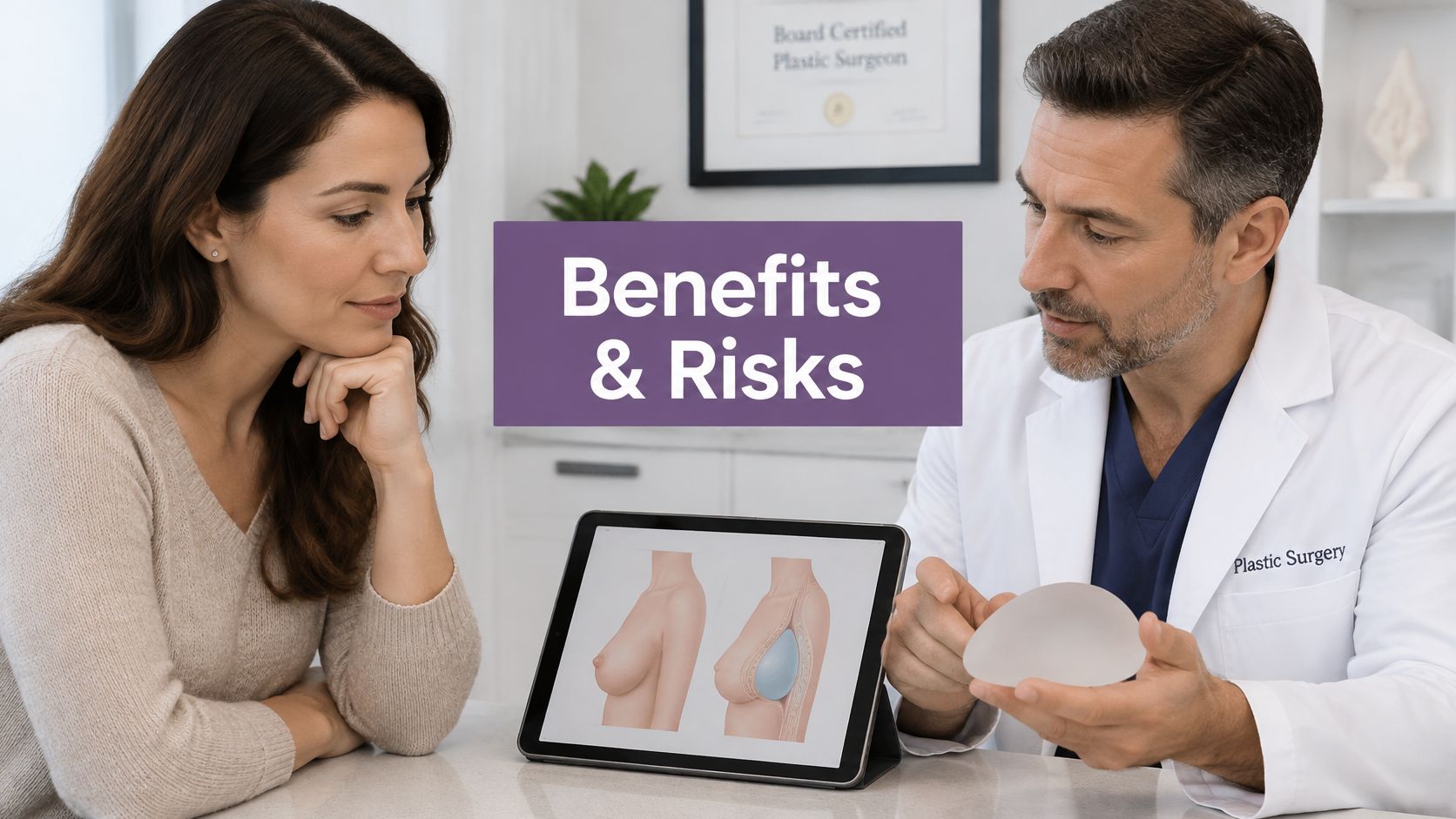
The cosmetic benefit can be meaningful: added fullness, improved proportion, and correction of some volume differences. A balanced assessment of the pros and cons of breast augmentation gives equal attention to what happens afterward, including monitoring, changing breast tissue, and the possibility of another operation.
Table of Contents
- Breast Augmentation Pros and Cons at a Glance
- What Augmentation Reliably Delivers and What It Cannot Fix
- Complications and Long-Term Risks to Weigh
- Silicone Versus Saline Implants and Long-Term Monitoring
- Recovery, Downtime and Anesthesia Choices
- Alternatives to Augmentation and When They Fit
- Confirm Whether Augmentation Fits Your Goals
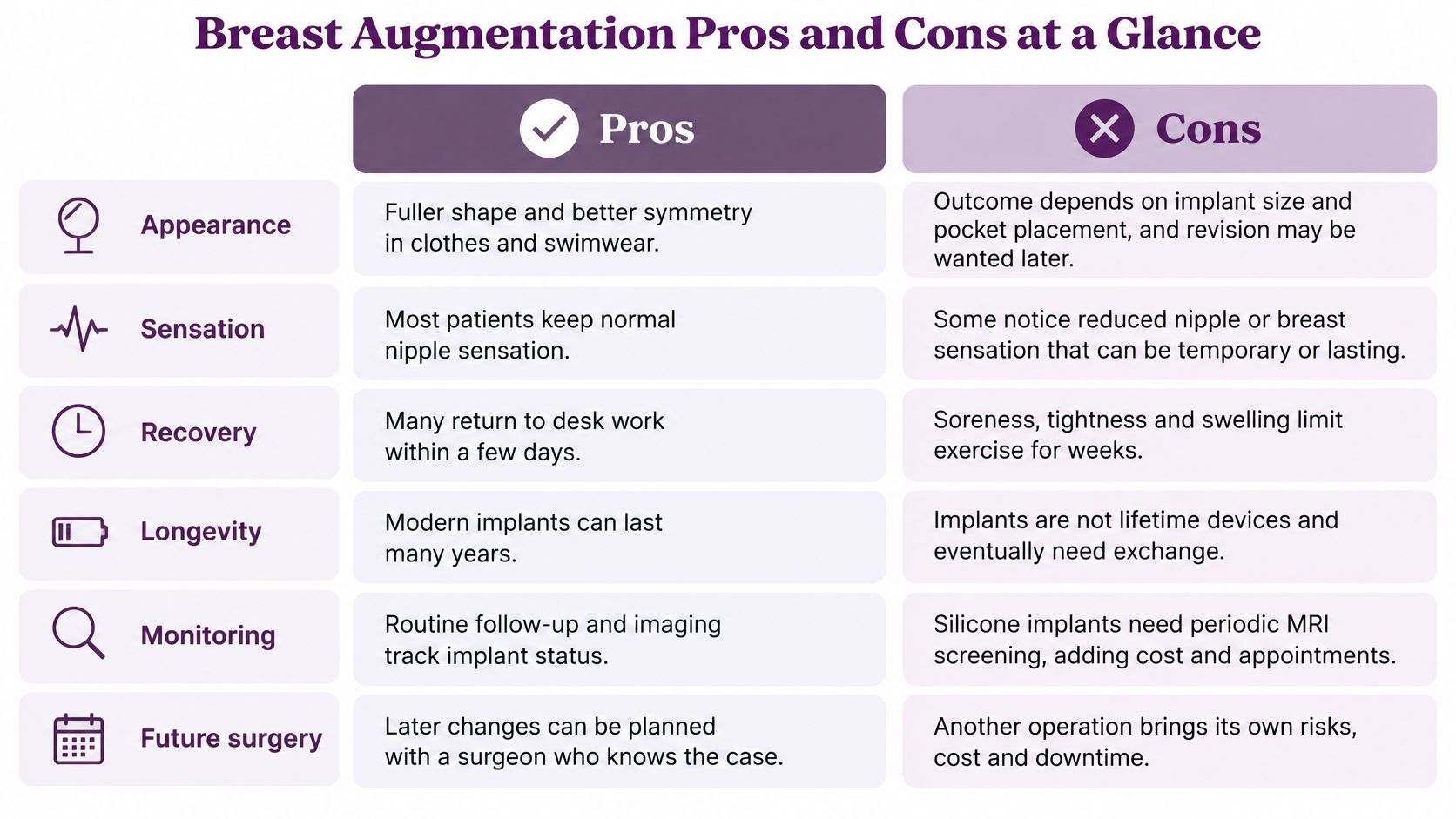
Breast Augmentation Pros and Cons at a Glance
Breast augmentation benefits and costs by decision criterion
| Decision Criterion | Potential Benefit | Potential Cost or Limit |
|---|---|---|
| Appearance | Adds volume and can improve proportion | Result depends on anatomy; sagging may need a lift |
| Sensation | Some patients keep breast sensation | Nipple and breast sensation changes can occur in some patients |
| Recovery | Usually a short initial recovery | Swelling, soreness and activity limits can last weeks |
| Longevity | Results can be durable | Implants are not lifetime devices and may need replacement |
| Monitoring | Routine imaging can detect problems early | Silicone rupture can be silent, so imaging is ongoing |
| Future surgery | One operation for the initial result | Revision surgery may be needed later |
The strongest reason to consider augmentation is a specific volume-related goal. That might mean restoring fullness after weight changes, improving balance between breasts, or choosing a shape that feels more proportionate to your frame. Implant size, implant type, and existing anatomy all influence what's achievable.
Sensation deserves a separate conversation from appearance. Changes are reported in some patients, not most, and preserved sensation can't be guaranteed for an individual. Likewise, a manageable initial recovery doesn't mean unrestricted activity immediately after surgery.
Assess the whole commitment
The FDA's consumer guidance on breast implants emphasizes that implants aren't lifetime devices and that complications may require further surgery. It also notes that surveillance imaging may not be covered by insurance. A satisfactory appearance therefore doesn't remove the need for a follow-up plan.
Think of the decision as two connected choices: whether you want the cosmetic change, and whether you accept the medical responsibilities attached to maintaining it. Someone who welcomes fuller breasts but strongly rejects future imaging or surgery has an unresolved conflict, even if the initial operation seems affordable.
Decision test: Write down your top two goals and the costs, inconvenience, or uncertainty you would accept to achieve them.
Verdict: Augmentation may suit adults with stable health and realistic goals who accept follow-up imaging and possible future surgery; use the final eligibility checklist to identify reasons to wait, and test your written goals against the trade-offs below.
What Augmentation Reliably Delivers and What It Cannot Fix
Augmentation most predictably adds breast volume. It can improve fullness relative to the body frame and help address volume loss or mild asymmetry. It doesn't make the starting anatomy irrelevant, and equal implant volumes don't necessarily create identical-looking breasts.
The distinction between volume and position is particularly important. An implant fills space within the breast, while a lift changes the skin envelope and breast position. Adding fullness isn't the same as lifting stretched tissue.
When more volume misses the goal
Consider someone whose breasts became less full and moderately drooped after pregnancy or weight loss. If the main concern is low breast position, a larger implant may create a heavier breast without correcting the underlying looseness. A lift, or a lift combined with an implant, may better match the desired shape.
For readers considering post-breastfeeding changes, Milk&Lace's evidence-based advice for breastfeeding moms offers additional context for questions about breast support and appearance. Such advice shouldn't be treated as a substitute for examining whether a concern involves volume loss, stretched skin, or breast position.
Sizing trends also suggest that maximum enlargement isn't everyone's goal. In the 2025 ASPS-reported U.S. figures described by the Los Angeles Times, 36% of surveyed surgeons reported patients choosing smaller implants, compared with 12% reporting a shift toward larger implants. Those are surgeon-reported trends, not evidence that a particular implant size produces a better outcome.
Choose proportion rather than a cup-size promise
A moderate implant may better preserve proportion and reduce the physical or visual burden of excessive volume. But smaller doesn't automatically mean suitable, and larger doesn't substitute for a lift. Tissue quality, available breast coverage, chest dimensions, and lifestyle all matter.
Useful goal descriptions are more precise than a bra label:
- Fullness: Describe where you want more volume, such as the upper breast or overall silhouette.
- Position: Identify whether low breast position or nipple position bothers you.
- Balance: Explain which differences between breasts you hope to reduce.
- Practical fit: Discuss exercise, clothing preferences, and how much added volume you want to carry.
An implant should serve the intended shape, not become the reason to accept an unsuitable operation.
Describe your goal in terms of shape, position, and proportion, then ask whether an implant alone can achieve it without creating a different problem.
Complications and Long-Term Risks to Weigh
A complication rate is useful only when you know who was studied and for how long. First-time cosmetic augmentation, revision surgery, and reconstruction aren't interchangeable populations. Device design and follow-up duration also affect the results.
Reported complication rates in FDA-reviewed breast implant data
| Outcome | Reported Rate | Study Context |
|---|---|---|
| Reoperation | 12.6% | FDA-reviewed silicone-gel study, first-time augmentation, study period |
| Severe capsular contracture | 6.0% | Same silicone-gel study; painful or constricting scar tissue around the implant |
| Implant removal with replacement | 4.6% | Same silicone-gel study, first-time augmentation |
| Reoperation at follow-up | 25.5% | FDA post-approval data, one implant cohort |
These figures aren't directly comparable measures of competing implants. They demonstrate why a single percentage shouldn't be presented as your personal probability, especially without a follow-up interval.
Understand what each complication means
Reoperation means another operation, which may involve implant adjustment, replacement, removal, or treatment of surrounding tissue. Capsular contracture occurs when scar tissue around the implant tightens enough to cause firmness, distortion, or pain. Severe contracture may require surgery.
Rupture means a break in the implant shell. Other outcomes include altered nipple sensation, breast drooping, malposition, where the implant sits somewhere other than intended, and persistent asymmetry. Infection, pain, scarring, and wrinkling also belong in informed consent.
The FDA notes that rupture can occur at any time and that complications generally become more likely the longer implants remain in place. Its saline implant informed-decision booklet identifies possible rupture causes including normal aging, trauma, surgical manipulation, mammography compression, and capsular contracture. This isn't a reason to skip mammography; it's a reason to coordinate breast screening with clinicians who know you have implants.
Breast implant illness requires a careful discussion
Some patients report systemic symptoms they associate with implants, commonly described as breast implant illness. A 2025 systematic review of 6,048 women found that 81.9% reported symptom improvement after removal, with symptoms appearing an average of 6.4 years after implantation. A 2024 UK multicentre study of 100 patients undergoing removal and total capsulectomy found that 98% reported symptom improvement.
These patient-reported outcomes don't establish that implants caused every symptom or guarantee improvement after removal. Removal and capsule surgery have their own risks, so symptoms warrant medical assessment rather than an automatic surgical prescription.
Keep inherited breast-cancer concerns separate from implant complications. Haven Medical's explanation of BRCA1 and BRCA2 gene mutations can help frame a family-history discussion, but it doesn't determine implant suitability.
Before surgery, establish what would trigger exchange, removal, or capsular surgery. Use our guide to when to replace breast implants to prepare questions, then ask: What is your revision rate for the proposed implant, and over how many years was it measured?
Silicone Versus Saline Implants and Long-Term Monitoring
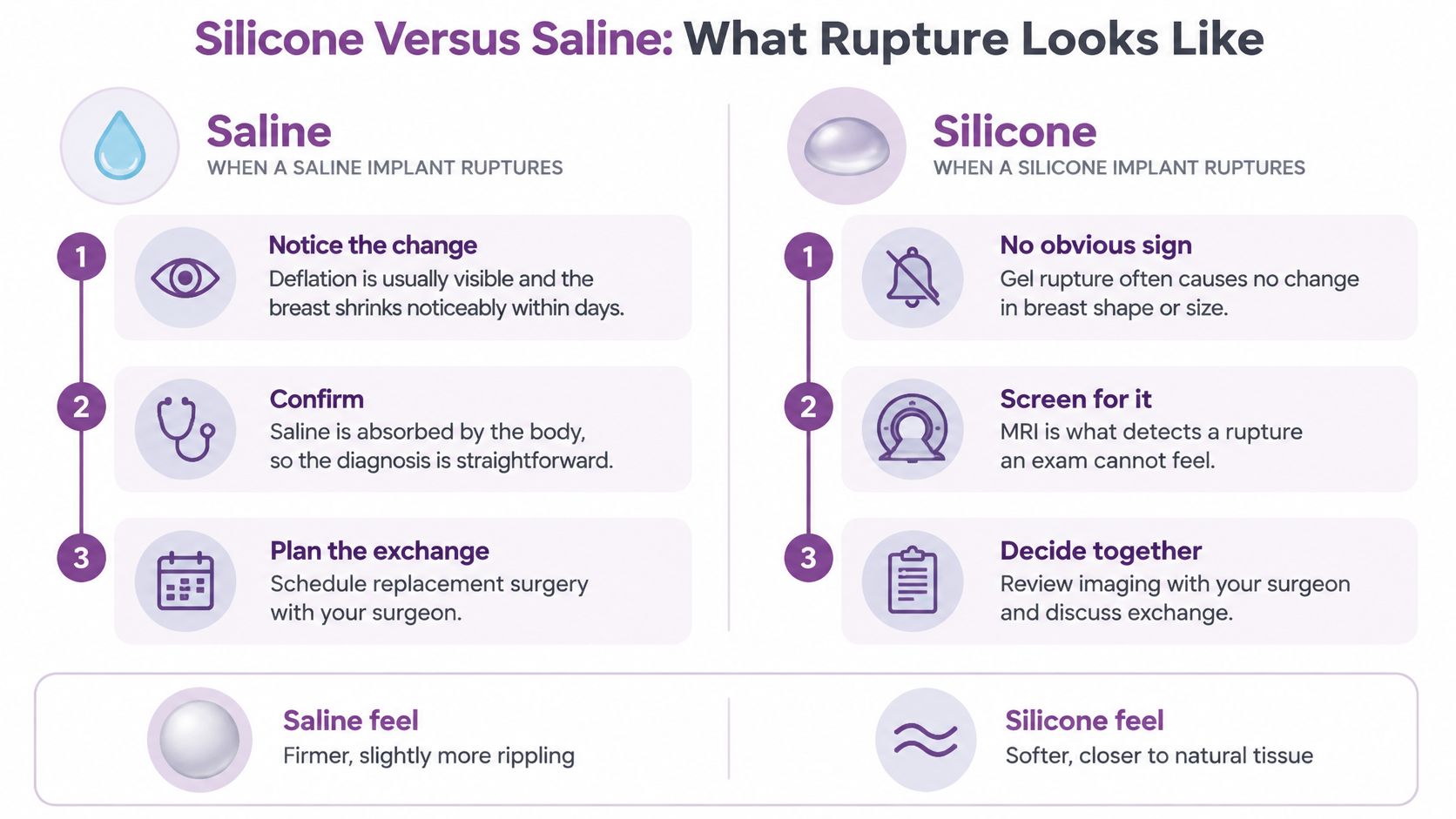
Saline rupture usually produces visible deflation; silicone rupture can be silent. That contrast changes how patients and clinicians monitor the device. An unchanged breast shape doesn't reliably confirm that a silicone implant is intact.
Silicone gel versus saline implants at a glance
| Feature | Silicone Gel | Saline |
|---|---|---|
| Rupture signs | Often silent, with no obvious breast change | Usually causes visible deflation |
| Feel | Often described as more natural | Typically firmer |
| Preferred imaging | MRI is most effective; ultrasound is an acceptable first screen | No equivalent routine screening recommendation |
| Insurance for monitoring | May be limited | Confirm coverage for symptom-driven evaluation with the insurer |
The FDA's guidance on implant risks and complications identifies MRI as the most effective method for detecting silent silicone rupture and accepts ultrasound for screening patients without symptoms. It recommends initial ultrasound or MRI 5–6 years after implantation, followed by repeat imaging every 2–3 years. Symptoms or an unclear ultrasound result call for MRI evaluation rather than waiting for the next scheduled screen.
Separate scheduled screening from symptom evaluation
Scheduled imaging looks for a problem that may not be noticeable. Symptom-triggered evaluation addresses a new concern, such as a change in appearance, firmness, or discomfort. Neither replaces the other, and imaging doesn't prevent rupture or eliminate the possibility of future surgery.
Saline implants have no equivalent routine rupture-screening recommendation because failure generally becomes apparent through deflation. That doesn't mean saline implants need no follow-up or that every change can be diagnosed at home.
Compare feel with follow-up feasibility
Silicone's potential advantage is a more natural feel, but that benefit comes with a recurring imaging obligation. Baseline breast tissue and implant position also influence the result, so material alone doesn't determine how natural a breast will look or feel.
Before choosing, work through these practical questions:
- Access: Can you reliably attend the recommended imaging appointments?
- Coverage: What will your insurer cover, and what might you pay yourself?
- Records: Where will implant details and imaging reports be kept if you move?
- Response: Who will review a concerning result and explain the next step?
Our silicone-or-saline breast augmentation comparison can help organize that discussion. Ask which implant is recommended for your anatomy, what monitoring it requires, and whether the schedule and potential expense fit your life.
Recovery, Downtime and Anesthesia Choices
Recovery is a sequence of milestones, not a single return-to-normal date. Being comfortable enough to answer emails isn't the same as being ready to lift a child, move equipment, or resume strenuous exercise. Plan around the demands of your actual day rather than the least demanding definition of work.

The early recovery phases
During the first days, expect soreness, tightness, swelling, and instructions about breast support. Arrange help with tasks that involve reaching, lifting, or carrying, and use the supportive bra recommended by the surgical team. Some patients can resume desk-based work after a few days, but the surgeon should set that timing.
During the early weeks, heavy lifting and strenuous exercise remain restricted until clearance. The breasts may continue changing in appearance for months as swelling resolves and tissues settle. An early photograph therefore isn't a reliable assessment of the final result.
Recovery planning should account for:
- Procedure details: Implant placement, surgical technique, and whether a lift is combined.
- Implant size: The amount of added volume and the demands placed on existing tissue.
- Individual healing: Medical history, smoking, and how the body responds to surgery.
- Home and work demands: Childcare, commuting, physical employment, and available assistance.
What awake anesthesia does and doesn't mean
Awake augmentation uses local anesthesia for appropriately selected patients. Avoiding general anesthesia may offer a smoother recovery experience for some patients, but it doesn't remove the recovery required by the breast operation itself.
Awake does not mean no discomfort, no downtime, or no complication risk. Local anesthesia has its own considerations, and neither every patient nor every procedure qualifies. The surgeon must decide whether the approach fits the planned operation and medical history.
Recovery planning: Ask for separate clearance dates for work, driving, lifting, and exercise instead of accepting a single downtime estimate.
Before scheduling, request clear instructions about prescribed pain control, symptoms requiring urgent contact, activity restrictions, and follow-up appointments. Also ask when the surgeon expects to assess the settled appearance, rather than assuming that comfort means healing is complete.
Alternatives to Augmentation and When They Fit
Start with the change you want: more volume, less sagging, or a different appearance without surgery. These are different goals, and choosing an operation before defining the goal can lead to an unnecessarily complicated plan.
Breast augmentation alternatives and their trade-offs
| Option | Best Suited For | Key Trade-Off |
|---|---|---|
| Breast lift | Sagging, loss of firmness or nipple position change with adequate volume | Removes excess skin but adds no implant volume |
| Breast augmentation with implants | Volume loss or a wish for more size | Implant-related monitoring and possible revision |
| Fat transfer breast augmentation | Modest volume gain using the patient's own fat | Less predictable volume; some fat may be absorbed |
| Lift plus implants | Sagging combined with volume loss | Longer operation and possibly longer recovery |
| Non-surgical support | Patients wanting no procedure | Changes appearance without changing breast tissue |
Match the procedure to the concern
A breast lift addresses excess skin and breast position. It can suit someone who likes their existing volume but dislikes how the breast sits. The trade-off is surgical reshaping and scars, not an increase in implant-based fullness.
Fat transfer breast augmentation uses fat collected from another body area to add a modest amount of breast volume. It avoids an implant, but the retained volume is less predictable because some transferred fat may be absorbed. It also involves healing at the fat-harvest sites, so implant-free doesn't mean procedure-free.
A lift plus implants may fit when both position and fullness need correction. Combining goals can make anatomical sense, but it shouldn't be treated as an automatic upgrade. Ask why both components are necessary and whether a staged approach deserves consideration.
No procedure is a legitimate option
Supportive bras and clothing can change the silhouette without changing breast tissue. This may be enough for someone whose concern is limited to how certain clothes fit, or who isn't comfortable accepting surgical risks.
Our comparison of breast implants and fat transfer offers a framework for discussing volume-related choices. A useful consultation should also consider whether neither option addresses the main concern.
- Primarily sagging: Evaluate lifting rather than assuming enlargement will solve it.
- Primarily volume loss: Compare implants with the more limited volume potential of fat transfer.
- Both position and fullness: Discuss a combined or staged plan.
- Uncertain benefit: Wait until you can describe a result worth the recovery and risks.
The practical conclusion is that the best alternative isn't necessarily the least invasive one. It's the option whose mechanism matches the change you want, with trade-offs you're willing to accept.
Confirm Whether Augmentation Fits Your Goals
A useful candidacy assessment asks whether you can accept both the intended result and its less desirable possibilities. In FDA-reviewed silicone-gel implant studies, 20% to 40% of augmentation patients underwent reoperation during the first 8 to 10 years. That range isn't a replacement deadline or an individual forecast, but it makes future surgery a realistic planning issue.
Signs that the decision may fit
- Stable health: Your medical history and breast health have been reviewed.
- Specific goals: You can explain the desired shape and size without expecting perfection.
- Follow-up readiness: You're willing to attend examinations and recommended imaging.
- Financial flexibility: You can consider expenses beyond the original procedure.
- Personal motivation: The change is something you want, not pressure from someone else.
Consider waiting if pregnancy or breastfeeding is planned soon, breast-health concerns remain unresolved, or avoiding all future surgery is a firm priority. Pregnancy and breastfeeding can change breast size and shape. If sagging is the main issue, a different operation may fit better.
At Luxe Aesthetic Surgery & Medical Spa, every Awake Breast Augmentation begins with a personalized consultation about goals, anatomy, lifestyle, and desired outcome. We offer Awake Breast Augmentation using local anesthesia and advanced surgical techniques to enhance size, shape, fullness, and balance for appropriate candidates, with suitability determined by the surgeon. Our Awake Breast Lift is designed for sagging, loss of firmness, stretched skin, or position changes associated with aging, pregnancy, breastfeeding, weight fluctuations, or genetics.
Bring a clinical and financial checklist
Ask which implant type and size fit your anatomy, why that choice is recommended, and what might lead to revision. Request a discussion of the likely course over time rather than a promised replacement date. Clarify what happens if you're unhappy with the appearance and how mammography will be coordinated around implants.
A written estimate should distinguish:
- Initial surgery: Surgeon, implant, anesthesia, and facility charges.
- Ongoing monitoring: Scheduled imaging and possible out-of-pocket costs.
- Future treatment: Potential revision, replacement, or removal expenses.
- Practical recovery costs: Time away from work and help at home.
No Luxe price is quoted here because a personalized plan and itemized estimate are needed. The decision isn't whether augmentation offers benefits in general, but whether its particular benefits justify its continuing responsibilities for you.
Luxe Aesthetic Surgery & Medical Spa offers personalized breast procedure consultations and awake breast augmentation under local anesthesia for appropriate candidates. Visit Luxe Aesthetic Surgery & Medical Spa to book a consultation, and bring your goals, medical history, and questions about monitoring, recovery, and future revision costs.