Medical Expertise at Luxe Aesthetic Surgery
Luxe Aesthetic Surgery & Medical Spa is led by Haimesh Shah, MD, RPVI , a physician specializing in cosmetic surgery, body contouring, laser procedures, and venous medicine. Dr. Shah is a Diplomate of the American Board of Laser Surgery, American Board of Venous & Lymphatic Medicine, American Board of Wound Management, and American Board of Internal Medicine. He also holds the Registered Physician in Vascular Interpretation (RPVI) credential and has contributed to peer-reviewed medical research.
Table of Contents
- Understanding What Is Fat Transfer Step by Step
- Harvesting Fat With Liposuction
- Processing the Harvested Tissue
- Reinjecting Fat in Small Parcels
- How Fat Transfer Techniques Evolved
- Restoring Facial Volume
- Augmenting and Balancing the Breasts
- Shaping the Buttocks and Body
- Correcting Scars and Rejuvenating Hands
- Plan Your Fat Transfer Goals
- What Studies Show About Retention
- Why Retention Varies So Much
- Planning for Some Absorption
- Understanding the Published Limitations
- Recognizing the Possible Risks
- Reviewing Your Candidacy
- What Recovery Actually Feels Like
- The First Three Months
- Preparing for Your Consultation
- Is Fat Transfer Permanent
- How Does Fat Transfer Differ From Dermal Fillers
- Can Someone With Low Body Fat Have Fat Transfer
- How Many Fat Transfer Sessions Are Usually Needed
What Is Fat Transfer? Also known as autologous fat grafting, it moves your own fat to where you need more volume. The process pairs gentle liposuction with careful processing and precise injection to restore fullness and support natural-looking contours.
Understanding What Is Fat Transfer Step by Step
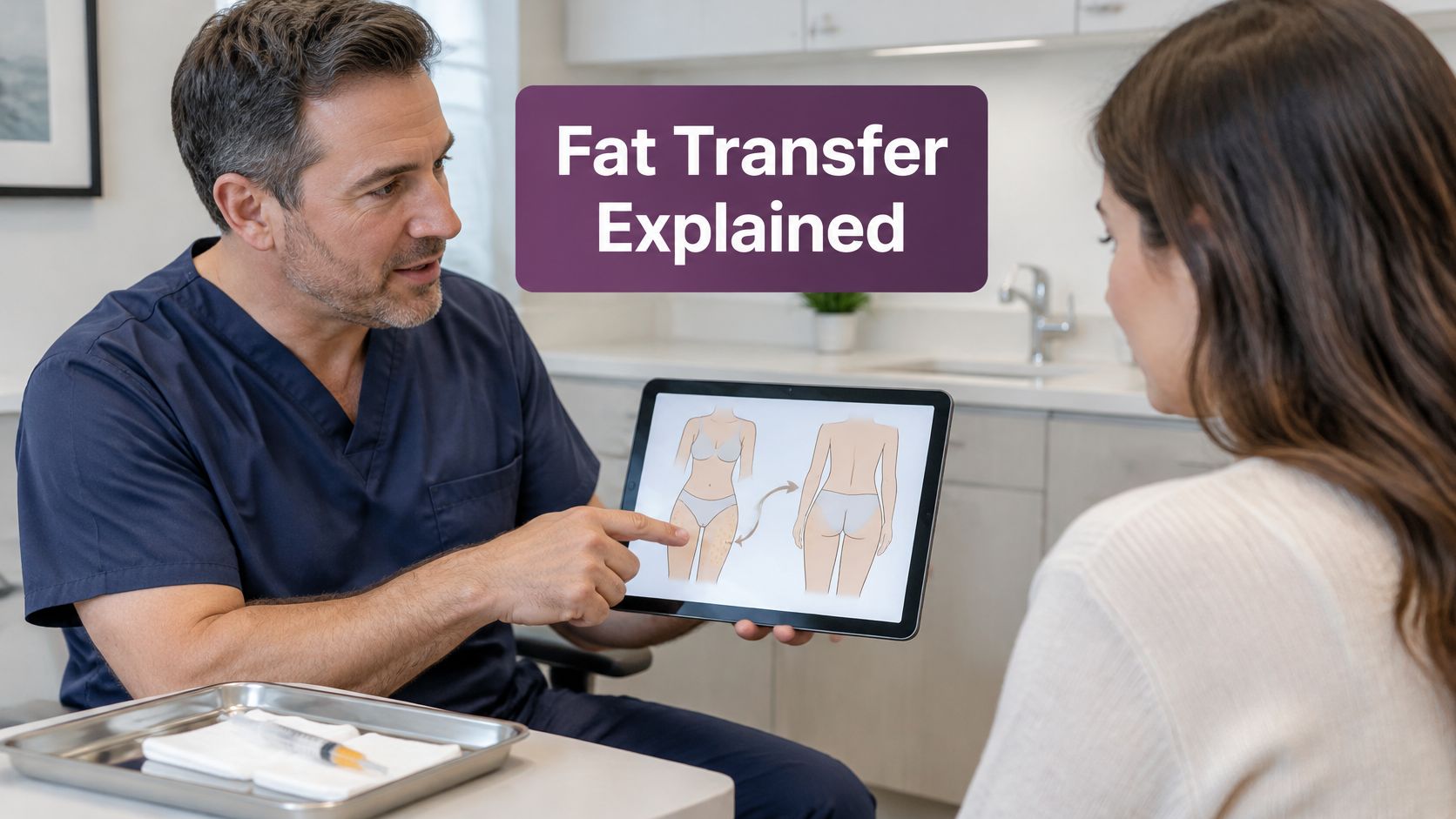
Think of it as a three-part process. First your physician collects fat from a donor area where you have a little extra. Then that fat is cleaned and prepared. Last, tiny amounts are placed exactly where volume may be needed for appropriate candidates.
| Stage | What Happens | Typical Goal |
|---|---|---|
| Donor area | Liposuction removes localized fat from the abdomen, waist, flanks, thighs, arms, or another suitable area | Collect fat and possibly refine the donor contour |
| Processing | The harvested tissue is cleaned so usable fat is separated from fluid and debris | Prepare healthy tissue for placement |
| Placement | Small parcels are injected into carefully selected tissue layers | Restore volume, soften contours, or improve symmetry |
| Healing | Some fat is absorbed while surviving fat establishes a blood supply | Settle into a natural-looking result |
Fat transfer uses your own living tissue for volume, yet the outcome depends far more on placement technique and blood supply than on how much fat is moved.
A garden comparison helps here. Picture moving seedlings from a crowded bed to a thin patch. Adding extra plants won’t help if the soil is poor or the roots are crowded together.
Fat behaves in a similar way. Each small parcel needs close contact with healthy surrounding tissue to establish a new blood supply and settle in.
You’ll hear a few different names for the same basic idea. Autologous fat grafting simply means the fat comes from your own body. Fat injection refers to how the prepared fat is delivered. ALMI fat transfer is a branded approach that packages harvesting, processing, and targeted placement across different treatment areas.
Luxe Aesthetic Surgery & Medical Spa offers autologous fat grafting and ALMI fat transfer as part of its body contouring and medical aesthetics services. When researching clinics, patient acquisition for med spas can help readers understand the business side of choosing a medical spa, although clinical credentials and safety should remain the priority.
The rest of this guide covers three key questions: how fat transfer works, where it may be used, and who may be a good candidate. With that foundation, it’s much easier to talk through goals, donor fat, recovery, and possible risks with a qualified physician.
Fat transfer is a careful move of living tissue from one area to another. Fat is taken from an area where you have a little extra, prepared for grafting, and then placed where you may need more fullness or improved shape. Unlike an implant, transferred fat must establish a blood supply to persist long-term.
Harvesting Fat With Liposuction
Harvesting is done with a thin cannula through tiny incisions. The abdomen, waist, flanks, back, arms, and thighs are common donor areas, though your anatomy and goals determine what may be most appropriate.
For appropriate candidates, Luxe may perform awake liposuction under local anesthesia, and that harvested fat can then be used for transfer depending on the treatment plan. Local anesthesia does not remove surgical risk, not every patient qualifies, and your physician will determine whether an awake approach is appropriate.
Processing the Harvested Tissue
Once removed, the fat is not ready to be placed immediately. Processing helps filter out blood, anesthetic fluid, oil, and damaged cell debris. What remains is cleaner tissue intended for more precise placement.
You will not feel this processing step itself. Around the treated areas, expect the usual early healing signs such as bruising, swelling, and tenderness. Results vary.
Reinjecting Fat in Small Parcels
Placement is where individualized technique matters. Results depend less on total volume and more on how the fat is placed. Your physician places tiny parcels of fat into specific tissue layers so surrounding blood flow may reach each parcel.
Picture brick and mortar. Each parcel is a brick, and the surrounding tissue is the mortar supporting it. That distributed placement helps avoid placing fat as one concentrated mass.
The key principle is simple: distributed placement may help grafted fat connect with living tissue and establish a blood supply.
| Stage | Purpose | What Patients Typically Notice |
|---|---|---|
| Harvesting | Collects fat and may refine the donor contour | Small incisions, soreness, swelling, or bruising |
| Processing | Removes fluid and debris from usable tissue | No separate incision or recovery stage |
| Reinjection | Places prepared fat in targeted tissue layers | Temporary swelling and changing volume during healing |
This infographic maps the three connected stages and shows how harvesting, processing, and reinjection work together.
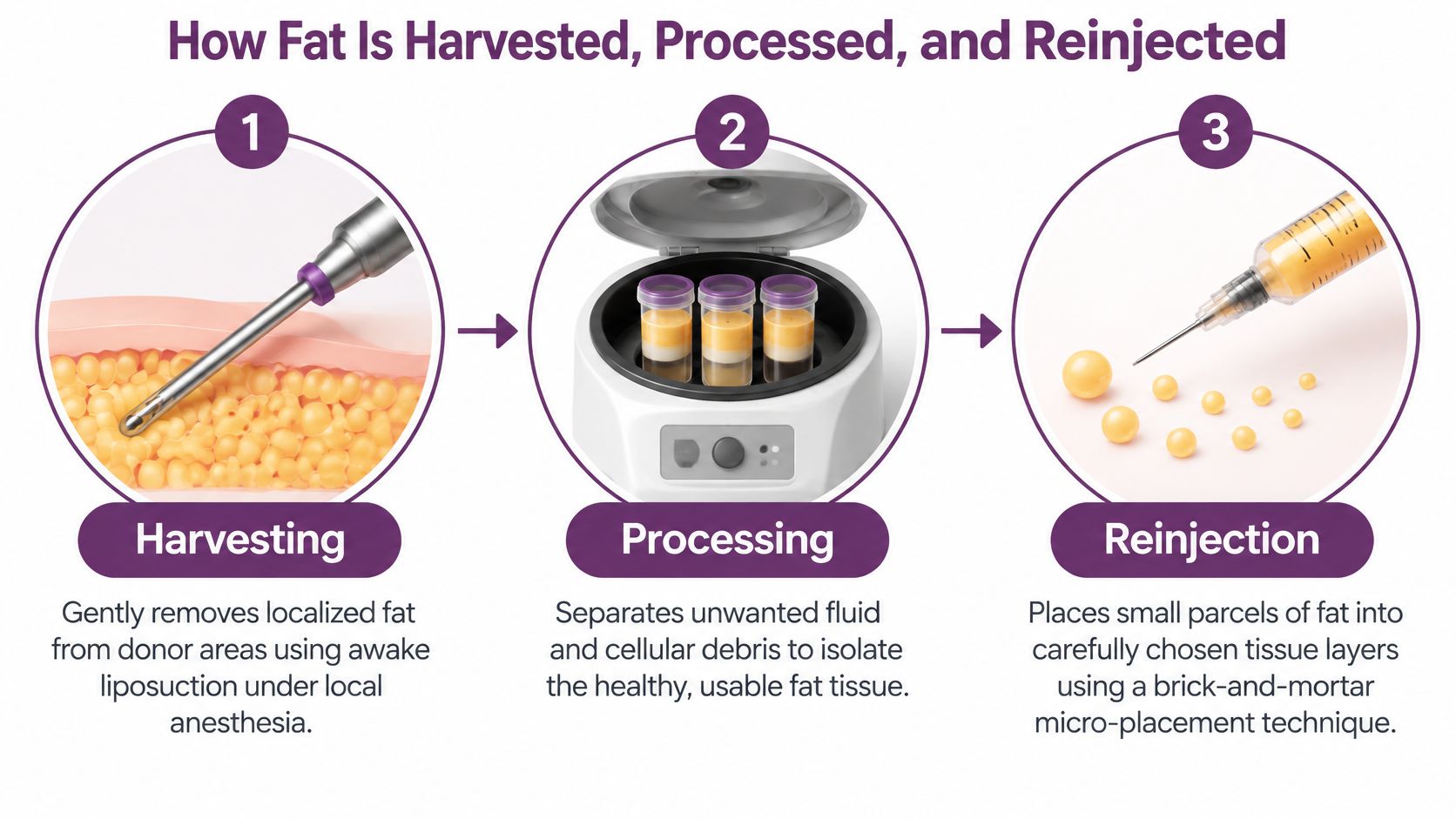
A good result depends on both preparation and placement technique — not just how much fat is moved.
How Fat Transfer Techniques Evolved
The idea is not new. In 1893, Neuber used forearm fat to fill a depressed facial scar. That early work led into an open-surgery era from 1889 to 1977, followed by liposuction-based harvesting from 1977 through 1994.
Then in the 1990s, Sydney Coleman popularized a gentler, more refined approach built around careful processing and micro-placement. That foundation still informs many modern fat grafting methods.
Patients can learn more about preparing for liposuction and what to expect.
At Luxe Aesthetic Surgery & Medical Spa, your physician will evaluate your anatomy and goals, including whether awake liposuction may be appropriate for your harvest or if staging may be preferable.
Fat transfer may restore lost volume, improve symmetry, or refine contours in several areas. What may be appropriate depends on your anatomy, how much donor fat is available, and the outcome you are seeking.
Restoring Facial Volume
As we age, the cheeks, temples, and midface may lose fullness. With facial fat grafting, your own fat is placed carefully beneath the tissue to support softer fullness.
Think of it like refilling a cushion from the inside, rather than just smoothing the cover. For example, someone with volume loss in the cheeks who wants a softer contour — but is not seeking a facelift — might discuss this option during a consultation.
Cheek enhancement is one area where fat transfer is often discussed, depending on how much volume is desired. Cheek filler options provide a nonsurgical point of comparison.
Luxe's Non-Surgical Facelift is another option. It may restore the appearance of volume, soften the look of lines, and improve contour definition without surgery. You can read more about facial volume loss and available treatments to weigh the differences.
Augmenting and Balancing the Breasts
Fat transfer to the breasts may add modest volume and improve the appearance of unevenness. It may be discussed by patients seeking a natural-looking change in fullness without an implant.
For example, a patient seeking a small, subtle change might have fat taken from the abdomen or flanks and transferred to the breasts, if anatomy allows. Luxe also offers Awake Breast Augmentation, performed under local anesthesia for appropriate candidates to address size, shape, and balance.
Shaping the Buttocks and Body
Fat transfer to the buttocks uses your own fat to support shape and volume in the buttocks. Because the fat often comes from the waist or hips, donor-site contouring may also refine those areas.
How much change may be seen depends on:
- How much harvestable fat is available
- Where that fat is distributed
- Whether individual proportions allow the planned transfer in one session
In some cases, a second staged session may be discussed to build volume more conservatively over time.
Correcting Scars and Rejuvenating Hands
On a smaller scale, fat grafting may be used for hand rejuvenation. It is intended to support fuller-looking padding that can thin over time.
It may also be used to improve the appearance of depressed scars from injury or prior surgery. These cases typically use less fat, but placement still needs to be precise.
Available donor fat limits what one area can achieve. If you are hoping for a larger change, staged treatment or a different approach may be recommended. That planning starts with an in-person consultation.
Plan Your Fat Transfer Goals
To request a personalized assessment at Luxe Aesthetic Surgery & Medical Spa in Southern California, reach out to the practice. You can talk through your target area, donor options, recovery, and whether fat transfer may be appropriate for you.
Not Every Transferred Fat Cell Survives. That’s normal.
Some of the fat is absorbed during healing. The remaining fat that establishes a new blood supply may persist long term. How much remains varies considerably from person to person.
It depends on the patient, the area treated, how the fat was prepared, and how long after the procedure volume was measured.
What Studies Show About Retention
For the breast, a 2023 systematic review and meta-analysis found pooled volume retention of 54% at the latest follow-up, with a 95% confidence interval of 48.5% to 59.5%.
That same review compared processing methods. Retention was 51.5% after centrifugation versus 38.7% after sedimentation.
These are group averages, not personal guarantees. The studies also used different techniques, measurement tools, and follow-up times.
Results in the face vary even more widely. A meta-analysis of 27 studies involving 1,011 patients reported retention ranging from 26% to 83%, with a pooled average of 47% and follow-up from 3 to 24 months.
| Clinical Context | Reported Retention | Follow-Up Context |
|---|---|---|
| Breast Autogenous Fat Grafting | 54% pooled average | Latest follow-up across included studies |
| Breast Grafting Confidence Interval | 48.5% to 59.5% | Statistical range around the pooled estimate |
| After Centrifugation | 51.5% | Depends on the included studies |
| After Sedimentation | 38.7% | Depends on the included studies |
| Facial Fat Grafting | 26% to 83% | 3 to 24 months |
| Facial Pooled Estimate | 47% | Meta-analysis of 27 studies and 1,011 patients |
Why Retention Varies So Much
Picture each parcel of fat like a seedling. It may persist when the surrounding tissue can support it. Without adequate blood supply, some grafted fat does not survive.
A few factors may influence the outcome:
- Harvest and purification method — gentler handling may deliver more intact fat to the recipient site
- Injection technique — small, distributed parcels may survive better than one large collection
- Recipient tissue health — blood flow, skin quality, and scarring all play a role
- Personal habits — smoking, general healing ability, and weight changes matter
Timing also affects reported numbers. Early swelling can make volume look greater than it is. A short follow-up may not capture later reabsorption.
Published averages give useful context, but no study can predict your exact retention percentage.
Planning for Some Absorption
Most physicians expect some volume loss. They factor it into individualized treatment planning when deciding how much to transfer.
Depending on your goal and available donor fat, staged treatments may be more appropriate than attempting a larger change in one session.
Fat that survives remains living tissue. It may decrease with weight loss and increase with weight gain. Maintaining a stable weight may help support steadier-looking results over time.

Fat transfer uses your own tissue instead of a synthetic implant. When the graft is retained, it tends to feel soft and natural.
Since fat is commonly taken from the abdomen, waist, flanks, back, arms, or thighs, donor-site contouring is often part of the individualized plan.
That said, results depend on tissue survival, precise placement, and your anatomy. Fat transfer is not risk-free and is not right for everyone.
Understanding the Published Limitations
Not every transferred cell develops a lasting blood supply. That is why some volume loss is expected.
One systematic review of non-enriched fat grafting found a mean retained volume of 41.63% after an average follow-up of 13.9 months.
- Cosmetic cases averaged 45.76% retention
- Reconstructive cases averaged 38.26% retention
- Cell-enriched methods averaged around 65.68% with stromal vascular fraction and 69% with platelet-rich plasma
Those higher enriched averages are not promises. Studies varied widely in processing, technique, patient selection, and follow-up time, so head-to-head comparisons are limited.
Published averages provide context, not a prediction of your personal outcome.
Recognizing the Possible Risks
Fat transfer is surgery, and possible complications deserve a clear discussion. Possible issues may include:
- Infection, bleeding, swelling, or anesthesia-related problems
- Fat necrosis, when grafted tissue does not survive
- Oil cysts or other fluid collections
- Lumps, contour irregularities, or uneven volume
- Asymmetry between the treated area and nearby tissue
- Scarring, numbness, or changes in skin sensation
- Need for revision surgery if volume settles unevenly
Your individual risk profile depends on the treatment area, how much fat is transferred, surgical technique, and personal health history. Those considering breast enhancement can review the trade-offs in Luxe’s guide to breast implants versus fat transfer.
Reviewing Your Candidacy
At an in-person consultation, your physician will carefully evaluate several factors:
- Adequate donor fat: Enough usable fat must be available to support your volume goal.
- Stable weight: Changes in weight can affect both grafted fullness and donor contours.
- Nonsmoking status: Smoking affects circulation and healing, which may reduce graft survival.
- Realistic goals: Fat transfer is usually subtler than implants and may require staged sessions.
- Medical history: Medications, bleeding risk, prior surgery, skin quality, and healing issues all matter.
- Recipient tissue quality: Healthy tissue with good blood flow may provide a better environment for grafted fat.
Feasibility depends on individual anatomy, medical history, and the desired outcome. A consultation is necessary to determine whether fat transfer is appropriate. Request a personalized assessment at Luxe Aesthetic Surgery & Medical Spa to talk through donor fat, expected retention, staging, and your safest options.
What Recovery Actually Feels Like
Fat transfer heals in two places at once — the donor area where fat was taken, and the recipient area where it was placed.
It helps to consider them separately. A smooth-looking donor site doesn’t mean the grafted area has fully settled.
In the first few days, some swelling, bruising, tenderness, or tightness may occur on one or both sides. Many patients notice more soreness where fat was harvested, while the face or breasts can look temporarily fuller from swelling.
The First Three Months
This is the settling phase for both areas. Swelling gradually fades, and some transferred fat is naturally absorbed.
Final-appearing volume can take several months to become clearer. Your physician will usually track changes across follow-up visits before discussing any additional staging.
Grafted areas often look fuller right away because of swelling, so the first week isn’t a reliable preview of the result.
Everyone recovers a little differently depending on the area treated and overall health. Donor soreness can feel more achy than the recipient site, while facial swelling tends to be more visible at first but often fades relatively quickly.
Your physician will provide guidance around work, exercise, lifting, compression garments, and wound care. Stable weight, avoiding smoking, and following activity guidance closely may support healing.
- Bring goal photos. Include several angles of what you want changed — and what you want left alone.
- Share your full history. Cover prior surgeries, cosmetic procedures, medications, supplements, allergies, and health conditions.
- Ask about donor selection. Talk through which area may offer enough fat with the best contour trade-off.
- Review retention and staging. Ask how much volume may settle over time and whether more than one session might be discussed.
- Discuss anesthesia. Ask whether local anesthesia may be appropriate for the size of your planned procedure.
- Schedule follow-up. Those check-ins allow your physician to monitor healing and volume changes over time.
Preparing for Your Consultation
Medical Director Haimesh Shah, MD, RPVI, is a board-certified physician specializing in cosmetic surgery and phlebology. He has training and experience in liposuction, body contouring, and autologous fat grafting.
At a consultation at Luxe, you can talk through realistic goals, what recovery may involve, and whether fat transfer may suit your anatomy and health history. The team can also explain how donor fat supply, recipient tissue, and desired proportions shape an individualized plan focused on balanced, proportionate outcomes.
If you are considering fat transfer in Southern California, request a personalized assessment from Luxe Aesthetic Surgery & Medical Spa. You can compare donor options, clarify your goals, and get a clear sense of next steps.
Is Fat Transfer Permanent
Not entirely — and that's normal. After the procedure, your body naturally absorbs some of the transferred fat during healing.
The fat that remains and develops a blood supply becomes living tissue. That portion may persist for years. Still, results are not unchanging. Weight gain or loss, natural aging, and any future treatments can all affect how results look over time.
How Does Fat Transfer Differ From Dermal Fillers
Fat transfer uses your own tissue and involves surgery, while dermal fillers are typically quick, in-office injections.
Here's how they tend to compare:
- Fillers may work well for small, precise changes and generally need regular maintenance
- Fat transfer may be a better fit for broader, natural-looking volume — if you have enough donor fat and are an appropriate candidate
Which option may make sense depends on how much volume is desired, donor availability, healing time, and how much downtime you can accommodate.
Can Someone With Low Body Fat Have Fat Transfer
Having low body fat doesn't automatically rule out treatment. It makes individualized planning especially important.
When donor fat is limited, reaching a desired volume safely can be difficult. A qualified physician can evaluate whether:
- A small, targeted graft may be realistic
- A staged approach might be discussed
- A different facial or body-contouring option may be more appropriate
How Many Fat Transfer Sessions Are Usually Needed
There isn't a set number that applies to everyone. For modest goals, one session may be enough.
Larger volume goals often require staged procedures spaced over time. Your physician will also consider the recipient area, how much usable donor fat is available, the technique used, and how healing progresses.
Fat transfer results depend on anatomy, technique, healing, and the patient's goals.
Schedule a consultation at Luxe Aesthetic Surgery & Medical Spa to talk through donor fat, expected retention, and realistic options for your goals in Southern California today.