Medical Expertise at Luxe Aesthetic Surgery
Luxe Aesthetic Surgery & Medical Spa is led by Haimesh Shah, MD, RPVI , a physician specializing in cosmetic surgery, body contouring, laser procedures, and venous medicine. Dr. Shah is a Diplomate of the American Board of Laser Surgery, American Board of Venous & Lymphatic Medicine, American Board of Wound Management, and American Board of Internal Medicine. He also holds the Registered Physician in Vascular Interpretation (RPVI) credential and has contributed to peer-reviewed medical research.
Are you choosing a breast augmentation incision based only on where the scar will be visible? That question matters, but it doesn't address the decisions that often affect the operation more directly: how clearly the surgeon can create the implant pocket, how effectively bleeding can be controlled, how the implant can be positioned, and how practical a future revision may be.
The four established breast augmentation incision types are inframammary, periareolar, transaxillary, and transumbilical. Each can be appropriate in selected circumstances. None is universally safest or best, and a “hidden scar” doesn't automatically produce the most controllable or durable surgical plan.
Table of Contents
- What Breast Augmentation Incision Type Actually Determines
- Comparing the Four Main Incision Approaches
- Incision Risks, Sensation Changes, and Complication Patterns
- How Incision Choice Affects Anesthesia and Awake Procedure Planning
- Choosing the Right Incision Based on Your Priorities
- When to Seek a Consultation About Incision and Anesthesia Options
What Breast Augmentation Incision Type Actually Determines
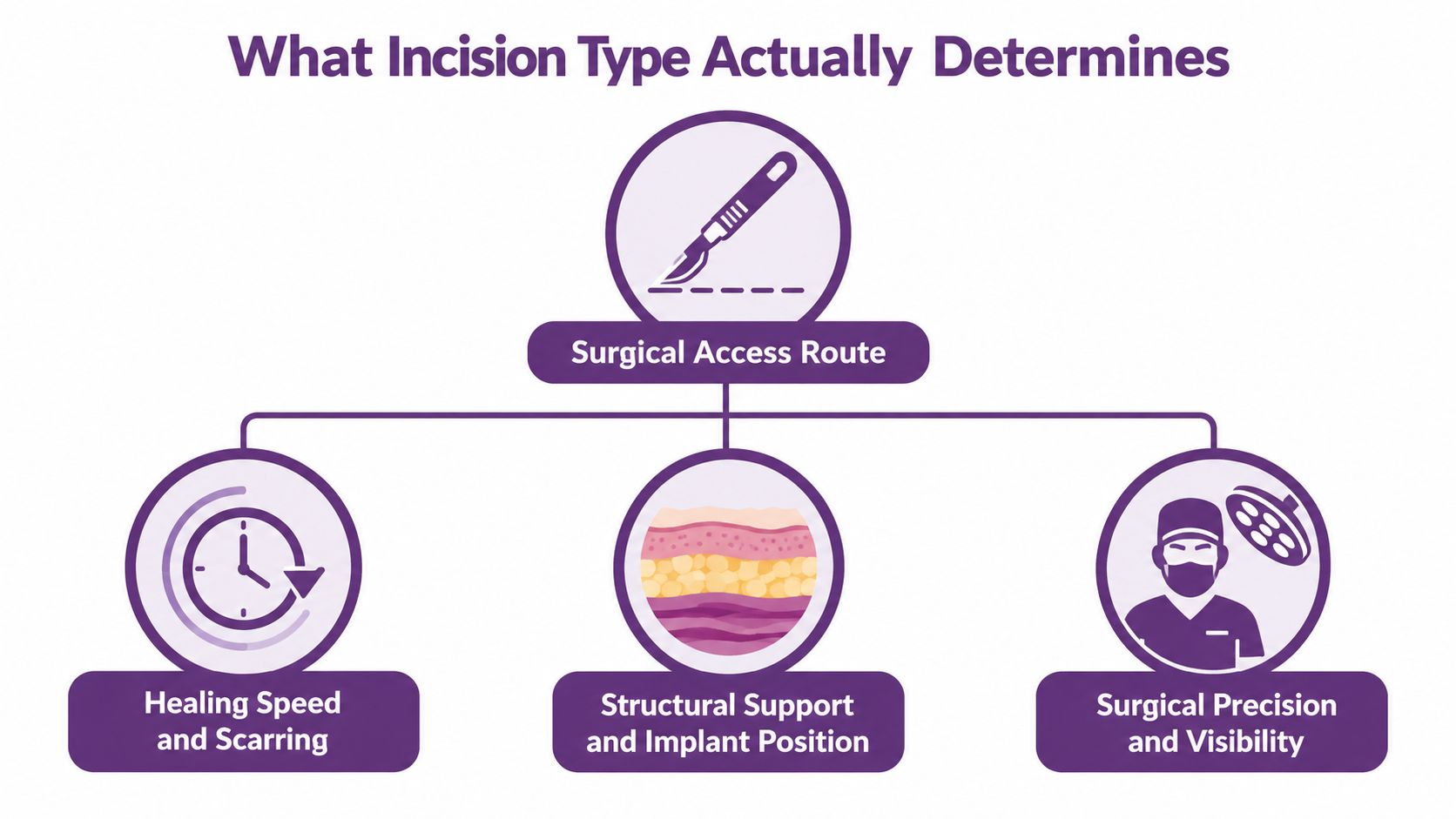
Incision selection determines the route from the skin to the implant pocket. That route influences what the surgeon can see, which tissues must be crossed, how accurately the pocket boundaries can be formed, and how easily the implant can be exchanged or repositioned later. The FDA's patient information on breast implants identifies the inframammary approach as the most common option and describes meaningful differences among inframammary, periareolar, and transaxillary access.
The inframammary incision sits in the natural fold beneath the breast. It generally provides the most direct exposure for pocket dissection, implant placement, bleeding control, and later access. A periareolar incision follows the border between the areola and surrounding skin. It can camouflage well, but the surgeon passes through breast tissue near ducts and nerves. A transaxillary incision is placed in the armpit, keeping the breast skin free of a surgical scar while creating a longer, less direct path to the pocket. Transumbilical access, sometimes called TUBA, enters through the navel and is generally limited to saline implants.
Three questions matter more than scar concealment
First, how much exposure does your surgeon need? Direct access can make it easier to define the lower and side boundaries of the pocket, protect the desired breast-fold position, and manage bleeding. More distant routes may preserve the breast skin but require greater technical precision through a narrower or longer corridor.
Second, where will the scar sit in your daily life? An inframammary scar may be concealed by the breast and clothing, but it can be visible in certain swimwear or when lying down. Periareolar access uses a natural color transition. Transaxillary access moves the scar to the armpit, where it may be visible when the arm is raised. Transumbilical access places the scar at the navel, but it limits the implant options and revision pathway.
Third, what happens if you need surgery later? Implant exchange, pocket adjustment, treatment of malposition, or removal may be more straightforward through an existing inframammary or periareolar site. Transaxillary and transumbilical approaches may require a new incision for certain corrections.
A retrospective study of 619 primary breast-augmentation patients found that incision location was significantly associated with total reoperation rate, with p = 0.0054, but it didn't show a statistically significant relationship with individual complications such as capsular contracture, rippling, rupture, hematoma, or infection. The practical lesson is not that one incision prevents complications. It's that access should be evaluated separately from implant type and pocket location, as reported in the retrospective study of incision location and reoperation.
Practical rule: Choose the incision that gives your surgeon reliable control of the planned pocket while respecting your scar, sensation, implant, and revision priorities.
Comparing the Four Main Incision Approaches
The right comparison isn't “visible scar versus invisible scar.” It's a balance among scar placement, surgical exposure, implant compatibility, and future access. Your breast-fold position, areolar diameter, tissue thickness, implant dimensions, planned pocket, and previous surgery can make one route more practical than another.
| Incision type | Scar placement | Surgical access | Implant compatibility | Revision access |
|---|---|---|---|---|
| Inframammary | In the crease beneath the breast | Direct access with strong control of pocket boundaries, implant position, and hemostasis | Compatible with saline and silicone-gel implants | Often allows later exchange, removal, or pocket correction through the same region |
| Periareolar | Along the areola and breast-skin border | Central access can be useful, but the route crosses breast tissue near ducts and nerves | Can accommodate saline and silicone-gel implants when anatomy and implant dimensions permit | May provide access for later surgery, although the original tissue pathway remains a consideration |
| Transaxillary | In a fold of the armpit | More distant and technically demanding route to the breast pocket | Can be used for saline and selected silicone-gel plans, but access may limit implant dimensions | Corrections may require another incision, particularly for malposition or bleeding-related problems |
| Transumbilical | At the navel | Limited visualization and more difficult direct hemostasis | Generally limited to saline implants placed while deflated | Limited pathway for direct revision or pocket correction |
Inframammary access
The inframammary route is usually the most versatile because the incision sits close to the lower breast pocket. The surgeon can work directly on the fold, inspect the pocket, position the implant, and address bleeding with less dependence on a remote corridor. The American Society of Plastic Surgeons also describes this route as direct and notes that future removal or replacement may potentially use the same site in its overview of breast augmentation incision considerations.
Its limitation is straightforward: the scar is on the breast area, even though the fold often conceals it when you're standing. Fold anatomy matters. If the incision is placed inaccurately, the scar may sit below the breast rather than within the natural crease, so the surgeon's ability to reproduce the intended fold is more important than choosing the incision name.
Periareolar access
Periareolar placement can be appealing when scar camouflage is a major concern and the areola provides a clear border. It can also facilitate central pocket work. The trade-off is that the incision crosses breast tissue and lies close to nerves and ducts. That makes nipple sensation and future breastfeeding plans relevant parts of the consultation, rather than minor details.
Transaxillary and transumbilical access
Transaxillary surgery preserves the breast skin envelope, but the surgeon must reach the pocket from the armpit. The FDA notes that this approach may limit implant size, while the distance from the pocket can make positioning and later correction more complicated. Transumbilical access removes the breast-surface scar, but it generally requires a saline implant and makes direct bleeding control more difficult. A systematic review of less common augmentation access routes described complications in transumbilical series and noted that some transaxillary cases required conversion to open surgery for bleeding or implant-positioning issues.
The scar location is only one line in the decision matrix. If you value silicone-gel implant choice, precise pocket control, and a straightforward revision route, direct access may carry more weight than keeping the breast skin untouched.
Incision Risks, Sensation Changes, and Complication Patterns
Patients often hear that one incision has a higher complication rate and assume the incision alone caused the difference. Surgical evidence is more complicated. Implant characteristics, pocket plane, operative technique, follow-up duration, patient selection, and revision history can all affect the observed result.
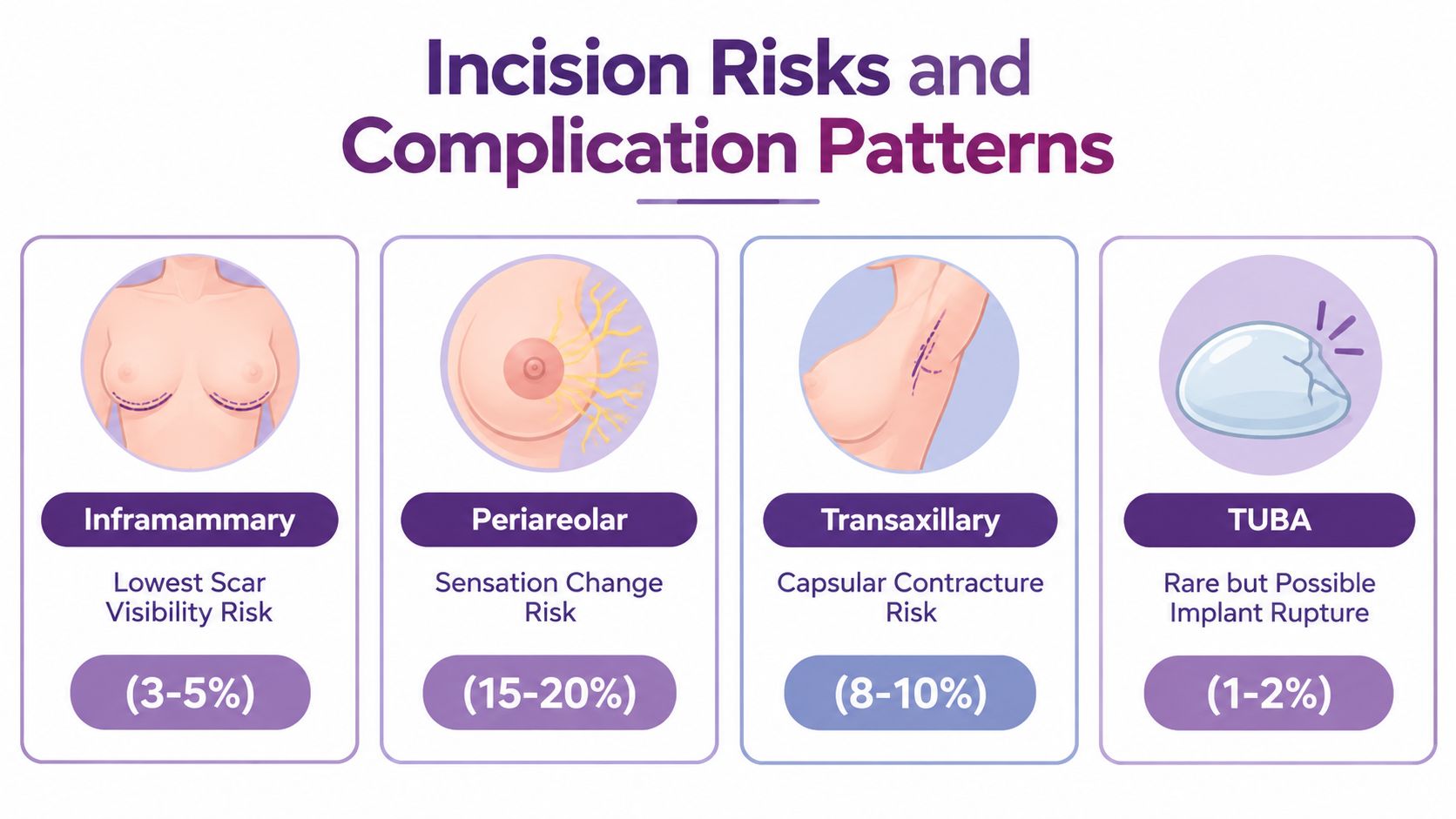
One published comparison reported capsular-contracture incidence of 0.5% per breast for inframammary incisions, 2.4% for periareolar incisions, and 6.4% for transaxillary incisions. Those figures come from a specific study population and shouldn't be treated as universal rates. A separate endoscopic comparison reported overall complication rates of 1.8% for inframammary and 2.7% for transaxillary augmentation, without a statistically significant difference. Both findings reinforce the need to interpret benchmarks in context, as discussed in the published comparison of augmentation access routes and outcomes.
What the evidence does and doesn't establish
Capsular contracture is not determined by incision location alone. A separate evidence review concluded that access incision is unlikely to determine contracture risk and noted that research is conflicting about whether periareolar access increases contracture. That distinction matters because patients shouldn't select an incision based on the promise that it will eliminate a particular implant complication.
Nipple sensation deserves separate attention. A 2026 scoping review reported that persistent nipple sensory change was generally below 5%, while large cohorts found periareolar incisions associated with approximately three times the risk of hypoesthesia and pain compared with inframammary incisions. The review's findings are summarized in recent research on breast augmentation incision choice, sensation, and complications.
That doesn't mean every periareolar incision causes a sensory problem, or that inframammary access eliminates one. It means the sensory-risk signal deserves a direct conversation, particularly if nipple sensation is important to you or you've had previous breast surgery. Breastfeeding questions also require nuance. Crossing breast tissue may raise concerns about ductal integrity, but an incision doesn't allow anyone to predict an individual lactation outcome with certainty.
A concealed scar can be a worthwhile priority, but it shouldn't conceal the conversation about sensation, implant control, and revision access.
Scar care also belongs in the plan. Once the incision has closed and your surgeon approves scar treatment, some patients discuss silicone products and sun protection. If you're researching postoperative options, you can shop scar patches online, but any product should be compatible with your surgeon's instructions and the stage of healing. For a focused discussion of sensory concerns, review this guide to nipple sensitivity after breast augmentation.
How Incision Choice Affects Anesthesia and Awake Procedure Planning
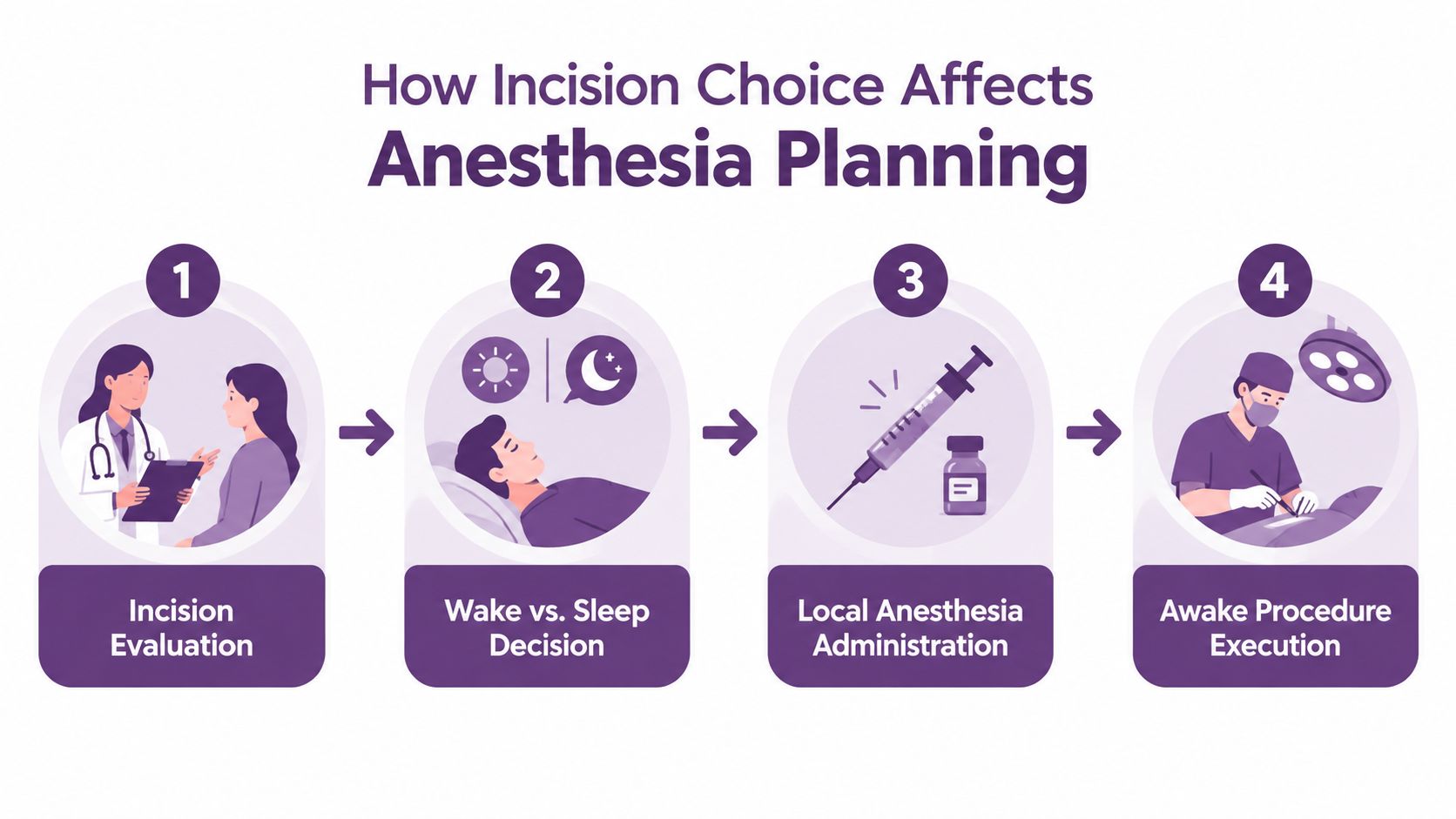
Incision choice and anesthesia planning should be discussed together, especially if you're considering breast augmentation under local anesthesia. The route determines where the surgeon injects local anesthetic, how much tissue requires anesthesia, how easily the pocket can be accessed, and how comfortable it may be to maintain a controlled workflow while you're awake.
A direct inframammary route may make localization more straightforward because the operative field is close to the incision. Periareolar access can also provide relatively direct central access, but the surgeon must account for the tissues and sensory structures near the areola. Transaxillary surgery creates a longer path from the armpit to the breast pocket, which may make the awake workflow more demanding. Transumbilical surgery involves a separate route and limited direct visualization, so it requires particularly careful discussion of feasibility.
What “awake” actually means
“Awake” generally means the procedure is performed with local anesthesia for an appropriately selected patient, rather than assuming that every breast augmentation can or should use that approach. It doesn't mean the surgery is risk-free, painless, or suitable for every anatomy, implant plan, medical history, or level of comfort with being conscious during surgery.
The surgeon still has to create the pocket, control bleeding, insert the implant, and confirm position. Implant dimensions, tissue coverage, pocket location, surgical complexity, and the patient's response to local anesthesia all influence the plan. General anesthesia may remain the more appropriate choice in some circumstances.
Questions that improve the consultation
Ask how the selected incision changes the local-anesthetic plan, whether the implant can be inserted through the proposed route without compromising pocket control, and what happens if discomfort or bleeding requires a change in the operative plan. You should also ask whether the surgeon considers you an appropriate candidate for local anesthesia based on your medical history and the technical details of the operation.
Luxe's approach to breast augmentation under local anesthesia emphasizes selection rather than a universal promise. The practical goal is to match anesthesia and access to the patient and operation, not to force every incision into an awake workflow.
Choosing the Right Incision Based on Your Priorities
There isn't a single correct answer for every patient. I start by identifying which trade-off a patient is least willing to accept, then compare that priority with the anatomy and implant plan.
If the breast scar is your strongest concern
Transaxillary access may appeal because the incision is in the armpit rather than on the breast. The cost is a more distant operative route, possible limitations related to implant dimensions, and more complicated access for certain revisions. Transumbilical access also avoids a breast scar, but its saline-only limitation and less direct control make it a narrower option.
If you accept a scar in the breast fold but want broad implant compatibility and direct pocket control, inframammary access may align better with your priorities. The FDA describes this route as offering the best implant-pocket access and control, while also noting approach-specific considerations for periareolar and transaxillary surgery.
If precision and future surgery matter most
Inframammary access often deserves serious consideration when you want silicone-gel implant flexibility, careful control of the lower pole, and a practical route for later exchange or correction. Periareolar access can work for selected anatomy, but the areolar diameter, implant dimensions, breast tissue, and sensory priorities must be assessed together.
Implant shape is part of that discussion. Patients comparing options can review round versus anatomical breast implants while recognizing that implant shape, profile, size, pocket, and incision are related decisions, not isolated selections.
If sensation or future breastfeeding is central
Periareolar access deserves careful scrutiny when nipple sensation is especially important or when future pregnancy and feeding are part of your plans. That doesn't make it automatically inappropriate, and it doesn't make another incision a guarantee of a particular breastfeeding result. It does mean you should discuss ducts, nerves, existing sensation, areolar anatomy, and the planned pocket before choosing it for camouflage alone.
If you're interested in an awake workflow
Ask whether the incision gives the surgeon enough access and control to perform the planned operation comfortably under local anesthesia. A direct route may be more compatible with an efficient awake workflow, but candidacy still depends on your medical history, anatomy, implant dimensions, and surgical complexity. The anesthesia plan should follow the operation, not the other way around.
When to Seek a Consultation About Incision and Anesthesia Options
A consultation is appropriate when you have narrowed your priorities but haven't decided which trade-off you can accept. Bring specific questions about scar placement, implant type, pocket location, nipple sensation, future breastfeeding, and how the surgeon would approach a later exchange or correction.
Your provider should assess the breast-fold position, areolar dimensions, existing tissue, asymmetry, skin quality, prior surgery, implant dimensions, and medical history. Those details may rule an approach in or out, even when the scar location seems attractive in theory.
Ask these questions directly:
- Pocket control: Which incision gives you the clearest view of my planned pocket?
- Implant access: Does my preferred saline or silicone-gel implant fit comfortably through the proposed route?
- Revision planning: If I need an exchange or pocket correction, can you use the original incision?
- Sensation: How does the incision affect the nerves and ducts relevant to my anatomy?
- Anesthesia: Am I an appropriate candidate for local anesthesia, or would general anesthesia provide a better-controlled plan?
- Contingencies: What would change if bleeding, implant positioning, or comfort became a concern during surgery?
No incision is universally superior. The strongest decision matches your anatomy and implant plan with a surgeon's ability to create and control the pocket, while giving honest weight to scar visibility, sensation, anesthesia, and future access.
Luxe Aesthetic Surgery & Medical Spa provides individualized consultation for breast augmentation, breast implant exchange, and selected awake procedures using local anesthesia when clinically appropriate. Visit Luxe Aesthetic Surgery & Medical Spa to discuss your incision options, implant goals, anesthesia questions, and long-term revision plan with the practice team.