Medical Expertise at Luxe Aesthetic Surgery
Luxe Aesthetic Surgery & Medical Spa is led by Haimesh Shah, MD, RPVI , a physician specializing in cosmetic surgery, body contouring, laser procedures, and venous medicine. Dr. Shah is a Diplomate of the American Board of Laser Surgery, American Board of Venous & Lymphatic Medicine, American Board of Wound Management, and American Board of Internal Medicine. He also holds the Registered Physician in Vascular Interpretation (RPVI) credential and has contributed to peer-reviewed medical research.
If the skin on the back of your upper arm snaps back after you pinch it, why do so many conversations about arm contour still jump straight to an arm lift? Most pages blur two different problems. Localized fat sits in the subcutaneous layer, above the muscle, and can be suctioned. Loose skin is a separate tissue, and suction does not reliably take it away. That single distinction changes the technique, the result you can expect, and whether an arm lift still belongs in the plan.
Liposuction of the upper arms removes fat, usually along the back, inner, and outer arm. It does not cut away hanging skin. The back of the arm is the usual target. Sensory nerves run along the inner arm, so incision sites and cannula paths are planned to protect feeling and keep the line even from shoulder to elbow.
Table of Contents
- Techniques for Upper-Arm Liposuction Compared
- Who Qualifies Based on Fat and Skin Quality
- What Results Look Like and What Liposuction Cannot Fix
- When Arm Lift Surgery Joins Liposuction
- Risks, Complications and Lidocaine Safety
- Recovery Timeline Week by Week
- Book a Consultation to Confirm Your Arm Plan
Techniques for Upper-Arm Liposuction Compared
Upper-arm liposuction removes localized fat from beneath the skin. It does not remove loose skin. The practical question is which method fits your arms, and which anesthetic goes with it.
| Technique | How it works | Anesthesia | Typical fit |
|---|---|---|---|
| Tumescent liposuction | Dilute local anesthetic and epinephrine solution is infiltrated before fat removal | Local tumescent anesthesia, sometimes with sedation | Localized fat with reasonably good skin elasticity |
| Awake liposuction | Tumescent-based procedure performed while the patient is awake | Local anesthesia only | Selected patients for whom local anesthesia is appropriate |
| Laser-assisted (SmartLipo) | Laser energy loosens fat before suction and may encourage some skin contraction | Local tumescent anesthesia; approach varies by practice | Moderate fat with some skin laxity; benefit varies by patient |
| Mini liposuction | Smaller cannulas and incisions for limited areas | Local tumescent anesthesia | Small, targeted areas of fat |
Three choices that separate the methods
Three decisions separate these methods: the anesthesia, the cannula size and number of incisions, and whether energy is used to loosen fat before suction.
Tumescent infiltration is what made local-anesthesia liposuction practical. Liposuction emerged in Europe in the late 1970s as a “dry” method without fluid infiltration, commonly under general anesthesia. In 1985, California dermatologist Jeffrey A. Klein developed the tumescent technique, infiltrating a dilute solution of local anesthetic, epinephrine, and other ingredients before fat removal, and the approach was first formally reported in the American Journal of Cosmetic Surgery in 1987, as described in a historical review of tumescent liposuction. That step reduced blood loss and postoperative discomfort compared with earlier methods and allowed selected patients to stay awake. The upper arm is a relatively limited area, so it can suit an office-based, minimally invasive workflow when dosing, anatomy, and planning are appropriate. Anesthesia choice is still a clinical decision, not a universal indication.
Laser and other energy devices are often marketed as upgrades that tighten skin while fat comes out. They can loosen fat and may encourage some contraction in selected patients. They are not interchangeable, and no single device is the right upgrade for every arm. A surgeon still has to judge elasticity, symmetry, and how the contour transitions at the shoulder and elbow.
Practical rule: Write down the technique recommended for your arms, the anesthesia planned, and the reason for that choice before you leave the visit.
Awake treatment means you are numbed with local anesthetic and remain conscious. It does not mean every patient qualifies, that discomfort is zero, or that recovery is guaranteed to be easier. Mini liposuction uses smaller cannulas and fewer, smaller incisions when the fat pocket is small. If the skin already hangs, none of these rows replaces an honest talk about excision.
Who Qualifies Based on Fat and Skin Quality
What makes an arm a good candidate for liposuction rather than a lift? Two checks decide it: how much localized fat sits on the arm, and how well the skin can recover once that fat is gone. Circumference alone cannot answer either question. A tape measure can shrink while the skin still drapes.
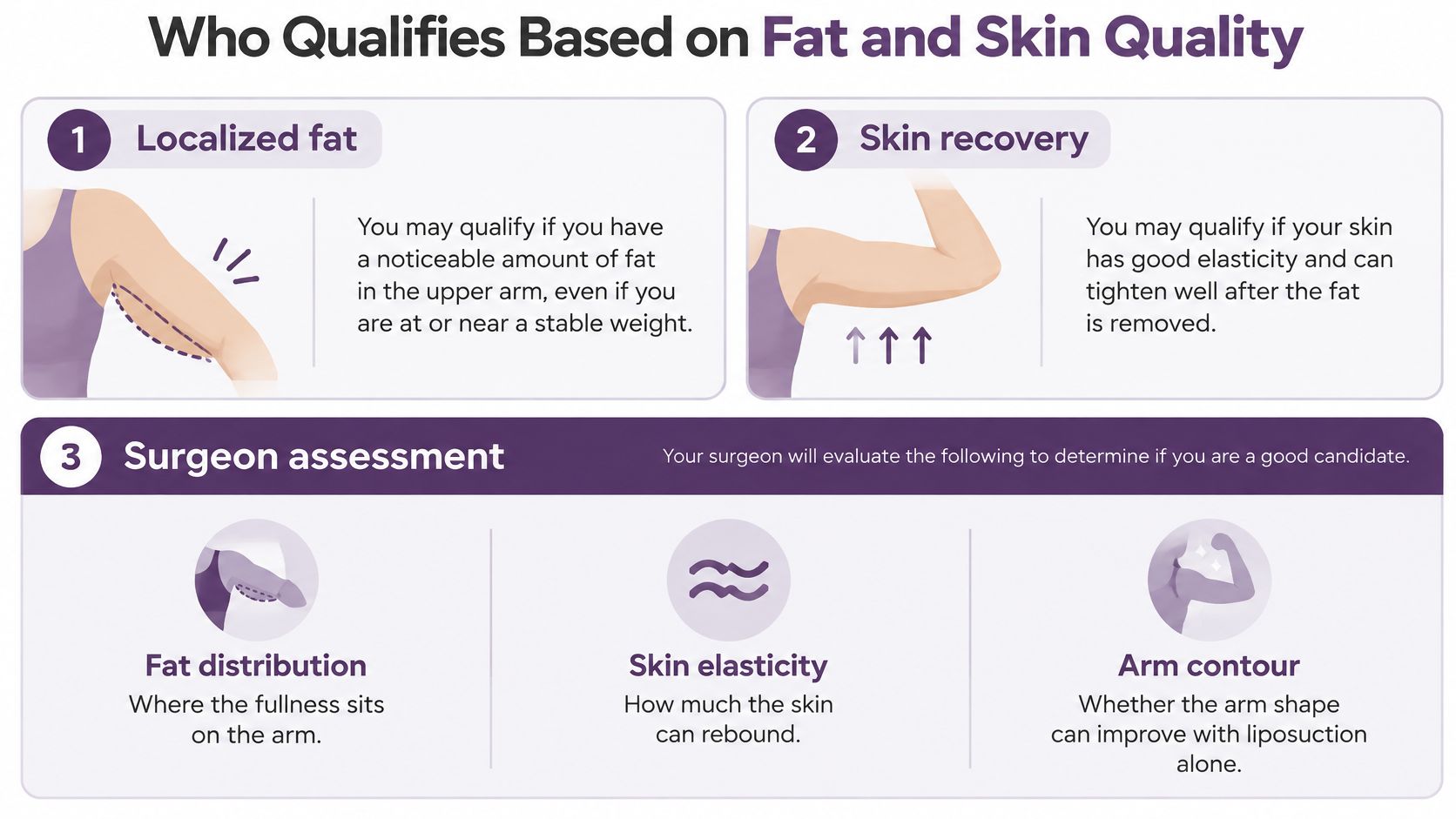
A useful exam documents pinch thickness, tissue recoil when the skin is gently pulled and released, the degree of ptosis (how much the tissue hangs), and how far the excess runs along the posterior and medial arm. Say you can pinch a firm centimeter of fat on the back of the arm and the skin recoils in a second. That pattern points toward suction. If the pinch is mostly thin skin that stays folded, suction will not create a tight arm. The fat is the removable layer. The skin is the envelope that has to shrink back around the new contour.
A retrospective study of upper-arm rejuvenation patients reported mean circumference reductions that rose with laxity grade. The same series supported matching the operation to the grade of laxity. The table keeps the grade separate from the suction-alone result so the two do not get confused.
| Skin laxity grade | Treatment studied | Mean circumference reduction with suction alone |
|---|---|---|
| Mild excess | Suction-assisted liposuction alone | 6.8% |
| Moderate deformity | Suction-assisted liposuction alone | 15.1% |
| Severe laxity | Suction-assisted liposuction alone | 17.3% |
Source: Aesthetic Surgery Journal report. In this 50-patient series, 78% were satisfied when suction was used alone. These are mean reductions with suction alone, not combined-treatment results. A larger percentage drop in a severe arm does not mean suction fixed the skin. It means more fat came out, which can leave laxity more obvious. In moderate or severe laxity, a surgeon may discuss adding radiofrequency-assisted tightening or an excisional step, but those combined approaches do not inherit the figures above.
What you can judge before the visit
- Stable weight: Large swings after surgery change the contour you just refined.
- Realistic expectations: Fat removal can slim the arm. It cannot promise tight skin.
- Scar tolerance: An excisional step leaves a scar whose length follows the amount of skin removed.
- Staged treatment: You may accept a later tightening procedure if suction alone is not enough.
Poor elasticity means aggressive fat removal may expose or worsen residual laxity, and a later excisional procedure may still be required even when the fat contour improves. The surgeon will also screen for issues that can delay or rule out surgery, including bleeding or clotting disorders, blood thinners, active infection, smoking, unstable medical conditions, and pregnancy.
Photograph both arms from the front, side, and back in the same light. Note how much skin you can pinch and whether it recoils. Bring those notes to the consultation.
What Results Look Like and What Liposuction Cannot Fix
Skin laxity improved in 339 of 496 patients (68.3%) in a 2024 retrospective study of circumferential upper-arm liposuction, a series with a mean operating time of 71.7 minutes that also reported significant improvement in 458 patients (92.3%), a 99.0% overall satisfaction rate, and early problems that were uncommon and mostly temporary: localized hard nodules with mild tenderness in 0.8%, localized pain or numbness in 0.6%, mild incision pigmentation in 0.6%, and temporary limitation of arm abduction on one side in 0.4%, as reported in Aesthetic Plastic Surgery.
That 68.3% is the number to hold onto if your concern is hanging skin rather than fat. It means skin laxity improved in about two-thirds of that series and did not improve in nearly a third. Suction changes fat volume under the skin. It does not shrink the skin envelope itself. The skin behaves like a fitted cover: remove some stuffing and the cover may sit looser, not tighter. The technique choice follows that split between fat volume and skin quality.
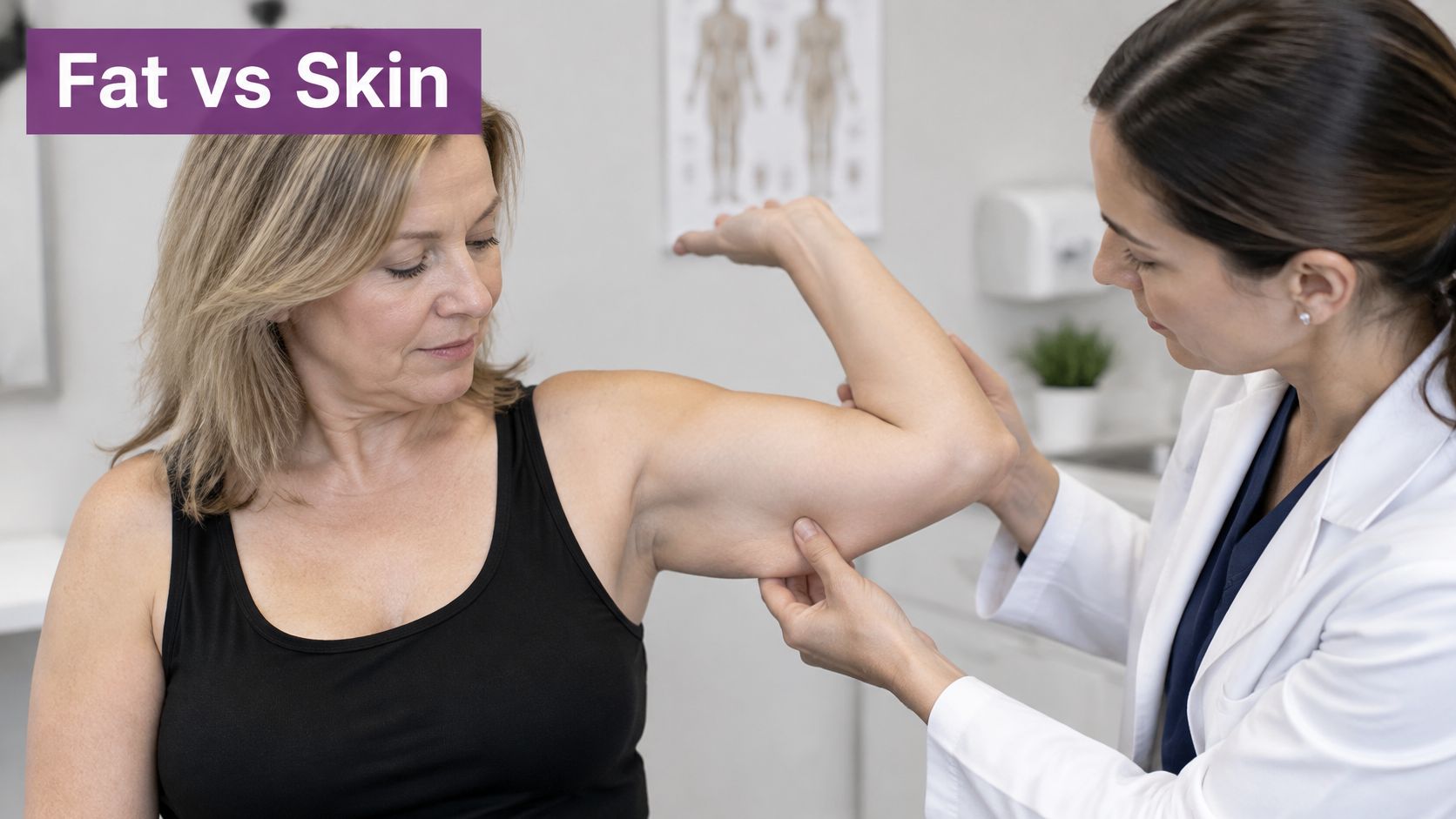
Early photos are a poor judge because swelling hides the contour for weeks. Results tend to fall into three buckets.
- Visible contour improvement: The arm looks slimmer once swelling settles, which is the usual goal when fat was the main issue.
- Partial skin improvement: Some recoil happens, and the arm looks better without becoming tight.
- A separate skin procedure: The fat is reduced, and redundant skin remains.
Wait until swelling has clearly receded before you decide whether the skin needs its own operation.
Take standardized photos in the same lighting, pose, and distance at baseline, 3 months, and 6 months. Compare those frames, not a bathroom mirror on a swollen day.
When Arm Lift Surgery Joins Liposuction
Brachioplasty, the excisional arm lift, removes excess skin through an incision, usually along the inner arm. Scar length follows how much skin must go. Short-scar brachioplasty is the version used when laxity is advanced but does not require a scar running the full length of the arm.
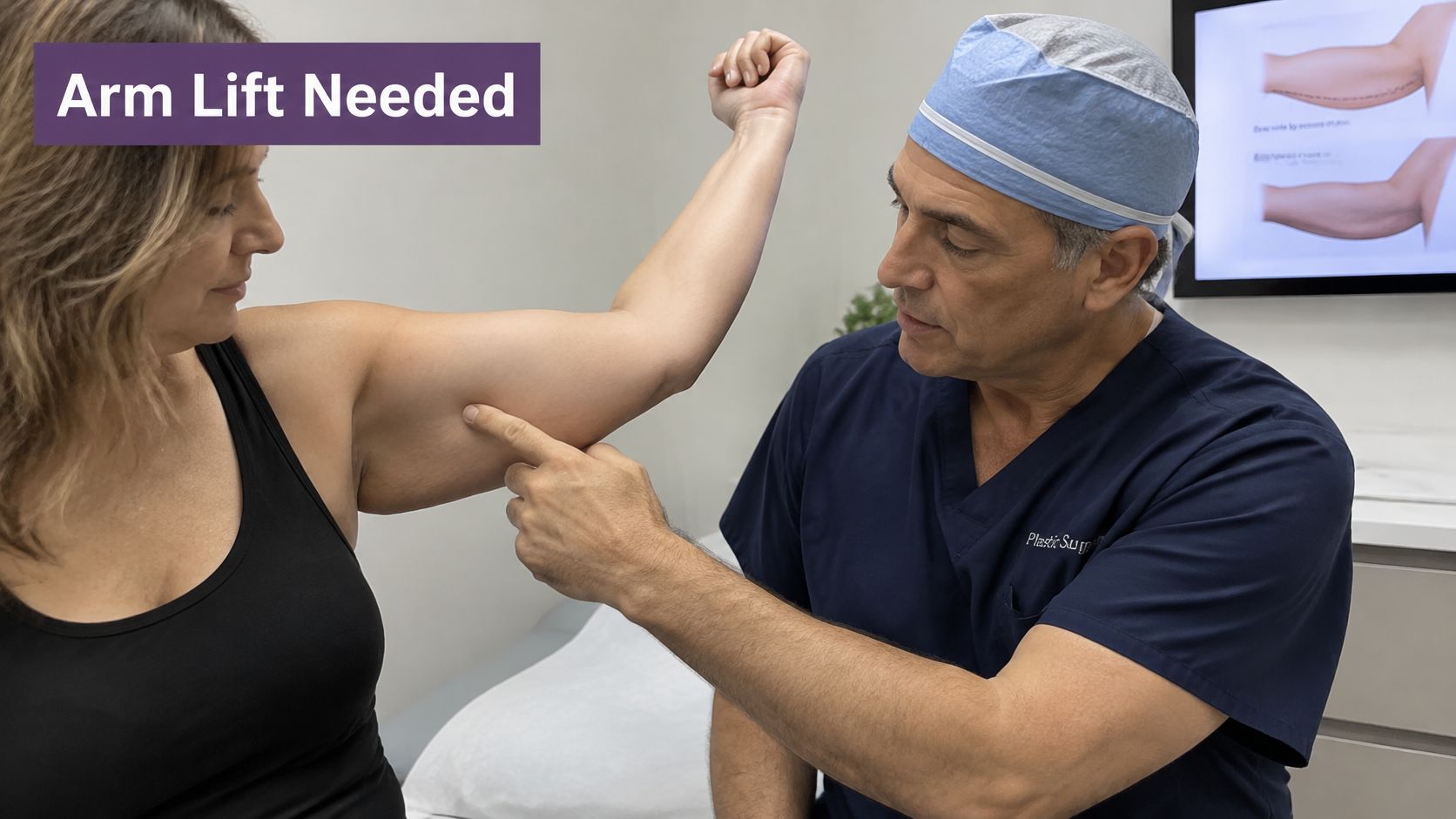
The surgical decision starts with one question: will the skin redrape after fat is removed? If the answer is yes, liposuction alone can finish the contour. If the answer is no, no amount of fat removal will pull hanging skin back into place. That is why the same operation can look complete on one patient and incomplete on another.
Once pinch, recoil, and hang are clear, the sequencing choice is one of three.
- Liposuction alone when fat is the problem and recoil is good.
- Radiofrequency-assisted liposuction when laxity sits in an intermediate range and some contraction is a reasonable goal.
- Liposuction with brachioplasty, either in the same session or staged, when hanging skin will not redrape.
The practical decision rule is straightforward. A surgeon chooses radiofrequency over excision when the skin still has enough recoil to contract and the laxity is mild to moderate. Excision is chosen when skin hangs below the arm crease or a pinch test leaves a fold that will not retract. A 2025 argon-plasma series in patients with mild-to-moderate laxity reported average reductions of 29% in ptosis and 42.7% in skin thickness, with results stabilizing after day 30, as described in this plasma-assisted arm series. Those are short-term changes in patients with mild-to-moderate laxity, not proof that device-assisted tightening replaces skin excision.
The trade-off in the arm lift decision
A larger prospective series reported a 27.5% complication rate, including temporary sensory changes and fat necrosis, and 16 patients required revision for residual skin laxity, according to the PubMed record of that series. Those figures are a reason to plan carefully. You are weighing scar length against the degree of tightening, the chance of a second procedure, and whether you can live with that scar and that staging. Combining liposuction with a tightening approach is discussed further in this guide to lipo with skin tightening.
Ask which of these three outcomes is most likely for your arms, where the scar would sit, and whether the lift would happen the same day or later.
Risks, Complications and Lidocaine Safety
Serious complications are uncommon, including when treatment is limited to the arms. Uncommon is not the same as impossible, and a smaller treatment area does not remove the need for selection, technique, and monitoring.
FDA consumer information on liposuction names several potentially serious risks: infection, fat embolism, organ puncture, persistent sensory changes, prolonged swelling, skin necrosis, fluid imbalance, and toxicity from lidocaine used for local numbing. Organ puncture is far less relevant in the arm than in the abdomen, but infection, sensory change, skin injury, fluid shifts, and anesthetic toxicity still apply. Candidacy assessment, appropriate technique, monitoring during the procedure, and following postoperative instructions are what keep those risks in check.
Lidocaine is its own concern
Lidocaine numbs the arm in many tumescent and awake procedures. Toxicity is a drug effect, separate from the fat removal itself. How tumescent local anesthesia is mixed and dosed is part of that safety plan, and the total dose has to fit your weight and medical history.
Warning signs of lidocaine toxicity include:
- Lightheadedness: You feel faint, unsteady, or unusually drowsy.
- Ringing in the ears: A new buzz or ring that was not there before the procedure.
- Slurred speech: Words come out thick or hard to form.
- Metallic taste: A sudden metal or bitter taste in the mouth.
- Numbness around the lips and tongue: Tingling or numbness that is not at the surgical site.
- Muscle twitching: Small jerks you cannot control.
- Seizures: A convulsion is an emergency.
Any of these symptoms needs immediate medical attention. Do not wait to see if it passes.
Before you agree to treatment, ask who monitors you during the procedure, what the emergency plan is if you feel unwell, and which signs you should report after you leave the office. Write the answers down. A clear plan is part of an honest consent, not an extra.
Recovery Timeline Week by Week
The American Society of Plastic Surgeons states that patients commonly have soreness and swelling for several days after laser- or ultrasound-assisted liposuction, and many can return to work within a few days, although recovery varies. The same guidance notes that a compression garment may be recommended, and that skin firming after assisted techniques can continue for up to six months.
| Period | What is typical | What to expect from activity |
|---|---|---|
| Days 1-3 | Soreness and swelling are common; a compression garment may be recommended | Many return to desk-based work within a few days, though recovery varies |
| End of week 1 | Swelling usually begins to decrease | Light daily activity as the surgeon allows |
| Weeks 2-4 | Compression garment use may continue for several weeks | Gradual return to exercise as the surgeon advises |
| Up to 6 weeks | Swelling may persist for as long as six weeks | Full exercise and heavy lifting only when cleared by the surgeon |
| Up to 6 months | Skin firming after assisted techniques can continue | Final contour judged after this period |
Swelling usually begins decreasing by the end of the first week and may last as long as six weeks. Garment use may continue for several weeks when your surgeon recommends it. Do not judge the final contour in week two. The same photo schedule, baseline, 3 months, and 6 months, is how you see change without guessing.
What you control
- Wear the compression garment as directed, including overnight if that is the instruction.
- Follow the limits on lifting and exercise, even when the arms feel fine.
- Attend each scheduled follow-up so progress can be compared in person.
- Report fever, spreading redness, or new pain to the care team the same day.
Fit matters as much as hours worn. Thermo Recovery Wear's compression sleeve guide walks through how a sleeve should feel during healing, and our notes on how long to wear a compression garment after lipo cover the usual wear schedule in more detail. This timeline is a starting point. Your surgeon sets the exact limits for your arms.
Book a Consultation to Confirm Your Arm Plan
A pinch test can tell you there is fat under the skin. It cannot tell you whether the skin will retract once that fat is gone. That distinction decides the technique, the anesthesia plan, and whether an arm lift should be added. An in-person exam is where recoil, hang, medical history, and how much fat can safely come out are assessed.
Luxe Aesthetic Surgery & Medical Spa serves Los Angeles, Santa Barbara, and Ventura Counties. Awake liposuction removes stubborn fat from areas such as the abdomen, waist, flanks, back, arms, thighs, and more, using local anesthesia. Not every patient qualifies for an awake approach, and that question is settled at the visit, not online.
Haimesh Shah, MD, RPVI, serves as Medical Director. His expertise covers hi-definition liposuction surgery, body contouring surgeries, and venous disorders. He learned medical and cosmetic vein procedures, non-surgical facelifts, liposuction and body contouring techniques, and autologous fat grafting directly from nationally and internationally recognized cosmetic surgeons.
Bring arm photos, a current medication list, and a short weight history. Ask for the recommended plan in writing. Use the visit to lock down:
- Skin-laxity grade: How it was measured, not just a tape number.
- Awake suitability: Whether your arms and health fit local anesthesia.
- Anesthesia and monitoring: Who watches you and what the emergency plan is.
- A realistic result: Whether a skin procedure could still be needed.
- A written recovery schedule: Garment wear, work, and exercise limits for your arms.
If separating excess fat from loose skin is the decision you need to make, the exam is what settles it. Visit Luxe Aesthetic Surgery & Medical Spa to request a consultation.