Medical Expertise at Luxe Aesthetic Surgery
Luxe Aesthetic Surgery & Medical Spa is led by Haimesh Shah, MD, RPVI , a physician specializing in cosmetic surgery, body contouring, laser procedures, and venous medicine. Dr. Shah is a Diplomate of the American Board of Laser Surgery, American Board of Venous & Lymphatic Medicine, American Board of Wound Management, and American Board of Internal Medicine. He also holds the Registered Physician in Vascular Interpretation (RPVI) credential and has contributed to peer-reviewed medical research.
The popular advice sounds simple. Get liposuction, add skin tightening, and you'll leave with a flatter, firmer result. That shortcut is where many patients get misled, because lipo with skin tightening isn't one procedure with one predictable outcome. It's a decision about two different tissues, fat and skin, and they don't always respond the same way. Sometimes fat removal alone is enough. Sometimes an energy device may help suitable skin contract a bit more. Sometimes only removing excess skin surgically will match the result you're picturing, and no device can substitute for that.
Table of Contents
- Why Lipo and Skin Tightening Are Different Goals
- Understanding Fat Removal and Skin Recoil
- Comparing Standard and Awake Liposuction
- Comparing SmartLipo and Other Energy Options
- Matching Treatments to Patient Examples
- What Happens During Combined Treatment and Recovery
- Set Realistic Results and Make an Informed Choice
Why Lipo and Skin Tightening Are Different Goals
Think of a filled bag. If you take some contents out, the bag gets smaller, but its outer material doesn't automatically shrink to fit. If that material is still springy, it may settle smoothly. If it's stretched, thin, or creased, it may fold or look deflated instead. Your abdomen, arms, thighs, or neck work in a similar way, and that's why fat volume and skin laxity have to be judged separately.
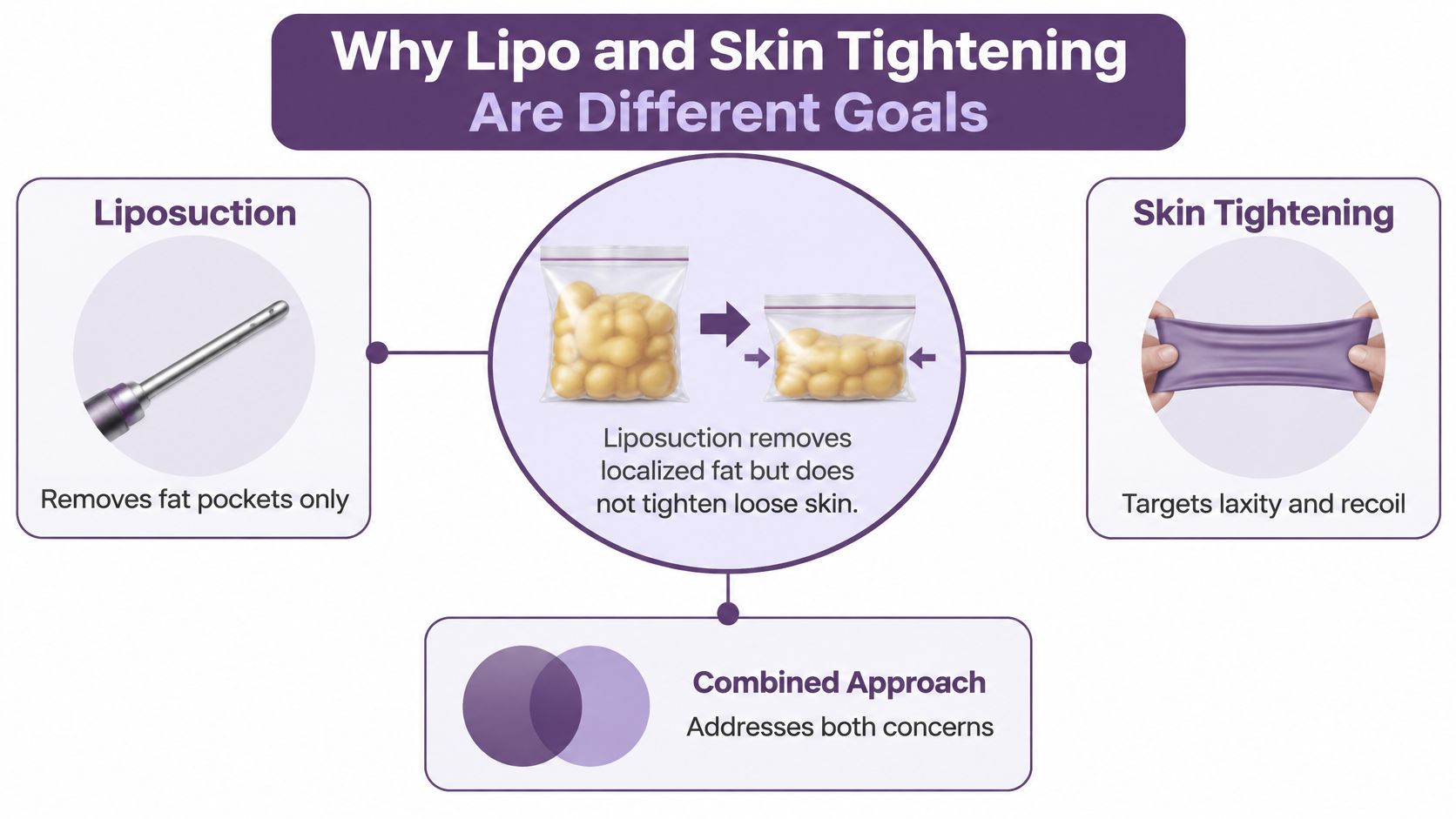
Liposuction removes localized fat through a cannula. It doesn't reliably remove loose skin, and it doesn't guarantee that the skin left behind will tighten. The American Society of Plastic Surgeons explains that reduced firmness and elasticity, often associated with aging, can prevent skin from conforming smoothly to new contours, and it identifies poor skin quality as a major contraindication in its overview of common liposuction misconceptions. In areas such as the abdomen or under the chin, excess fat and sagging skin can exist together, so removing fat alone may create a deflated look.
The vocabulary that helps you decide
- Localized adiposity: A pocket of fat that persists despite stable weight and exercise.
- Skin laxity: Looseness you can pinch, fold, or see hanging when you bend or move.
- Elasticity and recoil: How well skin snaps back after it's stretched or after volume beneath it changes.
- Redundant skin: Enough excess skin that contraction alone is unlikely to make it lie flat.
Energy-based tightening sits between those extremes. It's an adjunct, a tool added to fat removal to encourage tissue contraction in selected patients, not a promise that loose skin will disappear. Mild laxity with decent recoil is a different problem from redundant skin after major weight loss or pregnancy. If you can't yet tell whether your concern is mostly fat, mostly skin, or both, that's normal. That distinction is the starting point for every honest consultation, and it should come before anyone discusses a device name or a package price.
Understanding Fat Removal and Skin Recoil
A smooth contour depends on more than how much fat is removed. Fat gives an area its volume and, to a degree, its support. Skin forms the surface. Connective tissue underneath helps that surface redrape. When fat is reduced, the skin has less to cover, so its quality becomes more visible, not less.
That's why removing more fat doesn't always create a tighter result. In tissue with poor support, aggressive removal can highlight looseness, rippling, or unevenness. A careful plan balances fat reduction against how much recoil the skin can realistically provide. For background on preparation and expectations, this complete guide to liposuction and how to prepare outlines the consultation and planning steps in more detail.
What your surgeon is actually assessing
- Skin thickness and tone: Thicker, firmer skin often redrapes differently from thin, crepey skin.
- Stretch marks: These can signal that the skin's internal support has been stretched and may not contract well.
- Treatment area: The abdomen, inner thighs, and upper arms often behave differently from areas with naturally firmer skin.
- History: Pregnancy, weight loss, weight cycling, and sun damage can all affect recoil.
Controlled thermal treatment, when it's used, aims to heat tissue beneath the skin in a measured way so collagen contracts initially and remodels over time. That process depends on technique, temperature control, and patient selection. It isn't the same as taking out additional fat, and more heat isn't automatically better. Excessive superficial heating raises risk, while too little treatment may do very little.
Skin contraction is not equivalent to a tummy tuck or body lift. Contraction asks existing skin to shrink. Excision removes skin that cannot shrink enough.
That single distinction prevents a lot of disappointment. If you have mild to moderate laxity and adequate recoil, a combined approach may be reasonable to discuss. If you have pronounced hanging skin, a formal lift, a tummy tuck, or a staged plan that includes excision may be more appropriate. Staging isn't a failure. Sometimes contouring fat first and reassessing skin later, or combining procedures in a planned sequence, gives your surgeon a clearer view of what your tissue can do.
Comparing Standard and Awake Liposuction
Anesthesia is important, but it shouldn't decide whether a contour problem is treatable with liposuction. Patients sometimes start with a preference, such as wanting to avoid general anesthesia, and then work backward to a procedure. It's safer to work forward from your anatomy. First, what needs to change, fat, skin, or both. Then, which technique fits. Then, which anesthesia approach fits that technique and your medical history.
At Luxe Aesthetic Surgery & Medical Spa, awake liposuction refers to selected procedures performed under local anesthesia, including tumescent, hi-definition, SmartLipo, and mini liposuction approaches where appropriate. Medical Director Haimesh Shah, MD, RPVI, is a board-certified physician specializing in cosmetic surgery and phlebology, and treatment planning there is based on anatomy, goals, lifestyle, and medical history. Awake doesn't mean every patient qualifies, and it doesn't mean zero discomfort or no recovery.
Anesthesia and Technique Context
| Approach | Primary Focus | What It Does Not Guarantee |
|---|---|---|
| Standard liposuction | Mechanical removal of localized fat | Tight skin or correction of significant laxity |
| Tumescent technique | Fluid with local anesthetic to support fat removal | A painless experience for every patient |
| Awake liposuction in selected patients | Local anesthesia for appropriately chosen cases | Universal candidacy or avoidance of all risks |
| Hi-definition liposuction | More sculpted contouring around natural anatomy | Definition if loose skin covers the contour |
| Mini liposuction | Smaller, focused areas of fat | Results for large areas or redundant skin |
Performing certain procedures under local anesthesia may allow appropriately selected patients to avoid general anesthesia and may offer a more efficient experience. It doesn't change the underlying limits of skin. Fat removal, fluid management, thermal control if energy is added, and your tissue response still matter. Local anesthesia also has its own considerations, and your physician has to determine whether the size of the area, the combination of procedures, and your health make an awake approach sensible.
Ask a direct question during consultation. If my skin doesn't contract as hoped, what happens next. A thoughtful answer will cover alternatives and contingencies, not just reassurance. Your preference about anesthesia deserves respect, but it can't override laxity, skin quality, or the amount of contour change you're asking for.
Comparing SmartLipo and Other Energy Options
Device names create confusion because they sound like competing promises. It's more useful to think in families. Each family uses a different form of energy, each has different evidence behind it, and none should be presented as universally superior for every body and every degree of laxity.
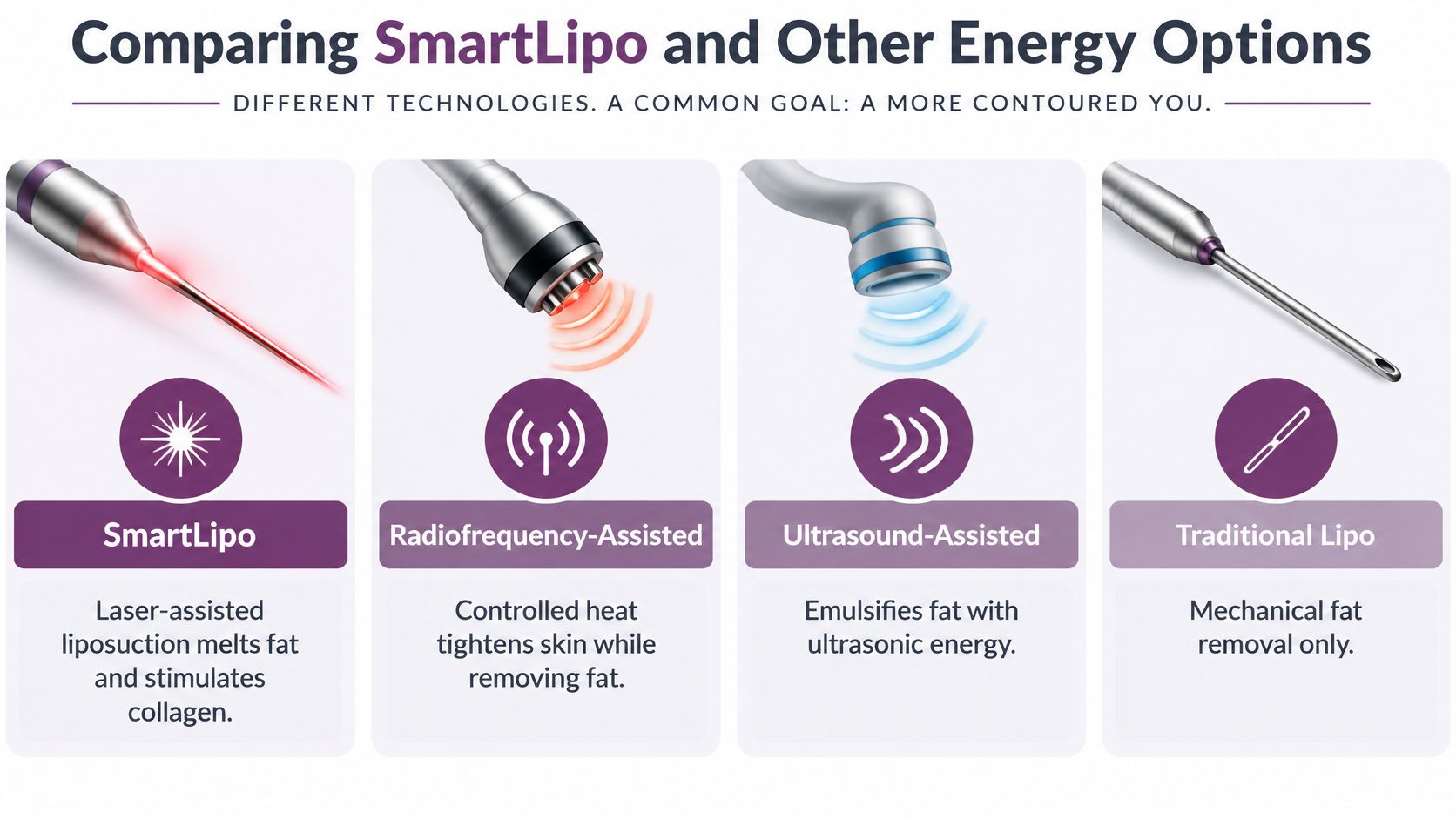
SmartLipo is laser-assisted liposuction. Laser energy is used alongside fat removal with the goal of supporting tissue coagulation and collagen stimulation. Radiofrequency-assisted liposuction, often shortened to RFAL, delivers controlled thermal treatment beneath the skin while fat is addressed. Ultrasound-assisted liposuction uses ultrasonic energy to emulsify fat. Traditional suction-assisted liposuction relies on mechanical fat removal without an added energy step aimed at contraction.
What the contraction numbers actually show
A systematic review reported linear skin contraction ranging from 12.7% to 47% at 6 months after radiofrequency-assisted liposuction, and in a small split-body study of 12 patients the radiofrequency side showed a 36% reduction in measured surface area at one year compared with 8% on the liposuction-only side, as summarized in this systematic review of subsurface radiofrequency treatments. A later comparison calculated average skin-retraction estimates of 31.38% for radiofrequency-assisted liposuction, 29.87% for laser-assisted liposuction, 17.0% for ultrasound-assisted liposuction, and 12.35% for traditional suction-assisted liposuction, while emphasizing substantial heterogeneity and high risk of bias. That caution matters. Different devices, endpoints, populations, and follow-up periods make a simple ranking unreliable.
A useful question to ask: How was tightening measured in the study you're quoting, with photographs, surface area, circumference, or patient ratings.
Radiofrequency treatment also has patient-reported data in specific areas. In a study of 227 patients with lower-face and neck laxity, 78.8% rated their six-month outcome as moderate to excellent, while independent reviewers rated 89.1% of photographic results as moderate to excellent, with no major complications requiring additional intervention reported in that study of subcutaneous radiofrequency treatment for face and neck laxity. Those results support careful use in selected patients, particularly with mild to moderate laxity, but face and neck data shouldn't be transferred automatically to a post-pregnancy abdomen.
Renuvion and why wording matters
Renuvion, also called J-Plasma, uses helium plasma with radiofrequency energy and has a regulatory history patients should understand clearly. In March 2022 the FDA warned against using it for dermal resurfacing or skin contraction procedures intended to improve appearance, including with liposuction, and on April 27, 2023 it cleared the Renuvion APR handpiece for coagulation of subcutaneous soft tissue following liposuction for aesthetic body contouring, as explained in the FDA safety communication on Renuvion and J-Plasma use. That narrower clearance isn't a blanket approval for every skin-tightening claim. If you're considering Renuvion J-Plasma skin tightening treatment, ask what exact indication applies to your case, how outcomes will be judged, and what alternatives exist.
A prospective study of helium-plasma treatment for neck and submental laxity reported improvement in 82.5% of participants at 180 days, representing 52 of 63 patients. That's meaningful short-term data for that defined area and population. It doesn't prove identical results after body liposuction or in every demographic. Higher energy may improve contraction in some settings, but it can also increase pain, downtime, and adverse effects, so operator experience and thermal monitoring aren't side details. They're central to safety.
Matching Treatments to Patient Examples
Hypothetical examples make candidacy easier to grasp, as long as you remember they illustrate reasoning, not a prediction for your body. Two people can point to the same area, use the same words, and need different plans.

Example one, stubborn fat with good recoil. A patient at a stable weight has fullness at the flanks and lower abdomen, firm skin, and no significant stretch marks. When the skin is pinched and released, it settles promptly. Liposuction alone may be a reasonable discussion here because the surface has a credible chance of redraping over a smaller contour. Adding energy automatically may not be necessary, and paying for an adjunct you don't need doesn't improve judgment.
Example two, fat plus mild to moderate laxity. A patient after pregnancy or moderate weight loss has lower abdominal fat, some stretch marks, and skin that feels less firm but doesn't hang in a fold. This is the gray zone where lipo with skin tightening is often discussed. Your surgeon has to weigh the degree of laxity, where stretch marks are concentrated, tissue thickness, and how much change you expect. A combined energy approach may be considered, with a clear warning that contraction is variable and won't equal excision.
Example three, pronounced hanging skin. A patient after substantial weight loss has skin that folds over the waistband, extensive stretch marks, and looseness that remains obvious standing, sitting, and bending. Removing fat and adding energy is unlikely to make that skin lie flat because there is too much of it. Excisional surgery, such as a tummy tuck or lift depending on the area, addresses the actual problem by removing skin. A staged plan may also be discussed.
A 2025 review supports that conditional framework, noting that excisional procedures remain the standard for substantial excess skin while energy-based options are mainly attractive when patients prioritize less downtime and accept potentially less dramatic results, and a quantitative review of 19 studies found extreme heterogeneity with I² = 96.8% and serious risk of bias in approximately half, as reported in this 2025 review indexed on PubMed. Your tolerance for scars and downtime matters, and so does your tolerance for a modest result. A preference for an awake or minimally invasive procedure cannot overcome anatomical limits, and a responsible surgeon should say so before scheduling, not after swelling resolves.
What Happens During Combined Treatment and Recovery
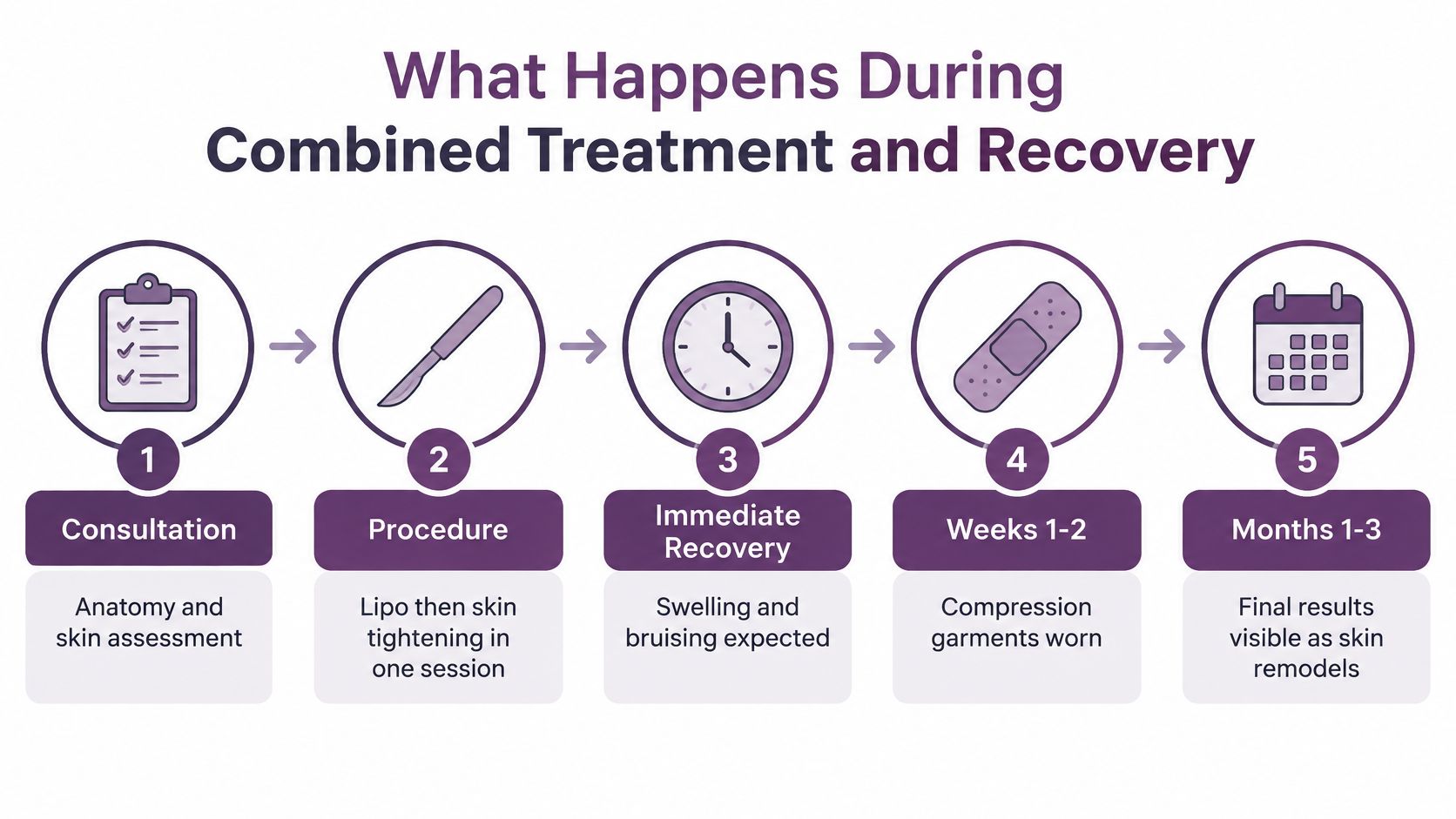
Most patients imagine treatment day first. In practice, the quality of the result is heavily influenced before that day arrives, during assessment and planning. Recovery then unfolds in phases, and skin remodeling, when it occurs, is gradual rather than immediate.
From consultation to follow-up
- Assessment: Your surgeon examines fat distribution, skin quality, laxity, stretch marks, prior scars, and overall proportions, and reviews medical history and medications.
- Goal setting: You discuss what change you're hoping for, what trade-offs you accept, and whether liposuction alone, combined treatment, excision, or staging fits best.
- Procedure planning: Areas, technique, anesthesia approach, and whether energy will be used are selected for your anatomy rather than from a standard package.
- Treatment: Fat is removed, energy may be applied if it's part of the plan, and tissue response is monitored throughout.
- Aftercare and follow-up: Instructions, garment use if recommended, activity modification, and review visits are individualized.
Swelling, bruising, and tenderness are common expectations after liposuction, and their extent varies with the areas treated, the technique used, and your healing response. Compression garments are often part of aftercare discussions because they support the treated area as swelling changes, but the specifics should come from your surgical team. This guide to recovery after liposuction and optimizing healing covers general healing considerations without turning them into a fixed timetable.
Avoid judging your contour too early. Swelling can mask shape, skin can feel firm or uneven while healing, and areas may not change at the same pace. That's frustrating, but early appearance isn't the final result. What matters is following instructions, attending follow-up, and reporting concerns such as increasing pain, spreading redness, fever, drainage changes, or areas that look or feel markedly different from what your team described.
Don't plan your recovery around someone else's social media timeline. Your areas treated, combined procedures, health, and tissue response set your pace.
If energy tightening was included, ask how your surgeon will evaluate contraction over time and when a fair assessment can be made. Photographs under consistent conditions are more useful than memory. If residual laxity remains after healing, you should already know from the initial consultation whether observation, additional treatment, revision, or excision would be discussed. That contingency conversation is part of informed consent, not pessimism.
Set Realistic Results and Make an Informed Choice
A good result isn't only smaller. It's proportionate, as smooth as your tissue allows, and consistent with what was promised before surgery. That last point is where realistic expectations protect you. Lipo with skin tightening can be a thoughtful combination for selected patients, but it doesn't erase the differences between fat removal, skin contraction, and skin excision.
Your outcome depends on the anatomy treated, how much fat is removed, skin quality and elasticity, the technique and device chosen, your healing response, and whether excess skin needed to be removed. Possible downsides include swelling that persists, asymmetry, contour irregularities, uneven contraction, altered sensation, delayed healing, residual laxity, and the need for revision. The American Society of Plastic Surgeons also lists anesthesia complications, bruising, pigmentation changes, infection, poor wound healing, rippling or loose skin, fluid accumulation, blood or fat clots, deeper-structure injury, and cardiopulmonary complications among liposuction risks in its liposuction safety information for patients. Adding a tightening step doesn't remove those surgical risks, and energy use adds its own need for careful thermal control.
Reading conflicting evidence without panic
Renuvion evidence illustrates why you shouldn't rely on a single headline. A randomized study of 76 patients undergoing lipoabdominoplasty, summarized in a 2025 regulatory filing, reported better laxity, excess-skin, and satisfaction scores with Renuvion at six months, one year, and two years without increased complications. Yet a 2025 systematic review found studies commonly relied on subjective photo assessments and surveys, none used standardized photographs with measurements comparing Renuvion against traditional methods, and it concluded evidence didn't support tightening claims beyond what traditional or ultrasonic liposuction may achieve, as described in this systematic review of helium plasma radiofrequency. Both findings can be discussed. One favorable trial doesn't settle a heterogeneous literature, and a critical review doesn't mean no patient ever benefits.
Smaller emerging studies need the same restraint. A 2025 study of 15 volunteers reported 2% circumference reduction and 9% fat-thickness reduction after eight radiofrequency sessions, but it lacked publicly accessible trial registration. Small samples can generate hypotheses. They shouldn't be sold as certainty.
Your consultation checklist
- Diagnosis first: Is my main issue fat, laxity, poor skin quality, or a combination.
- Indication: What is this device cleared for, and how does that apply to my area.
- Measurement: How will we judge tightening, and when.
- Alternatives: What would liposuction alone, excision, staging, or no surgery offer.
- Contingency: If skin doesn't contract enough, what's the next step and what would it involve.
Bring photos of results you like if they help explain your goals, but ask whether those patients had skin like yours and whether skin was removed. For Southern California patients, an in-person assessment is the point where general information becomes a personal recommendation. That's the right place to decide whether fat removal alone, a combined approach, or excisional contouring is the more honest path to the result you want.
If you're weighing liposuction alone against a combined tightening plan or excisional contouring, a personalized skin and anatomy assessment at Luxe Aesthetic Surgery & Medical Spa can clarify which approach fits your degree of laxity, recoil, and goals. Schedule a consultation to discuss your options, the evidence and limits of each technique, and a recovery plan built around your medical history and lifestyle.