Medical Expertise at Luxe Aesthetic Surgery
Luxe Aesthetic Surgery & Medical Spa is led by Haimesh Shah, MD, RPVI , a physician specializing in cosmetic surgery, body contouring, laser procedures, and venous medicine. Dr. Shah is a Diplomate of the American Board of Laser Surgery, American Board of Venous & Lymphatic Medicine, American Board of Wound Management, and American Board of Internal Medicine. He also holds the Registered Physician in Vascular Interpretation (RPVI) credential and has contributed to peer-reviewed medical research.
Post surgical lymphatic massage should be gentle manual lymphatic drainage, not forceful deep massage, and it should begin only after the surgeon confirms that the incisions, drains, and healing tissues are ready. Evidence from 6 randomized controlled trials involving 117 patients who received manual lymphatic drainage and 120 comparison patients found no statistically significant difference in limb-volume reduction between groups.
What question should matter more than “How many sessions do I need?” After surgery, the safer question is whether the swelling has been assessed, whether the tissue can tolerate treatment, and whether massage is addressing routine postoperative fluid or a complication that needs medical care.
Swelling, tightness, bruising, firmness, and asymmetry can be part of recovery after liposuction, abdominoplasty, breast surgery, fat grafting, or reconstructive procedures. Those same changes can also overlap with a seroma, hematoma, infection, wound problem, or thromboembolic complication. That's why post surgical lymphatic massage belongs in a coordinated recovery plan, not in a race to apply more pressure or book more appointments.
The central principle is simple: gentle matters more than force. A qualified clinician uses a low-pressure, anatomy-directed technique and follows the operating surgeon's protocol. Massage may support comfort, mobility, and temporary fluid management, but it isn't a guaranteed way to prevent lymphedema, eliminate fibrosis, or create a superior final contour.
Table of Contents
- What Post Surgical Lymphatic Massage Actually Is
- What the Evidence Actually Supports
- How to Start Post Surgical Lymphatic Massage Safely
- When Massage Helps Versus When It May Be Unsafe
- Scheduling Tips and Recovery Support Habits
- When to Pause Massage and Contact Your Surgeon
What Post Surgical Lymphatic Massage Actually Is
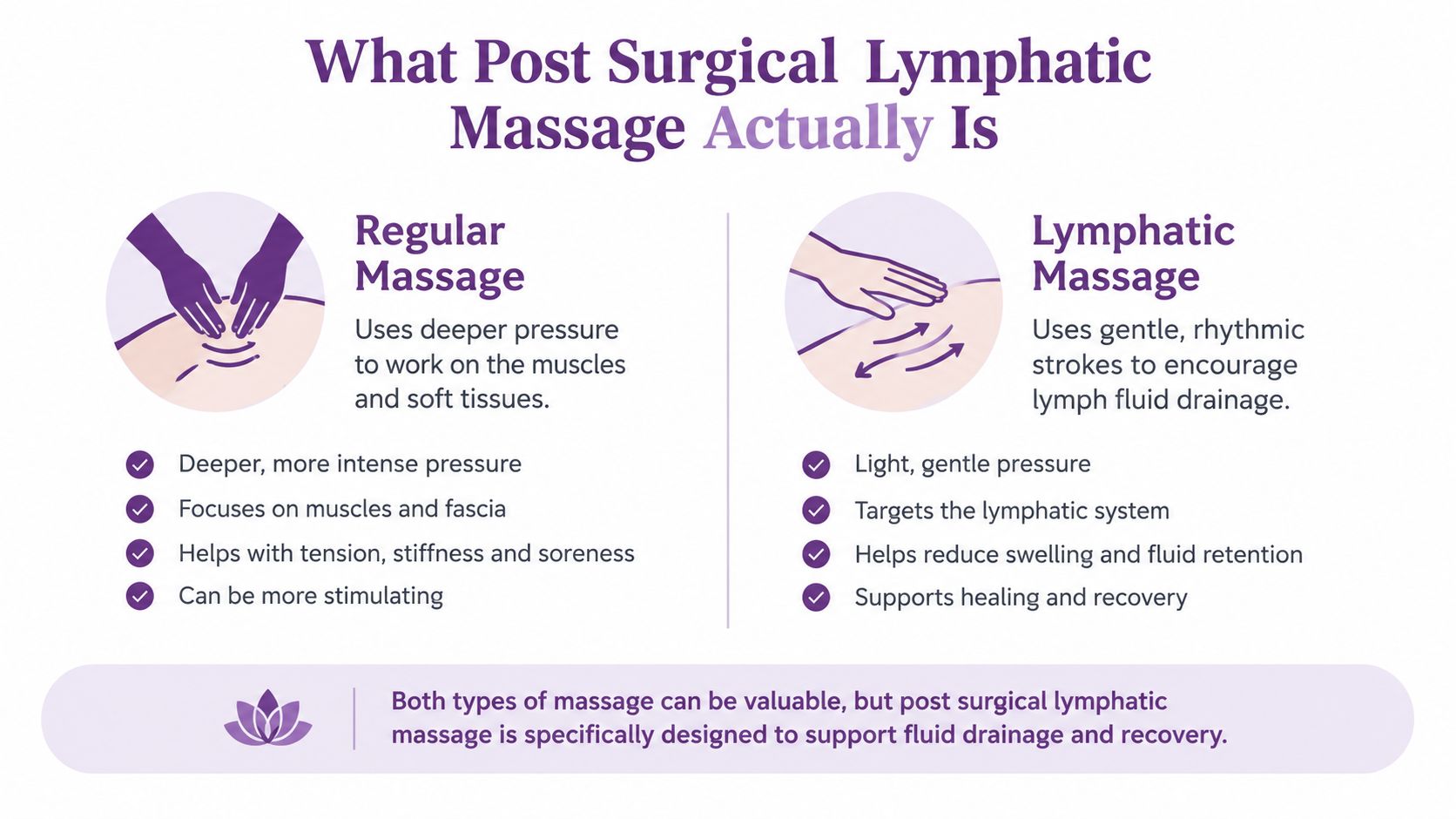
Manual lymphatic drainage, or MLD, is a specialized technique that uses very light, slow, skin-stretching movements to encourage fluid movement through available lymphatic pathways. It isn't designed to knead muscle, break up tissue aggressively, or produce soreness as proof that treatment worked.
Classical massage and MLD can look similar to a patient watching from the outside, but their goals and mechanics differ. Classical massage often focuses on muscles, tension, and deeper pressure. MLD uses a deliberate sequence, gentle rhythmic strokes, and pressure appropriate for superficial lymphatic structures and vulnerable postoperative tissue.
The distinction became especially important in the 2023 International Society of Lymphology consensus document, which states that classical massage generally doesn't appear beneficial for lymphedema and warns that overly vigorous massage may damage lymphatic vessels or their attachments to surrounding tissues. The same consensus places MLD within complete decongestive therapy, a broader model that can include compression, exercise, skin care, and patient education. Read the International Society of Lymphology consensus document on lymphatic treatment principles.
What a gentle session is trying to do
A post surgical session generally starts away from the most affected area. The therapist may first work with proximal drainage pathways, then move from adjacent intact areas toward the operative region. This approach respects the fact that surgery may have altered, interrupted, or temporarily overloaded normal routes.
The therapist should work around, not directly across, fresh incisions, open wounds, unstable grafts, or painful areas. Deep kneading, rapid rubbing, and attempts to force fluid through a tender site don't make the treatment more effective. They may increase irritation, pain, inflammation, bleeding, or fluid accumulation.
Patients who want broader information about fluid-related discomfort can also review this resource on edema management for joint pain, while remembering that postoperative swelling still requires assessment in the context of the specific operation.
Where it fits in recovery
The appropriate treatment area, pressure, and timing depend on the procedure, healing status, infection risk, and underlying vascular or lymphatic conditions. After liposuction or abdominoplasty, a therapist may need to account for the trunk, flanks, abdomen, and extremities according to the surgeon's operative map.
A surgeon's protocol should take priority over a generic online schedule. Patients considering treatment can review the postoperative lymphatic massage service information from Luxe and discuss whether the approach fits their procedure, current symptoms, and medical history.
Practical rule: If a session feels like deep tissue massage, pressure alone isn't evidence of quality. Postoperative MLD should feel controlled, light, and tailored to healing tissue.
What the Evidence Actually Supports
The evidence supports a measured role for MLD. It may help with short-term symptoms such as swelling, discomfort, tightness, or mobility when a clinician selects it for the individual patient. It doesn't support describing massage as a guaranteed standalone solution for edema, long-term contour, or lymphedema prevention.
The evidence review of breast-cancer-related lymphedema pooled 6 randomized controlled trials, with 117 patients receiving MLD and 120 receiving comparison treatments. The weighted mean difference in limb-volume reduction was 75.12, with a 95% confidence interval from -9.34 to 159.58 and p = 0.08, which wasn't statistically significant. Review the evidence summary on manual lymphatic drainage for breast-cancer-related lymphedema.
That review also reported Level 1 evidence that MLD alone produces inferior results compared with regimens combining compression and other modalities for reducing limb volume. Other evidence suggested possible benefits for pain and physical function. In practical terms, massage may be useful, but its value is more credible as part of rehabilitation than as a replacement for compression, exercise, skin care, education, or follow-up.
Why session counts can mislead
Many cosmetic-surgery reports combine MLD with compression garments, walking, therapeutic devices, wound care, or other interventions. When several treatments happen together, researchers can't always isolate what MLD contributed.
An 18-patient study combining MLD with therapeutic ultrasound reported statistically significant reductions in pain, swelling, and fibrosis, but its design couldn't isolate the independent effect of MLD. Review the postoperative study discussing MLD and therapeutic ultrasound. This is encouraging for symptom support, but it isn't proof that massage alone prevents fibrosis or improves the final aesthetic result.
A cited randomized trial involving 60 postoperative patients found statistically significant swelling reductions at 4 and 6 weeks, while the difference was no longer significant at 3 months. A 2023 systematic review similarly concluded that MLD may accelerate swelling resolution during the first 4 to 8 weeks without clearly changing final aesthetic outcomes at 6 to 12 months. Review the postoperative lymphatic massage evidence summary.
What to measure instead
Good progress isn't measured by how much pressure a therapist uses or how many sessions a patient completes. More useful benchmarks include:
- Standardized photographs: Take images under consistent conditions so changes can be compared more reliably.
- Fixed measurements: Record waist or limb circumference at the same anatomical landmarks.
- Symptoms and function: Track pain, range of motion, tightness, and tolerance of prescribed garments.
- Tissue changes: Document induration or fibrosis mapping rather than assuming every firm area is ordinary swelling.
- Drain and garment information: Record drainage output when applicable and note whether compression remains tolerable.
The literature doesn't establish a reliable universal success percentage after cosmetic surgery. A responsible plan uses serial findings and changing symptoms to decide whether to continue, adjust, pause, or investigate.
How to Start Post Surgical Lymphatic Massage Safely
The first appointment shouldn't be scheduled solely because swelling is present. Start with the operating clinician's instructions, then confirm that the wound, drains, tissue integrity, and overall health permit treatment.
Four checks before the first session
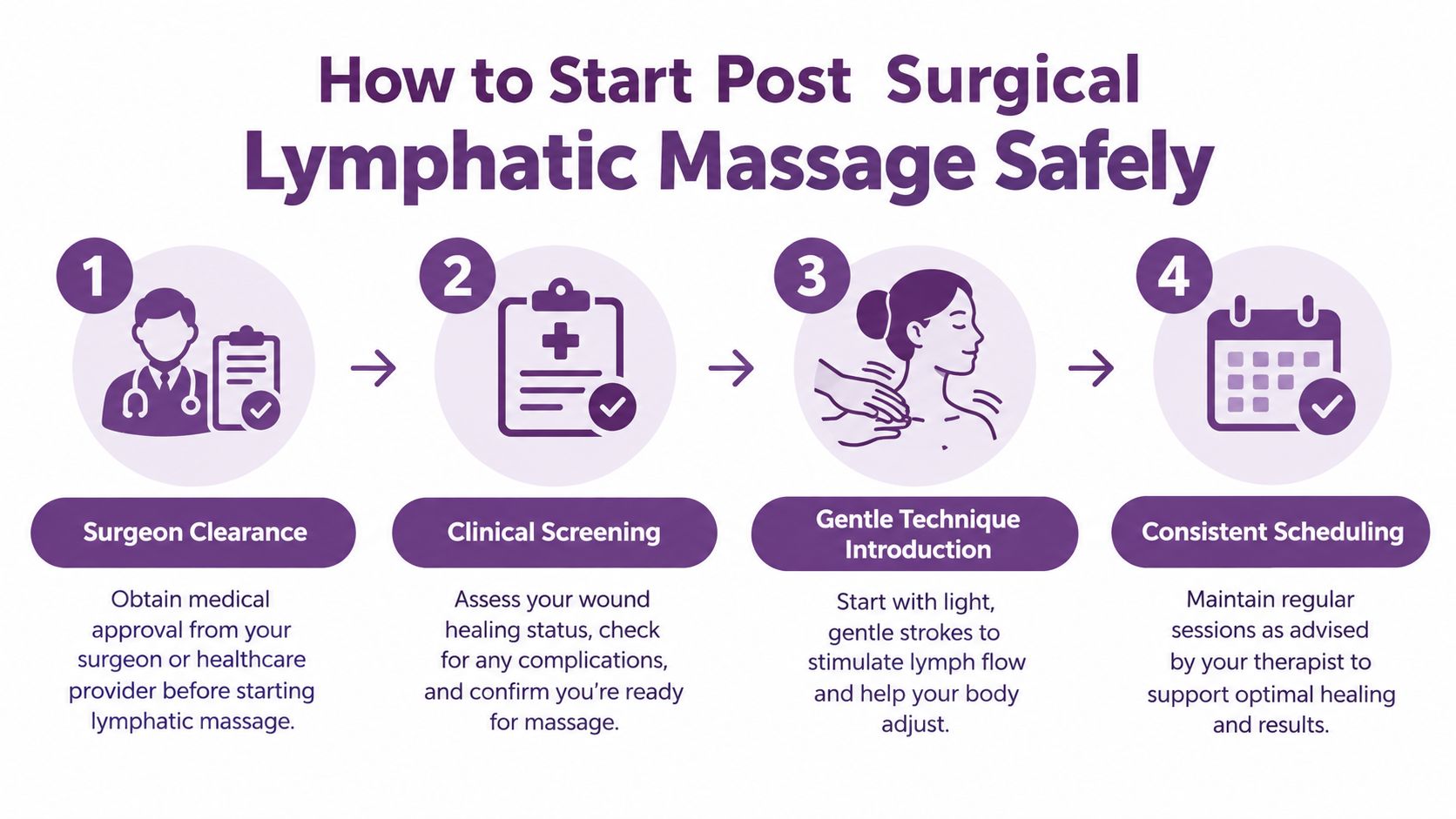
1. Obtain surgeon clearance. The operating clinician should confirm that the incisions, drains, grafts, and surrounding tissues can tolerate gentle treatment. Timing depends on the operation and protocol, not on a universal rule such as “start immediately.”
2. Complete a clinical screen. The therapist should ask about fever, rapidly increasing unilateral swelling, wound separation, active bleeding, suspected seroma, and thromboembolic symptoms. Massage isn't a substitute for medical evaluation when any of these findings may be present.
3. Confirm the treatment map. After liposuction or abdominoplasty, the sequence may be individualized across the trunk, flanks, abdomen, and extremities. The therapist should know which areas were treated and which routes remain appropriate.
4. Begin with light technique. The session should use slow, superficial skin-stretching movements. The therapist should clear proximal pathways first, progress through nearby intact territories, and avoid direct work over fresh incisions, open wounds, unstable grafts, or painful areas.
Questions to ask before treatment
A patient should be able to explain what the massage is intended to address and how the provider will adapt the session to the operation. Useful questions include:
- Which areas will you avoid because they're still healing?
- How will you distinguish ordinary swelling from a possible seroma or hematoma?
- What symptoms should make me stop treatment and contact my surgeon?
- How will we measure progress?
- How does the plan fit with my compression, walking, and wound-care instructions?
The treatment provider should also know about anticoagulant use, infection concerns, heart or kidney disease, and any history that could change the safety assessment. A massage therapist shouldn't assume that postoperative swelling is automatically appropriate for massage.
When Massage Helps Versus When It May Be Unsafe
Routine swelling can be uncomfortable, but discomfort alone doesn't tell you why fluid has accumulated. A calm, stable recovery pattern may fit a surgeon-approved MLD plan. Sudden change, one-sided symptoms, systemic illness, or wound deterioration calls for medical assessment instead.
MLD should be delayed or performed only after specific clinician clearance when conditions such as active infection or cellulitis, suspected deep-vein thrombosis, untreated heart failure, significant kidney disease, unhealed wounds, active bleeding, or unexplained worsening swelling are present. A peer-reviewed clinical review also identifies untreated cancer, decompensated right-sided heart failure, untreated deep-vein thrombosis, acute cellulitis, acute asthma, and uncontrolled hypertension as conditions in which MLD shouldn't be performed. Review clinical contraindications for manual lymphatic drainage.
Recovery Massage Decision Check
| Scenario | Recommended Action |
|---|---|
| Mild, expected swelling with stable pain and intact healing areas | Follow the surgeon's protocol and use only gentle treatment from an appropriately trained clinician. |
| Fresh incision, open wound, unstable graft, active bleeding, or significant pain | Avoid direct treatment and contact the surgical team for guidance. |
| Fever, spreading redness, unusual warmth, or drainage that is worsening | Pause massage and seek prompt medical evaluation. |
| One-sided rapidly increasing swelling, calf symptoms, sudden pain, or suspected clotting | Treat it as a medical concern, not a massage problem. Seek urgent assessment. |
| Shortness of breath or other thromboembolic symptoms | Seek urgent medical care rather than attending a massage session. |
| Persistent firmness, new fluctuant swelling, or worsening asymmetry | Ask the surgeon whether imaging, aspiration, or another evaluation is needed. |
Safety boundary: “Lymphatic” doesn't mean risk-free. The cause of swelling must be considered before treatment begins.
Patients recovering from liposuction can also read this discussion of lymphedema risks and recovery after liposuction. The key distinction is that massage may complement follow-up, but it can't diagnose a complication or replace the surgeon's examination.
Scheduling Tips and Recovery Support Habits
A practical schedule should respond to the operation, the surgeon's instructions, comfort, and observable progress. There's no reliable basis for assuming that more sessions automatically produce faster healing, particularly because studies often use combined treatment plans and procedure-specific protocols aren't standardized.
Build the routine around the whole plan
Compression garments should be worn exactly as prescribed, with attention to fit and tolerance. Excessive tightness, new pain, skin changes, numbness, or breathing difficulty should be reported rather than solved by adding more massage.
Walking and gentle movement can support the broader recovery plan when the surgical team permits them. Activity should be gradual and procedure-appropriate. It shouldn't be used to justify ignoring pain, drainage, dizziness, or restrictions.
Hydration and wound care remain routine responsibilities, not optional additions. Follow the surgeon's instructions for wound cleaning, drain management, medication, bathing, and activity.
Massage appointments should be reassessed as symptoms change. A patient may benefit from a short, individualized course, a reduced schedule, or no further treatment if the intended goals have been met or the clinical picture changes.
A simple daily check
At home, note whether swelling is stable or changing, whether pain is improving or escalating, and whether garments and movement remain tolerable. Keep questions for the follow-up visit rather than using repeated massage to self-treat an unexplained change.
Patients can also review this lipo recovery guide for broader postoperative planning. The useful goal isn't to chase a particular number of appointments. It's to support healing while giving the surgical team enough information to identify problems early.
When to Pause Massage and Contact Your Surgeon
Massage should stop when the recovery pattern no longer looks stable. A new symptom can change the safety of the entire plan, even if earlier sessions felt comfortable.
Contact the surgeon promptly about worsening asymmetry, sudden pain, redness, warmth, fever, shortness of breath, calf symptoms, persistent drainage, or a new fluctuant swelling. These findings can point to infection, bleeding, a fluid collection, or a clotting concern. Applying additional pressure before the cause is known may delay the care that matters.
Use a clear escalation pathway
- Stop the session or postpone the next one if a concerning symptom appears.
- Document the change, including when it began, where it is located, and whether it is getting worse.
- Contact the operating team and describe the symptom plainly. Include changes in pain, temperature, redness, drainage, swelling, garment tolerance, or mobility.
- Follow the recommended level of care. Sudden breathing symptoms, suspected clotting, rapidly increasing one-sided swelling, or severe deterioration may require urgent evaluation.
- Ask about further investigation when firmness or asymmetry persists. Ultrasound, aspiration, or another clinical assessment may be more appropriate than additional massage.
The timing evidence also varies by procedure. A review of MLD after total knee replacement found that all 7 reviewed studies began treatment 2 days after surgery, but the treatment courses differed. Despite those early schedules, the review concluded that MLD didn't significantly reduce lymphedema, improve range of motion, or relieve pain in that setting, and it didn't recommend routine MLD for that rehabilitation context. Read the review of manual lymphatic drainage after total knee replacement.
Those findings can't be transferred automatically to cosmetic or abdominal surgery. They do reinforce the need for a procedure-specific protocol rather than a universal start date.
MLD also shouldn't be presented as a guaranteed method for preventing long-term lymphedema. A meta-analysis of breast-cancer patients found that 8 trials involving 338 participants showed no statistically significant reduction in lymphedema compared with control treatment. The standardized mean difference was −0.09, with a 95% confidence interval from −0.85 to 0.67. Review the meta-analysis of MLD for lymphedema prevention.
A separate clinical trial of 106 women after radical breast-cancer surgery compared active exercises with MLD delivered two sessions weekly for one month. Seroma, wound dehiscence, and infection rates didn't differ between groups. The cumulative incidence of lymphedema was 23.8%, with no significant difference between groups and a reported p-value of 0.29. Review the clinical trial comparing exercise and MLD after breast-cancer surgery.
The safest conclusion is also the most useful one: gentle post surgical lymphatic massage may support selected recovery goals, but it must remain coordinated with surgical follow-up, compression, mobility, wound care, and reassessment when symptoms change.
If you're recovering from cosmetic surgery in Southern California, Luxe Aesthetic Surgery & Medical Spa offers individualized aesthetic care, including lymphatic massage options for appropriate postoperative patients. Visit the practice to discuss your procedure, healing status, symptoms, and a recovery plan that puts medical clearance and safe technique first.