Medical Expertise at Luxe Aesthetic Surgery
Luxe Aesthetic Surgery & Medical Spa is led by Haimesh Shah, MD, RPVI , a physician specializing in cosmetic surgery, body contouring, laser procedures, and venous medicine. Dr. Shah is a Diplomate of the American Board of Laser Surgery, American Board of Venous & Lymphatic Medicine, American Board of Wound Management, and American Board of Internal Medicine. He also holds the Registered Physician in Vascular Interpretation (RPVI) credential and has contributed to peer-reviewed medical research.
You may pull on leggings and still notice the blue, red, or purple lines you were hoping to hide. If those visible leg veins have you considering treatment, it helps to know what sclerotherapy can address, what happens during a visit, and why the best plan depends on more than appearance.
Sclerotherapy is an injection treatment that closes selected veins so blood can flow through other, healthier vessels. It's used for some spider veins, reticular veins, and small varicose veins, but not every visible vein should be treated the same way. A clinician first considers your symptoms, vein pattern, medical history, and whether deeper vein problems need evaluation.
Table of Contents
- What Sclerotherapy Treatment Is
- How Sclerotherapy Evolved Into a Modern Vein Treatment
- Who Is a Good Candidate and Who Should Avoid It
- How the Injection Works Inside the Vein
- What the Procedure Visit Looks Like Step by Step
- Results You Can Reasonably Expect and When to Plan a Touch-Up
- Side Effects, Risks, and How Sclerotherapy Compares to Other Vein Treatments
- Aftercare, Follow-Up, and Your Next Step
What Sclerotherapy Treatment Is
A vein works like a return road carrying blood toward the heart. Sclerotherapy places a chemical solution called a sclerosant inside a selected superficial vein. The solution irritates the vessel's inner lining, encouraging it to seal shut. Over time, the body gradually absorbs the treated vein as blood takes healthier routes back toward the heart.
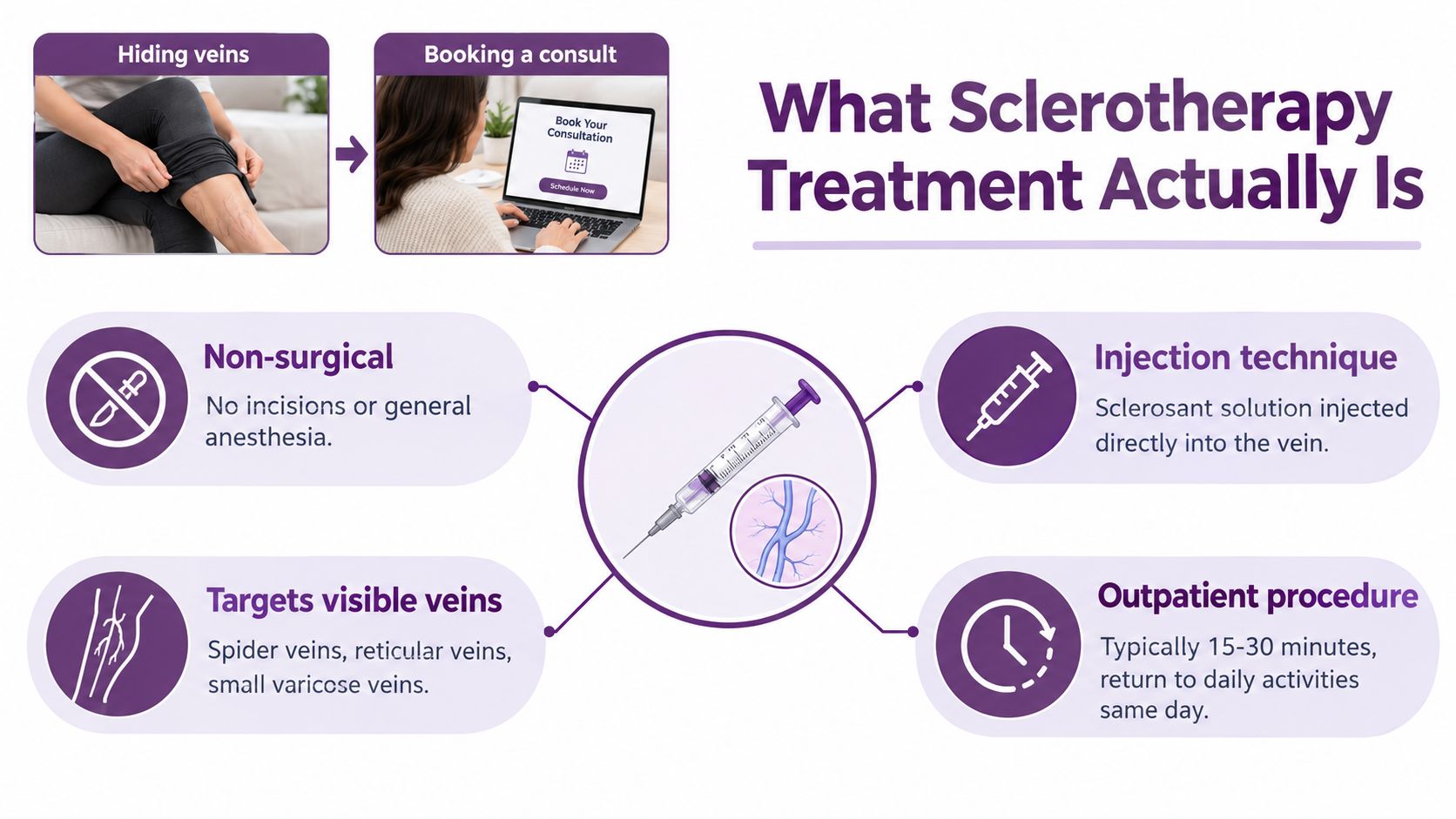
“Visible veins” describes several different patterns. Spider veins are fine lines near the skin. Reticular veins are somewhat larger, often blue or green vessels beneath the surface, while small varicose veins may look raised or enlarged. Those distinctions help a clinician assess which vessel needs attention and how it connects to the surrounding circulation.
The treatment choice depends on anatomy and vein function. Laser treatment uses light energy and may suit certain surface vessels. Ablation targets problematic veins deeper in the leg, while surgical approaches may suit particular varicose-vein patterns. An examination helps determine which approach fits the vein you can see and the circulation supporting it.
A useful mental model: The treated vein stays in place as it seals shut, and blood reroutes through healthier vessels.
That gradual process helps explain why closure and visible fading are different milestones in assessing treatment.
If you're gathering information before an appointment, health explainers for older readers can offer broader context. At your consultation, the central question is whether injection suits the visible vein or whether its appearance points to a circulation problem needing further evaluation. That assessment gives treatment a purpose beyond changing how a line looks.
How Sclerotherapy Evolved Into a Modern Vein Treatment
Sclerotherapy has more than 170 years of documented clinical history. In 1853, European physicians reported early attempts to obliterate veins by injecting chemical agents. One historical account describes Charles-Gabriel Pravaz and Eduard Chassaignac using iron perchloride for vein obliteration in patients that year; another records Joseph Pierre Pétrequin and Soquet developing an iodine–tannin solution in Paris. These accounts differ in the agents and practitioners they describe, but both illustrate the same early principle: an injected chemical could irritate a vein and encourage it to close. A medical review of sclerotherapy's history traces this development and its clinical context.
Clinicians in the late nineteenth and early twentieth centuries tested a range of substances, including iron perchloride, phenol, concentrated saline, glucose, iodine solutions, alcohol, and sodium salicylate. The experimentation mattered, but it also revealed the risks of using agents that could cause toxicity or excessive complications. Several early preparations were abandoned as clinicians learned more about safety and tolerability.
By the 1920s, sodium salicylate had become an important sclerosant in European practice, marking a step toward more standardized treatment. The story isn't one of a single discovery perfected at once. It's a gradual clinical refinement, shaped by experience with which substances and methods were too unpredictable.
Today, the underlying idea remains familiar, but the approach is more controlled. Treatment planning emphasizes choosing an appropriate agent and concentration, selecting patients carefully, and using ultrasound guidance when treating deeper veins. This history helps explain why sclerotherapy is a vascular treatment method with a long clinical evolution, not a recent cosmetic trend.
Who Is a Good Candidate and Who Should Avoid It
Sclerotherapy may be considered for spider veins, reticular veins, and some small varicose veins. People seek treatment for different reasons: one person may want visible lines to fade, while another may be troubled by aching or heaviness. Those concerns deserve assessment because visible veins can be cosmetic, but they can also occur alongside a circulation issue that calls for medical evaluation.

What screening involves
A responsible consultation checks whether the proposed treatment is suitable for both the vein and the person. The clinician may ask about medications and clotting history, past vein problems, allergies, and relevant medical conditions, then examine the area being considered for treatment. Ultrasound may be appropriate when symptoms or the vein pattern suggest that deeper circulation needs evaluation.
Clinical guidance lists several reasons sclerotherapy may be unsafe or inappropriate, including a known allergy to the proposed sclerosant, an active systemic infection or infection at the treatment site, a personal history of deep-vein thrombosis, severe peripheral arterial disease, advanced collagen-vascular disease, and previous cardiovascular or neurologic events after sclerosant injection. Clinical guidance on sclerotherapy contraindications emphasizes the need to consider these factors before treatment.
The reason for screening is straightforward. The treatment is designed to irritate and close a vein, so a clinician must consider your circulation, clotting risk, medical history, and ability to tolerate the agent. A quick online checklist can't establish candidacy.
Questions worth raising
Tell your clinician about prior blood clots, allergies, infections, medications, and any history of unusual reactions to vein injections. If you're unsure whether a symptom or past diagnosis matters, bring it up rather than trying to screen yourself out or in.
The right decision may be to treat a surface vein, investigate underlying circulation first, or consider another method. A consultation should give you a clear explanation of why the proposed option fits your vein pattern, along with alternatives if it doesn't.
How the Injection Works Inside the Vein
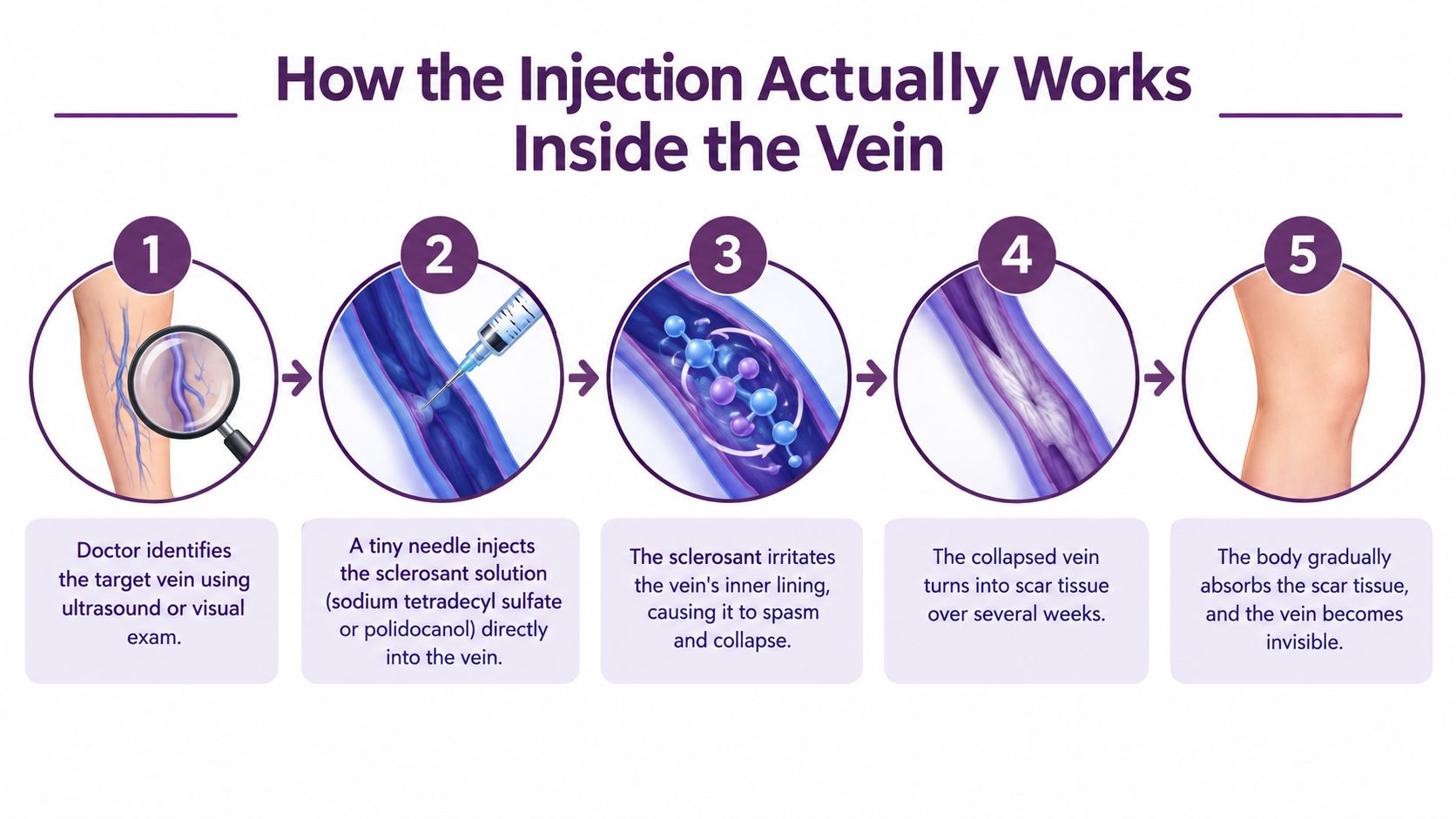
The injection starts a healing response inside the vessel. Sclerosants such as sodium tetradecyl sulfate, often abbreviated STS, or polidocanol irritate the vein's inner lining. The resulting inflammation helps the walls seal together, like the sides of a narrow tube sticking shut. The treated vessel gradually scars, shrinks, and is eventually reabsorbed by the body.
That sequence takes time, so the appearance immediately after an injection cannot show the final result.
Liquid and foam have different uses
Liquid sclerosant goes directly into a selected vessel. Foam is made by mixing sclerosant with air or another gas. Its bubbles displace blood, giving the agent more direct, longer contact with the vein wall. This makes foam useful for some larger or deeper varicose veins, while liquid may suit smaller superficial vessels.
The choice depends on the target vein and the treatment plan. The review of injection techniques for spider veins found that sodium tetradecyl sulfate, polidocanol, and heparinized hypertonic saline cleared veins more effectively than normal saline. It did not establish one agent as consistently best for clearance or patient satisfaction. Higher concentrations were associated with more pain and local effects, so a stronger solution is not automatically a better choice.
Why ultrasound may be used
A visible surface vein may provide enough information to identify the injection target. For deeper or larger vessels, ultrasound gives the clinician a view beneath the skin to locate the vein and guide delivery. Foam is also visible during ultrasound-guided treatment.
The vessel wall needs time to scar down and be reabsorbed, which is why results are assessed weeks later. Treatment redirects circulation away from the selected vessel. New channels or underlying reflux may still need attention, making follow-up and possible retreatment part of managing chronic venous disease.
What the Procedure Visit Looks Like Step by Step
The visit starts with a discussion of your concerns and an examination of the veins. If the pattern or symptoms suggest a deeper problem, the clinician may use duplex ultrasound to map the circulation and assess for reflux in trunks or perforators. That mapping can help determine whether surface injections are appropriate on their own or whether another vein needs attention first.
Once the treatment plan is clear, the skin is cleaned and the clinician uses a fine needle to inject small amounts of sclerosant into selected veins. You may feel a brief sting, burning sensation, or cramp at an injection site. People often worry that every injection will be intensely painful, but the experience varies with the site, vein, and individual sensitivity; ask your clinician what to expect for your plan.
The clinician may place cotton balls or compression pads over treated spots and apply compression stockings. Depending on the procedure and your instructions, you may walk briefly before leaving. Sclerotherapy is generally performed in an office setting, but treatment time and aftercare depend on the number and type of veins addressed.
Follow the care instructions you're given rather than relying on a generic timetable. Walking is commonly encouraged, while strenuous lower-body exercise, intense heat, and direct sun exposure on treated areas may need to be limited for a period. Ask specifically when you can resume workouts, use a hot tub, or stop wearing compression, since recommendations vary by treatment plan.
A calm mental rehearsal can make the visit feel less mysterious: consultation and mapping, skin preparation, injections, compression, then instructions for home. You can also ask before treatment whether the clinician expects to use liquid or foam and whether ultrasound will guide the injections.
Results You Can Reasonably Expect and When to Plan a Touch-Up
“Successful” sclerotherapy can mean more than one thing. A treated vein may become less visible, symptoms may ease, ultrasound may show that a target vessel has closed, or the person may remain free of new reflux over time. These outcomes are related, but they aren't interchangeable. A vein can look better without guaranteeing that new veins won't form later.
| Outcome measure | What it tells you | Typical timeframe | Why it matters |
|---|---|---|---|
| Visible fading | Whether treated surface veins are becoming less noticeable | Gradual, as the body absorbs the treated vessel | Addresses appearance, but doesn't assess deeper circulation |
| Symptom relief | Whether aching or heaviness has improved | Assessed during follow-up | Measures how you feel, not just how a vein looks |
| Ultrasound-confirmed closure | Whether the treated vessel has sealed | Checked when clinically indicated | Shows what happened to the target vein |
| Recurrence or new reflux | Whether venous problems develop again | Considered over longer follow-up | Helps distinguish durable improvement from freedom from future disease |
Longer-term results underline why follow-up isn't automatically a sign that the original treatment failed. A multicenter study of ultrasound-guided foam sclerotherapy for saphenous-trunk disease reported that 85.5% of patients had no truncal reflux at follow-up; 26% experienced recurrence at a median of 48 months, and 14.4% needed additional treatment for symptoms. It also reported an approximately 77.7% five-year disease-free period. The study's reported long-term outcomes describe a specific group treated for saphenous-trunk disease, not a universal forecast for every patient or every vein pattern.
Those results support a more realistic expectation: venous disease can be chronic, and new reflux may develop even after a treated vein closes. Treatment may be staged, and the clinician may recommend review or additional care based on symptoms, examination, or ultrasound findings.
Ask what success means for your own plan. If your main concern is appearance, discuss how visible fading will be assessed. If symptoms or deeper reflux are part of the picture, ask how the clinician will evaluate those separately.
Side Effects, Risks, and How Sclerotherapy Compares to Other Vein Treatments
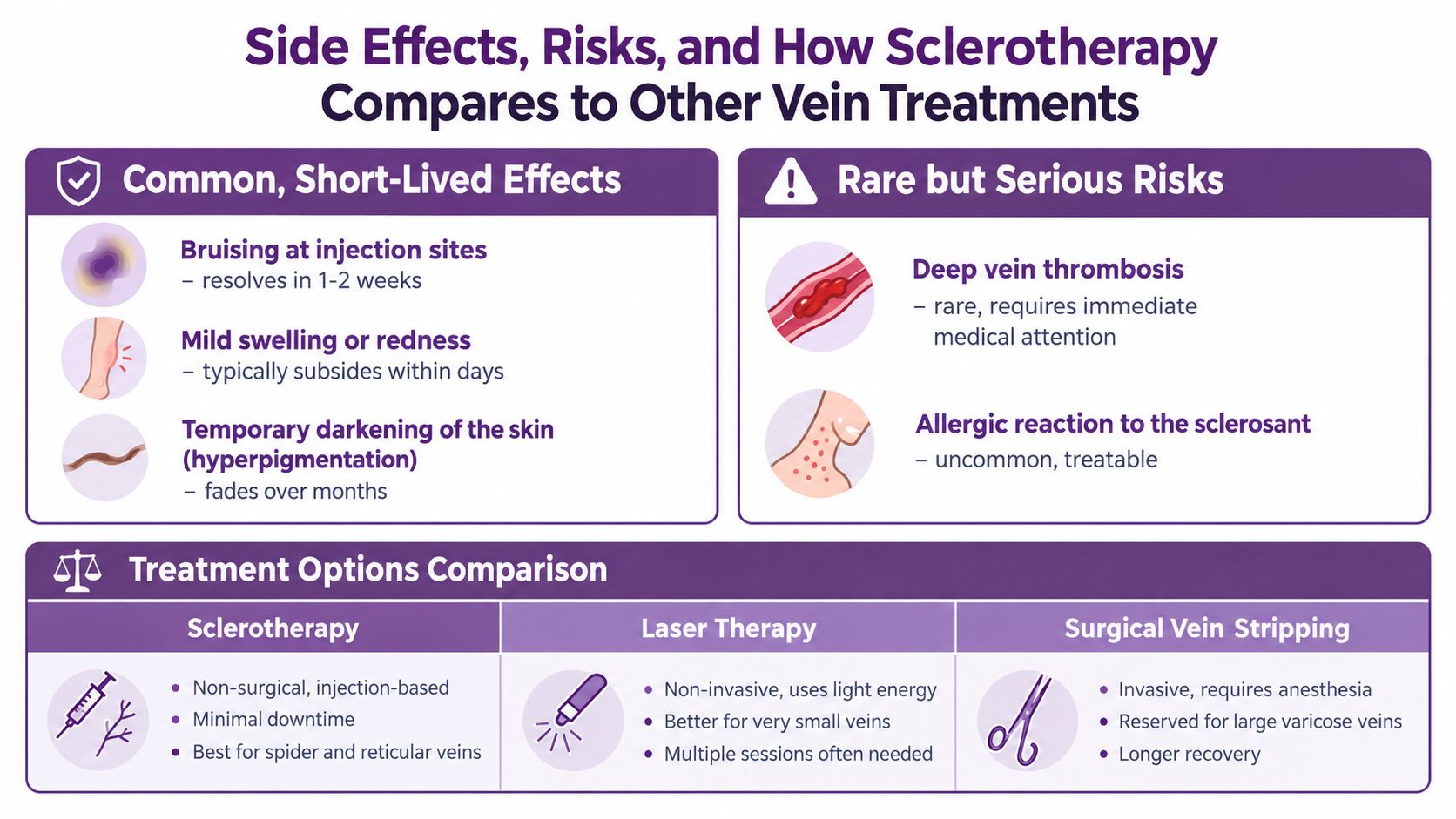
Bruising, itching, mild swelling, temporary skin discoloration, and small surface-vessel changes can occur after sclerotherapy. The type and duration of effects vary, and higher sclerosant concentrations have been associated with more pain and local reactions in treatment for spider and reticular veins. More serious concerns can include allergic reaction, skin injury or ulceration, superficial inflammation of a vein, and blood clots. The risk of deep-vein thrombosis may increase slightly, although the evidence for that finding is low certainty. A Cochrane review of sclerotherapy for varicose veins notes uncertainty in the evidence, so individual risk should be discussed with the treating clinician.
The treatment should match the vein
Sclerotherapy is an injection-based option for spider veins, reticular veins, and some small varicose veins. Foam may be used for larger or deeper targets. For larger varicose veins, a Cochrane review found that polidocanol foam reduced residual veins more effectively than liquid in the studies assessed, but the evidence was rated very low certainty. The same review found only a modest, uncertain difference between foam concentrations. The result supports tailoring treatment to anatomy and technique, not assuming foam is always the right choice.
Other approaches serve different purposes. Thermal ablation, including radiofrequency ablation, may be considered for refluxing saphenous trunks. Microphlebectomy removes selected bulging branch veins through small skin openings, while surface laser treatment uses light energy for certain superficial veins when injections aren't preferred. A clinician can explain which category fits your anatomy and whether ultrasound assessment is needed.
If you're researching supportive approaches alongside medical evaluation, this Lifeworks Integrative Health supplement is a product resource, not a substitute for diagnosis or vein treatment. For information about care specifically addressing varicose veins, Luxe's varicose vein removal service describes a treatment option to discuss with a qualified clinician. Seek prompt medical advice for significant or worsening symptoms after treatment.
Aftercare, Follow-Up, and Your Next Step
After treatment, follow the compression and activity instructions provided for your specific plan. Walking may be recommended, while prolonged standing or strenuous exercise may need to be limited temporarily. Ask when to return to workouts or hot tubs, and protect treated areas from direct sun if your clinician advises it, since irritation or pigmentation can be a concern.
Visible fading takes time. Your clinician can tell you when to expect a review and whether a follow-up examination or ultrasound is appropriate. Don't judge the outcome only by what you see immediately after the injections; the treated vein changes gradually, and the review should reflect the purpose of treatment, whether that was appearance, symptoms, or closure of a target vessel.
Before moving ahead, check that the plan answers these questions:
- What is being treated? Confirm whether the target is superficial or whether deeper reflux needs assessment.
- Why this method? Ask why liquid, foam, ultrasound guidance, or another treatment fits your vein pattern.
- What should I watch for? Get clear instructions on expected effects and when to contact the clinic.
- How will we assess the result? Agree on what improvement means and whether follow-up is planned.
Luxe Aesthetic Surgery & Medical Spa offers sclerotherapy and varicose vein treatments. Medical Director Haimesh Shah, MD, RPVI, is a board-certified physician specializing in cosmetic surgery and phlebology, and the practice describes individualized planning for cosmetic vein care. When comparing where to seek aesthetic care, an Aesthetics clinic overview may help you think through the questions to bring to a consultation.
If you're in Southern California and considering sclerotherapy, request a consultation with Luxe Aesthetic Surgery & Medical Spa to discuss your visible veins, symptoms, and whether ultrasound assessment or another approach should come first. Bring your medication and clotting history, allergy information, and questions about aftercare so your clinician can help shape an appropriate plan.