Medical Expertise at Luxe Aesthetic Surgery
Luxe Aesthetic Surgery & Medical Spa is led by Haimesh Shah, MD, RPVI , a physician specializing in cosmetic surgery, body contouring, laser procedures, and venous medicine. Dr. Shah is a Diplomate of the American Board of Laser Surgery, American Board of Venous & Lymphatic Medicine, American Board of Wound Management, and American Board of Internal Medicine. He also holds the Registered Physician in Vascular Interpretation (RPVI) credential and has contributed to peer-reviewed medical research.
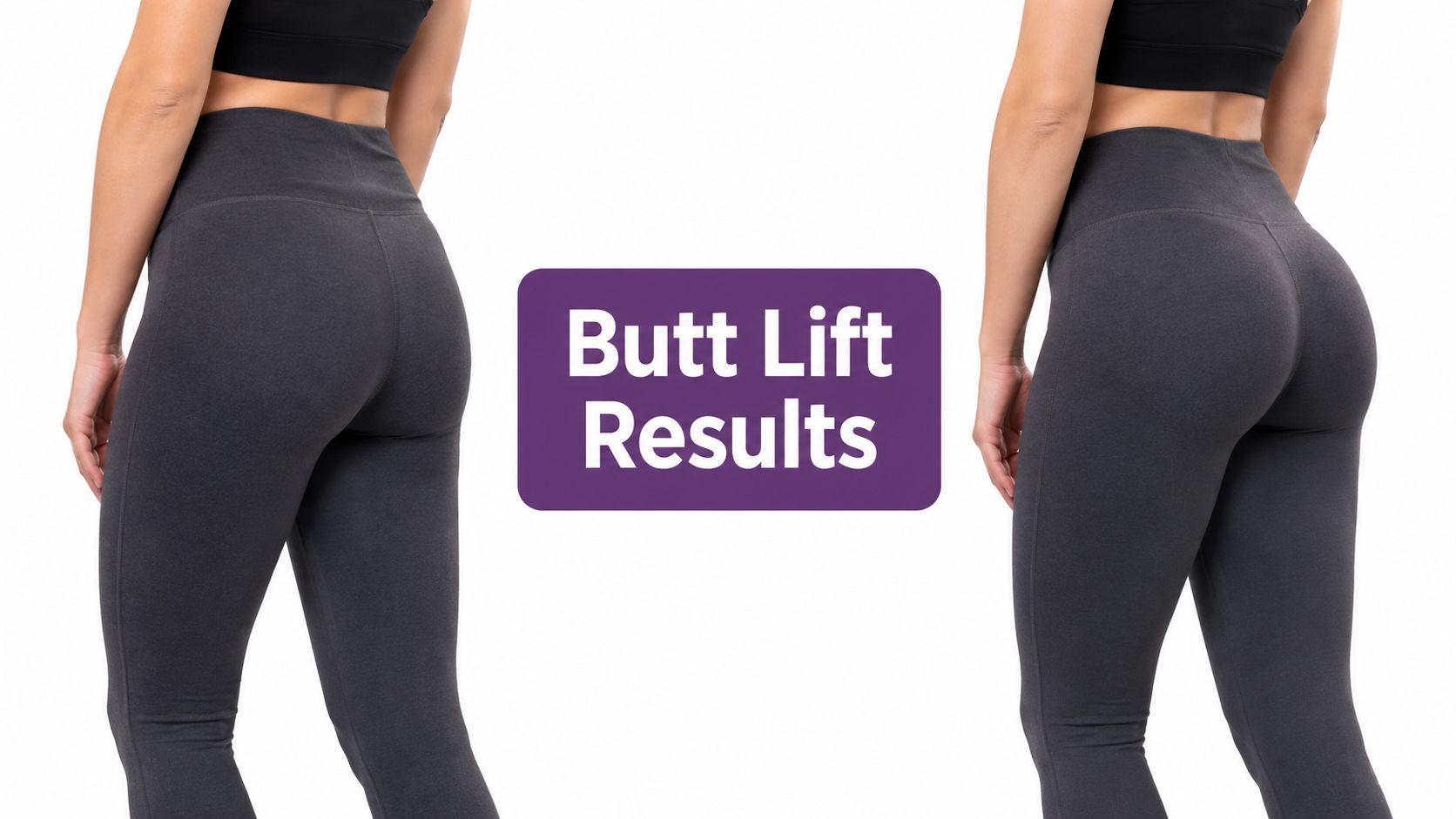
The most popular advice for judging a butt lift before and after gallery is also the least reliable. Picking the most dramatic transformation rewards swelling, posture, lighting and case selection as much as surgery. A photo records one patient at one moment. It doesn't prove how much fat survived, whether placement stayed in a safe layer, or whether a similar result fits your body. Read each image as a timed record with limits, not as a promise.
Table of Contents
- Butt Lift Before and After Results Compared by Procedure
- What Every Trustworthy Gallery Caption Should State
- Case Gallery Categories and What Each Photo Shows
- Gallery Red Flags That Hide the Real Outcome
- Recovery Timeline From Surgery to Settled Contour
- Outcome Statistics Behind the Photographs
- Patient Factors That Change Your Own Result
- Where Luxe Fits Among Butt Lift Options
- Safety Checklist and Questions Before Booking
Butt Lift Before and After Results Compared by Procedure
Different operations create different photo signals. A Brazilian butt lift, or BBL, rearranges your own tissue. An implant adds a manufactured shape. A lift without added volume changes position, not size. Comparing those images as if they were the same procedure leads to the wrong conclusion.
| Procedure | Volume source | Where augmentation sits | Typical photo change | Main trade-off |
|---|---|---|---|---|
| Brazilian butt lift (autologous fat grafting) | Patient's own fat, harvested by liposuction | Subcutaneous layer above the gluteal muscle | Added projection and upper-pole fullness; donor area looks slimmer | Volume depends on fat survival and weight stability |
| Fat grafting with ultrasound guidance | Patient's own fat | Subcutaneous layer, with cannula tip tracked on ultrasound | Similar contour change, with follow-up data reported in recent reviews | Results depend on provider experience and technique; evidence base is smaller |
| Gluteal implants | Manufactured implant | Placed in a surgically created pocket | Immediate, stable volume; shape set by implant | Implant-specific risks and possible future revision; discuss with the surgeon |
| Buttock lift without added volume | No volume added; excess skin and tissue removed | Skin and fat repositioned | Lifted position and firmer skin; no added projection | Suits sagging rather than volume loss; incision placement matters |
How to read the rows
A fat grafting photo shows two changes at once. The buttocks gain contour from transferred fat, and the donor area may look slimmer after liposuction. That combined effect can make the waist-to-hip change appear larger than the graft alone produced.
An implant photo shows volume that's present from the start and shaped by the device. It doesn't depend on graft survival, but it carries a different revision and complication profile that a still image can't reveal.
A lift photo should be judged by position and skin tension. Look for where the buttock sits and how the lower fold looks, not for added projection. If volume is your main concern, a lift alone answers a different problem.
Similar-looking photos can differ because of procedure type, time since surgery, and starting body shape and weight.
Use the table to sort cases before you compare them. Then check timing in the recovery timeline and technique in the safety checklist near the end. A gallery only becomes useful when you know which operation produced the image.
What Every Trustworthy Gallery Caption Should State
A caption should let you test the photo without guessing. If you can't tell what was done, when the after image was taken, or whether weight changed, you can't judge what the result means.
Caption fields to look for
- Procedure in plain terms: Brazilian butt lift with autologous fat grafting, implant, or lift, because each carries a different risk and revision profile.
- Technique: Subcutaneous grafting, ultrasound guidance, implant placement, or skin removal, because technique affects both contour and safety.
- Donor area and volume per side: The liposuction site and approximate amount injected, because volume sets the scale of possible change.
- Injection plane: The layer where fat was placed, because placement above the muscle is a central safety point for grafting.
- Surgeon credentials: The wording from the practice's current physician biography, because titles shouldn't be upgraded for marketing.
- Photo timepoint: Time measured from surgery, because swelling can inflate an early result.
- Weight at surgery and at the photo: Both values, because weight change alters grafted fat and surrounding tissue.
- Editing statement: Whether the image was edited, because retouching can smooth contour irregularities you need to see.
A standard set includes front, side, back and three-quarter views. Each view should use the same posture, clothing, lighting and camera distance at every timepoint. A back view alone can hide asymmetry that's obvious from the side.
A useful caption might read in prose like this. Subcutaneous fat grafting from the flanks, photographed at 12 weeks, weight stable since surgery, no image editing. That single pattern tells you the operation, source, timing and one major confounder.
Without a follow-up date, a caption is incomplete. You don't know if you're seeing swelling, a settling graft, or a stable contour. Even a complete caption describes one patient's result. It doesn't predict yours, because anatomy, donor fat, healing and weight stability differ.
Case Gallery Categories and What Each Photo Shows
Grouping cases by technique prevents false comparisons. The categories below use the caption fields already defined, but each one asks you to look for a different visual signal. Entries should use only consented, verified patient photos. Where no verified photo is available, a labeled illustrated diagram is more honest than an invented case presented as a patient.
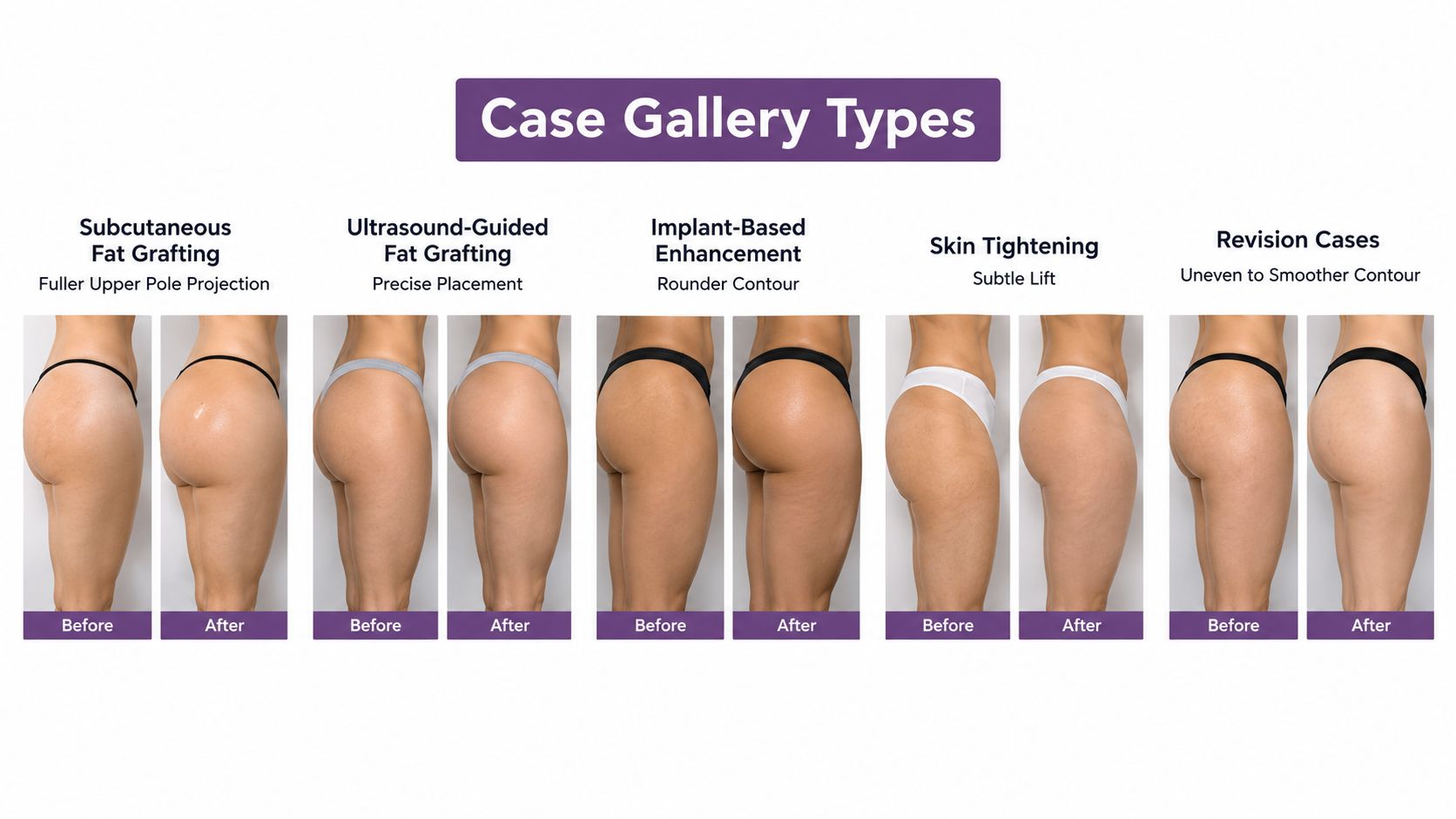
Subcutaneous fat grafting
The signal is projection and upper-pole fullness paired with a slimmer donor area. An illustrative entry might state fat harvested from the abdomen and flanks, graft placed subcutaneously, and photos at a settled timepoint with stable weight. Check whether fullness looks distributed rather than concentrated in one spot. A diagram for this category should show skin, subcutaneous fat, gluteal fascia and gluteal muscle, with graft marked above the fascia and never in the muscle.
Ultrasound-guided fat grafting
Expect a similar contour signal, with the added information that the cannula tip was tracked during placement. The caption should still state donor area, approximate volume per side and photo timing. Ultrasound guidance describes how placement was monitored. It doesn't, by itself, prove fat survival or symmetry in that case.
Gluteal implants
Here the signal is immediate volume and shape stability. Because the implant sets much of the form, compare outline and position across views rather than asking how much fat survived. Captions should identify the procedure clearly so readers don't mistake device-based volume for grafted fat.
Buttock lift without added volume
Look for lifted position and firmer skin, not a larger buttock. Side and three-quarter views help you judge where tissue sits after excess skin removal. When reviewing folds and lower buttock contours, related gluteal fold photo examples can help you separate position changes from added projection.
Staged procedures
A staged case places volume across separate sessions. It needs images at distinct intervals, not one final image that hides how the result was built. Captions should separate the volume and timing for each stage. That structure also shows whether the plan limited volume in a single session rather than chasing a target size at once.
Across all five categories, the strongest galleries show consistency. Same views, same conditions, clear timepoints, and no unexplained weight change.
Gallery Red Flags That Hide the Real Outcome
The most misleading gallery shows only the single best angle from the best case. Practices choose what to publish, so an outcome you don't see may still be common. A polished selection tells you what's possible in selected patients. It doesn't tell you the full distribution of results.
What to request when something is missing
- No follow-up dates: Request the photo timepoint measured from surgery for every after image.
- No donor-site photos: Request before and after views of the liposuction area, since contour problems can occur there too.
- Inconsistent conditions: Request a standardized set with matched lighting, posture, clothing, weight and camera distance.
- Possible retouching: Request unedited originals and a clear editing statement. For practical checks on altered files, AI Image Detector's image forensics guide explains signs readers can inspect before trusting a polished image.
- Promised size: Treat a guaranteed cup, clothing or measurement outcome as marketing. Ask for a volume range and the plan if that volume can't be placed safely.
- One photo per patient: Request a longer-term case with more than one timepoint.
A practice may decline to share some patient images for privacy. That alone doesn't prove poor quality. Verified credentials, technique answers and emergency planning still carry weight when photos are limited.
A before-and-after photo can't show internal fat survival or a complication that develops after the photo was taken.
Treat missing context as missing evidence. Ask for it directly, and don't fill the gaps with the most favorable assumption.
Recovery Timeline From Surgery to Settled Contour
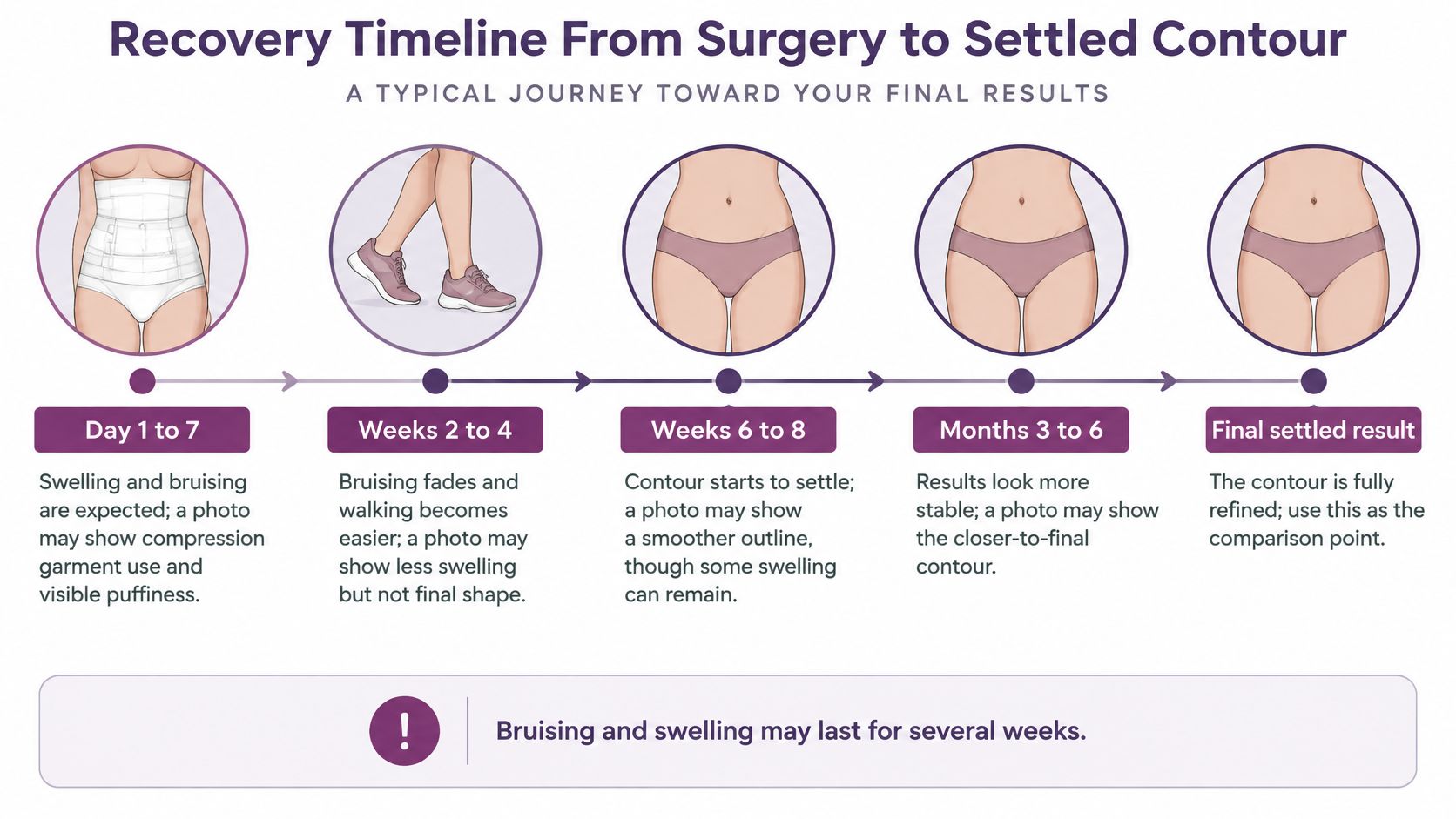
Timing changes what a photo means. The UK National Health Service surgical fat transfer guidance reports that bruising and swelling may last for several weeks, patients may need approximately two weeks away from work, and a surgical fat transfer can take up to six months to fully settle because some injected fat is reabsorbed during the first few months. An early image can therefore exaggerate size, while a later image may show less volume.
| Milestone | Typical timing | What a photo can show | What it can mislead about |
|---|---|---|---|
| Day of surgery | Day 0 | Immediate post-surgical shape and compression | Swelling makes the result look larger than it will settle |
| Early recovery | First two weeks | Bruising, swelling and early projection | Bruising and swelling may last several weeks; not a final contour |
| Mid recovery | Around six weeks | Swelling reducing; contour starting to show | Some swelling remains and contour is still changing |
| Settling period | Three to six months | Shape closer to stable; reabsorption largely complete in early months | Fat transfer can take up to six months to fully settle |
| Long-term contour | After weight stabilizes | Lasting shape compared with stable baseline | Depends on weight stability; results vary between patients |
Reading each milestone
On the day of surgery, compression and swelling dominate. The outline may look dramatic, but it isn't retained volume. During the first two weeks, bruising and garment shape can distort both buttock and donor areas.
Around six weeks, you'll usually see a clearer contour, yet the result is still moving. At three to six months, reabsorption and settling make the comparison more meaningful. After that, judge durability against a stable baseline photo from the settled period, not against an image from the first weeks.
Brazilian butt lift results are described as semi-permanent and may last several years or longer, but they depend on fat survival, weight stability and healing. No single photo proves lifelong volume. Individual recovery varies, and your provider's instructions govern activity limits, sitting precautions and return to exercise.
Practical rule: Compare photos only at matching intervals. A day-one image set against a month-six image doesn't measure retained volume.
Outcome Statistics Behind the Photographs
Published outcomes keep a striking gallery in proportion. The systematic review and meta-analysis indexed in PubMed covered 19 studies involving 4,105 patients, found approximately 400 mL of decanted fat per buttock, and reported a mean complication rate of 7%, with 6.7% minor and 0.32% major complications. The same review emphasized avoiding injury to gluteal vessels to reduce fat embolism risk.
| Reported measure | Figure | Study context |
|---|---|---|
| Fat volume per buttock | About 400 mL | Meta-analysis of 19 studies with 4,105 patients |
| Mean complication rate | 7% (6.7% minor, 0.32% major) | Same meta-analysis of 19 studies |
| Complication rate, subcutaneous-only injection | 4% | 2021 review; not statistically significant versus intramuscular |
| Complication rate, any intramuscular injection | 28.7% | 2021 review; not statistically significant versus subcutaneous-only |
| Ultrasound-guided minor complications | 6.32%; no deaths or fat embolisms reported | 2025 systematic review of 4 studies with 6,235 patients |
| Seroma and infection, ultrasound-guided studies | Seroma 2.94%; infection 0.23% | Same 2025 systematic review |
| Satisfaction with size and projection | 95.0% and 93.4% | Same review; follow-up ranged from 1.5 to 24 months |
Follow-up changes the question
A result at 1.5 months answers an early healing question. A result at 24 months says more about durability. When a study combines wide follow-up windows, don't read every outcome as long-term. Ask which timepoint a gallery case represents and whether complications or revisions occurred after that photo.
Complications are not mortality
A complication rate counts events such as seroma, infection or fat necrosis. A mortality estimate counts deaths and is far more sensitive to survey method and case denominator. Older survey calculations produced roughly 1 death per 6,214 cases to 1 per 2,351 cases, while a later summary after technique changes reported approximately 1 in 14,921 cases. Those figures aren't interchangeable, and none predicts an individual patient's risk by itself.
Satisfaction has limits
High satisfaction with size and projection doesn't measure symmetry, donor-site contour, durability, or whether a revision was needed. The ultrasound-guided studies also enrolled mostly female patients with a mean BMI around 30.1 kg/m², so the averages may not map neatly onto a very different body. Use population figures to frame consultation questions, not to certify a gallery.
Patient Factors That Change Your Own Result
Two patients can receive a similar graft and photograph very differently. Your starting anatomy and post-surgery weight pattern decide how closely another person's image predicts your outcome. If you're weighing candidacy, this discussion of whether a Brazilian butt lift is right for you is a useful companion to the factor checks below.
- Body weight stability: Gaining or losing weight changes grafted fat and surrounding tissue, so match this factor to cases in Case Gallery Categories and What Each Photo Shows.
- Donor fat available: Harvestable fat caps transferable volume and therefore achievable projection, which is why captions in What Every Trustworthy Gallery Caption Should State should name the donor area and volume.
- Body frame and existing buttock shape: The same volume looks larger on a narrower frame or flatter baseline, so compare yourself with similar starting shapes in the gallery categories.
- Skin elasticity: Loose skin limits how cleanly tissue can be repositioned in a lift, making skin quality central when reviewing lift cases rather than grafting cases.
- Prior abdominal or pelvic surgery: Scarring and altered tissue planes can affect harvest sites and safe planes, which your surgeon assesses alongside the markers in Safety Checklist and Questions Before Booking.
- Smoking and medical conditions: Healing capacity and complication risk affect both recovery photos and settled contour, so timing in Recovery Timeline From Surgery to Settled Contour may not match your course.
Study averages add another caution. Ultrasound-guided cohorts had a mean BMI of about 30.1 kg/m². If your body differs substantially, their satisfaction and complication averages become less direct guides.
Candidacy and expected volume are determined in consultation, not by matching your body to a gallery photo.
Bring your weight history, prior surgery history and medical conditions to that discussion. Those details often explain more about your likely result than the most dramatic image in a gallery.
Where Luxe Fits Among Butt Lift Options
Luxe Aesthetic Surgery & Medical Spa describes itself as a cosmetic surgery, body contouring and medical aesthetics destination serving patients throughout Southern California. Within this decision, it's one option to evaluate with the same caption, timing and safety tests you'd apply anywhere else.
Check the current Luxe service pages to confirm whether Brazilian butt lift, autologous fat grafting, buttock implants or buttock lift are currently offered. Don't assume a service is available because it's common elsewhere, and don't assume a butt lift is performed awake unless the current procedure page confirms that approach for appropriate candidates.
The Medical Director is Haimesh Shah, MD, RPVI. Luxe's current physician biography describes Dr. Shah as a board-certified physician specializing in cosmetic surgery and phlebology, with training and experience in autologous fat grafting and body contouring. Use that exact credential language when comparing providers.
Decisions a gallery can't make for you
You still need to choose between fat grafting, implants and a lift based on anatomy, goals, donor fat, skin quality and acceptable trade-offs. You also need to decide how much weight to give online images versus an in-person examination. A gallery can show selected outcomes and aesthetic direction. A consultation can test whether your tissue, medical history and desired volume fit a safe plan.
Any practice gallery shows selected results, so use it as a prompt for specific questions. Verify location details, provider credentials, service listings and gallery content on the Luxe website before booking, since those details can change over time.
Safety Checklist and Questions Before Booking
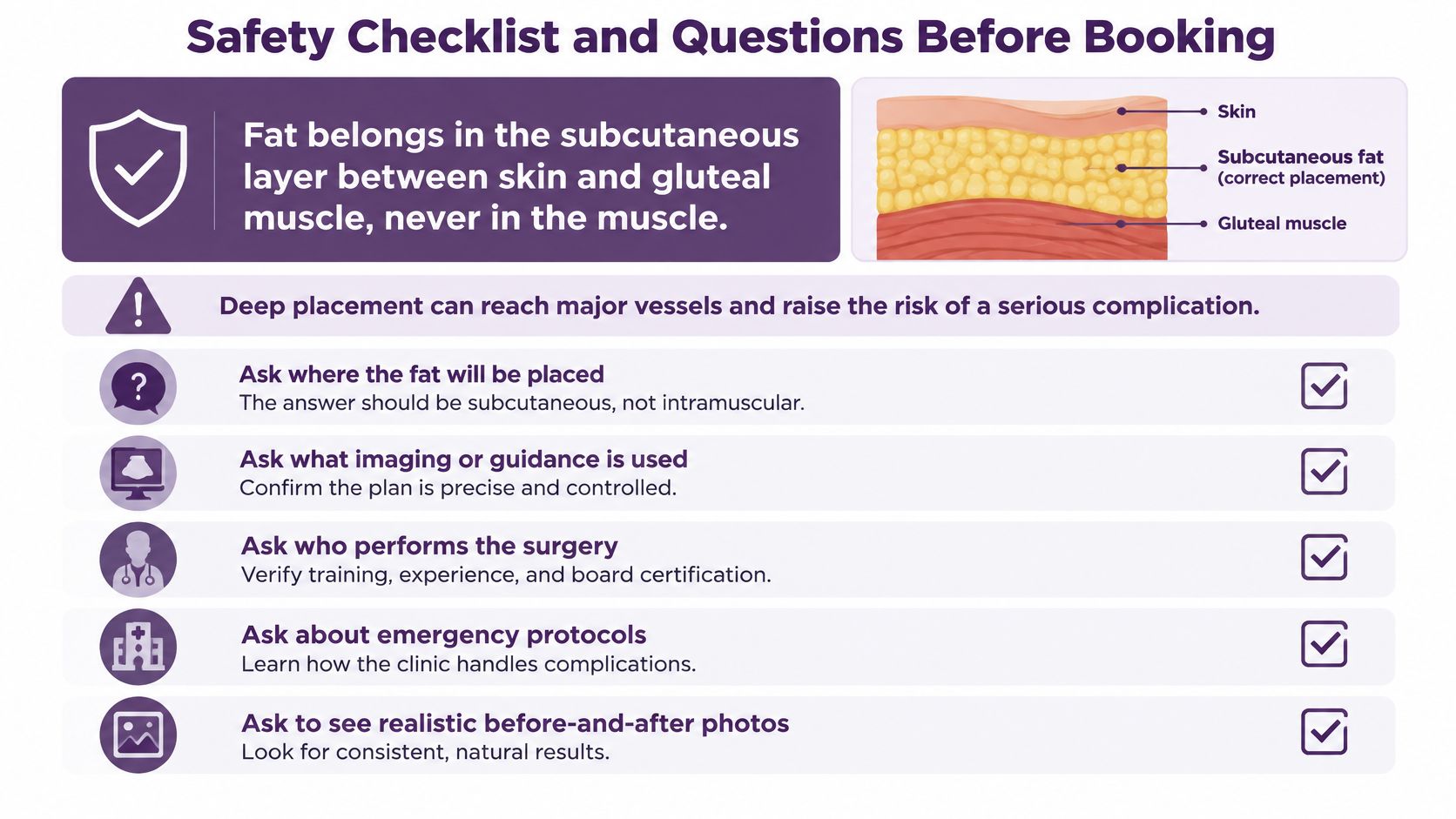
Safety starts with anatomy. The joint gluteal fat grafting safety statement from major plastic surgery organizations specifies that grafted fat should remain in the subcutaneous tissue between skin and gluteal muscle and should not be injected into the muscle. Deep injection can place the cannula near major vessels and increase the risk of a potentially fatal pulmonary fat embolism. For a fuller risk discussion, review this comprehensive BBL surgery safety guide before your consultation.
Safety markers to verify
- Ultrasound monitoring of the cannula tip: Real-time imaging helps the surgeon track placement during injection. Ask, "Will ultrasound be used throughout cannula navigation and injection in my case?"
- Fat stays above the gluteal fascia: The fascia is the boundary above the muscle, and crossing it moves toward deeper vessels. Ask, "How will you confirm fat remains above the fascia?"
- Stiff cannula of at least 4 millimeters: A stiffer, larger cannula is intended to reduce bending and unintended deep advancement, with no downward angulation. Ask, "What cannula size and angle controls do you use?"
- Injection only while the cannula moves: Moving delivery avoids a stationary high-pressure bolus in one spot. Ask, "Do you inject only while the cannula is moving?"
- Volume limit or staged plan: A predetermined size shouldn't override safe placement. Ask, "If my desired volume can't be placed safely, will you reduce it or stage the procedure?"
- Facility and emergency readiness: The team should explain monitoring, escalation and transfer arrangements if a complication occurs. Ask, "What happens here, step by step, if I develop a serious complication?"
These markers reduce risk. They don't remove it. Ultrasound-guided studies reporting no deaths in their included cases don't make any individual operation risk-free, and technique quality still depends on the person performing it. A smaller or staged result may be safer than pursuing a fixed volume.
If a plan can't explain the injection plane in plain language, the gallery shouldn't settle the decision.
Confirm before you book
- Procedure fit: Which butt lift type fits your goals, donor fat and skin quality?
- Credentials: Do the stated credentials match the current physician biography exactly?
- Plane and imaging: Is placement subcutaneous only, and is ultrasound used?
- Expected volume range: What range is realistic for your donor fat and frame?
- Staged option: Is staging offered if safe volume is limited?
- Follow-up and photos: What visits and standardized photo timepoints are planned?
- Recovery: How much time away from work and which activity limits should you expect?
- Facility and anesthesia: Where will surgery occur, what anesthesia is planned, and what emergency arrangements exist?
- Cost in writing: Are fees, revision policies and financing terms documented before you commit?
Ask how complications such as seroma, infection, fat necrosis, asymmetry and contour irregularity are detected and managed. Also ask who performs each part of the operation, who monitors you during recovery, and whom you contact after hours. Clear answers should name people and steps, not rely on general reassurance.
Your next step is a consultation at a Luxe location. Bring this checklist, your weight history, prior surgery history and a short list of gallery cases that match your starting shape. Request standardized photo sets for the exact procedure being proposed, with timepoints and weight stated. A consultation determines candidacy, expected volume and whether an awake approach is even applicable. Results vary, and no checklist converts a selected before-and-after image into a personal guarantee.
If you're comparing butt lift options in Southern California, visit Luxe Aesthetic Surgery & Medical Spa to review current Brazilian butt lift and body contouring services, provider credentials and gallery information. Book a consultation to discuss your anatomy, donor fat, safe injection plane, likely volume range and recovery plan before you rely on any before-and-after photo.