Medical Expertise at Luxe Aesthetic Surgery
Luxe Aesthetic Surgery & Medical Spa is led by Haimesh Shah, MD, RPVI , a physician specializing in cosmetic surgery, body contouring, laser procedures, and venous medicine. Dr. Shah is a Diplomate of the American Board of Laser Surgery, American Board of Venous & Lymphatic Medicine, American Board of Wound Management, and American Board of Internal Medicine. He also holds the Registered Physician in Vascular Interpretation (RPVI) credential and has contributed to peer-reviewed medical research.
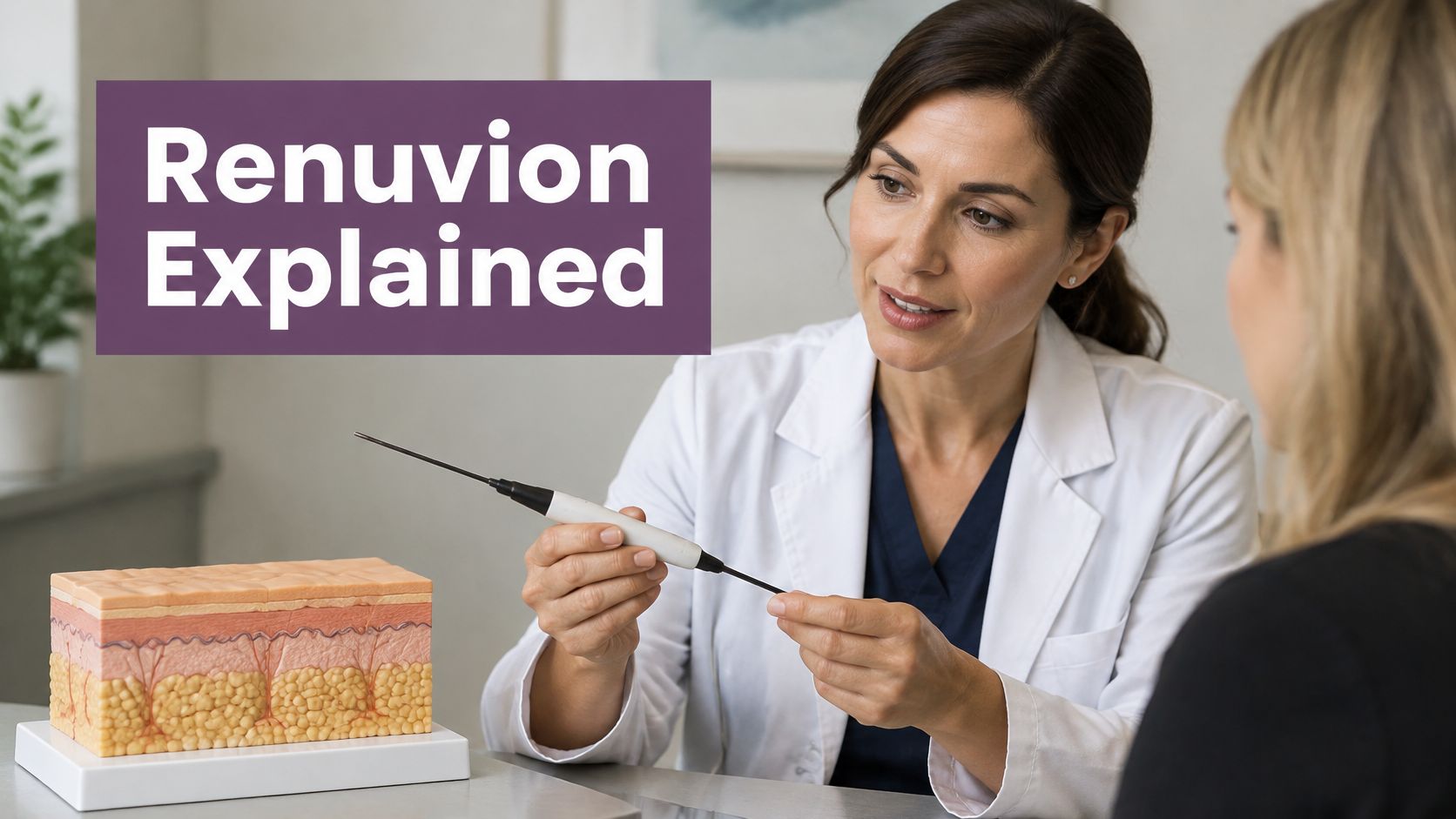
Renuvion, also called J-Plasma, is helium-plasma radiofrequency passed under the skin to contract soft tissue, and its FDA clearance depends on the specific handpiece and treatment area. It's not a substitute for excising hanging skin. Why, then, do so many consultations start with the device name instead of the anatomy it's meant to treat? Starting with your fat pattern, degree of laxity, and skin quality gives you a clearer decision than starting with a brand name.
Table of Contents
- What Renuvion J-Plasma Does Under the Skin
- Which Renuvion Uses the FDA Has Cleared
- How a Renuvion Session Fits with Liposuction
- Satisfaction and Results Patients Can Expect
- Risks Recovery and Warning Signs
- Renuvion Versus Liposuction Alone or a Tummy Tuck
- Deciding if Renuvion Fits Your Anatomy
What Renuvion J-Plasma Does Under the Skin
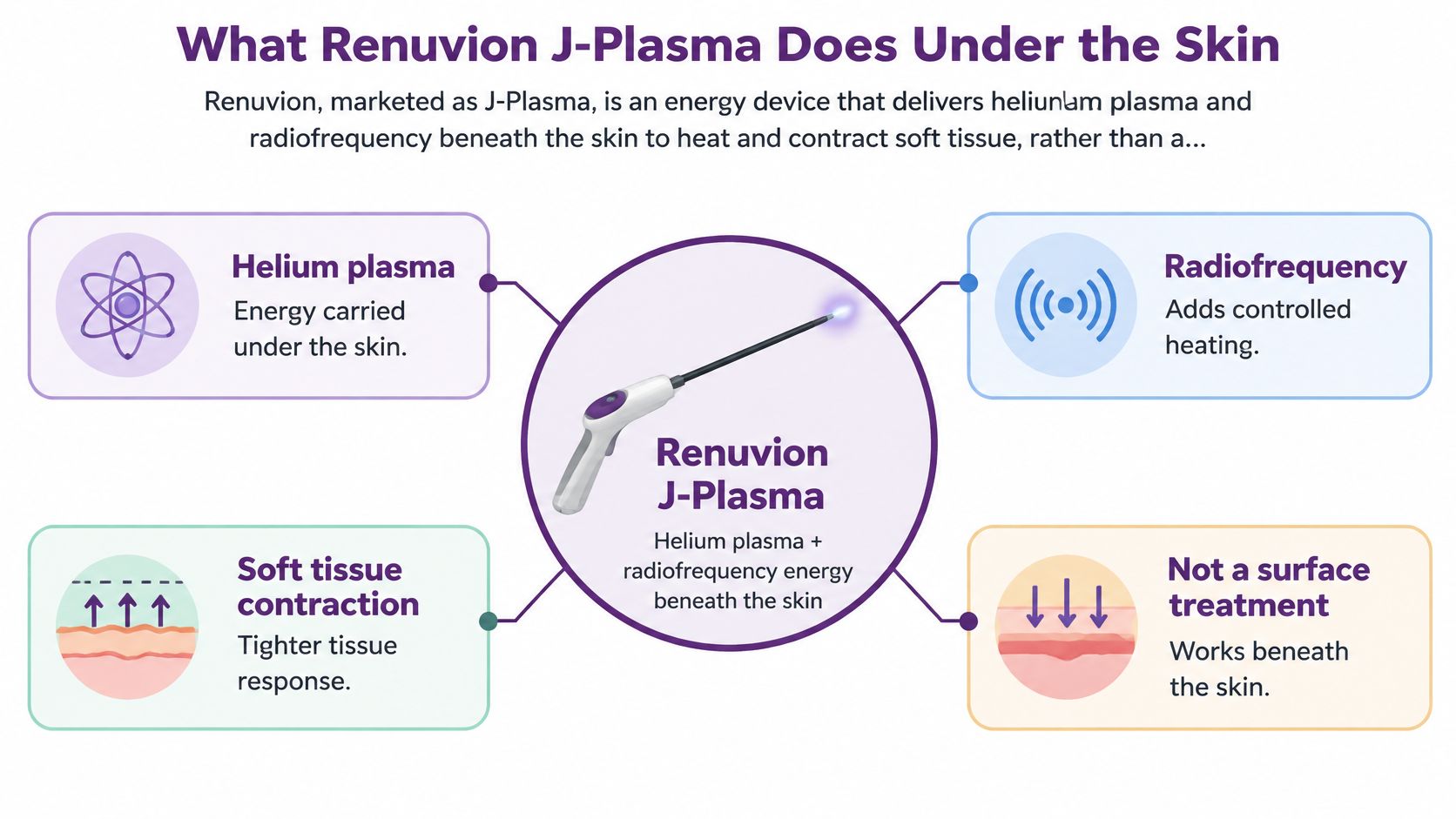
Renuvion J Plasma skin tightening is often misunderstood as a surface laser. It isn't. The device delivers energy beneath the skin through small openings, similar to the entry points used for liposuction, so the work happens in the tissue layer under the surface rather than on top of it.
Think of a lined jacket. Warming and drawing in the lining can make the garment sit closer, but you haven't ironed the outer face and you haven't cut away excess cloth. That distinction explains both the appeal and the limit of this approach.
How the Energy Creates Contraction
A slim cannula is passed in the subcutaneous plane, the layer just under the skin. Helium is energized into a focused plasma, and radiofrequency adds controlled heating to the fibrous network that connects skin to deeper tissue. That heated network can contract during treatment.
Some tightening is therefore immediate, but it's only part of the story. Over the following months, the body remodels collagen in the treated tissue, and firmness may continue to change. If you're comparing technologies, it helps to separate subsurface treatment from surface approaches and review what to expect from facial radiofrequency as a different context for radiofrequency use.
What It Does Not Do
Renuvion doesn't remove fat by itself. When fat is the problem, liposuction does that work, and plasma treatment, when used, addresses the tissue that remains. It also doesn't cut away skin, so a fold that hangs when you bend won't reliably disappear because energy was passed beneath it.
Areas commonly discussed include the abdomen, flanks, arms, thighs, neck, and under-chin region, usually where laxity is mild to moderate rather than severe. In tummy tuck planning, it may enter the conversation only when excess skin is limited, not as a way to avoid excision for a large apron of skin.
Practical rule: Energy can contract tissue to a degree. It cannot delete tissue that's truly redundant.
Whether Luxe Aesthetic Surgery & Medical Spa offers this treatment, and under what protocol, must be confirmed on its current service page before it's stated for any individual plan. Candidacy is decided in consultation with Medical Director Haimesh Shah, MD, RPVI, a board-certified physician specializing in cosmetic surgery and phlebology. The next question is regulatory, because the authorized use depends on the handpiece in the surgeon's hand and the area being treated.
Which Renuvion Uses the FDA Has Cleared
FDA-cleared Renuvion uses by handpiece
| Handpiece or clearance | Date | Authorized use | Does not mean |
|---|---|---|---|
| General soft-tissue clearance | Before the March 2022 warning | Cutting, coagulation, and ablation during open and laparoscopic surgery | Cosmetic skin tightening or resurfacing |
| Renuvion Dermal Handpiece | May 25, 2022 | Moderate to severe wrinkles in Fitzpatrick types I, II, or III | Body-wide skin contraction |
| Renuvion APR Handpiece | July 15, 2022 | Lax skin in the neck and submental region | The same clearance for every body area |
| Post-liposuction soft-tissue use | April 27, 2023 | Coagulating subcutaneous soft tissue after liposuction for aesthetic body contouring | A substitute for excising hanging skin |
This table matters because "skin tightening" isn't one blanket approval. The FDA safety communication on Renuvion/J-Plasma aesthetic uses explains that in March 2022 the FDA warned against using the device for dermal resurfacing or for subcutaneous skin contraction intended to improve skin appearance, whether performed alone or with liposuction. At that time, the general clearance covered cutting, coagulation, and ablation of soft tissue during open and laparoscopic surgery, not specifically cosmetic tightening.
Reading Each Row as a Patient Situation
The May 25, 2022 clearance for the Renuvion Dermal Handpiece covers treatment of moderate-to-severe wrinkles in patients with Fitzpatrick skin types I, II, or III. That's a wrinkle indication for lighter Fitzpatrick types with a dermal handpiece. It doesn't turn the system into a cleared body-tightening device for every area.
The July 15, 2022 clearance for the Renuvion APR Handpiece covers subcutaneous dermatological and aesthetic procedures addressing lax skin in the neck and submental region. Say your main concern is looseness under the chin, with reasonable skin quality and no large hanging fold. That's the kind of concern this row is about.
The April 27, 2023 clearance covers coagulating subcutaneous soft tissue after liposuction for aesthetic body contouring. That fits a different scenario, such as mild to moderate body laxity treated at the same time fat is removed. The wording is tied to post-liposuction coagulation, which is narrower than a promise of tightening any body area on its own.
Factors That Change the Fit
- Amount of redundant skin: Mild looseness and a hanging fold are different problems.
- Skin quality: Sun damage, thinning, and poor elasticity affect how tissue responds.
- Fat distribution: The plan differs when fat, laxity, or both drive the contour.
- Personal history: Age, smoking, prior surgery, and medical history all affect healing and selection.
Mild to moderate laxity may improve with a matched, cleared use. Substantial hanging skin still needs excision, such as a tummy tuck or body lift. Local anesthesia for selected awake procedures at Luxe, when appropriate, is also a separate candidacy decision. It doesn't make every Renuvion case safer, and it doesn't remove downtime. Match your concern to a row first, then compare devices.
How a Renuvion Session Fits with Liposuction
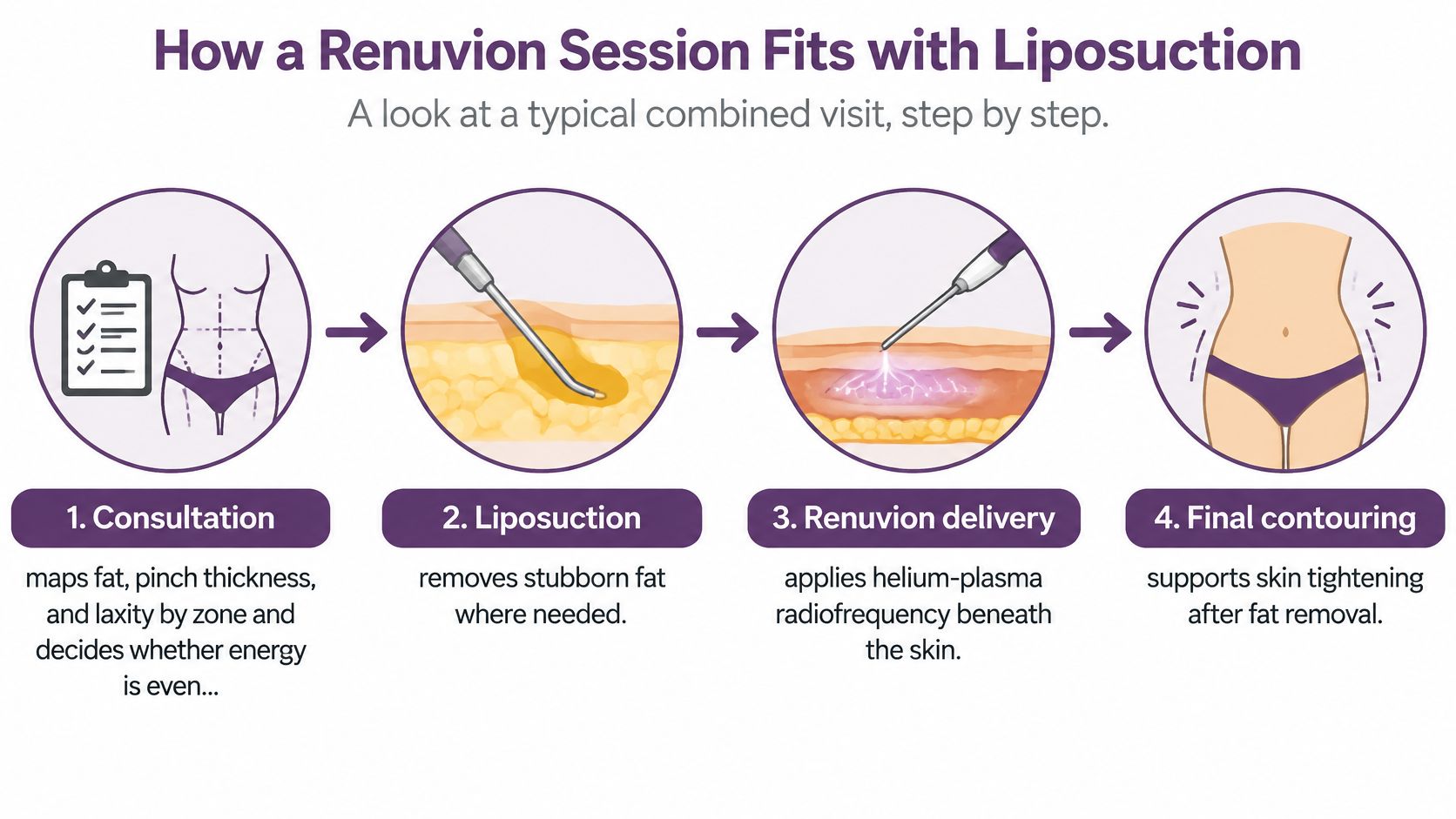
A combined session has a logic to its order, even though no two patients follow an identical script. Contour comes first, then any energy is applied to the thinner tissue that remains.
A Typical Sequence
- Consultation: Your physician maps fat, pinch thickness, and laxity by zone and decides whether energy is appropriate at all.
- Markings: Areas planned for fat removal are separated from areas where skin quality may respond to heat.
- Anesthesia plan: Local tumescent anesthesia may be used for selected awake liposuction when the physician judges a patient suitable, while some surgeries need a different plan.
- Liposuction first: Resistant fat is removed so the cannula later treats a thinner flap. Readers planning that step can review a complete guide to liposuction preparation and expectations.
- Renuvion passes: The cannula is passed in the subcutaneous plane with helium plasma and radiofrequency, with settings and number of passes chosen for that zone.
- Area-specific care: The neck and under-chin follow the APR indication and shouldn't be assumed to behave like the abdomen.
- Dressing and compression: Small openings are dressed and a compression garment is placed.
Why the Neck Evidence Stays With the Neck
The clearest neck example comes from a prospective, multicenter, evaluator-blinded clinical trial conducted under an FDA investigational device exemption, reported in the Aesthetic Surgery Journal neck and submental trial. In that study, the primary safety endpoint was met, and 96.9% of patients reported no pain or only mild-to-moderate pain through day 7.
That trial evaluated Renuvion used alone to improve loose skin in the neck, and it supported clearance for that neck and submental use. It doesn't prove that every use marketed as J-Plasma tightening has equivalent safety or effectiveness. Keeping the evidence attached to its indication protects you from overgeneralizing.
Order also creates a common confusion. Fat removal changes contour on its own, and swelling can temporarily smooth or firm an area, so an early tighter look may reflect liposuction, swelling, healing, plasma, or a mix. Internal heating can still injure skin if energy or passes are excessive, which is why operator experience and area-specific protocols matter. Early firmness isn't your final contour.
Satisfaction and Results Patients Can Expect
The most useful published benchmark here is modest, and that's exactly why it's helpful. In a 2025 retrospective cohort of 174 consecutive cases in Aesthetic Surgery Journal Open Forum, helium-plasma radiofrequency was used with high-definition liposuction or other aesthetic procedures, and 44% of patients were classified as very satisfied while 41% were classified as partially satisfied.
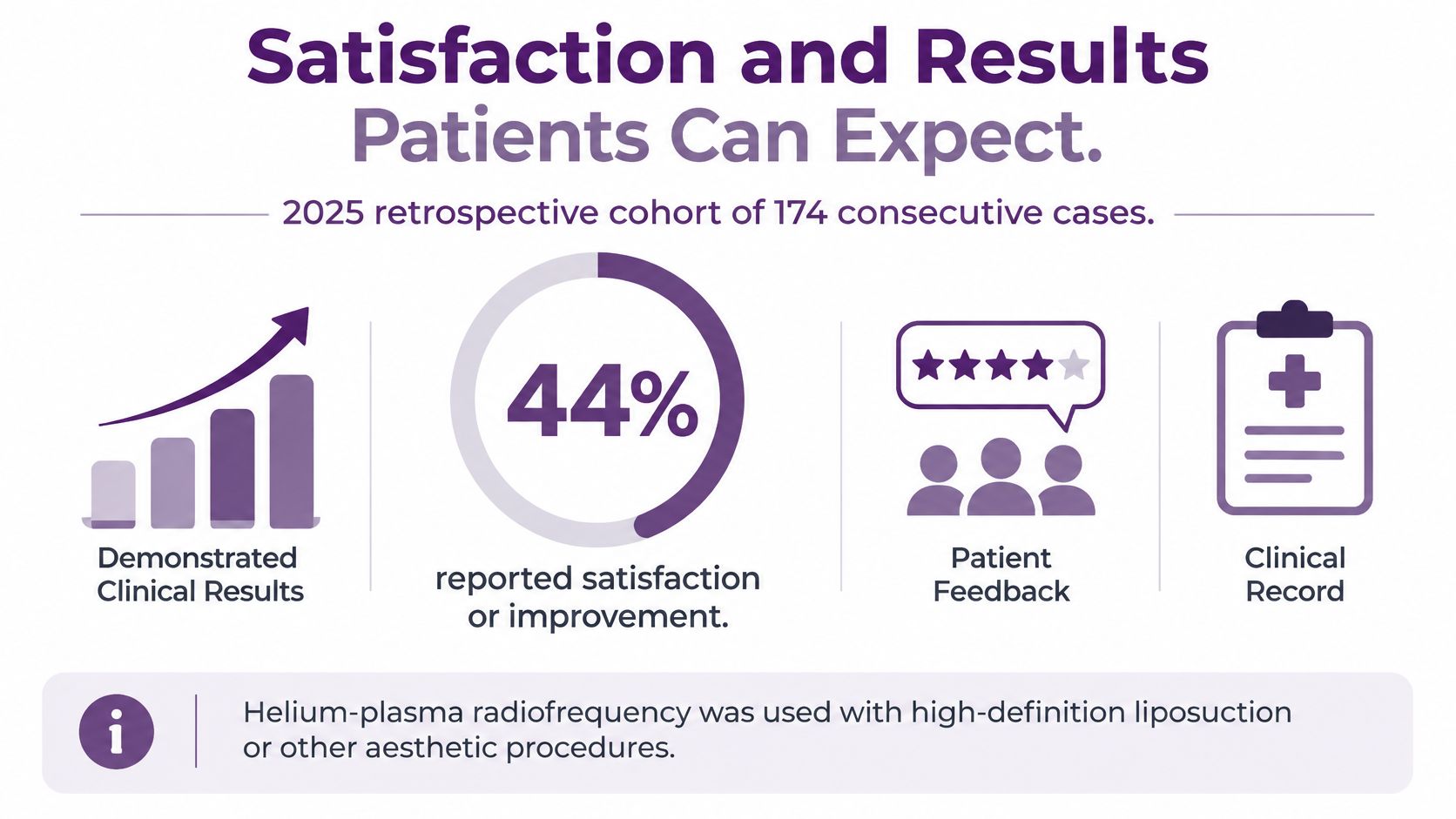
Those numbers describe a counseling range, not a promise for your abdomen, arms, or neck. The study was observational and procedures were combined, with no control group to separate the device's effect from liposuction and normal healing. Results may not generalize to every body region, energy protocol, operator, or anatomy.
Three Ways the Same Data Can Look in Real Life
Say a patient has mild abdominal laxity after fat removal. She notices gradual firmness over several months and feels her contour matches what she hoped for. That experience fits the very satisfied group, but it doesn't establish that plasma alone caused the change.
Another patient is partially satisfied. The contour is better, yet swelling lingers and some looseness remains once healing settles. A third person discovers redundant skin was the main problem all along and needs a different operation, because energy treatment can't remove the excess.
What the Months After Treatment Usually Involve
Bruising and swelling are common in the first weeks. You'll typically wear a compression garment as directed, follow activity limits based on the treated areas, and wait while collagen remodeling continues for several months. Photos at two weeks don't show the final result.
Weight stability supports any contour result, since later gain or loss changes the tissue you're judging. If you're rebuilding eating habits after surgery, learning to set a realistic daily calorie target can help you keep expectations grounded without turning recovery into a crash diet.
Judge a practice by area-specific outcomes, energy settings, delayed events, and patient-reported satisfaction, not by early photos alone.
Long-term durability isn't established by the available research. Ask how long results are expected to last for your area, and how aging and weight change may affect them. Results vary, and no single timeline fits every anatomy.
Risks Recovery and Warning Signs
It's tempting to assume that a device passed under the skin must be gentler than surgery that removes skin. The safety record says you shouldn't assume that. The FDA MedSun newsletter on Renuvion/J-Plasma documents serious risks when the device was used for aesthetic skin procedures, including second- and third-degree burns, infection, skin-color changes, scarring, nerve damage, significant bleeding, and air or gas accumulation under the skin, in body cavities, or in blood vessels.
Reported Renuvion risks and complication counts
| Source | Event | Count |
|---|---|---|
| MAUDE 2020-2025 | Burns or scars | 66 reports |
| MAUDE 2020-2025 | Pain | 18 reports |
| MAUDE 2020-2025 | Hospitalization | 16 reports |
| MAUDE 2020-2025 | Life-threatening | 15 reports |
| MAUDE 2020-2025 | Numbness | 7 reports |
| MAUDE 2020-2025 | Nerve injury | 4 reports |
| MAUDE 2020-2025 | Death | 3 reports |
| MAUDE 2020-2025 | Helium embolism | 1 report |
| 2025 cohort, 174 cases | Focal overcorrection or depression | 2 (1%) |
| 2025 cohort, 174 cases | Pneumoperitoneum | 2 (1%) |
| 2025 cohort, 174 cases | High-pitched or reedy voice | 1 (0.6%) |
| 2025 cohort, 174 cases | Extended bruising | 1 (0.6%) |
Read both halves of the table with their caveats attached. MAUDE entries are adverse-event reports summarized from 2020 through 2025, not a controlled trial, so they cannot establish how often events happen or prove the device caused each one. The cohort counts come from an observational series, so they also can't be turned into a personal risk estimate.
The pneumoperitoneum cases deserve one plain sentence. Gas-related complications can occur even when the intended effect is superficial tissue contraction. That's because internal heat and helium are the same features that create contraction, so settings, passes, and operator experience matter.
Ordinary Healing Versus Symptoms That Need Urgent Care
Swelling, bruising, soreness, temporary numbness, and garment wear are common parts of recovery. Your timeline depends on the treated areas, whether liposuction was combined, and how you heal. If liposuction is part of your plan, guidance on recovery after liposuction and optimizing healing can help you prepare questions for your own aftercare instructions.
Contact your care team urgently, or seek emergency care, for expanding pain, blistering or darkening skin, fever, shortness of breath, chest or abdominal distension that could suggest gas, bleeding that doesn't slow, or weakness and numbness that worsen. Don't wait for a routine follow-up to report those changes.
A selected awake procedure may streamline the anesthetic plan for some patients, but it still carries local-anesthetic, procedural, and healing risks. In consultation, ask for the exact indication, the treatment area, who performs the passes, and how complications are handled if they occur.
Renuvion Versus Liposuction Alone or a Tummy Tuck
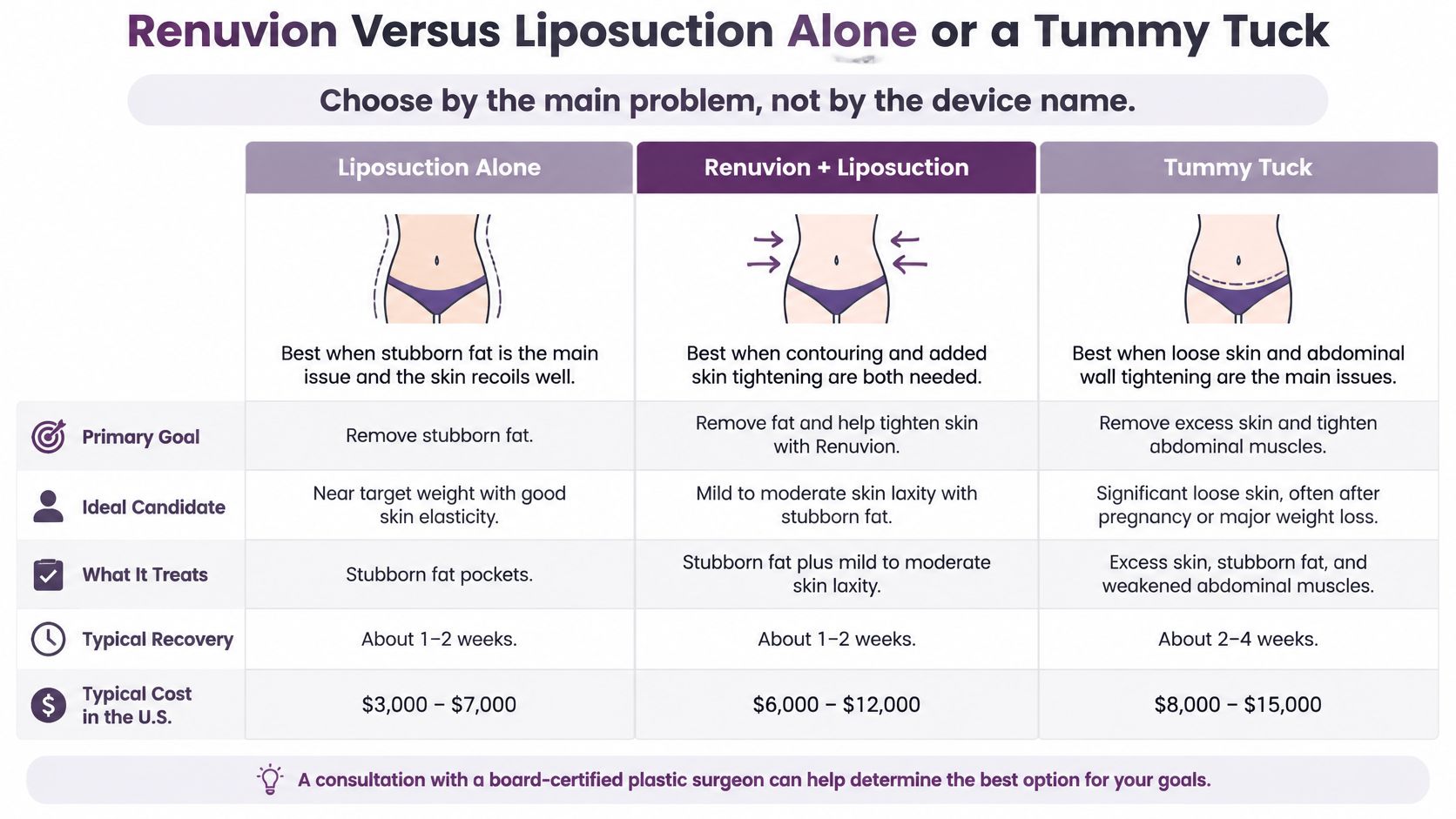
Choose by the main problem, not by the device name.
How to match the problem to the procedure
| Option | Best suited to | Does not reliably do | Recovery character |
|---|---|---|---|
| Renuvion after liposuction | Mild to moderate laxity plus unwanted fat in a cleared area | Remove hanging skin or guarantee contraction beyond liposuction | Combined swelling, bruising, and compression; timeline varies |
| Liposuction alone | Resistant fat when skin quality and recoil are already good | Dependable skin tightening | Swelling, garment wear, and activity limits by area |
| Tummy tuck or skin excision | Substantial redundant or hanging skin | Avoid a longer scar or act as a no-downtime option | Longer surgical recovery and a permanent scar |
| Other energy-based tightening | Selected mild laxity after an individualized consult | Match excision or prove superiority to liposuction | Device-specific swelling and downtime |
A Verdict for Each Anatomy
If stubborn fat is the issue and your skin recoils well when pinched, liposuction alone may be enough. Adding energy in that situation adds cost and risk without a clear problem for it to solve. Readers weighing the two operations can compare liposuction versus a tummy tuck and which option fits before deciding.
If mild to moderate laxity exists alongside fat, Renuvion after liposuction is the use that matches the 2023 body-contouring clearance. Even then, keep the evidence limit in view. A 2025 systematic review in PMC concluded that evidence does not support skin-tightening claims beyond traditional or ultrasonic liposuction.
If skin hangs, folds over a scar, or remains in sheets after major weight loss or pregnancy, a tummy tuck or other excision removes tissue that energy cannot reliably shrink. Other energy-based tighteners can be discussed for selected mild laxity, but they shouldn't be described as equivalent to excision.
Edge Cases Readers Often Miss
In combined cases, part of the tighter look is the liposuction contour and postoperative healing. Smokers and people with poor skin quality may heal less predictably, prior surgery can change tissue planes and scars, and the neck indication isn't a license to treat the abdomen the same way. Fitzpatrick type also limits the dermal wrinkle handpiece to types I through III.
An awake tummy tuck or awake liposuction at Luxe, for appropriate candidates, is an anesthesia pathway. It isn't evidence that adding Renuvion removes risk or scars. The situation-based verdict is simple, energy for limited laxity, excision when skin must be removed, and a consultation when fat and skin are both moderate.
Deciding if Renuvion Fits Your Anatomy
Sort yourself before you book. Bring photos or a clear description of the main concern, whether that's pinchable fat, mild looseness after weight change, neck and under-chin laxity, or skin that hangs in folds when you bend. Naming the problem accurately changes the whole conversation.
Start With the Honest Category
If your skin hangs, plan the visit as a discussion of excision rather than a request to avoid scarring at any cost. A scar can be a reasonable trade for removing tissue that energy can't address. Avoiding that discussion often leads to paying for tightening and still needing surgery later.
If fat and mild laxity coexist, ask whether Renuvion J Plasma skin tightening after liposuction matches a cleared use for that exact area. If fat is minimal and the neck or under-chin is your concern, ask about the APR indication specifically instead of relying on body-contouring examples.
Questions Worth Asking in Consultation
- Which handpiece applies: Ask which handpiece and FDA-cleared indication fit your area.
- Whether liposuction alone is enough: Ask what added benefit energy is expected to provide for you.
- Scars and garments: Confirm the scar locations, compression plan, and activity limits.
- Safety monitoring: Ask how the surgeon monitors for burns, contour dents, and gas-related events.
- Anesthesia fit: Ask whether an awake local-anesthesia approach suits your health and procedure.
Not everyone qualifies for awake surgery, and local anesthesia still carries risk. Your physician should explain why a pathway fits you, not present it as automatically easier.
You can review options with Luxe Aesthetic Surgery & Medical Spa, where Dr. Haimesh Shah, a board-certified physician specializing in cosmetic surgery and phlebology, plans body contouring around anatomy and goals. Confirm the service area on Luxe's location page before assuming a particular office serves you, and treat before-and-after photos as examples only, not predictions. Pricing and financing should be confirmed on the current site during your consultation process.
The decision sentence is worth repeating to yourself. Renuvion is a selective adjunct for limited laxity in a cleared area, not a universal tightener and not a tummy tuck replacement.
If you're deciding between liposuction alone, Renuvion J Plasma skin tightening in a cleared area, or excision for hanging skin, Luxe Aesthetic Surgery & Medical Spa can evaluate your fat pattern, skin quality, and degree of laxity and explain which option matches your anatomy. Visit Luxe Aesthetic Surgery & Medical Spa to request a consultation and discuss a personalized body contouring plan.