Medical Expertise at Luxe Aesthetic Surgery
Luxe Aesthetic Surgery & Medical Spa is led by Haimesh Shah, MD, RPVI , a physician specializing in cosmetic surgery, body contouring, laser procedures, and venous medicine. Dr. Shah is a Diplomate of the American Board of Laser Surgery, American Board of Venous & Lymphatic Medicine, American Board of Wound Management, and American Board of Internal Medicine. He also holds the Registered Physician in Vascular Interpretation (RPVI) credential and has contributed to peer-reviewed medical research.
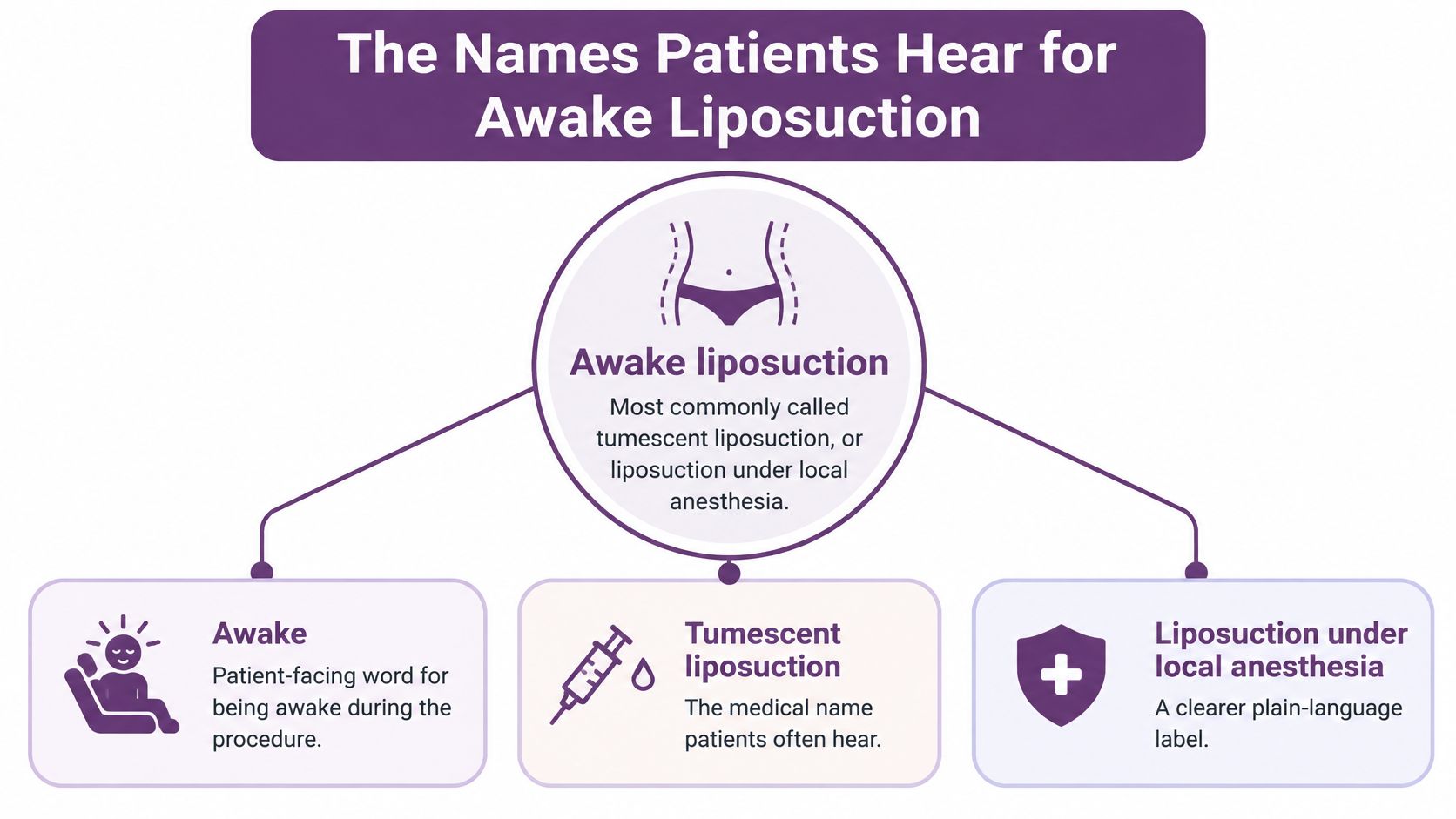
Awake liposuction is most commonly called tumescent liposuction, or liposuction under local anesthesia. “Awake” is the patient-facing term, describing the patient's responsiveness rather than a separate fat-removal technique.
But if you're awake, does that necessarily mean you're receiving local anesthesia alone? Not always. A clinic may use the word awake even when it adds medication for relaxation or sedation, so understanding the full anesthesia plan matters more than recognizing the advertised name.
Table of Contents
- The Names Patients Hear for Awake Liposuction
- How Tumescent Numbing Makes Awake Surgery Possible
- Awake Versus General Anesthesia Liposuction Compared
- Who Qualifies for Awake Liposuction
- Lidocaine Dosing Limits and Complication Risks
- What Recovery Usually Looks Like Day by Day
- Choose Your Anesthesia Plan at Your Consultation
The Names Patients Hear for Awake Liposuction
Tumescent liposuction under local anesthesia is the clearest clinical answer to “What is awake liposuction called?” The shorter names overlap, but they don't all describe exactly the same thing: some describe awareness, while others identify how the treatment area is numbed.
Think of the terminology as labels attached to different parts of the same procedure. Awake tells you something about the patient's experience; local anesthesia identifies where the numbing medication works; tumescent identifies the fluid-infiltration technique.
Awake liposuction terms and what each one means
| Term | What It Describes | Clinical Precision |
|---|---|---|
| Awake liposuction | Patient-facing name for liposuction in which the patient stays responsive | Descriptive, not a technique name |
| Awake lipo | Informal shortening of awake liposuction | Informal, same meaning |
| Wide-awake liposuction | Variant wording for the same local-anesthesia approach | Patient-facing variant, not a separate technique |
| Tumescent liposuction | Fat removal after a dilute lidocaine and epinephrine solution is infiltrated into the fat | Established technical term |
| Liposuction under local anesthesia | Procedure using numbing medication without general anesthesia | Precise as a local-only label when no IV or inhaled anesthetic is added |
| Tumescent liposuction under local anesthesia | Full clinical label combining the technique and anesthetic method | Most precise label |
The connection between these names is easier to see when you separate the patient-facing description from the medical method.
California dermatologist Jeffrey Klein formally described the tumescent technique in 1987, establishing an approach that enabled selected liposuction procedures without general anesthesia or intravenous sedation, as documented in this history of liposuction. That history explains why tumescent is an established technical term rather than another advertising phrase.
What the name doesn't tell you
Wide-awake isn't a separate fat-removal technology. Likewise, liposculpture describes a contouring goal, while terms such as laser-assisted or high-definition describe another aspect of treatment rather than establishing the anesthesia plan.
A clinical review of tumescent liposuction supports distinguishing local-anesthesia treatment from approaches involving additional anesthetic medication. A patient can remain responsive while receiving an adjunct, so consciousness alone doesn't identify every drug being used.
Practical test: Ask whether the plan uses local anesthesia alone or adds oral or IV sedation. The answer is more informative than the word awake.
How Tumescent Numbing Makes Awake Surgery Possible
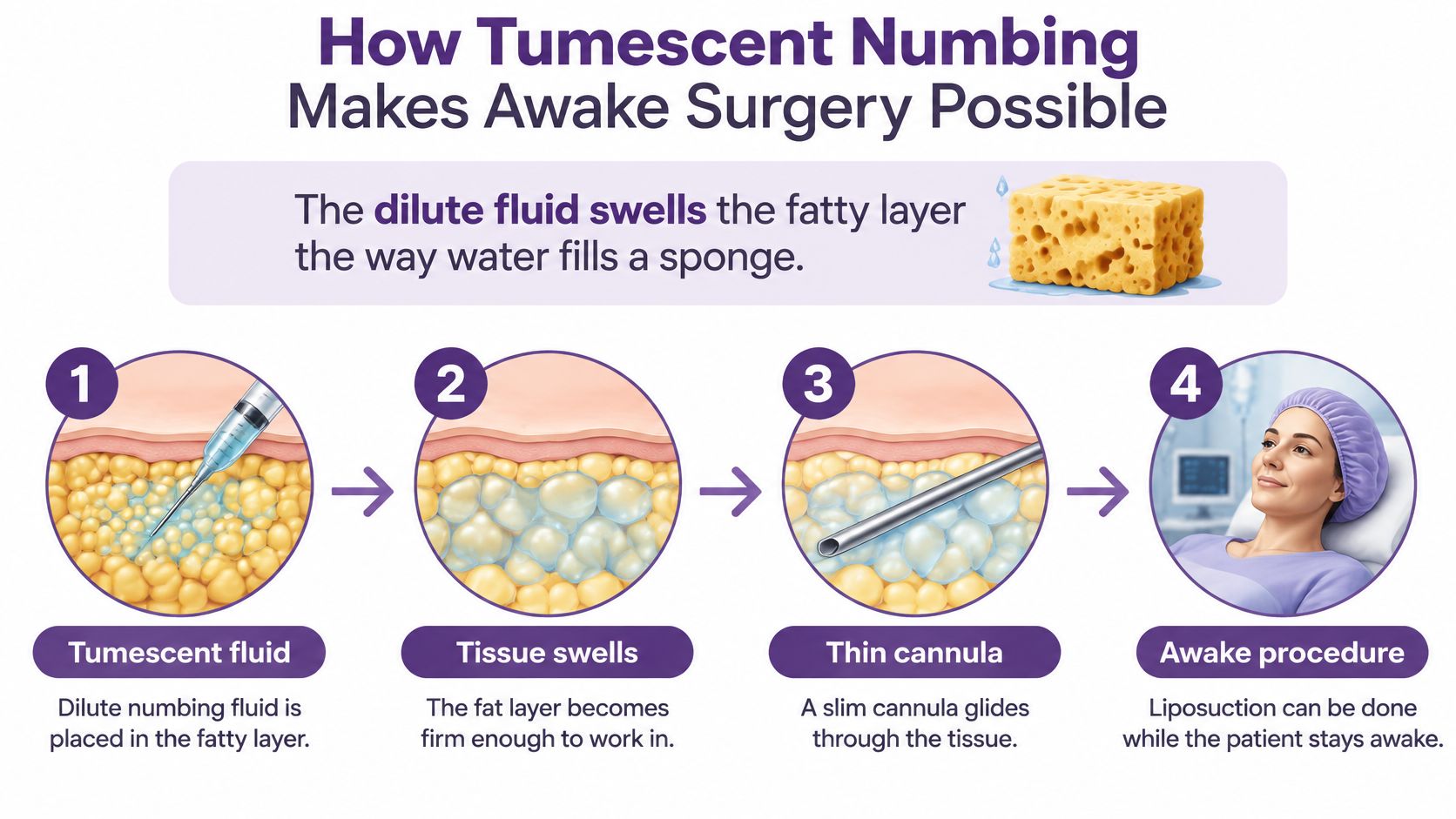
The dilute fluid swells the fatty layer somewhat like water filling a sponge. The tissue becomes swollen and firm, creating the tumescence that gives the technique its name.
Say you're having a localized contouring procedure. Before removing fat, the surgeon distributes the numbing solution throughout the planned treatment area rather than relying only on injections around the skin openings.
The treatment sequence
- Place the tumescent fluid. The surgeon introduces saline containing dilute lidocaine and epinephrine through small cannulas into the fatty layer to distribute medication across the treatment field.
- Allow the tissue to swell. The infiltrated fluid makes the tissue firm and expanded, preparing the area for controlled cannula-assisted treatment.
- Allow the medication to work. Lidocaine blocks pain transmission, while epinephrine narrows small blood vessels and helps reduce bleeding.
- Remove the targeted fat. Once adequate numbness is established, the surgeon uses a suction cannula to remove fat according to the contouring plan.
This illustration summarizes the physical sequence, but medication selection and assessment remain clinical tasks.
Before the late 1980s, substantial fat removal under local anesthesia was difficult because conventional lidocaine dosing could approach safety limits; Klein's dilute, larger-volume approach helped make it practical, according to an Aesthetic Surgery Journal historical review.
Numbness isn't the same as no sensation
You may still notice movement, pressure, or tugging. Experiences differ, and being responsive lets you tell the surgical team when a sensation becomes uncomfortable.
Sharp pain isn't something you're expected to tolerate. Tell the team promptly so the surgeon can reassess, pause, or modify treatment within the agreed safety plan.
The explanation of tumescent local anesthesia can help you prepare questions about how the treatment area is numbed. The important distinction is that the fluid isn't merely a mechanical preparation: it contains medication whose total dose and absorption require careful planning.
Awake Versus General Anesthesia Liposuction Compared
The terms awake and tumescent describe different parts of a liposuction plan. Awake refers to the patient's level of consciousness; tumescent refers to local anesthetic fluid placed in the treatment area. A procedure can use local anesthesia alone or combine it with sedation, so the word “awake” does not tell you the full medication plan.
| Factor | Awake (Tumescent Under Local Anesthesia) | General Anesthesia |
|---|---|---|
| Anesthetic used | Local anesthetic solution, alone or with sedation, depending on the plan | General anesthetic given by an anesthesia provider |
| Patient awareness | Responsive with local-only anesthesia or conscious sedation | Unconscious during treatment |
| Typical suited volume | Limited or staged areas, as assessed by the surgeon | Larger-volume or multi-area treatment, as assessed by the surgeon |
| Monitoring | Vital signs, medication totals, and lidocaine dosing are assessed throughout | Continuous monitoring under anesthesia care |
| Recovery focus | Recovery depends on the medications used and the procedure performed | Recovery includes the effects of general anesthesia as well as surgical healing |
| Typical setting | Office procedure room or accredited facility appropriate to the plan | Accredited surgical facility or hospital appropriate to the plan |
A technical review of tumescent liposuction distinguishes local-only tumescent treatment from procedures that add intravenous, inhaled, or general anesthesia. It also explains why greater treatment volume can make fluid management, blood loss, temperature control, and anesthetic toxicity more consequential.
Potential benefits and limitations of awake treatment
- Avoiding unconsciousness: Appropriate candidates may undergo treatment without general anesthesia.
- Remaining responsive: Some patients value being able to communicate; others may find awareness stressful.
- Treatment scope: Limited or staged areas can be considered as part of the overall plan.
- Comfort and stillness: You need to tolerate positioning and procedural sensations without sudden movement.
- Medication constraints: The surgeon must keep the plan within individualized local-anesthetic limits.
A benefit only matters if it fits your health, preferences, and proposed procedure.
When general anesthesia may fit better
- Awareness preference: Some patients prefer not to be conscious during treatment.
- Procedure extent: Larger-volume, multi-area, or longer procedures may call for general anesthesia or monitored anesthesia care.
- Anesthesia planning: The anesthesia provider should explain the risks and recovery requirements associated with the proposed approach.
For a small, single-area contouring goal, awake treatment is one option to discuss. With a more extensive plan, the comparison may be between staged local-anesthesia treatment and a procedure using monitored anesthesia care or general anesthesia.
Choose the anesthesia plan that fits the operation and the patient, not an operation designed around a preferred advertising label.
Who Qualifies for Awake Liposuction
Appropriate patient selection matters more than the name of the anesthetic approach. Wanting to avoid general anesthesia is a preference to discuss, not proof that a local-only procedure will meet your needs.
A systematic review of liposuction complications identifies factors such as patient selection, anesthesia type, aspirated volume, monitoring, and fluid management as important to risk assessment. Those considerations require a medical evaluation rather than a decision based on photographs alone.
What your physician evaluates
- Treatment area and estimated volume: A localized concern may allow a different plan from widespread contouring, even when both patients describe their goal as abdominal liposuction.
- Number of areas: Your physician considers the combined scope, not only whether each area can technically be treated.
- Staging options: Separating treatment into sessions may be worth discussing when a single extensive procedure isn't appropriate.
- Medical history: Heart, lung, liver, and kidney conditions can influence medication handling, monitoring needs, and the choice of setting.
- Current medications: Prescription medicines, nonprescription drugs, and supplements belong on the preoperative medication list.
- Positioning and stillness: Joint pain, back problems, or difficulty maintaining a position may affect whether you can comfortably complete treatment.
- Anxiety: Your ability to remain calm enough to cooperate is a legitimate clinical consideration, not a test of willpower.
When the plan may need to change
Consider patients with similar-looking flank fullness. One may want a modest adjustment and feel comfortable remaining responsive; another may want several surrounding areas treated and feel highly distressed about awareness.
Their external anatomy may look comparable, but their procedural needs aren't the same. Extensive areas, high anticipated aspirate volume, significant medical conditions, or anxiety that prevents stillness may change the anesthesia recommendation or make postponement appropriate.
Our liposuction candidacy checklist can help you organize your history and goals before an appointment. Bring a complete medication list and describe practical limitations, including positions you can't comfortably maintain.
Your physician should determine candidacy after reviewing your anatomy, medical history, and desired changes together. In some circumstances, a hospital or accredited surgical facility may provide a more appropriate environment than an office-based procedure room.
Lidocaine Dosing Limits and Complication Risks
Maximum lidocaine doses cited in the literature
Lidocaine dose figures depend on how the medication is used. The published study of estimated maximal safe tumescent lidocaine dosages reports FDA labeling of 7 mg/kg, published tumescent estimates of approximately 28 mg/kg without liposuction and 45 mg/kg with liposuction, and a cited American Society for Dermatologic Surgery guideline maximum of 55 mg/kg.
| Context | Maximum Lidocaine Dose (values from the cited study linked above) | What It Applies To |
|---|---|---|
| Ordinary infiltration local anesthesia (FDA labeling) | 7 mg/kg | Standard infiltration with epinephrine, not tumescent liposuction |
| Tumescent lidocaine without liposuction | Approximately 28 mg/kg | Published estimate |
| Tumescent lidocaine with liposuction | Approximately 45 mg/kg | Published estimate for liposuction |
| Liposuction entirely under local anesthesia (ASDS guideline) | 55 mg/kg | Higher cited maximum, not interchangeable with other values |
Use these figures as context for clinician-led dosing, not as a personal dosing guide. Published estimates inform medical judgment; the appropriate amount depends on the patient, medication formulation, and procedure.
Ordinary infiltration and tumescent infiltration differ in concentration, distribution, and absorption. Epinephrine, timing, whether liposuction removes some infiltrated medication, and total procedure volume also affect how a dose is interpreted.
Why the calculation requires clinical judgment
A surgeon considers body weight alongside medical history, medication interactions, solution concentration, and all other local anesthetic administered. Treating a larger surface area may require more solution, while the total amount of medication still needs careful calculation.
A clinical review of tumescent anesthesia emphasizes individualized dosing and recognition of delayed local-anesthetic systemic toxicity. Absorption can continue after treatment, so medication-related risk may persist after the procedure ends.
Warning symptoms can include ringing in the ears, a metallic taste, numbness around the mouth, or dizziness. Report symptoms immediately during treatment and follow the surgical team's urgent instructions if they occur afterward. A seizure, collapse, or difficulty breathing requires emergency assistance.
Safety distinction: Awake describes the patient's state of consciousness; tumescent describes an anesthetic technique. Safety depends on the medication plan, monitoring, and emergency readiness.
Complications beyond medication toxicity
Liposuction carries surgical risks whether or not the patient remains awake.
- Seroma: Fluid can collect beneath the skin and may require assessment or treatment.
- Hematoma: Blood can accumulate in a treated area.
- Contour irregularity: Unevenness or asymmetry may appear during healing or persist.
- Skin injury: Treated skin can sustain damage.
- Infection: Increasing redness, pain, or concerning drainage needs medical review.
- Local-anesthetic toxicity: Excessive anesthetic in the circulation can affect the nervous and cardiovascular systems.
Written perioperative protocols should cover dose documentation, monitoring, discharge instructions, and responses to complications. Patients should know whom to contact after hours and when to seek emergency care rather than wait for a routine callback.
What Recovery Usually Looks Like Day by Day
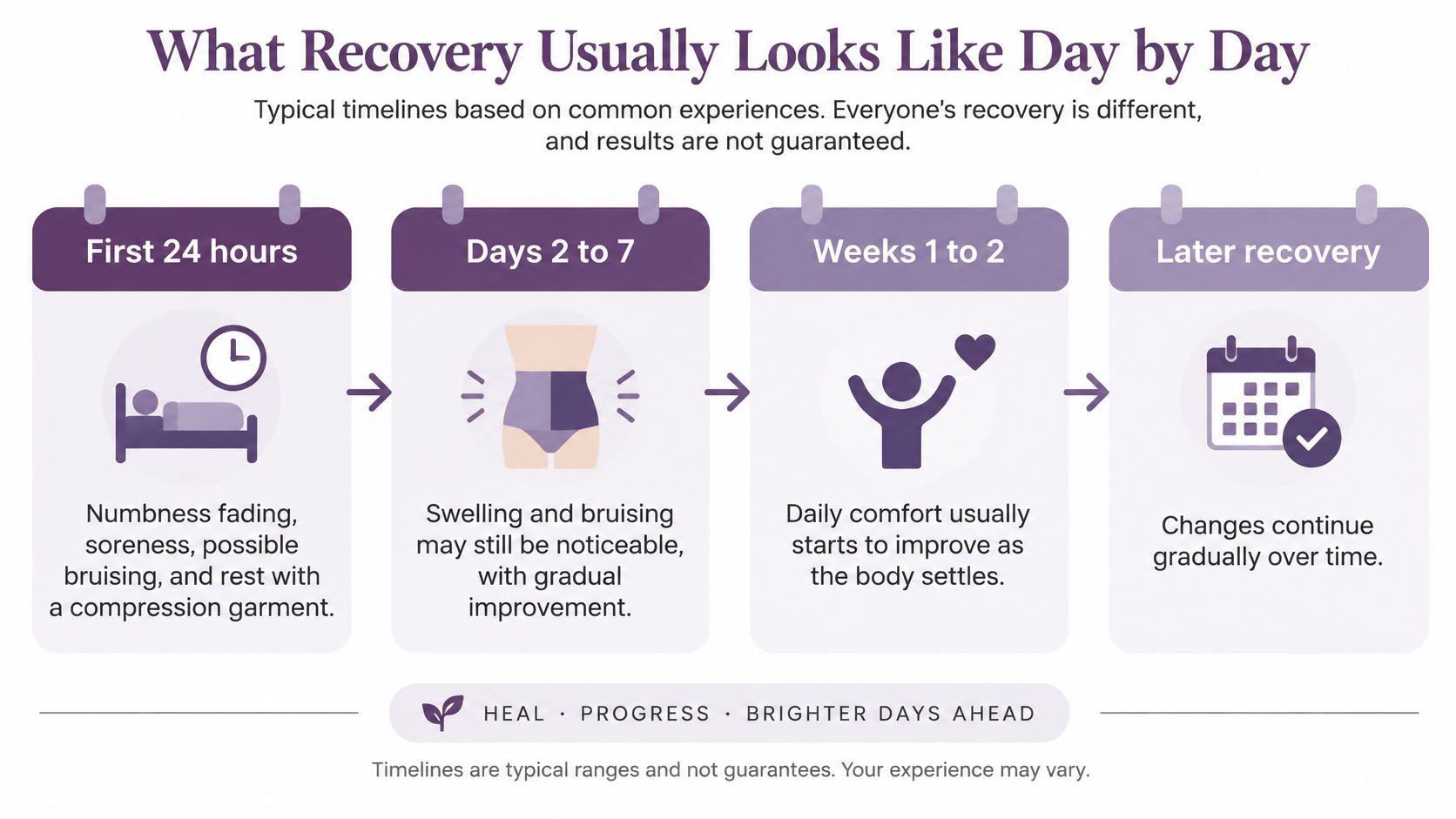
Recovery after liposuction unfolds over time, and the pace depends on the treated area, amount removed, and individual healing. The day ranges below offer general orientation. Your surgeon's written instructions guide decisions about compression, wound care, driving, work, and exercise.
The first day
As numbness fades, soreness and bruising can become more noticeable. Rest, use your compression garment if prescribed, and follow the medication and dressing instructions provided by your surgical team.
Days 2–7
Swelling and bruising commonly remain visible during the first week, then begin to improve. Gentle walking is often part of early recovery; wait for your surgical team's clearance before heavy lifting or strenuous activity.
Desk work and exercise readiness are separate milestones. Plan around your actual duties, including commuting, carrying equipment, prolonged standing, or caring for children.
The following weeks
As comfort improves, your surgeon can guide a gradual return to normal activity. Early contour changes offer only a partial view of the result because swelling can obscure the shape as healing continues.
For more detail on healing and preparation, read this guide to recovery after liposuction and optimizing healing. If a clinician recommends professional help at home, Vitals Healthcare Doctor On Call describes continuous clinical support after hospital discharge. Any outside care should coordinate with, not replace, your surgeon's instructions.
- Contact your surgical team promptly: Report fever, increasing pain or redness, unusual drainage, or concerning swelling.
- Seek urgent assessment: New one-sided leg swelling or pain needs prompt attention.
- Get emergency help: Breathing difficulty, chest pain, or collapse requires immediate emergency assistance.
Save your after-hours contact information before treatment so you can reach the right care team promptly if a concern arises.
Choose Your Anesthesia Plan at Your Consultation
A useful consultation ends with a specific plan you can explain in plain language. You should understand what medication will be used, what treatment is proposed, and what the team will do if circumstances change.
Bring these questions in writing so the conversation doesn't stop at whether you're awake or asleep.
Questions that clarify the proposed procedure
- Which anesthetic will be used? Ask whether the plan is local only, local with oral or IV sedation, or general anesthesia, and who will administer and monitor it.
- Which areas are planned? Discuss the estimated fat volume and whether the proposed scope fits a single session.
- How is my lidocaine dose calculated? Ask how your weight, medical history, medications, and other anesthetics affect the calculation.
- What safety resources are in place? Clarify monitoring, emergency equipment, facility accreditation where applicable, and arrangements for escalation of care.
- What happens if the plan needs to change? Discuss discomfort, anxiety, incomplete treatment, and whether the procedure would be paused or stopped.
A clear answer doesn't need to be full of technical terminology. It should explain why the proposed approach suits you and identify its limits without minimizing them.
Planning care with Luxe
At Luxe Aesthetic Surgery & Medical Spa, we offer awake liposuction using local anesthesia for stubborn fat in areas such as the abdomen, waist, flanks, back, arms, and thighs, with tumescent and hi-definition options. We serve patients throughout Los Angeles, Santa Barbara, and Ventura counties.
Your consultation allows us to weigh your anatomy, goals, and medical history before recommending an individualized plan. Bring your medication list, relevant medical records, and a description of the changes you're hoping to achieve.
Our office is open Monday through Friday from 9am to 6pm, with Saturday visits by appointment only, and is closed Sunday. When arranging your consultation, make the anesthesia question your starting point, then compare the proposed treatment with your comfort needs and medical circumstances.
Luxe Aesthetic Surgery & Medical Spa offers awake liposuction and individualized body-contouring planning for appropriate candidates. Visit Luxe Aesthetic Surgery & Medical Spa to request a consultation, and ask whether local anesthesia alone fits your treatment areas, health history, and goals.