Medical Expertise at Luxe Aesthetic Surgery
Luxe Aesthetic Surgery & Medical Spa is led by Haimesh Shah, MD, RPVI , a physician specializing in cosmetic surgery, body contouring, laser procedures, and venous medicine. Dr. Shah is a Diplomate of the American Board of Laser Surgery, American Board of Venous & Lymphatic Medicine, American Board of Wound Management, and American Board of Internal Medicine. He also holds the Registered Physician in Vascular Interpretation (RPVI) credential and has contributed to peer-reviewed medical research.
The most popular answer to how long after liposuction can I drink alcohol is also the most misleading one. 24 hours gets repeated as if it's a green light for tomorrow night. It isn't. It's a safety floor, the earliest point anyone should even start thinking about it, and for many people the answer is set by their pain medicines and how their incisions are healing, not by the clock.
Table of Contents
- How Long to Wait Before Alcohol
- Why Alcohol Interferes With Healing
- Steps Before You Consider a Drink
- Signs You Should Wait Longer
- Tips for the Alcohol-Free Stretch
- Ask Your Surgeon Before the First Drink
How Long to Wait Before Alcohol
There is no single waiting period that fits every liposuction patient. Healing speed, medicines, anesthesia type, bleeding risk, and written instructions from the surgeon all shift the date. A fixed date from a general article is a guess.
Think of 24 hours as the floor under the whole decision. The Cleveland Clinic surgical guide states that patients should not drink alcoholic beverages for at least 24 hours after surgery because alcohol can interact adversely with anesthesia and other drugs, and the same guidance says not to drive or operate machinery during that period. Clearing that first day means little if dizziness, heavy sleepiness, nausea, dehydration, or a general unwell feeling is still present.
The Medicine Rule Runs Longer Than the Clock
Most patients are waiting on prescriptions, not the calendar. Alcohol stays off the table for the entire time opioids are in use, including oxycodone, morphine, hydromorphone, fentanyl, or tramadol, which Mayo Clinic anesthesia guidance specifically advises not to combine with alcohol. The same pause applies to benzodiazepines, gabapentin or pregabalin, muscle relaxants, sleep aids, and other sedatives.
Combination pills such as oxycodone-acetaminophen add liver strain to that sedation risk, since alcohol increases concern around acetaminophen containing products. The bottle looking almost empty is not the signal. The signal is that those medicines have been stopped and the prescriber has said alcohol is allowed.
Longer abstinence periods seen in research describe biology, not a drink date. A 2025 consensus statement from the Association of Anaesthetists reports that at least 2 weeks of abstinence can improve platelet function and reduce bleeding risk, while 8 weeks or longer may improve wound healing. Those findings explain why recovery stays sensitive well after day one. They do not set week two or week eight as clearance.
Alcohol Timing After Liposuction by Situation
| Situation | Earliest consideration | Why it is often longer |
|---|---|---|
| Any liposuction, first night | At least 24 hours with no alcohol | Residual anesthesia and early drug interactions |
| Still taking opioids, benzodiazepines, gabapentinoids, muscle relaxants, or sleep aids | Only after those medicines are stopped and the prescriber allows alcohol | Sedation, slow breathing, falls, and possible fatal interaction |
| Acetaminophen combination pain pills | Same medicine based wait, plus liver caution | Alcohol adds risk on top of acetaminophen |
| Bruising, oozing, or active swelling | Not while those signs are active | Bleeding is harder to judge and clotting may be less reliable |
| Uncomplicated healing, off sedating medicines | Often a conservative window of several weeks, then surgeon approval | 24 hours is a minimum, not a restart date |
| Bleeding risk and wound healing biology | Abstinence findings only, not a liposuction drink date | See platelet and wound healing timelines discussed above |
| Awake or tumescent liposuction but feeling fine | Same medicine and healing rules | Alertness does not equal healed tissue |
| Frequent or heavy drinking | Do not quit abruptly, tell the surgical team | Stopping suddenly can carry its own medical risk |
Use the row that matches medicines and symptoms. When two rows apply, follow the longer wait. Feeling alert soon after awake liposuction with local anesthesia changes none of this, because postoperative analgesics, dehydration, active drainage, and delayed bleeding can still be present. Any longer instruction from the treating surgeon wins.
Why Alcohol Interferes With Healing
Healing after liposuction isn't finished when anesthesia wears off. Small access sites need to close, bruised tissue needs to settle, and fluid needs to move out in an orderly way. Alcohol works against several parts of that process at once.
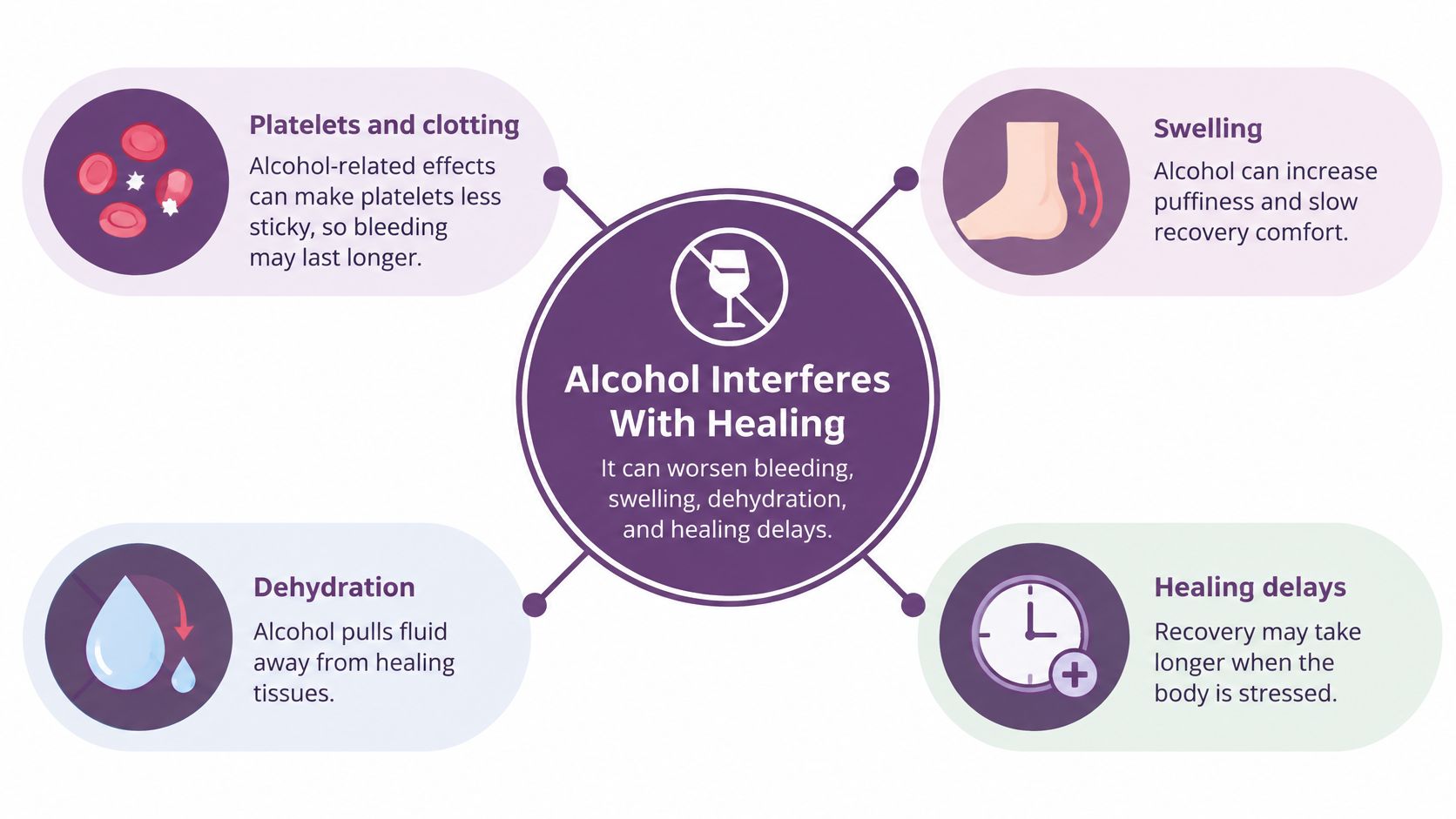
Platelets are the blood cells that help you clot, and alcohol related effects can influence platelet function so platelets may become less sticky and bleeding may increase. When you're still oozing a little from access sites, a drink can also blur the picture. You and your clinic both have a harder time telling ordinary drainage from drainage that's getting worse.
What the Infection Data Does and Doesn't Say
Hazardous alcohol exposure is linked to impaired immune competence, poorer wound healing, and impaired coagulation. A perioperative study in Acta Anaesthesiologica Scandinavica found hazardous alcohol consumption independently associated with severe postoperative infection, with an adjusted odds ratio of 3.26 (95% CI 1.42 to 7.54). That is not a liposuction complication rate, and it doesn't mean one drink after every procedure causes infection. It does show why surgeons treat alcohol as a healing issue, not just an anesthesia issue.
Readers often merge three very different patterns into one question:
- A single drink after clearance: an uncomplicated recovery, off sedating medicines, with your surgeon aware and in agreement.
- Repeated or binge drinking: several drinks, several nights, while tissues are still repairing.
- Any alcohol during active swelling and drainage: the riskiest timing of the three, regardless of quantity.
Fluid balance matters too. Alcohol promotes fluid loss while early recovery instructions push fluids, and dehydration can worsen dizziness and make swelling harder to read. If you're trying to judge whether puffiness is normal, adding a dehydrating drink doesn't help. The broader picture of understanding alcohol's mind and body effects is useful background here, since judgment is part of the risk, not a side note.
Say you feel surprisingly good on day three. You're still draining a little, and you take one opioid tablet at night to sleep. A glass of wine at dinner feels harmless because you feel recovered. It isn't proven safe by how you feel, because the interaction risk arrives after the drink, not before it. Alcohol can also lead to falls, skipped compression, too much activity, missed doses, and missed warning signs like faintness or excess bleeding. Our guide to recovery after liposuction and optimizing healing covers how those early days are supposed to look when things are on track.
Moderation is not a substitute for clinical clearance. Your medication list and recovery status matter more than a fixed drink count.
Steps Before You Consider a Drink
24 hours without alcohol is the minimum, not clearance. The actual decision comes after that, when your medicine list no longer includes sedating drugs and your healing milestones check out. Run the steps below in order.
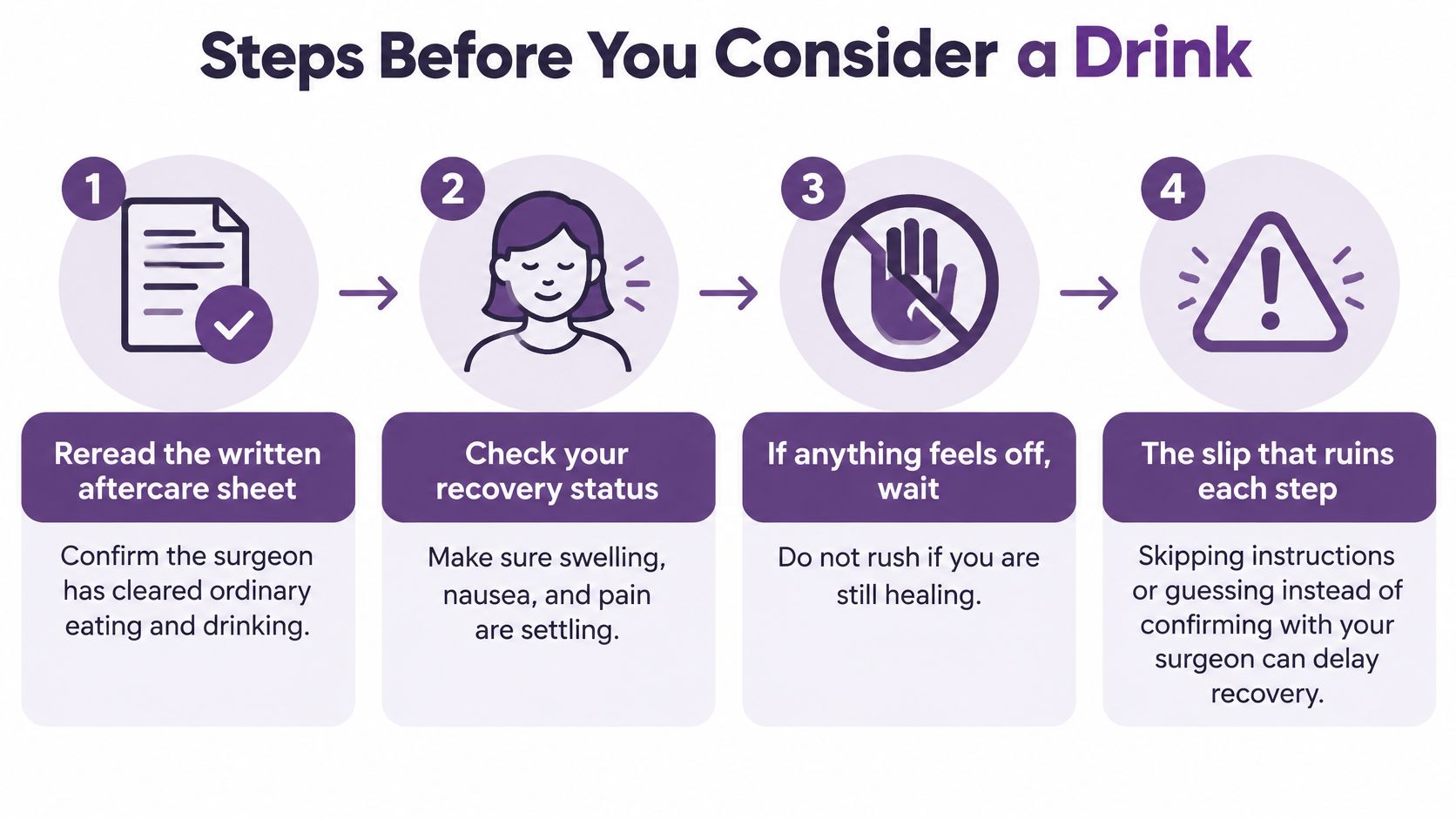
- Reread your written aftercare sheet first. Confirm your surgeon has cleared ordinary eating and drinking. Generic anesthesia advice often ends sooner than liposuction instructions, and your surgeon's sheet outranks anything you read online.
- Take no alcohol for at least the first 24 hours. That includes wine with dinner and alcohol hidden in cough syrups or nighttime remedies. Is a 24 hour drug label interval the same as liposuction clearance? No. The FDA safety labeling for remifentanil specifically advises avoiding alcohol for 24 hours after surgery, but that is a label floor for one drug, not your restart date.
- Write down every medicine you are still taking. List opioids, benzodiazepines, gabapentin or pregabalin, muscle relaxants, sleep aids, antibiotics, and prescription anti-inflammatories. The FDA safety labeling for remifentanil warns that alcohol combined with opioids, benzodiazepines, gabapentinoids, muscle relaxants, or residual anesthetic drugs can cause profound sedation, respiratory depression, hypotension, coma, or death. Checking only the pain pill while forgetting the sleep aid leaves the most dangerous interaction in place.
- Check your milestones before you ask. You want no active bleeding or unusual drainage, bruising and swelling clearly improving, steady food and fluids, normal urination, no dizziness or nausea, and safe walking. Because a garment can hide swelling, assess progress at each change and follow your plan for how long to wear a compression garment after lipo rather than loosening it for an evening out.
- Get explicit approval, not silence. Ask directly, especially after large volume fat removal or a combined procedure such as a tummy tuck or breast surgery. What if no one mentioned alcohol at your follow up? That silence is not permission.
- Tell the team if drinking has been frequent or heavy. Do not stop cold on your own. Withdrawal may begin 4 to 12 hours after the last drink and can last up to 24 hours, according to a 2024 perioperative review. Hiding intake out of embarrassment leaves the team unable to plan for it safely.
Local anesthesia does not let you skip steps three through five. Awake patients can still receive sedatives and postoperative analgesics, and those carry the same interaction risk.
Signs You Should Wait Longer
Time passing does not clear you if your body is still asking for help. Dizziness, heavy sleepiness, nausea, vomiting, poor eating, low fluid intake, ongoing drainage, fast spreading bruises, extra bleeding, fever, incision redness, worsening pain, or abnormal discharge all mean the drink waits. A date on the calendar never overrides those signals.
The early window can fool you because you may feel alert while reactions and coordination are still dulled by anesthesia or postoperative medicines. Alcohol makes that gap wider. It adds to dizziness and fluid loss, and it blurs the picture for you and your clinic when you try to judge whether swelling or bruising is getting better or worse.
Why the Early Window Looks Messy
Healing rarely moves in a straight line in the first days. Drainage often lessens early, then bruising and swelling rise and fall before they settle. That uneven pattern is normal, and it is also the reason day two or day three is not a green light on its own. As covered in Why Alcohol Interferes With Healing, bleeding risk is higher in this phase, so any sign of active bleeding deserves a sober read.
Keeping an eye on basic recovery signals is part of checking health through daily habits, and after liposuction those small checks matter more. Look when you change your garment. Are fluids staying down. Is urine normal. Can you walk steadily without nausea or lightheadedness. Stay with a responsible adult through the first stretch, since judgment can lag behind how well you think you feel.
Symptoms That Delay Alcohol and What to Do
| What you notice | Why alcohol waits | What to do |
|---|---|---|
| Dizziness, heavy sleepiness, or poor balance | Anesthesia or medicines may still be active | No alcohol, no driving, stay with a responsible adult |
| Nausea, vomiting, or poor eating and drinking | Dehydration and missed medicines become more likely | Pause alcohol and follow the surgeon's intake instructions |
| Ongoing drainage or bruises that are spreading | Bleeding and swelling are still being judged | Abstain and contact the team if bleeding or swelling increases fast |
| Fever, redness, worsening pain, or abnormal discharge | Possible complication, not a reason to self treat | Call the surgical team the same day |
| Still taking an opioid or other sedating pill | Interaction risk remains regardless of how alert you feel | Finish and clear the medicine before any drink is discussed |
Each row points to the same gate. Medicines first, healing milestones second. Dizziness means the nervous system has not reset. Nausea means fluids and doses are at risk. Drainage or spreading color means the wound story is unfinished. Fever, redness, or rising pain means the clinic needs to hear from you that day. A sedating prescription on the list means the answer stays no until it is finished and cleared.
Do not manage these signs with alcohol or a non prescribed pain remedy. Your surgeon's own instructions outrank this list.
Tips for the Alcohol-Free Stretch
Rules are easy to agree with at noon. They're harder at a birthday dinner on day five, when someone pours you a glass and you don't want to explain your surgery. Plan that moment in advance and it gets much simpler.

Start with fluids and food, because that's what early recovery asks for. Cambridge University Hospitals discharge guidance advises avoiding alcohol for at least 24 hours after a general anesthetic and recommends drinking plenty of fluid, about a glass or cup every hour if possible, and eating small amounts of light, easily digested food until the following day. Unless your own instructions differ, water and your surgeon approved diet come first.
For the dinner itself, try these substitutions:
- Use a one line refusal: "I'm on medication, so I'm off alcohol for a bit" closes the subject without surgical details.
- Order something sealed or clearly nonalcoholic: a bottled sparkling water or kombucha won't be refilled with wine by mistake, and Pep Tea's guide to Dry January has practical ideas for making a nonalcoholic drink feel like a deliberate choice rather than a penalty.
- Keep your routine ahead of the event: compression on, medication times unchanged, and short walks only if your surgeon encouraged them.
Don't use a drink as a sleep aid or as a replacement for prescribed pain control. Both swaps trade a measured dose for an unmeasured one, and alcohol disrupted sleep doesn't help tissue repair.
Antibiotics deserve a plain caution without a slogan. You don't need a myth about alcohol cancelling the drug. Nausea, dehydration, and poor judgment mid course are reason enough to wait for your prescriber rather than testing a drink. And if you drink heavily, willpower isn't a withdrawal plan. That risk belongs with your surgical team before and after surgery, not in a private resolve.
Once you've been cleared, a lower risk first evening looks modest. You're off sedating medicines, your swelling is stable, you've eaten, water is nearby, and you stop at one modest drink rather than making up for lost time. Even then, bruising and swelling vary by treated area, aspirate volume, and whether another procedure was combined with your liposuction, so your friend's timeline isn't yours.
If you're still deciding whether a symptom is normal, it's not a night for alcohol.
Ask Your Surgeon Before the First Drink
Approval beats arithmetic. Counting days past surgery feels concrete, but your surgeon clears the combination of medicines, wounds, and healing pace, not the calendar alone. A 24 hour pause is a safety floor after liposuction, even after awake liposuction with local anesthesia. The key is whether sedating drugs are finished, drainage has stopped, and swelling and bruising are stable.
Make that call productive by bringing specifics. List every pain or sleep medicine still in use, including a nighttime-only dose. Describe drainage, spreading bruises, or swelling that still shifts day to day. Name the size of the treated area and whether liposuction was paired with a tummy tuck, fat transfer, or another contouring step. Those details let your surgeon judge bleeding risk, fluid balance, and drug interaction in one pass.
If you are already a Luxe Aesthetic Surgery & Medical Spa patient, use the channel you were given. All surgery patients are given Dr. Shah's personal cell phone number for questions or concerns after the procedure, and an alcohol timing question belongs there instead of a guess based on a general rule. Haimesh Shah, MD, RPVI, Medical Director of Luxe Aesthetic Surgery & Medical Spa, holds board certifications with the American Board of Venous and Lymphatic Medicine, the American Board of Laser Surgery, and the American Board of Internal Medicine.
Planning a combined procedure raises sharper questions. Ask how the added area changes expected drainage time, which medicines will overlap and for how long, and what healing milestone should come first before alcohol enters the picture. Our list of essential questions for your liposuction surgeon can help you write those down before the consult.
The practice is open Monday through Friday, 9am to 6pm, Saturday by appointment only, and closed Sunday, so readers in Southern California who want aftercare explained before surgery can request a consultation during those hours. Bring your medication list, your alcohol habits, and your questions about anesthesia options and recovery milestones, starting with the one about your first drink.
If you're weighing liposuction and want aftercare explained before you commit, Luxe Aesthetic Surgery & Medical Spa offers personalized body contouring consultations where medicines, alcohol habits, anesthesia options, and recovery milestones are part of the conversation from the start. Visit the site to request a consultation and bring your medication list and your questions, including the one about your first drink.