Medical Expertise at Luxe Aesthetic Surgery
Luxe Aesthetic Surgery & Medical Spa is led by Haimesh Shah, MD, RPVI , a physician specializing in cosmetic surgery, body contouring, laser procedures, and venous medicine. Dr. Shah is a Diplomate of the American Board of Laser Surgery, American Board of Venous & Lymphatic Medicine, American Board of Wound Management, and American Board of Internal Medicine. He also holds the Registered Physician in Vascular Interpretation (RPVI) credential and has contributed to peer-reviewed medical research.
Many cosmetic liposuction patients wear compression nearly continuously for about 2–4 weeks and then taper, while one ASPS-cited surgeon range is 4–8 weeks, and your operating surgeon's instructions override any general timeline. That spread confuses people because it sounds like two different answers. It isn't. The early weeks are about steady support while swelling is heaviest, and the later weeks are about whether your tissues still need that support during the day. Asking how long to wear compression garment after lipo is really asking two questions. How long should you wear it almost all day and night, and what signs tell you it's time to step down? A calendar date alone can't answer the second question. Fit, swelling, skin condition, and incision healing can.
Table of Contents
- How Long Most Patients Wear Compression After Lipo
- How to Wear the Garment Through Each Phase
- Findings That Change How Long You Wear It
- Fit Pressure and Comfort Tips That Matter More
- Red Flags to Report Before You Keep Wearing It
- Confirm Your Wear Plan at Follow-Up
How Long Most Patients Wear Compression After Lipo
For routine cosmetic cases, plan on several weeks of compression, with the most intensive wear early. Most patients start with continuous or nearly continuous use, then reduce hours once swelling and tenderness improve. That taper is planned with the surgeon, not decided because the garment is annoying on a warm afternoon.
What the published ranges actually say
The American Society of Plastic Surgeons liposuction patient handbook says swelling generally begins decreasing by the end of the first postoperative week and that compression-garment use should continue for "a few weeks" to support healing and control residual swelling. The same guidance notes bruising and swelling commonly remain substantial during at least the first 48–72 hours. That helps set expectations. Feeling puffy and firm on day two doesn't mean the garment has failed.
A prospective study of male patients undergoing high-definition liposculpture reported an average wear period of 21.2 days, with a range of 20–25 days, under a protocol that recommended 3 weeks. Treat that as a reference point for one type of sculpting, not a prescription for every abdomen, arm, or thigh. Treated areas, fat volume removed, skin quality, edema, bruising, combined procedures, garment fit, and surgical technique can all move the timeline.
Another data point explains why some patients hear a longer number. An ASPS patient-recovery article reports one surgeon's recommendation that liposuction patients wear a customized compression garment for four to eight weeks. The article also describes bruising, swelling, and firmness as common during approximately the first through third weeks. So a four to eight week plan doesn't necessarily mean 24 hour wear for eight weeks. It often means full time wear first, then reduced hours while tissues settle.
A phase view you can use today
| Phase | Typical schedule | Hours per day | What is often happening |
|---|---|---|---|
| Days 0–7 | Nearly continuous, off only to shower and check skin | Nearly 24 hours | Bruising and swelling often heavy for 48–72 hours; swelling may start easing by day 7 |
| Weeks 2–3 | Still full time for many cosmetic cases | Nearly continuous | HD liposculpture series averaged 21.2 days (range 20–25); a 3-week protocol is a common reference |
| Weeks 4–8 | Daytime or reduced hours if swelling persists | Often at least 8–12 hours | One ASPS-cited surgeon range is 4–8 weeks; firmness can still be present |
| After about 8 weeks | Taper or stop only when the surgeon agrees | As directed, sometimes none | Swelling can keep improving past 6 weeks and sometimes for months |
| Combined tummy tuck, breast surgery, or large volume | Surgeon-specific, often longer | As written in aftercare | General cosmetic ranges do not override that plan |
One clinic protocol illustrates the reduced-hours idea in concrete terms. In 2024, NAISS Clinic recommended wearing compression garments 24 hours a day during postoperative weeks 1–3, then reducing use to at least 8–12 hours daily from week 4 through month 3. That's one practice's schedule for its patients, not a universal rule, but it shows how a taper can be written in hours instead of vague advice to "wear it less."
Practical rule: Circle the row that matches today, then check whether your written aftercare matches it. If it doesn't, your written aftercare wins.
Awake liposuction under local anesthesia doesn't automatically shorten this clock. The anesthesia plan changes how surgery is performed for appropriate candidates. It doesn't remove swelling, bruising, or the need for early support. If liposuction is combined with a tummy tuck, breast surgery, or another body-contouring procedure, follow the combined plan your surgeon gave you. That's the timeline built for the full operation, not liposuction alone.
How to Wear the Garment Through Each Phase
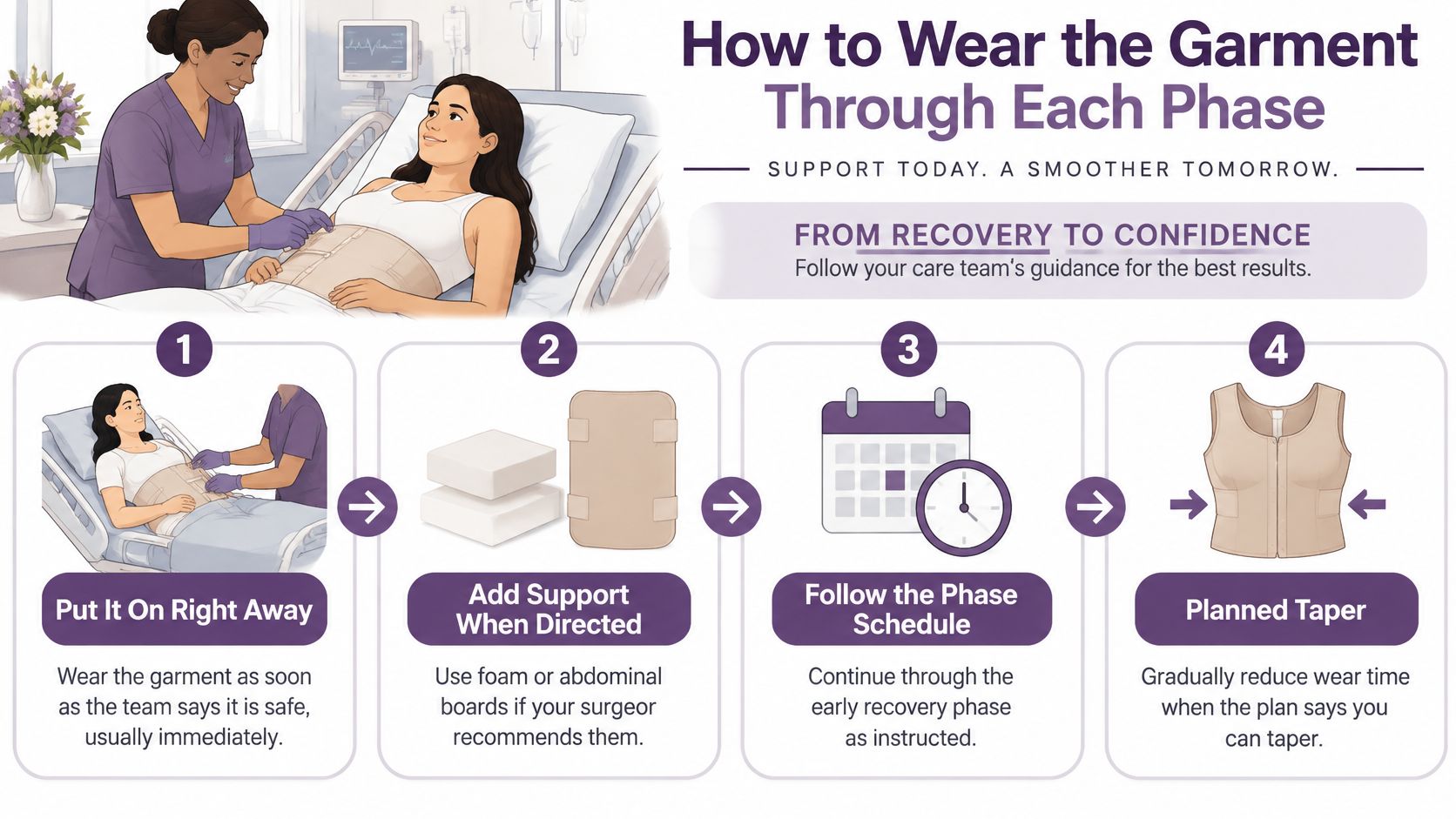
Think of compression as a sequence, not a single instruction to "keep it on." Each step has a job, and skipping ahead usually creates the problems patients blame on the garment itself.
The step-by-step pathway
- Put it on as soon as your team says it's safe. Compression usually begins immediately after liposuction. Add foam pads or an abdominal board only if your surgeon ordered them, because extra layers change where pressure lands.
- Wear it day and night through the first week. Remove it only for your allowed shower window and a quick look at incisions and skin. Long breaks early on let swelling rebound, which makes reapplying the garment harder.
- Get reassessed before you change hours. At follow-up, your team can check fit, edema, bruising, incision status, and activity level. A garment that fit on day one may gap or dig in by day seven.
- Stay full time through about weeks 1–3 unless told otherwise. Don't treat the end of week one as a finish line just because swelling starts to ease.
- Step down to set hours instead of quitting overnight. If swelling is still obvious, daytime-only wear or a minimum number of hours gives support during upright activity, when fluid tends to collect.
- Rotate a clean second garment. Wash and dry garments as the label directs so you're not wearing a damp garment for days or skipping wear while laundry dries.
- Sleep in it during the continuous phase. Do that unless breathing, pain, or your surgeon says otherwise. Nighttime isn't a free pass early in recovery.
- Pause briefly, then reapply. Shower, pat skin fully dry, inspect incisions, and put the garment back on before you settle on the couch without it.
- Wean over several days when cleared. Reduce hours gradually and watch end-of-day swelling, rather than stopping on an arbitrary calendar date.
Published schedules explain why step nine matters. Reported compression durations in a prospective high-definition liposculpture study and its cited protocols range from 7 days to 6 months, reflecting differences in treatment area, operative volume, and surgeon preference rather than one validated universal schedule. That study's patients averaged 21.2 days of garment use, and its authors recommended approximately 3 weeks partly because prolonged wear may allow garment folds to create contour deformities. Longer isn't always better if fabric is creasing into healing skin.
Making the routine work at home
Set up help before surgery if you'll be sore reaching hooks, zippers, or leg openings. Readers arranging support at home may find post-surgery guidance from Carevo Home Health Care useful for planning practical help during the first days. Keep the spare garment, gauze your team approved, and written instructions in one place. You're more likely to reapply compression promptly when you aren't hunting for supplies.
For a broader view of pain, activity, and healing milestones, see our guide to liposuction recovery and optimizing healing. Compression is one part of that plan, alongside walking as directed, incision care, and follow-up visits.
Stage garment use follows the same logic after awake liposuction. Local anesthesia changes the operating room experience for selected patients. It doesn't change the fact that treated tissues swell and need support. A successful step-down looks specific. You have less end-of-day swelling, no new fold marks pressed into skin, incisions that look stable, and a follow-up note that agrees you're ready for fewer hours.
Findings That Change How Long You Wear It
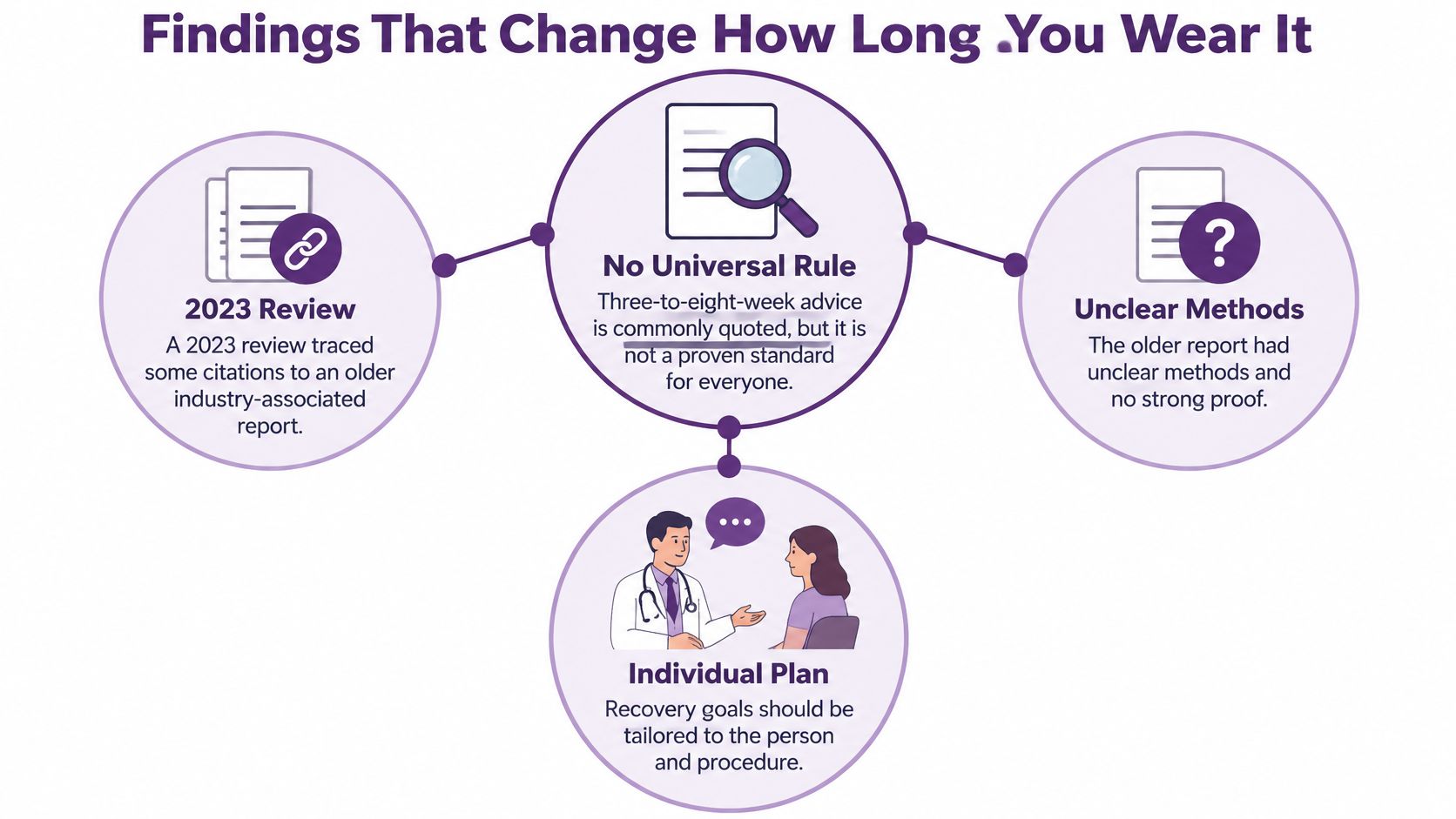
There's no proven universal week count. That's the finding patients most need to hear, because rigid rules can push people in two wrong directions. Some stop early because a friend stopped at three weeks. Others keep wearing a poorly fitted garment for months, hoping more time will fix swelling that needs reassessment.
Why the three to eight week rule is softer than it sounds
The American Society of Plastic Surgeons liposuction recovery page states that the surgeon determines both duration and garment type, while its recovery timeline shows swelling can continue improving beyond six weeks. A 2023 peer-reviewed review found that commonly cited protocols, such as three to eight weeks, trace partly to an older, industry-associated report with unclear methods and no statistical significance testing. That weakens the basis for treating six weeks as a law. It doesn't mean compression is useless. It means your taper should be justified by findings your surgeon can see and feel.
NICE evidence on liposuction for lipoedema shows how wide protocols can be in a different population, with durations from approximately five weeks to six months, some 24-hour wear initially, refitting as swelling decreased, and gradual weaning rather than abrupt stopping. Don't copy lymphatic or lipoedema schedules onto routine cosmetic liposuction. The condition being treated, and the outcome being protected, are different.
Findings that often support more time
- Larger fat volume or multiple areas: More treated tissue usually means more swelling to manage, and a longer daytime phase may be reasonable.
- Persistent pitting edema: If pressing the skin leaves a dent that fills slowly, ask before reducing hours.
- Looser skin: Your surgeon may want support while skin and deeper tissues settle, especially after larger-volume treatment.
- High-definition or athletic sculpting: Detailed contouring and surgeon-placed foam may come with a more specific wear and refit schedule.
- Combined procedures: Liposuction with a tummy tuck or other surgery follows the combined recovery plan, which can be longer.
One large series shows how a surgeon-directed protocol can look. In a retrospective study of 1,486 VASER-assisted liposuction cases, patients were advised to wear compression garments for a minimum of one month and to receive regular lymphatic-drainage massage for at least 15 days. The authors suggested those measures may have contributed to their observed results, but the study wasn't a randomized comparison. Don't read it as proof that compression prevents seroma or hematoma for every patient.
For arm treatment, patients sometimes ask whether everyday sleeves are interchangeable with a surgical garment. They're not automatically the same in pressure, coverage, or fit. General background on compression sleeve benefits from DME Superstore can help you understand why people use sleeves for support, but your surgeon should approve any substitute after liposuction.
Southern California heat, desk work, and poor sleep are real adherence problems. They're reasons to ask about a breathable second garment, a liner if approved, and a clear daytime taper. They aren't reasons to stop early on your own. Use this taper test instead. Swelling is stable or falling, incisions are closed, comfort is tolerable without constant adjusting, the garment isn't marking skin, and your surgeon gives an explicit go-ahead.
Fit Pressure and Comfort Tips That Matter More
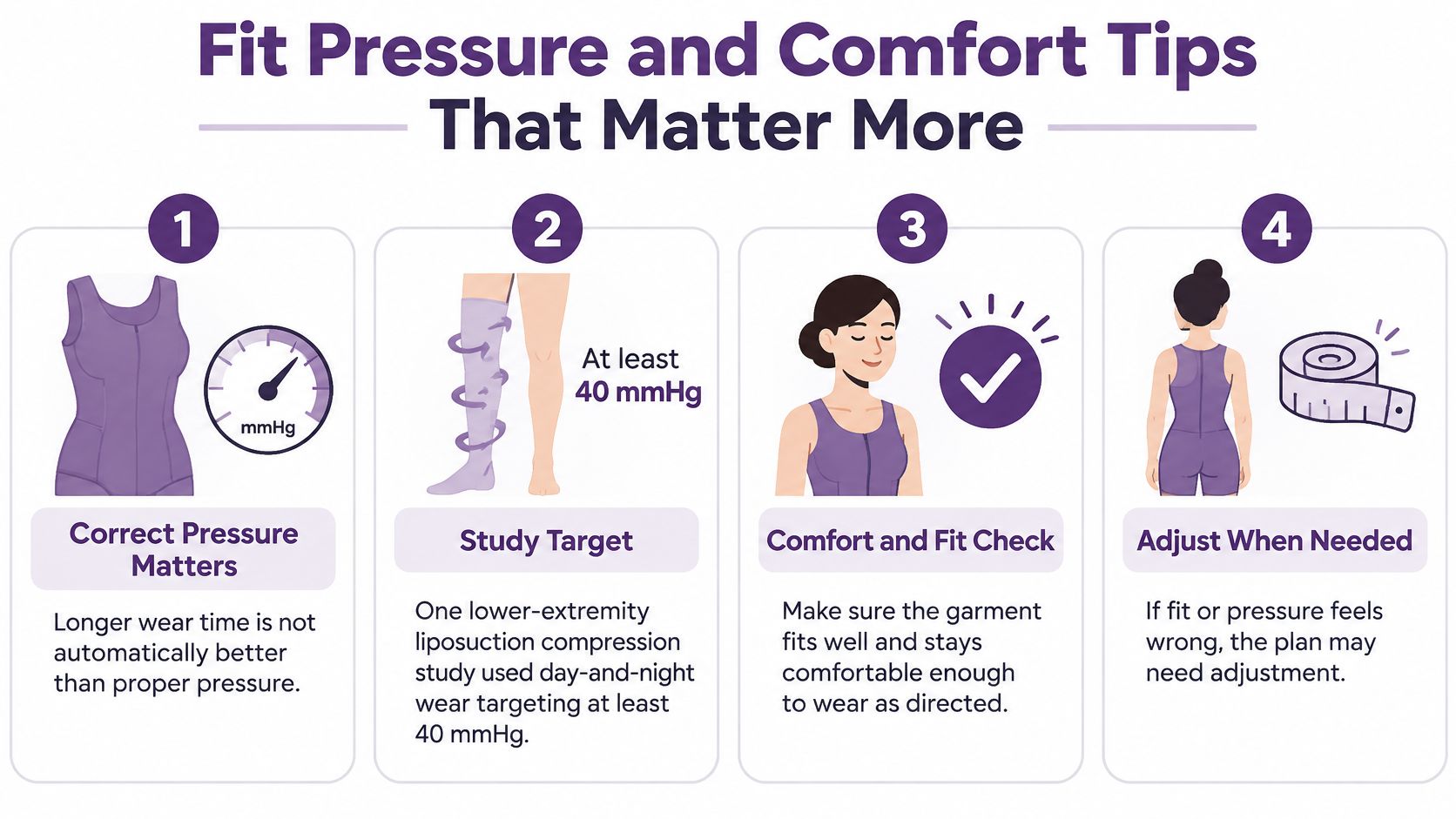
Tighter is not better. A garment should feel snug and even, like firm support you can breathe and move in. If you need to hold your breath to close it, or your fingers tingle beyond its edge, that's not extra benefit. That's a fit problem.
Pressure numbers need context
In a prospective postoperative compression study involving lower-extremity liposuction, treatment used continuous day-and-night compression with target pressures of at least 40 mmHg on the lower leg and 20 mmHg on the thigh, and pressure was reduced after 6 months. Those targets belong to that limb protocol. Don't copy them onto a cosmetic abdomen, back, or arms, and don't shop by mmHg alone after surgery. The same review notes excessive or uneven pressure can cause pain, distal swelling, vascular compression, skin injury, or infection, citing such complications in approximately 5%–7% of cases. Pressure only helps when it's distributed as intended.
A smooth, correctly sized garment worn for the right weeks does more for you than an overly tight garment worn for extra weeks.
Fit and laundry actions that prevent common problems
- Wear the size ordered: Don't size down for more squeeze. Sizing down can create a tourniquet effect at the waist, groin, knee, or arm edge.
- Smooth every reapplication: Flatten folds, rolled edges, twisted straps, and bunched fabric under the bust, at the waist, or behind the knee. Use open palms, not fingertips, so you don't drag tender skin.
- Check edges at night: Mild fabric marks that fade quickly can occur. Deep grooves, blistering, or swelling that balloons below the edge should be reported.
- Ask for a refit as swelling falls: A garment that gaps no longer gives even support. One that suddenly digs in may be rolling, shrinking in the wash, or sitting in the wrong place.
- Keep a clean spare: Wash according to the label, usually gently, and let it dry fully. Moisture held against incisions all day irritates skin and makes odor harder to judge.
- Protect incisions and drains only as directed: Use only surgeon-approved pads or dressings under the garment. Thick homemade padding can create a pressure ridge exactly where you don't want one.
- Reapply on dry skin: After showering, pat dry and let skin cool briefly. Pulling snug fabric over damp, tender skin increases friction.
Stage garments, meaning a firmer early garment followed by a lighter later one, can make sense when your surgeon prescribes them. The switch should happen because swelling and fit have changed, not because a package says week four is stage two. Compression can support tissues while swelling falls and may make the contour easier to see sooner. It won't erase every irregularity, and it can't compensate for folds left pressed into skin for hours.
Do a simple comfort check at the end of the day. Support feels even, skin beyond the edges is pink and warm, you can take a full breath, and you aren't repositioning the garment every few minutes. If constant adjusting is the only way you can tolerate it, call the office for a fit review. Don't tighten straps, add a waist trainer over it, or borrow a smaller garment. Those fixes increase uneven pressure.
Red Flags to Report Before You Keep Wearing It
Some discomfort is expected. Bruising, firm swelling, tenderness, and a snug garment are common early. The mistake is treating every symptom as a reason to wear compression longer or tighter. Circulation, breathing, wound, and skin-breakdown signs outrank the wear calendar.
Ordinary recovery versus a same-day call
A peer-reviewed review summarized in an analysis of compression use after liposuction reports that early compression recommendations were based on limited evidence and that pressure selection remains insufficiently standardized. It also notes garments may need refitting as postoperative swelling falls. ASPS describes compression as helping control swelling and support new contours, but notes swelling may take several months to fully resolve. Lingering puffiness alone, without the warning signs below, usually isn't an emergency. It also isn't a reason for indefinite wear.
For readers who like simple tracking, tools for tracking daily health can be a useful prompt to note pain, temperature, drainage, and swelling patterns in one place. Bring that log to follow-up. Dates and trends help your team more than "it's been swollen for a while."
| What you notice | Why it matters | What to do |
|---|---|---|
| New or spreading numbness | Possible nerve pressure or a too-tight panel | Call the office the same day; do not size down |
| Pale, blue, or mottled skin, or a cold extremity | Possible impaired circulation | Remove only if previously instructed and seek urgent care |
| Pain that keeps escalating | May be pressure injury, fluid, or infection rather than normal soreness | Contact the surgeon; do not add hours |
| Trouble breathing in the garment | Garment may be too high or too tight on the chest or abdomen | Loosen if told it is safe and get urgent help for breathing distress |
| Foul drainage, fever, or a worsening wound | Possible infection | Stop home experiments and be seen |
| Blister, deep red crease, or open rub | Fold or rolled edge causing skin injury | Stop wearing that spot's pressure and ask about refit |
| Swelling ballooning below the garment | Fluid or a tourniquet effect at the edge | Report it; a tighter garment is the wrong fix |
What not to do when something feels wrong
Don't buy a smaller size to chase swelling. Don't add binders, wraps, or foam that your surgeon didn't approve. Don't keep a blistered fold pressed against skin because you're afraid to miss hours. A short pause directed by your surgical team, with a refit or wound check, protects you better than silent endurance.
Questions about firm areas are also common as swelling changes. Our surgeon guide to lumps and bumps after lipo explains which firmness can be part of healing and which changes deserve review. Compression shouldn't be presented as a guarantee against seroma, contour dents, or infection. It supports healing. It doesn't replace examination when symptoms move in the wrong direction.
If you aren't sure whether a sign is urgent, call and describe exactly what you see. Say where the skin changed color, whether the limb feels cold, how pain has changed, and whether drainage or fever is present. Specific details let the office triage you quickly.
Confirm Your Wear Plan at Follow-Up
Bring the garment to your visit. Fit can't be judged well from a phone description, especially when folds form only when you sit, bend, or wear work clothes. Put it on the way you wear it at home so your team can see rolling edges, strap placement, and pressure marks.
Questions that turn a general range into your plan
- Hours this week: How many hours should I wear it now, and when does that change?
- Second garment: When should a second size or stage replace the first one?
- Foam or boards: Does foam stay, move, or come out at this visit?
- Daytime taper: What finding tells us I'm ready for daytime-only wear?
- Expected swelling: What swelling is still normal at six weeks for my treated areas?
- Massage timing: If massage is part of my plan, when should it start and how does it fit with garment hours?
That last question matters because massage isn't a substitute for compression, and compression isn't a substitute for follow-up. Readers considering it can review our overview of post-surgical lymphatic massage before asking whether it's appropriate for their stage of healing.
Awake liposuction, high-definition liposuction, and tumescent technique can all involve compression after surgery. Avoiding general anesthesia in selected patients doesn't mean zero swelling, a painless recovery, or a guaranteed shorter garment course. What changes the schedule is the area treated, the volume removed, your skin and tissue response, and how you're healing at each visit.
For readers in Los Angeles, Ventura, or Santa Barbara counties who are still planning surgery, Luxe Aesthetic Surgery & Medical Spa can fold garment timing into an individualized body-contouring plan. Dr. Haimesh Shah is a board-certified physician specializing in cosmetic surgery and phlebology and serves as Medical Director of Luxe Aesthetic Surgery & Medical Spa. Awake Liposuction removes stubborn fat from areas such as the abdomen, waist, flanks, back, arms, thighs, and more, using local anesthesia, for appropriate candidates. A consultation determines candidacy, treated areas, anesthesia planning, and aftercare. It doesn't promise a fixed number of days in a garment. If you already have a surgeon's written schedule, follow that schedule. If you don't yet have one, request a consultation and leave with wear hours, refit triggers, and warning signs in writing.
If you're planning liposuction and want compression timing explained before surgery, visit Luxe Aesthetic Surgery & Medical Spa to request a consultation and discuss an individualized body-contouring and aftercare plan. Bring your questions about full-time wear, daytime tapering, second garments, and fit checks, so your recovery instructions are clear before your procedure day.