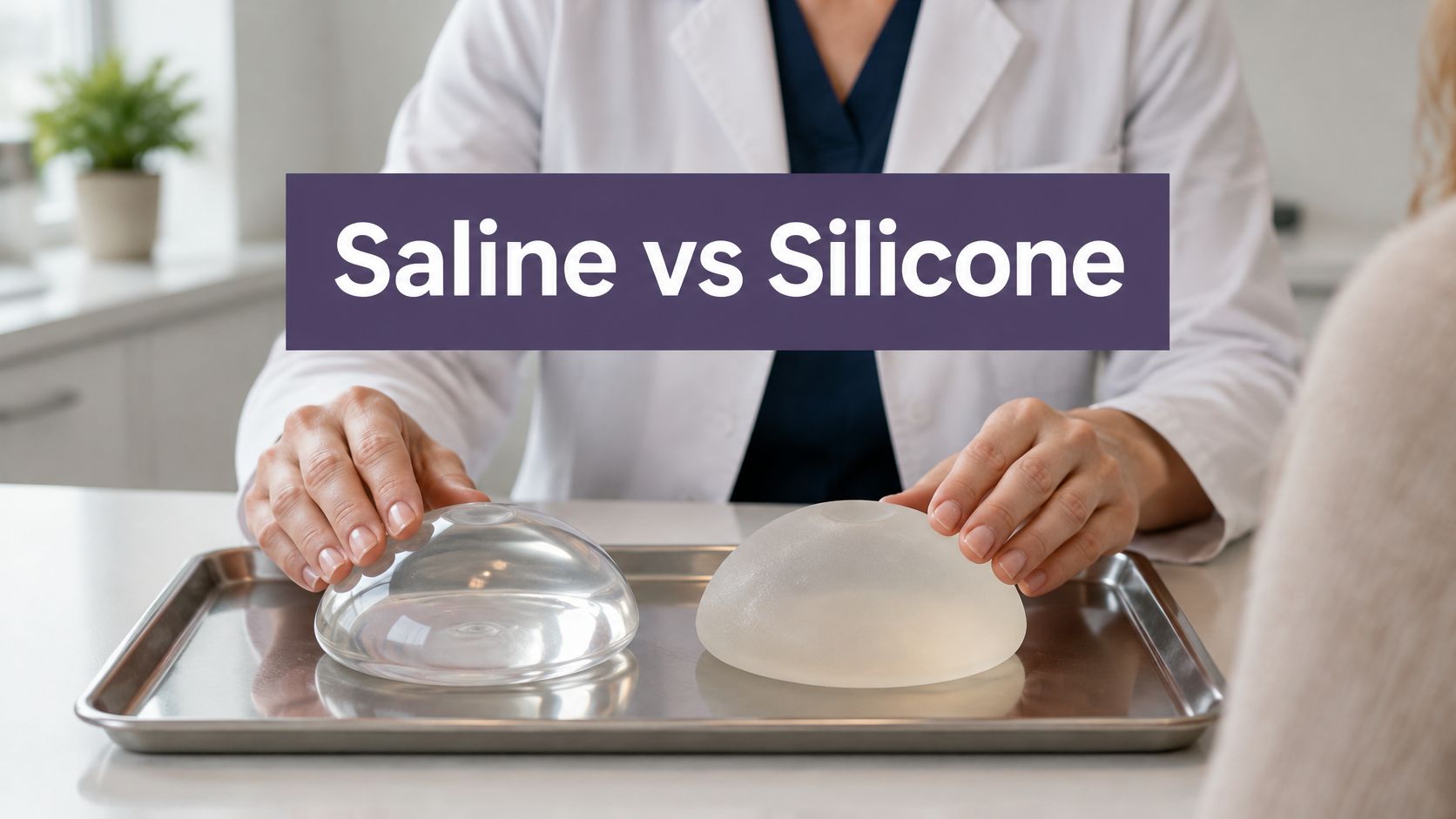
Medical Expertise at Luxe Aesthetic Surgery
Luxe Aesthetic Surgery & Medical Spa is led by Haimesh Shah, MD, RPVI , a physician specializing in cosmetic surgery, body contouring, laser procedures, and venous medicine. Dr. Shah is a Diplomate of the American Board of Laser Surgery, American Board of Venous & Lymphatic Medicine, American Board of Wound Management, and American Board of Internal Medicine. He also holds the Registered Physician in Vascular Interpretation (RPVI) credential and has contributed to peer-reviewed medical research.
"Watch for changes and call your surgeon" is the advice nearly every woman with breast implants has heard. It sounds sensible, and for saline implants it usually works, because a saline implant that fails tends to deflate visibly within days. For silicone gel, the same advice can create false comfort. A silicone implant can tear and keep its shape, its softness and its symmetry, with nothing on the outside to notice.
That is the part patients get wrong most often, and it isn't their fault. Most writing about breast implant leak symptoms reads like a checklist: pain here, swelling there, a lump, a change in shape. A checklist implies that a leak announces itself. The FDA's own patient information says the opposite, describing most silicone-gel ruptures as clinically silent.
This guide walks through what a leak can look like by implant type, what symptoms can and cannot prove, and which test settles the question. It also covers the part most articles skip: what to do when your breast looks and feels completely normal and you still want an answer.
Table of Contents
- Find Your Implant Type Before Comparing Signs
- Signs of a Leaking Breast Implant by Implant Type
- What Symptoms Can and Cannot Prove About Leakage
- Diagnosis and Urgency Steps for Implant Changes
- Revision Options Once a Leak Is Confirmed
- Book an Implant Evaluation at Luxe Aesthetic Surgery
Find Your Implant Type Before Comparing Signs
Every symptom list you'll read splits by fill material, so the first job is confirming which implant you have. Three steps get you there.
Step 1, pull the paperwork. Find the operative report or the implant card you were given after surgery. Both normally list the manufacturer, the fill material, the size and the date of the procedure. Save the surgeon's name alongside them.
Step 2, call the original surgeon's office. Practices keep implant stickers and operative notes in the chart, and the office can usually confirm the type from its files even if your copy is long gone. Ask them to send a copy rather than reading it over the phone.
Step 3, if the type is still unknown, take the cautious path. Assume any change could belong to either implant type and choose the more careful next step. In practice that means asking for imaging rather than waiting to see whether a symptom resolves.
Then write down three things before your first appointment: the implant type, the surgery date, and the number of years since. That last figure isn't trivia. The recommended imaging schedule for silicone implants is keyed to how long the device has been in place, so a clinician will ask for it in the first minute. If you're still weighing fills, our comparison of silicone versus saline breast augmentation explains how each behaves over time.
Signs of a Leaking Breast Implant by Implant Type
A breast can look and feel normal even when a silicone implant has ruptured. Symptoms differ by implant fill, so compare the signs below with your implant type, while remembering that symptoms alone cannot confirm a leak.
Breast implant leak symptoms by implant type
| Symptom | Saline implant | Silicone-gel implant | Next step |
|---|---|---|---|
| Visible loss of size or contour | Common; deflation is usually noticeable | Possible, but often absent in silent rupture | Clinical exam, then imaging if the change is new |
| Asymmetry between breasts | Common | Possible | Clinical exam; prompt visit if sudden |
| Shape change or rippling | Possible | Possible | Clinical exam and imaging |
| New firmness or hard lump | Possible; less typical than deflation | Possible; more likely when silicone leaks beyond the capsule | Prompt clinical assessment |
| Pain, tenderness or swelling | Possible | Possible; can also reflect infection or inflammation | Same-day care if severe, rapid, or with fever or redness |
| Tingling, numbness or burning | Possible | Possible | Clinical review |
| No symptoms or visible change | Uncommon, because deflation is visible | Common in silent rupture | Follow the imaging schedule |
Why a saline leak is obvious and a silicone leak often isn't
A saline implant is like a water balloon with a pinhole: when its shell breaks, sterile salt water leaks out and the body absorbs it. As the implant loses volume, the breast usually softens and flattens, making the change visible.
With a silicone implant, the gel may stay inside the fibrous capsule that forms around the device. The breast can retain its size, projection, and feel even if the shell has ruptured. The FDA's patient information on saline and silicone implant behavior explains that saline rupture commonly causes visible deflation as the fluid is absorbed, while silicone rupture may remain silent when gel stays within the surrounding scar capsule.
What silent rupture means
Silent rupture produces no symptoms and no visible change. A person may not detect it, and a physical examination alone cannot reliably rule it out. This is why watching for changes is not enough for silicone implants: imaging, following the recommended schedule, is the way to check for a rupture that cannot be felt or seen.
Rupture is uncommon in the early years, so routine screening begins later rather than immediately. The chance of rupture can rise as an implant ages, which makes the imaging schedule important even when the breast seems unchanged.
When silicone leaves the capsule
An intracapsular rupture keeps the gel within the scar capsule. An extracapsular rupture allows silicone to escape into nearby breast or chest tissue. That spread is more likely to cause a palpable change, such as hard lumps, thickening, or new firmness. The location of the gel matters because silicone outside the capsule can take more work to clear than gel contained within it.
The rule that holds up: a normal-looking, normal-feeling breast does not rule out silicone rupture. Imaging is needed to check for a silent leak.
No single sign proves a leak
Firmness, tenderness, or asymmetry can also result from capsular contracture, infection, or fluid around an intact implant. Treat symptoms as a reason to seek evaluation, not as proof of rupture.
- A one-sided change deserves attention. If one breast changes while the other does not, arrange a clinical review.
- Progressive firmness merits assessment. Hardening that builds over weeks may involve the capsule and should be examined, even without other symptoms.
- A normal exam cannot clear a silicone implant. An implant that feels intact and one that is intact are not the same finding.
- Take a dated photo of a change. It gives your clinician a comparison that memory may not provide.
What Symptoms Can and Cannot Prove About Leakage
A silicone implant can rupture without changing how the breast looks or feels. That is why symptom-watching alone cannot settle whether it is leaking: symptoms can prompt evaluation, but imaging is needed to assess the implant. The reverse confusion is common too. Fatigue, joint pain, or brain fog may occur alongside an implant concern, but those symptoms do not identify rupture as their cause.
New pain on one side, swelling, a hardening capsule, or a change in breast shape points to a local change worth discussing with a clinician. Whole-body symptoms call for a separate line of inquiry. Keeping those questions distinct makes it easier to investigate a possible implant problem without assuming it explains every symptom.

What the 2025 evidence supports
A 2025 systematic review and meta-analysis on breast implant illness symptoms found a modest association between implant rupture and overall breast-implant-illness-type symptoms (risk ratio 1.12, 95% CI 1.04 to 1.21). It also found a stronger association for silicone implants than non-silicone implants (risk ratio 2.11, 95% CI 1.49 to 2.99).
These figures describe patterns across groups, not a diagnosis for an individual. An association does not show that rupture caused someone's symptoms. The 2025 review published in Aesthetic Plastic Surgery reported rupture or bleed in 21.4% of 2,251 patients with breast implant illness. Most patients in that group therefore had no reported rupture or bleed, and symptoms alone could not distinguish an implant leak from an intact implant.
An FDA study of 344 women scanned with MRI found that women with MRI-diagnosed rupture were no more likely than women with intact implants to report persistent joint pain, swelling, stiffness, rash, or fatigue, or diagnosed illnesses. Taken together, this evidence supports checking the implant and assessing other possible causes, rather than treating a symptom pattern as proof.
The triage rule to use
Systemic symptoms can warrant two evaluations in parallel: imaging for rupture or another local implant complication, and a medical workup for other explanations, such as thyroid disease, anemia, autoimmune conditions, medication effects, or sleep problems. The FDA's review of medical device reports describes 10,318 reports submitted between January 1, 2008 and June 30, 2024 involving systemic symptoms in women with saline- or silicone-filled implants; fatigue appeared in 41.1% of the reports. Reports describe submitted experiences, not a confirmed cause for each symptom.
A symptom is a reason to look. It is never the look itself.
Explantation is a decision to discuss with a surgeon in light of imaging findings and personal goals. Removing implants addresses the implants, but whether it improves systemic symptoms cannot be guaranteed.
Diagnosis and Urgency Steps for Implant Changes
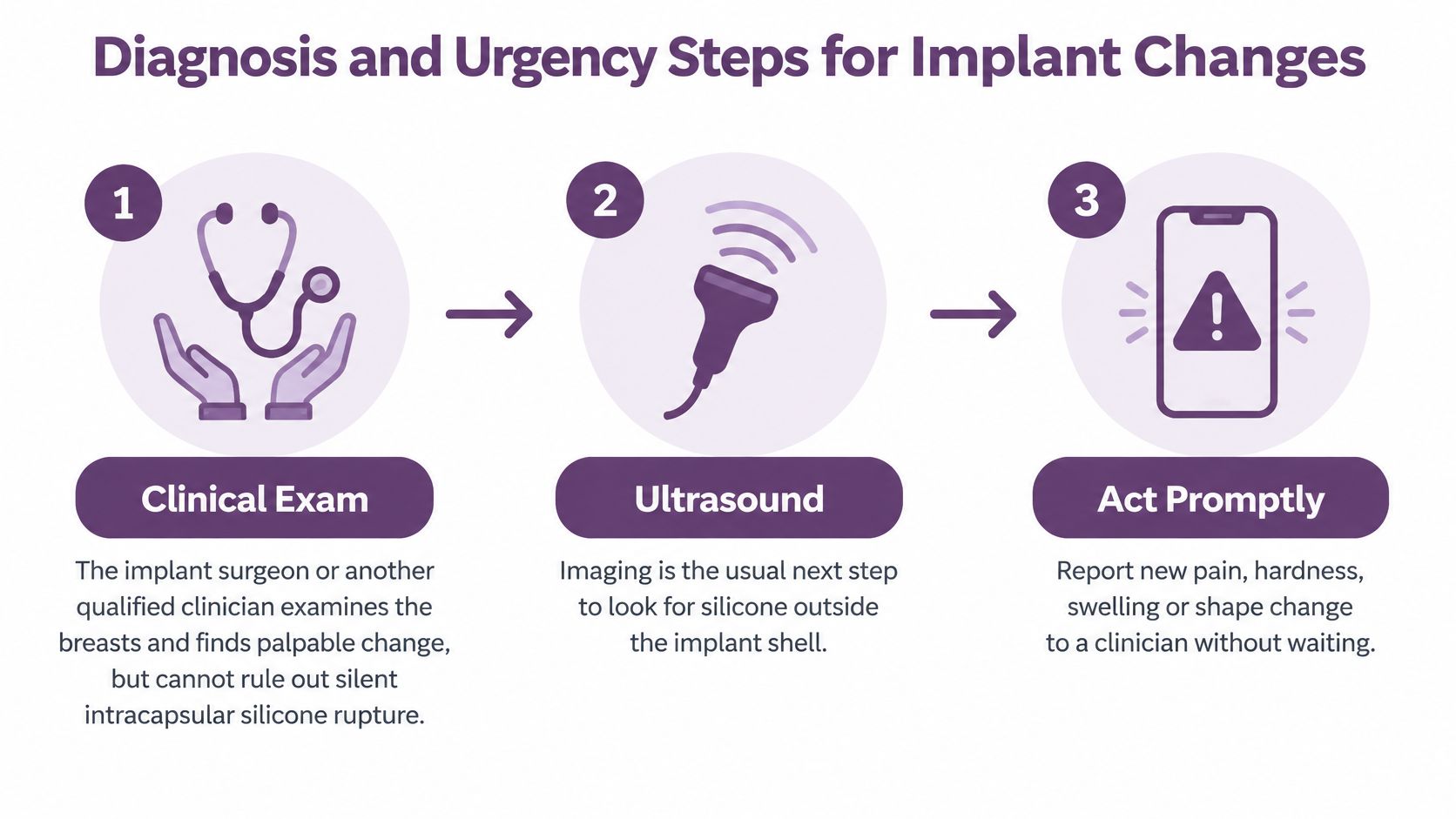
Evaluation follows a sequence, and each step exists because the one before it has a blind spot. Here is the order, then a way to match your situation to an action level.
The whole path is short, and knowing it in advance removes the guesswork about what happens next.
Step 1, the clinical exam
Your implant surgeon or another qualified clinician examines both breasts, checking for asymmetry, firmness, palpable lumps, thickening and changes in contour. This step is fast, involves no radiation and catches anything you can feel.
Its limitation matters. Mayo Clinic's guidance on breast implant evaluation notes that silicone-gel rupture is frequently clinically silent because the gel may remain contained within the fibrous capsule, so a normal breast examination does not reliably exclude rupture. When symptoms do appear, they can reflect local inflammation, gel migration or capsule remodeling, and they include new pain or tenderness, altered size or contour, asymmetry, hard lumps, thickening, swelling, numbness, tingling, burning or changed sensation.
Step 2, ultrasound
Ultrasound is the usual first imaging test and an acceptable screening option for patients without symptoms. It's widely available, uses no radiation and is far cheaper than MRI. It looks for silicone that has escaped the implant shell and can assess the capsule and any fluid collection.
Where it falls short is the contained rupture. An intracapsular tear can be harder to see on ultrasound than on MRI, so an inconclusive scan isn't reassurance.
Step 3, MRI
Non-contrast MRI is the study that settles a silent silicone rupture. The FDA's overview of breast implant risks and complications identifies MRI as the most effective method for detecting silent silicone rupture, with ultrasound as an acceptable screening alternative for asymptomatic patients. Ask for MRI specifically when you have symptoms or when an ultrasound leaves the question open.
Imaging tests for a suspected implant rupture
| Test | Best use | Strength | Limitation |
|---|---|---|---|
| Clinical breast exam | First check after a reported change | Quick, no radiation, finds palpable change | Cannot reliably exclude silent silicone rupture |
| Ultrasound | First imaging for a suspected leak; screening option without symptoms | Widely available, no radiation | Less reliable than MRI for intracapsular silicone rupture |
| Non-contrast MRI | Symptoms present or ultrasound inconclusive; silicone rupture | Most effective for silent silicone rupture, per the FDA | Higher cost; availability varies |
| Mammography | Not the preferred test for implant rupture | Routine breast screening tool | Intracapsular silicone rupture is hard to detect |
The timing is set for you. FDA guidance on breast implant rupture screening recommends a first ultrasound or MRI at 5 to 6 years after implantation for asymptomatic silicone-implant patients, then repeat imaging every 2 to 3 years thereafter, with MRI recommended when symptoms are present or ultrasound findings are inconclusive. If you're weighing whether to keep, exchange or remove your implants at that point, our guide to when to replace breast implants walks through the decision.
How urgent is your change
Three levels cover almost every situation.
Same-day care. Rapidly increasing swelling, severe pain, fever, redness or feeling systemically unwell points toward infection or another complication rather than leakage alone. A breast that turns hot, swollen and painful within a day needs same-day evaluation.
Prompt contact with your surgeon. A sudden contour change, progressive firmness, persistent pain, swelling or a new lump belongs in this group. A saline implant that has visibly softened over several weeks is a classic example: not an emergency, but not something to sit on either.
Scheduled screening. A nine-year-old silicone implant with no symptoms and no change belongs on the imaging calendar, not in an urgent queue.
Note the date you first noticed the change and take dated photos with consistent lighting. Your clinician can compare those images against the exam, and the timeline often matters more than the description.
Revision Options Once a Leak Is Confirmed
Once imaging confirms a rupture, the plan follows three inputs: the findings, your goals and your surgeon's assessment of the capsule and skin. The options run from least to most extensive.
Revision options after a confirmed leak
| Option | When it is considered | What it involves | Points to confirm |
|---|---|---|---|
| Implant removal only | Leak or symptoms, with no plan to replace | Removal of the implant | Capsule plan, breast shape afterward, and a recovery estimate set at your consultation |
| Exchange with new implants | Leak confirmed and the patient wants implants again | Removal and replacement with new implants selected for anatomy | Implant type, size, scar pattern, anesthesia type |
| Exchange with capsule removal | Significant rupture or capsular thickening | Removal of the implant and surrounding capsule, with or without new implants | Extent of capsule removal, and a recovery timeline planned around the added dissection |
| Exchange with lift | Skin laxity or changed breast position after removal or exchange | Lift added to the exchange | Added scar length, and a recovery estimate that accounts for the lift |
Removal alone suits a patient who is done with implants. Exchange keeps volume but commits to a new device and a new surveillance clock, so it's worth reviewing what an implant exchange costs before you settle on that route. Capsule removal adds operating time and typically a longer recovery, and it's the version usually discussed when gel has spread or the capsule has thickened. Adding a lift addresses skin that has stretched or a breast position that has dropped, at the cost of more scarring.
Questions to bring to the consultation
- Which implant type are you recommending, and why that one? Ask how it suits your tissue and your anatomy, not just your preferred cup size.
- Will the capsule be removed, and how much of it? The answer changes both the surgery and the recovery.
- Where will the scars fall? Ask to see where the incisions sit relative to your existing scars.
- Which anesthesia is planned? Confirm whether the procedure is general or local, and what that means for your day.
- How long should I expect to be out of normal activity? Get a range in weeks for your specific plan.
- Will the systemic-symptom workup continue alongside surgery? If fatigue or joint pain prompted the evaluation, those threads shouldn't stop at the operating room door.
Book an Implant Evaluation at Luxe Aesthetic Surgery
A silicone shell can split while the breast still looks and feels like last year's photos. A symptom list can only point. Confirmation needs an exam and a scan, because a leak cannot be settled from a checklist or a set of photographs.
Luxe Aesthetic Surgery & Medical Spa is a cosmetic surgery and medical aesthetics practice serving Los Angeles, Santa Barbara, and Ventura counties in Southern California, led by Medical Director Dr. Haimesh Shah, MD, RPVI. For appropriate candidates, Awake Breast Implant Exchange removes the existing implants and replaces them with new implants selected to complement the patient's anatomy and proportions. Imaging results and a consultation decide whether that path fits. Your surgeon will say so plainly. Surgery patients are given Dr. Shah's personal cell phone number for questions or concerns after the procedure.
Four things to prepare before you call
- Gather your implant records. Type, date of surgery, and the original surgeon's name can save an entire appointment. Those records work like a service history: without the year and the model, the next surgeon is guessing.
- Write down each symptom with the date it began. "A one-sided change that started in March" moves a workup faster than "it's been off for a while."
- Request the exam and imaging named in the testing table. Say "ultrasound" and "MRI" so the request is specific. A silent rupture is the case where a normal feel still needs a scan timed to the implant's age and fill, not another month of watching.
- Bring the questions from the revision section. They shape the plan once imaging shows what is inside the pocket.
A consultation can examine, image, and advise. It cannot confirm a leak over the phone, and no surgeon should choose the next step before seeing the breast and the scan. That limit is what makes the visit worth having.
If you are due for screening, noticing a one-sided change, or weighing an exchange, Luxe Aesthetic Surgery & Medical Spa can review your records, arrange the imaging your implant type and age call for, and talk through what the findings mean. Request a consultation and let a surgeon examine the implant before you decide anything.