Medical Expertise at Luxe Aesthetic Surgery
Luxe Aesthetic Surgery & Medical Spa is led by Haimesh Shah, MD, RPVI , a physician specializing in cosmetic surgery, body contouring, laser procedures, and venous medicine. Dr. Shah is a Diplomate of the American Board of Laser Surgery, American Board of Venous & Lymphatic Medicine, American Board of Wound Management, and American Board of Internal Medicine. He also holds the Registered Physician in Vascular Interpretation (RPVI) credential and has contributed to peer-reviewed medical research.
Routine facial microneedling is usually spaced every 4–6 weeks, in a course of about 3–5 sessions. Your exact interval should reflect your treatment goal, needle depth, and how fully your skin recovers.
The important distinction is between looking healed and being ready for another treatment. Redness can fade before the deeper repair process has finished, so a clear-looking complexion isn't permission to book sooner. A useful schedule gives your clinician a starting point, then leaves room to adjust based on your skin rather than the calendar alone.
Table of Contents
- Recommended Microneedling Intervals by Goal
- Why Recovery Sets the Pace Between Sessions
- What Changes How Often You Need Treatment
- Signs Your Skin Is Ready for the Next Session
- When to Delay, Change or Skip a Session
- Building a Personal Schedule With Your Clinician
- Book a Consultation to Set Your Schedule
Recommended Microneedling Intervals by Goal
Treatment schedules differ by goal and device. For routine facial microneedling, every 4–6 weeks across about 3–5 treatments is a practical starting range. An automated microneedling study used sessions 30 days apart. The shorter end of the range depends on clinical judgment and individual treatment planning.
| Treatment goal or device | Typical interval | Sessions in a course | Evidence basis |
|---|---|---|---|
| Routine facial microneedling for fine lines, texture, or mild laxity | Every 4–6 weeks | 3–5 | Automated microneedling study with sessions 30 days apart |
| Monthly facial protocol with a 0.5 mm pen | 4 weeks | 4 | Randomized controlled study conducted over 12 weeks |
| Atrophic acne scars | 2–4 weeks, most commonly | 3–8 | Systematic review of published treatment protocols |
| Deeper or 1.5 mm needling | At least 3 weeks | Set by scar severity and response | Published protocols describe roughly 3–8-week spacing |
| Radiofrequency microneedling, clinician only | 4–12 weeks | 1–3 | Radiofrequency microneedling protocol in the publication linked for deeper needling |
| Maintenance after a completed course | Set after reassessment | Only if clinically justified | No established fixed schedule |
The routine facial range reflects the automated microneedling study linked above. The radiofrequency row refers to a separate protocol in the publication linked for deeper needling. These are examples of clinical planning. Device and needle settings should be chosen by a clinician.
How to interpret the different ranges
Acne-scar treatment may involve a longer overall series than treatment for mild texture changes. A short interval used in a supervised scar study does not automatically apply to routine facial microneedling.
Radiofrequency, or RF microneedling, requires its own plan. Reviews describe shorter RF schedules than the study protocol shown in the table, illustrating how schedules can differ by device and treatment goal. RF adds energy to needling and should be performed by a trained clinician, rather than as a home treatment.
The FDA notes that more than one procedure may be needed to achieve a desired aesthetic improvement. A single appointment may be a starting point; whether more sessions are appropriate depends on the treatment plan.
For terminology, Luxe's explanation of derma roller treatment can help you prepare questions about the procedure. For conventional facials, facial timing advice from GLAZE offers separate context. Facial timing and medical microneedling schedules serve different purposes.
Why Recovery Sets the Pace Between Sessions
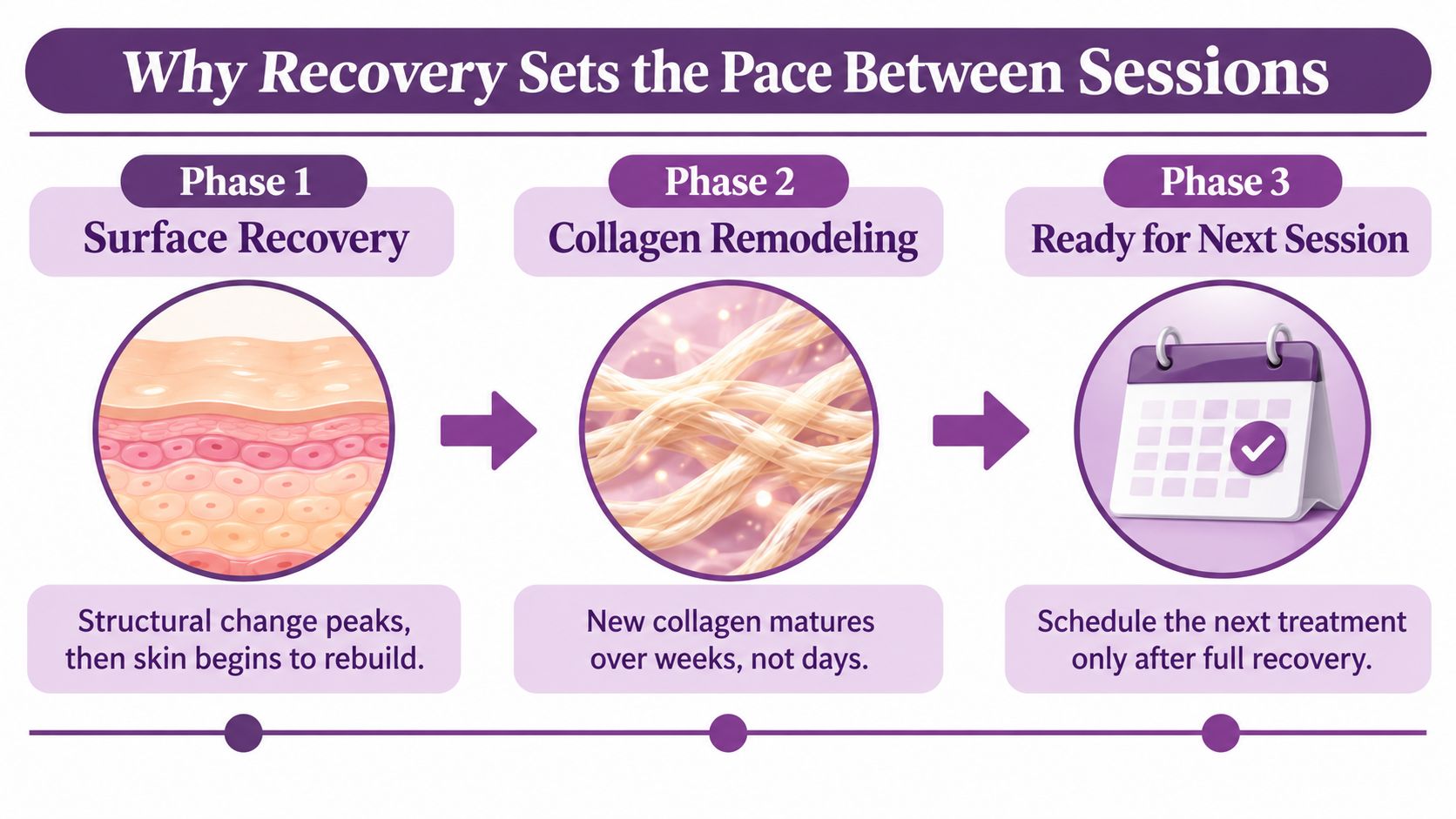
Microneedling starts a repair process that unfolds in stages. The skin's surface may look calmer before deeper recovery and remodeling have run their course, so visible redness alone cannot set the date for another session.
In a laboratory skin-model study, researchers observed almost complete epidermal recovery five days after treatment. This model helps explain surface healing, while a clinician's assessment is needed to judge readiness for another procedure.
Surface recovery comes before the full response
Early recovery includes restoration of the skin barrier. Your complexion may look calmer while still feeling tight or unusually sensitive, or reacting to products. Those changes can be hard to judge from a photograph, so pay attention to how your skin feels as well as how it looks.
The automated facial-treatment study described earlier reported measurable improvements by day 90, with the strongest statistically significant effects around day 150. These observation points show that the visible response can take time to develop. The study's results come from a model and cannot predict an individual's timeline.
Remodeling continues beyond the appointment cycle
A clinical reference on microneedling explains that collagen remodeling and neocollagenesis may continue for approximately 3–6 months after treatment. Your clinician may schedule another session once your skin has recovered sufficiently, even while changes from the earlier treatment are still developing.
Everyday comfort and readiness for another treatment are separate considerations. Between visits, keep skincare straightforward and follow your treating clinician's aftercare instructions. Avoid adding strong exfoliants or unfamiliar active products to try to speed improvement. For general information on barrier-supportive skincare, Ella & Eden's guide to key ingredients for sensitive skin describes product categories, while procedure-specific aftercare should come from your clinician.
Give your clinician time to assess whether a subtle early result needs more observation or whether a persistent concern calls for another treatment. Scheduling extra appointments before that assessment may expose your skin to procedures it does not need.
What Changes How Often You Need Treatment
Two people can request smoother skin and still need different treatment plans. Your clinician needs to identify what creates the unevenness, select an appropriate procedure, and assess how your skin responds before deciding how closely to space visits.
A prospective study of scar treatment illustrates individualized treatment courses rather than a single mandatory session count. The useful lesson is that the goal, treatment characteristics, and response must be considered together.
Goal and treatment intensity
- Treatment goal: Deeper acne scars may require a longer overall course than mild fine lines. That doesn't automatically mean closer appointments. For example, a clinician may continue a scar-focused series while ending a texture-focused course once the agreed goal has been reasonably addressed.
- Needle depth: Deeper treatment generally calls for more recovery time than a superficial cosmetic pass. If a clinician increases treatment depth for a scarred area, the next appointment may need to move later rather than remain on the original recurring schedule.
- Energy or adjuncts: Adding RF changes the procedure and its risk profile. Platelet-rich plasma, or PRP, also changes the treatment plan, but it doesn't automatically justify shorter gaps or fewer appointments. The provider should explain whether the combined protocol changes recovery or reassessment timing.
Pigment history and your actual healing response
Your skin's reaction matters more than a schedule that worked for someone else. Darker skin tones and a history of post-inflammatory pigmentation warrant particular attention to inflammation and discoloration. Someone who developed dark marks after a previous procedure may need a more conservative plan, even if the visible redness settles quickly.
Slow healing, prolonged sensitivity, and abnormal scarring history can also push an appointment later. For example, if tenderness remains when the next visit approaches, the appropriate adjustment is an assessment and a longer gap, not an attempt to complete the series on time.
Treatment choice deserves review too. If you're comparing microneedling with sublative rejuvenation, ask how the proposed procedure differs in energy delivery, recovery, and suitability for your concern. Don't assume different rejuvenation procedures share interchangeable schedules.
A change in device, depth, or skin response is a reason to reconsider the plan, not simply repeat the last appointment.
These factors help explain a clinician's decisions. They aren't a checklist for choosing your own needle depth, diagnosing a complication, or deciding that your skin can tolerate more frequent treatment.
Signs Your Skin Is Ready for the Next Session
The calendar opens a possible treatment window; your skin determines whether to proceed. Before rebooking, compare your skin with its usual baseline rather than with how it looked immediately after the procedure.
The FDA's consumer guidance on microneedling lists redness, dryness, roughness, tightness, itching, peeling, discomfort, burning, bruising, bleeding, and crusting among possible effects, many of which resolve within days or weeks. It also identifies less common problems, including pigment changes, infection, cold-sore reactivation, swollen lymph nodes, facial lines, and stinging or itching when products are applied.
| Skin signal | What it usually suggests | Next step |
|---|---|---|
| Mild redness, dryness, or tightness that has resolved | Usual short-term healing | Rebook once skin is back to its baseline and the clinician agrees |
| Peeling, roughness, or itching still present | Barrier may still be recovering | Wait until the surface is smooth and comfortable |
| Persistent redness, swelling, or tenderness | Incomplete recovery or inflammation | Hold the session and have a clinician assess |
| Crusting, drainage, or worsening pain | Possible infection or complication | Seek medical assessment before further treatment |
| Pigment darkening or lightening | Possible post-inflammatory change | Delay and reassess, especially with darker skin |
| Lines or texture still improving at 6–8 weeks | Collagen remodeling may still be continuing | Observe before adding sessions |
The final row is a monitoring scenario, not a deadline for improvement. If your clinician sees continuing progress, another procedure might add less value than allowing more observation time.
Check comfort as well as appearance
A useful self-check includes what happens during ordinary skincare. Does gentle cleansing feel normal? Is your usual moisturizer comfortable, or does it sting? Does the skin feel tender when lightly touched?
These observations don't diagnose a complication, but they give your clinician information that a treatment date alone can't provide. Photograph any new discoloration and describe whether symptoms are improving, unchanged, or worsening.
Know when to request an assessment
Persistent redness, significant swelling, drainage, or worsening pain shouldn't be treated as routine reasons to book another session. Contact your treating clinician rather than covering the problem with products or attempting another home treatment.
Repeating needling on inflamed or incompletely healed skin can increase irritation and delay recovery. Post-inflammatory hyperpigmentation is a particular concern when skin is prone to dark marks, so pigment changes deserve evaluation rather than more stimulation.
The decision is straightforward: rebook only when your skin has returned to baseline, a complication has been excluded, and the remaining goal still justifies treatment. Passing only the calendar check isn't enough.
When to Delay, Change or Skip a Session
A booked appointment does not guarantee that your skin or health is ready for treatment. New medication, a change in health, or a skin condition may mean the plan needs to pause.
The FDA's microneedling device guidance identifies situations that may require caution or medical clearance, including isotretinoin use within the previous six months. It also states that medical microneedling devices are not authorized for over-the-counter sale and that needle cartridges should not be reused.

Medical reasons to pause
Share relevant health and skin history with your clinician before treatment. This includes bleeding or clotting disorders, blood-thinning medication, immune suppression, recent isotretinoin use, uncontrolled diabetes, or autoimmune disease. Active infections, rashes, eczema, psoriasis, vitiligo, and cold sores may also affect whether treatment is appropriate. Disclose pregnancy, breastfeeding, keloid scars, or a history of keloids as well.
Do not stop prescribed medication to keep an aesthetic appointment. Your clinician can advise whether medical clearance or a medication discussion is needed.
RF and home devices need separate boundaries
Radiofrequency (RF) microneedling is a medical procedure, not a stronger version of a home roller. The FDA warns that certain RF microneedling uses have been associated with serious complications, including burns, scarring, fat loss, disfigurement, and nerve damage. RF microneedling should not be performed at home.
Home rollers and pens are not a way to fill the gap between professional visits. Using another device while your skin recovers adds a treatment your clinician may not have accounted for.
Switching procedures is not automatically a safer solution. If you are considering a chemical peel instead of a postponed needling appointment, have your skin assessed first. An unresolved reaction should be evaluated before another procedure is considered.
Building a Personal Schedule With Your Clinician
A personal microneedling schedule should follow how your skin responds, not a recurring calendar reminder. Your clinician can use the first session to assess tolerance and recovery, then adjust the plan before deciding whether another treatment makes sense.
For example, someone seeking improvement in fine lines and mild laxity might begin with a provisional course. Baseline photographs taken under consistent conditions can help the patient and clinician compare changes over time. Redness or an immediate glow alone does not show whether the goal has been met.
Separate treatment from observation
A useful plan distinguishes treatment from the time needed to evaluate its effects:
- Initial course: Choose a provisional number of sessions based on the concern, skin examination, and treatment intensity. Keep the plan flexible because recovery from the first session provides useful information.
- Response period: Compare the skin with baseline photographs after allowing time for changes to develop. Avoid adding treatment because the outcome is not yet clear.
- Possible maintenance: Reassess if benefits appear to fade, the concern returns, or goals change. Any maintenance plan should be based on that reassessment, not treated as an automatic extension of the initial course.
The evidence has limits. A review of acne-scar treatment evidence notes that many studies assess outcomes only one to three months after the final session, leaving optimal maintenance intervals and durability uncertain. That makes it difficult to set a universal long-term schedule from the available studies.
Make reassessment criteria explicit
Agree on the target outcome and how progress will be assessed. The clinician should explain the proposed session count, needle depth, and whether radiofrequency or an adjunct is part of the treatment. The plan should also specify when progress will be reviewed and what findings might lead to a longer interval, a different approach, or no further sessions.
Keep a simple record of recovery after each treatment, including discomfort, unusual reactions, and when your usual skincare feels comfortable again. Those details help the clinician base the next decision on your actual response rather than assuming each session will feel the same.
Book a Consultation to Set Your Schedule
Start by preparing enough information for a clinician to decide whether microneedling fits your concern. You can do that this week without booking a package or locking a date.
A calendar hold works like a restaurant reservation. It saves a time, but the kitchen still has to see the order and whether the dish is ready. Skin timing works the same way. The next session should follow finished recovery, not a reminder on your phone.
Write down the concern you want treated, such as acne-scar texture or fine lines, and what change would look meaningful in the mirror and in consistent photos. Say whether you can wait for gradual change. Health history, medications, and reasons to postpone are already covered in the planning questions and the signs for delaying a session. Bring those notes with you. Do not rebuild the lists.
Confirm the treatment and the payment
Ask which treatment is on the schedule: routine facial microneedling, microneedling with PRP, or an energy-based option. Those are not the same procedure. An interval that suits one can be too soon for another.
Monthly payment plans are available for surgical procedures, injectables, skin rejuvenation, and other treatments, so patients can pay without paying the full cost upfront. Confirm current terms and eligibility with the practice before you rely on a sample arrangement.
Leave with two dates in writing: when the skin will be rechecked, and what finding would move the next visit later. If redness is still active, that later date is the correct one.
Luxe Aesthetic Surgery & Medical Spa offers personalized medical aesthetic care, including microneedling with PRP, with scheduling based on an in-person skin evaluation. Visit Luxe Aesthetic Surgery & Medical Spa to request a consultation and discuss your skin goals, treatment suitability, and a recovery-aware schedule.