Medical Expertise at Luxe Aesthetic Surgery
Luxe Aesthetic Surgery & Medical Spa is led by Haimesh Shah, MD, RPVI , a physician specializing in cosmetic surgery, body contouring, laser procedures, and venous medicine. Dr. Shah is a Diplomate of the American Board of Laser Surgery, American Board of Venous & Lymphatic Medicine, American Board of Wound Management, and American Board of Internal Medicine. He also holds the Registered Physician in Vascular Interpretation (RPVI) credential and has contributed to peer-reviewed medical research.
The celebration is real, and so is the surprise. You hit the weight you worked for, your clothes hang differently, and a fold of skin still sits over the waistband, under the arm, or along the inner thigh. Showers take longer because skin overlaps. Joints feel better in a workout, while loose skin still moves on its own.
That gap between the number on the scale and the shape in the mirror is what body contouring after weight loss is meant to address. These operations remove or reshape skin that did not recoil, and they can reduce leftover fat in a mapped area. They do not peel away every stretch mark, and they do not lock your weight in place. The right operation depends on which fold you can lift in your hand, whether the skin still springs back, and whether your weight, nutrition, and medical risks are steady enough for a wound to heal.
Table of Contents
- Which Procedure Fits Each Area
- When You Are Ready for Surgery
- Massive Loss Versus Moderate Loss
- How Operations Are Staged
- Liposuction and Skin Tightening Adjuncts
- Risks and the Recovery You Should Expect
- Book a Plan That Matches Your Weight History
Which Procedure Fits Each Area
You already know the picture. The scale has settled, yet folds remain at the abdomen, arms, thighs, breasts, or back. Body contouring after weight loss is surgery that removes or reshapes that redundant skin and, when a defined pocket of fat remains, reduces the fat too. It does not restart weight loss. It does not erase stretch marks everywhere. A scar replaces the fold you dislike, and some looseness can remain at the edges.
Excision and liposuction solve different problems. Excision tailors skin that is already too big. Liposuction reduces volume under skin that can still recoil. Matching the concern to the operation keeps you from choosing a long scar for a small fat pocket, or a fat-only procedure for a heavy apron.
Concern by concern
| Concern | Procedure often considered | What changes | Usually not enough when |
|---|---|---|---|
| Hanging abdominal skin or muscle separation | Abdominoplasty (tummy tuck) | Excess skin and fat; abdominal wall may be tightened | Laxity continues around the hips and back |
| Skin apron circling the lower trunk | Lower body lift | Abdomen, flanks, outer thighs, and buttocks in one or staged plan | Only a small lower-belly fold remains |
| Upper-arm skin that hangs with movement | Brachioplasty (arm lift) | Redundant arm skin; liposuction may be added | Skin quality is good and only a small fat pocket remains |
| Inner-thigh folds, rubbing, or descent | Thigh lift | Inner-thigh skin and soft tissue | The problem is mostly outer-thigh fat with elastic skin |
| Deflated, low, or asymmetric breasts | Breast lift, reduction, or implant exchange | Skin envelope, nipple position, and volume | The only issue is a small amount of chest fat |
| Pinchable fat with springy skin | Liposuction | Fat volume in a defined area | Heavy redundant skin is the main problem |
| Mild to moderate surface laxity | Energy-based skin tightening such as Renuvion, as an adjunct | Soft-tissue contraction in selected areas | Large folds or a true skin apron are present |
A hanging abdominal apron, or muscles that have separated, is the usual reason for abdominoplasty. When laxity circles the hips and back, a lower body lift is the operation that changes the whole lower trunk. A small lower-belly fold does not need that circumferential scar.
Brachioplasty is for upper-arm skin that swings when you move. If the skin quality is good and only a small fat pocket remains, liposuction is usually the better match. Inner-thigh rubbing and descent point to a thigh lift. Outer-thigh fat under elastic skin does not.
Deflated or low breasts are a lift, a reduction, or an implant exchange chosen for the tissue that is left, including nipple position. Chest fat alone is not a breast operation. Pinchable fat with springy skin is liposuction. Mild surface laxity may be discussed as an energy-based adjunct. It is not a substitute for cutting away a heavy apron.
One area or several
Demand is broad, not a niche. In the United States, 46,577 post-massive-weight-loss body-contouring procedures were reported in 2020, covering redundant abdominal, breast, arm, thigh, and back skin, in a review of contouring after major weight loss. In a 2021 series of 180 post-bariatric patients covered there, abdominoplasty was the most common operation at 48.9%, and mammaplasty represented 21.1%. That cohort was predominantly female, 165 patients (91.7%), with a mean age of 46.3 years.
The same review describes a larger group of 653 massive-weight-loss patients and 1,254 contouring procedures. 57.58% had one anatomical site treated, 10.72% two sites, 16.23% three sites, and 15.16% four or more. A single-area plan is common. A multi-area plan is ordinary too, and it has to weigh where the skin sits, nutrition, residual weight, medical risk, and whether operations should be separated so you can recover.
Practical rule: Circle the one or two areas that limit hygiene, clothing, or exercise. That short list drives the rest of the plan.
When You Are Ready for Surgery
Readiness is a gate, not a mood. An expert review of post-bariatric contouring recommends stability within about 10 lb for at least 6 months, and typically waiting at least 12 months after bariatric surgery. That interval lets residual fat and skin laxity settle, and it leaves time to correct nutrition gaps. Further loss can create new sagging after the scar is closed. Regain can stress thinned skin. Liposuction reduces a fat pocket and excision removes redundant skin. Neither stops later weight change from reshaping the result.
A series of 43 post-bariatric patients linked a stable weight for at least three months before contouring with lower complication odds, an odds ratio of 0.24 (95% confidence interval 0.07 to 0.79). Operating during active loss fights that finding.
Looking well is not the same as healing well. A review of post-bariatric nutrition describes protein-calorie insufficiency that can last up to two years. Protein deficiency impairs collagen production, granulation tissue, and wound closure. Clinicians may check albumin or prealbumin, iron studies, vitamin B12, folate, vitamin D, zinc, and vitamin A, then set a target for you. In that review, nutrition variables before surgery were not clearly tied to fewer complications, while adequate protein afterward had the strongest protective association, an odds ratio of 0.27.
GLP-1 receptor agonists such as semaglutide can suppress appetite and bring nausea. That review notes they may reduce protein intake and contribute to lower albumin, vitamin B12, and zinc. Surgery is usually deferred while weight is still dropping. If the scale has stalled, a Vials + Vitals plateau review guide helps you tell a true plateau from loss that is still underway. Smoking, diabetes, and clot risk are optimized before any date is set. Our notes on crossing the finish line of a weight-loss journey treat that last stretch as planning, not a rush to the operating room.
- Stable weight across the window you and your clinician agreed on.
- Protein intake your clinician accepts, not a guess from the mirror.
- Labs reviewed, because a healthy look can hide a deficiency.
- Expectations that scars and some looseness can remain.
Massive Loss Versus Moderate Loss
Two people can both say they "lost the weight" and need entirely different operations.
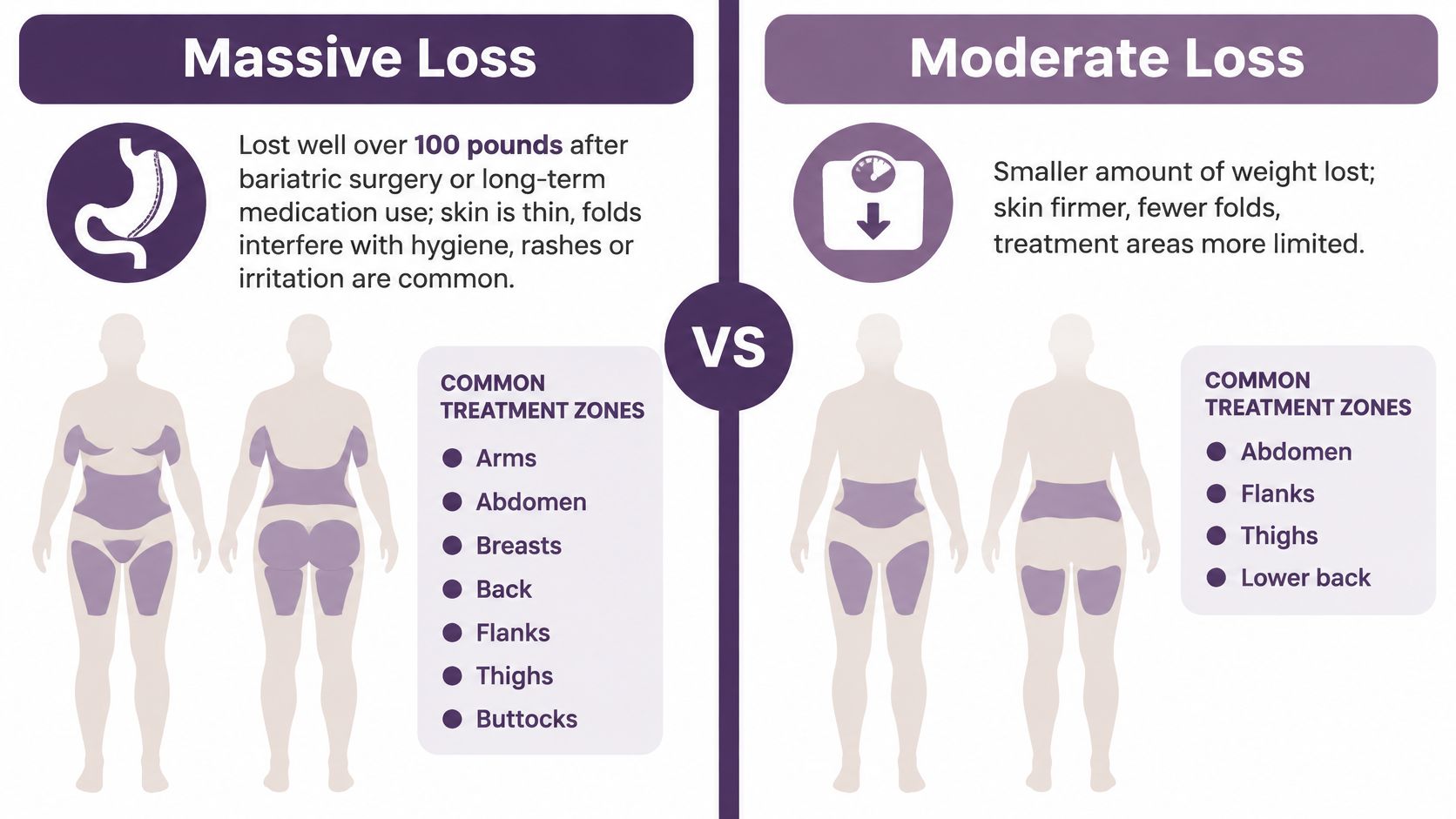
Patient A lost well over 100 pounds after bariatric surgery or long-term medication. Skin is thin. Folds interfere with hygiene. Rashes or small open areas show up in creases, and several regions need excision. A lower current BMI helps. It does not erase risk, so the visit weighs BMI, nutrition, and smoking together.
A 2025 review of contouring after significant weight loss notes that published post-bariatric series report overall complication rates as high as 56%, although one cited cohort characterized only 4.3% as major complications. That review also identifies increased thromboembolic risk in this setting. Patients with a normal BMI of 20 to 25 at surgery had fewer wound-healing complications than patients with a higher BMI, while maximum lifetime weight alone did not determine complication rates. Patient A is usually staged. Nutrition is scrutinized. The first goal is function, such as a cleaner abdominal fold, before cosmetic fine-tuning.
Patient B lost a moderate amount, say 30 to 60 pounds, with diet, exercise, or a GLP-1 medicine. Pinchable fat plus mild to moderate laxity sits in one or two zones, and elasticity may still recoil. Liposuction, a tummy tuck under local anesthesia for an appropriate candidate with selected abdominal laxity, or a skin-tightening adjunct may be discussed. A circumferential body lift is often unnecessary. Moderate loss is not automatically minor surgery if you smoke, have diabetes, or your weight is still moving.
Neither pathway removes every stretch mark or restores the pre-weight-gain shape. A staged calendar is often how Patient A's plan looks once it leaves the exam room.
- Count the zones that limit hygiene, clothing, or exercise.
- Name the tissue. A liftable fold is not the same as a fat bulge over springy skin.
- Pick the calendar. One focused procedure, or several operations with healing between them.
Which story is closer to yours?
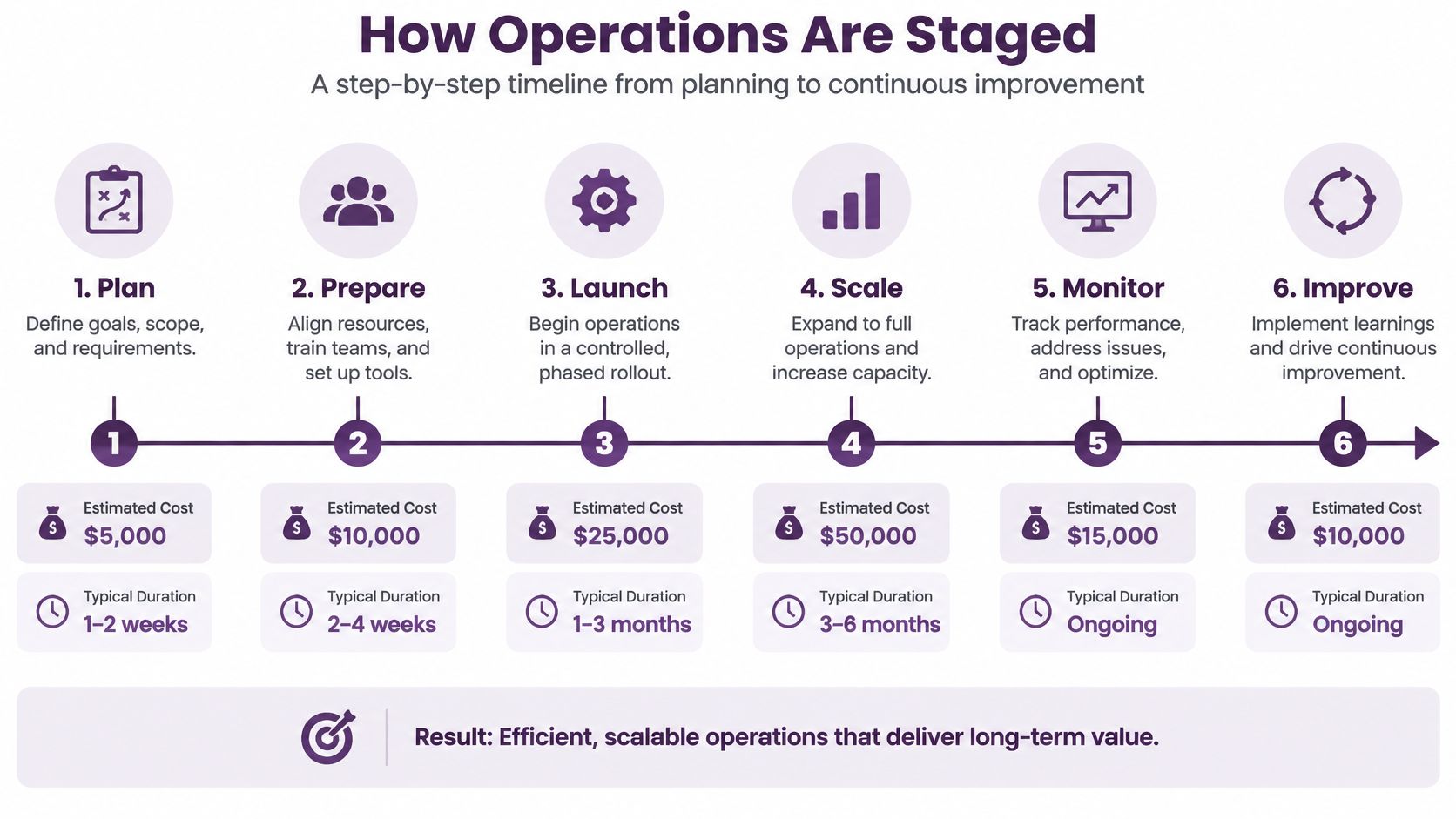
How Operations Are Staged
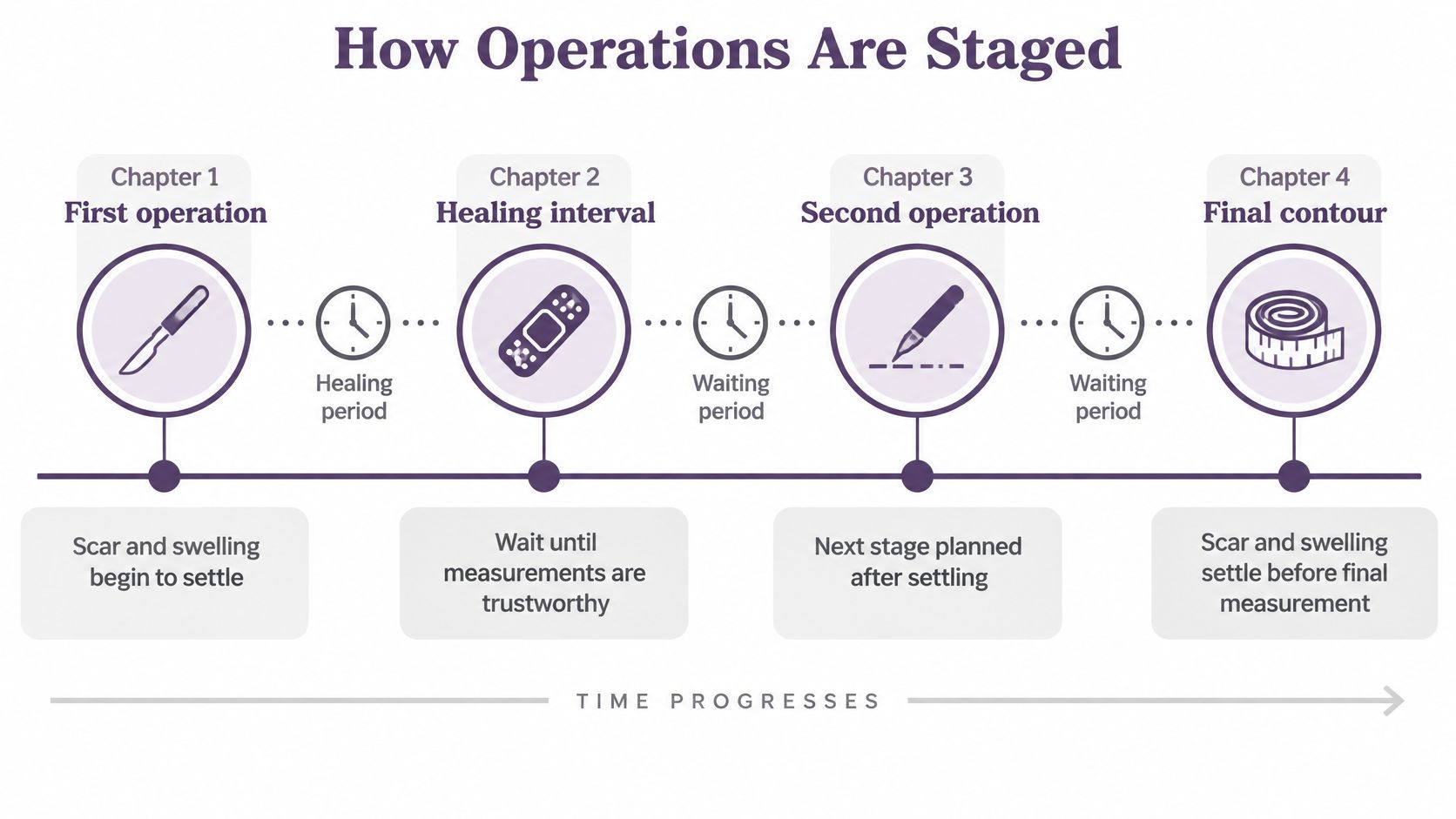
Treat each operation as a chapter. The scar and swelling of one chapter have to settle before the next measurement is trustworthy. Rushing the second date means the surgeon is marking skin that is still swollen.
Stony Brook University patient guidance recommends remaining weight-stable for at least 12 months before body contouring, because later gain or loss can worsen the look and raise the chance of another operation. That guidance also notes that staged operations are typically separated by three to six months so wounds, nutrition, and activity can recover.
A sample order
A common functional sequence starts with the abdomen or a lower body lift. That skin often causes the most hygiene trouble, and it sets the waistline that later breast or thigh plans are judged against. Arms and inner thighs often wait, because those scars are long and swelling there lingers. Breasts may wait until chest volume is stable.
A two-stage sketch many people can live with is abdomen first, then arms or breasts after healing. That is a plan, not a promise of a single remarkable day. Your physician decides the order and the spacing. A mommy makeover after weight loss is one way selected trunk and breast changes are combined when the exam supports it, still with the same recovery math.
Combining areas can be reasonable for a healthy patient with limited laxity when the team is prepared for a longer operation. Combining a circumferential lift with arms and thighs increases wound surface, time under anesthesia, and clot risk. A single-area plan is a common, sensible choice, not a failed transformation. Many patients do better finishing one chapter well than stacking every region into a single day.
Liposuction and Skin Tightening Adjuncts
Think of the skin as a garment. Liposuction takes volume out of the garment. Excision tailors fabric that is already too big. Energy devices try to shrink the lining a little. Mixing those jobs up is how people end up disappointed by a procedure that did exactly what it was built to do.
What liposuction can still do after the scale drops
After major loss, fat can remain at the waist, flanks, back, arms, thighs, or neck even when the rest of the body looks lean. Tumescent technique and hi-definition liposuction can refine those zones by reducing fat in a mapped layer. Hi-definition work is about contour, not about lifting a sheet of skin.
- Springy skin over a fat bulge: liposuction is often the primary tool.
- A fold you can lift in your hand: liposuction alone will not tailor that fabric.
- Both at once: liposuction is commonly paired with excision, but only after weight is stable, because later loss still changes the contour.
Pairing does not make either tool prevent future stretch if weight swings again. Our page on liposuction with skin tightening walks through how volume removal and surface contraction are planned together for selected areas.
For appropriate candidates, some liposuction and some tummy tuck procedures may be performed awake under local anesthesia. That may let a selected patient avoid general anesthesia and may streamline the day. It does not mean zero discomfort, zero swelling, or zero surgical risk, and it is not suitable for every person or every operation. Your physician decides after looking at anatomy, the amount of tissue, and medical history.
Where energy tightening stops
Renuvion, also called J-Plasma, uses helium plasma and radiofrequency energy to tighten soft tissue. It is an adjunct for appropriate mild to moderate laxity, sometimes in the same setting as liposuction. It is not a body lift.
Patients with thick folds, rashes under a pannus, or laxity that circles the trunk still need excisional surgery if they want that degree of change. Contraction varies from person to person. If excision is required, those scars are permanent. They fade. They do not vanish. No device prevents new stretch if weight rises or falls sharply afterward.
The published record for cutting away a heavy fold is much longer than the record for energy-based contraction. Ask what data exist for the device in your body area, and what degree of change is realistic on your skin, not on a best-case photo.
The pinch test keeps the choice honest. Springy skin and a fat bulge point toward liposuction, with or without a tightening adjunct. A fold you can gather in your hand points toward excision. If you are unsure which one you are holding, that is the question to settle in the exam, before you book a device or a scar.
Risks and the Recovery You Should Expect
Most problems in published series are wound and fluid issues handled with dressing changes and follow-up, not emergencies. Clots are uncommon and still the reason walking, compression, and a risk review belong in every plan. Rates below are drawn from post-bariatric series in a review of complications after post-bariatric abdominoplasty.
| Complication | Reported rate | What it usually means |
|---|---|---|
| Any complication in a 180-patient series | 26.1% | At least one wound, fluid, or other problem |
| Partial wound separation share of those events | 40.4% of complications | Edges separate and need wound care |
| Seroma share of those events | 14.9% of complications | Fluid collects under the skin |
| Overall complications after post-bariatric abdominoplasty | 29.8% of 898 patients | Includes minor and treated problems |
| Minor wound problems in that review | 15.8% | Dressing care rather than a return to the operating room |
| Complications needing medical intervention | 10% | Treatment beyond routine healing |
| Seroma after abdominal contouring | about 13.3% to 16.4% | Possible drainage or observation |
| Wound dehiscence | about 9.6% | Opening that needs local care |
| Infection | about 4.3% | Antibiotics or wound treatment |
| Hematoma | about 1.4% to 3.2% | A blood collection that may need drainage |
| Deep-vein thrombosis or pulmonary embolism | about 0.3% each | Uncommon but serious clot risk |
In that review of 898 patients, minor wound problems and problems needing medical care sat alongside five patients who developed deep-vein thrombosis or pulmonary embolism. The meta-analytic clot estimates are small. They are not a reason to skip prevention.
What the first month usually asks of you
Recovery commonly means drains or close fluid checks, a compression garment, and limited lifting for several weeks. Aggressive cardio and heavy training wait until your surgeon clears them, often on the order of a month after substantial trunk surgery and longer if several areas were treated. Swelling outlasts the first uncomfortable week. Some people also read clinic-friendly pain management strategies while they follow the medication plan their own surgeon prescribes. Scars are permanent. They fade. They do not disappear.
A 2024 analysis of patients after bariatric surgery found that people who later had body-contouring surgery maintained improved or stable health-related quality of life and appearance outcomes for up to 10 years after contouring. That durability is why many people accept the recovery. Risk rises with smoking, diabetes, a higher BMI, poor protein intake, and removal of a very large amount of tissue. None of those factors is a moral failing. Each one is a reason to change the date, the staging, or the plan.
Book a Plan That Matches Your Weight History
Arrive with three facts written down. Highest weight and current weight. How many months the weight has been stable. The one area that most limits clothing, exercise, or skin care. That list lets a consultation sort excision, liposuction, a possible skin-tightening adjunct, or a staged calendar, instead of handing you a generic menu.
Luxe Aesthetic Surgery & Medical Spa, led by Medical Director Haimesh Shah, MD, RPVI, plans body contouring around anatomy, goals, and medical history for patients throughout Southern California. Dr. Shah is a board-certified physician specializing in cosmetic surgery and phlebology. He has expertise in hi-definition liposuction surgery, body contouring surgeries, and venous disorders, and he trained in autologous fat grafting with recognized cosmetic surgeons.
For appropriate candidates, selected tummy tuck and liposuction procedures may be performed awake under local anesthesia. That may avoid general anesthesia. It is not suitable for every person or every operation, and it does not remove surgical risk. Renuvion may be discussed when mild to moderate laxity is part of the picture, not when a heavy apron is the main problem.
Bring the three facts, then let the exam decide the tool. A short list beats a wish to fix every region on one day.
A consultation confirms candidacy, scar placement, whether labs or a longer wait are wiser, and how a staged plan would be sequenced. Results vary. No outcome is guaranteed before an in-person examination, because skin quality, nutrition, and the amount of tissue still have to be seen.
Luxe Aesthetic Surgery & Medical Spa offers individualized body contouring after weight loss, including excisional surgery, liposuction, and skin-tightening options matched to your weight history rather than a one-size menu. If loose skin or stubborn fat is what remains after your loss, a consultation can sort timing, staging, and whether an awake approach is even appropriate. Visit Luxe Aesthetic Surgery & Medical Spa to request a visit and bring your stable-weight dates with you.