Medical Expertise at Luxe Aesthetic Surgery
Luxe Aesthetic Surgery & Medical Spa is led by Haimesh Shah, MD, RPVI , a physician specializing in cosmetic surgery, body contouring, laser procedures, and venous medicine. Dr. Shah is a Diplomate of the American Board of Laser Surgery, American Board of Venous & Lymphatic Medicine, American Board of Wound Management, and American Board of Internal Medicine. He also holds the Registered Physician in Vascular Interpretation (RPVI) credential and has contributed to peer-reviewed medical research.
Could removing inner thigh fat make loose skin more noticeable rather than give you the smoother shape you want? It could, which is why inner thigh fat removal starts with identifying the tissue causing the fullness, not choosing a procedure by name.
A pinchable fat pocket, hanging skin, and a combination of both can look similar in clothing but need different treatment plans. The useful question isn't how much fat can be removed. It's what can be changed while preserving smooth transitions, supportive tissue, and balanced proportions.
Table of Contents
- Which Inner Thigh Treatment Fits Your Case
- Why Inner Thigh Fat and Skin Need Different Plans
- How Awake Liposuction Is Performed Step by Step
- What Cryolipolysis Can and Cannot Change
- Skin Removal, Complications and Safety
- Recovery Timeline From Week One to Month Six
- Who Is a Poor Fit and When to Wait
- Confirm Your Candidacy Before You Book a Consultation
Which Inner Thigh Treatment Fits Your Case
Inner thigh treatment options by case
| Option | Best suited for | Anesthesia | Expected change | Removes or tightens skin |
|---|---|---|---|---|
| Awake or tumescent liposuction | Localized fat, stable weight, good skin elasticity | Local anesthesia for select patients | Contour refinement within anatomical limits | No skin removal; tightening isn't assured |
| Hi-definition liposuction | Stable-weight adults seeking more defined contours | Chosen after medical assessment and treatment planning | Sculpting of treated fat layers | No skin removal; tightening isn't assured |
| Mini liposuction | Smaller, localized fat areas | Selected according to treatment extent and medical history | Limited-volume contour change | No skin removal; tightening isn't assured |
| Cryolipolysis | Small, pinchable fat pockets at stable weight | None for this non-invasive treatment | Modest, gradual change over weeks to months | No skin removal |
| Medial thighplasty with liposuction | Excess skin plus localized fat, often after major weight loss | Requires a procedure-specific anesthesia plan | Skin removal and contour reshaping | Yes, excess skin is removed |
These categories describe different goals, not interchangeable levels of the same treatment. Hi-definition and mini liposuction still involve surgical fat removal. Their names alone don't establish how much tissue should be removed, which anesthesia is appropriate, or whether your skin will settle smoothly afterward.
Use the dominant problem to narrow the options
Fat-dominant fullness may point toward liposuction when weight is relatively stable and the skin has reasonable elasticity. Skin-dominant looseness may require excision. When both are present, the clinician needs to plan fat reduction and skin management together rather than treating them as unrelated problems.
The FDA consumer overview of liposuction describes liposuction as a contouring intervention rather than a general weight-loss treatment. It doesn't treat obesity, and removing localized fat won't reliably correct substantial redundant skin.
Cryolipolysis is a different choice: controlled cooling produces gradual contour change rather than suction-based removal during surgery. Someone seeking a subtle reduction in a small bulge may accept that trade-off; someone seeking substantial reshaping may not.
Practical rule: Choose the tissue problem before choosing the treatment name.
For example, a small upper-inner-thigh bulge with relatively firm skin raises a different question from a loose fold extending toward the knee. Match your main concern to a row in the table, then bring that row to a consultation as your starting question, not as a predetermined treatment choice.
Why Inner Thigh Fat and Skin Need Different Plans
Removing stuffing from a mattress doesn't shrink an oversized cover. Similarly, reducing fat beneath stretched skin may leave the skin loose or make existing laxity easier to see.
Genetic fat distribution, hormonal shifts, and weight changes can influence thigh fullness. Aging and major weight loss can also affect skin elasticity, so appearance alone doesn't tell you which tissue needs treatment.
Separate the patterns
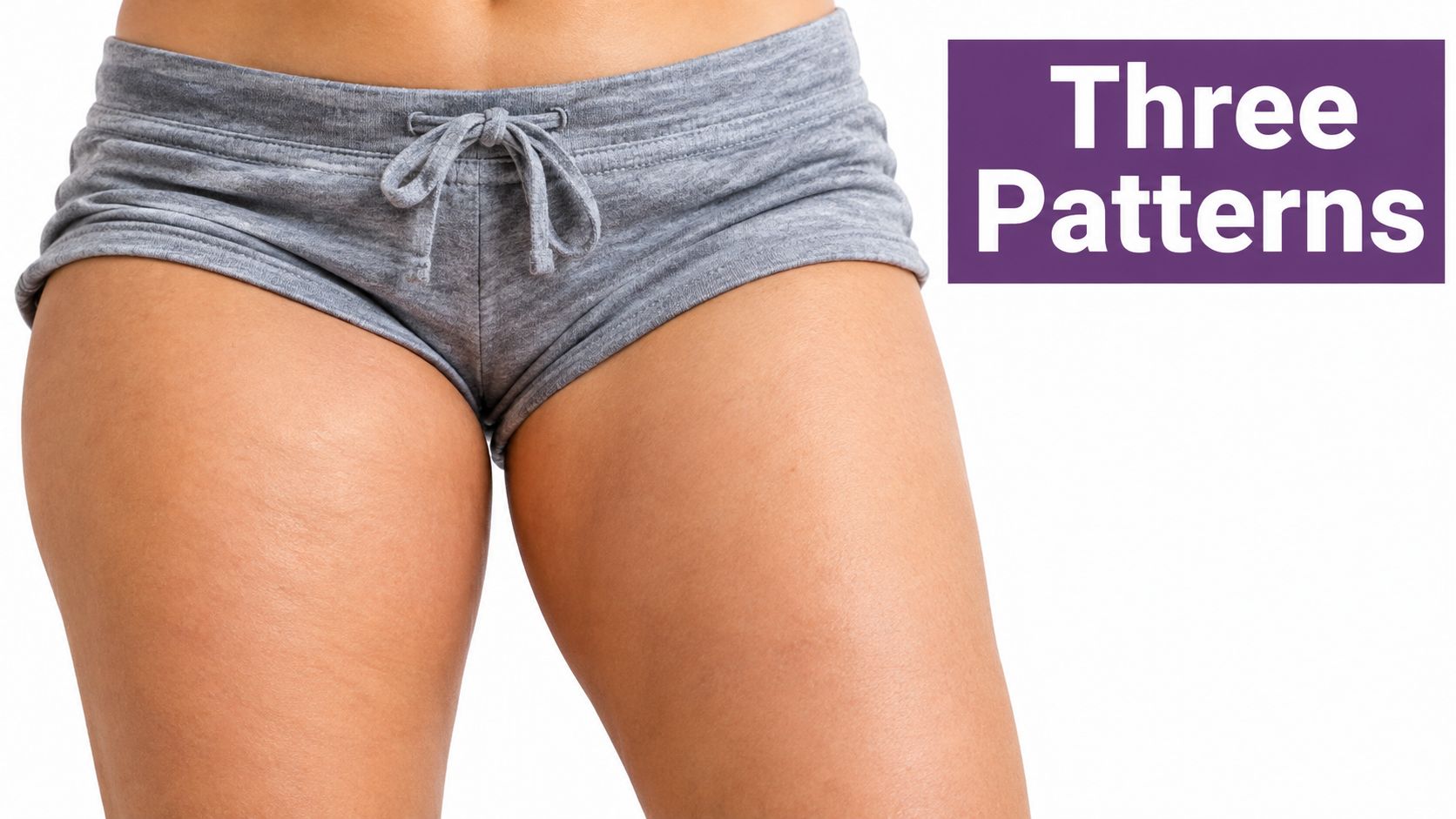
- Localized fat: A pinchable subcutaneous bulge may remain despite otherwise consistent eating and exercise habits.
- Excess skin: A loose fold may hang when standing even when there isn't much underlying fat.
- Mixed fullness: Both a fat pocket and a stretched skin envelope contribute to the contour.
These patterns can overlap. A pinch test is a useful observation, but it isn't a diagnosis or a way to determine how much fat can safely be removed.
Anatomy sets the limits
A cadaveric study of 20 fresh female thighs identified regional differences in the superficial fascial system across the medial, anterior, posterior, and lateral thigh subunits. This supporting connective tissue helps explain why the thigh can't be treated as a uniform layer of removable fat.
Some medial-thigh zones have strong attachments between skin and deeper fascia. Aggressive aspiration across those zones can produce depressions, irregularities, or postoperative laxity. Planning must also consider the transition from the upper to lower inner thigh and how the treated area meets the knee.
Conservative border feathering, gradually blending treated and untreated tissue, can help avoid an abrupt edge. Skin-focused planning requires a separate discussion; information about skin tightening for thighs can help you frame that conversation without assuming tightening equals surgical skin removal.
Before a consultation, ask yourself:
- Pinchability: Is there a distinct bulge you can gently pinch?
- Skin position: Does loose skin hang when you're standing?
- Weight stability: Has your weight remained stable for several months?
The dominant tissue problem, not thigh circumference alone, determines the treatment path.
How Awake Liposuction Is Performed Step by Step
Awake liposuction generally means local anesthesia is used while the patient remains awake. It's an option for appropriately selected patients, not a promise that everyone qualifies or that surgery involves no discomfort or risk.
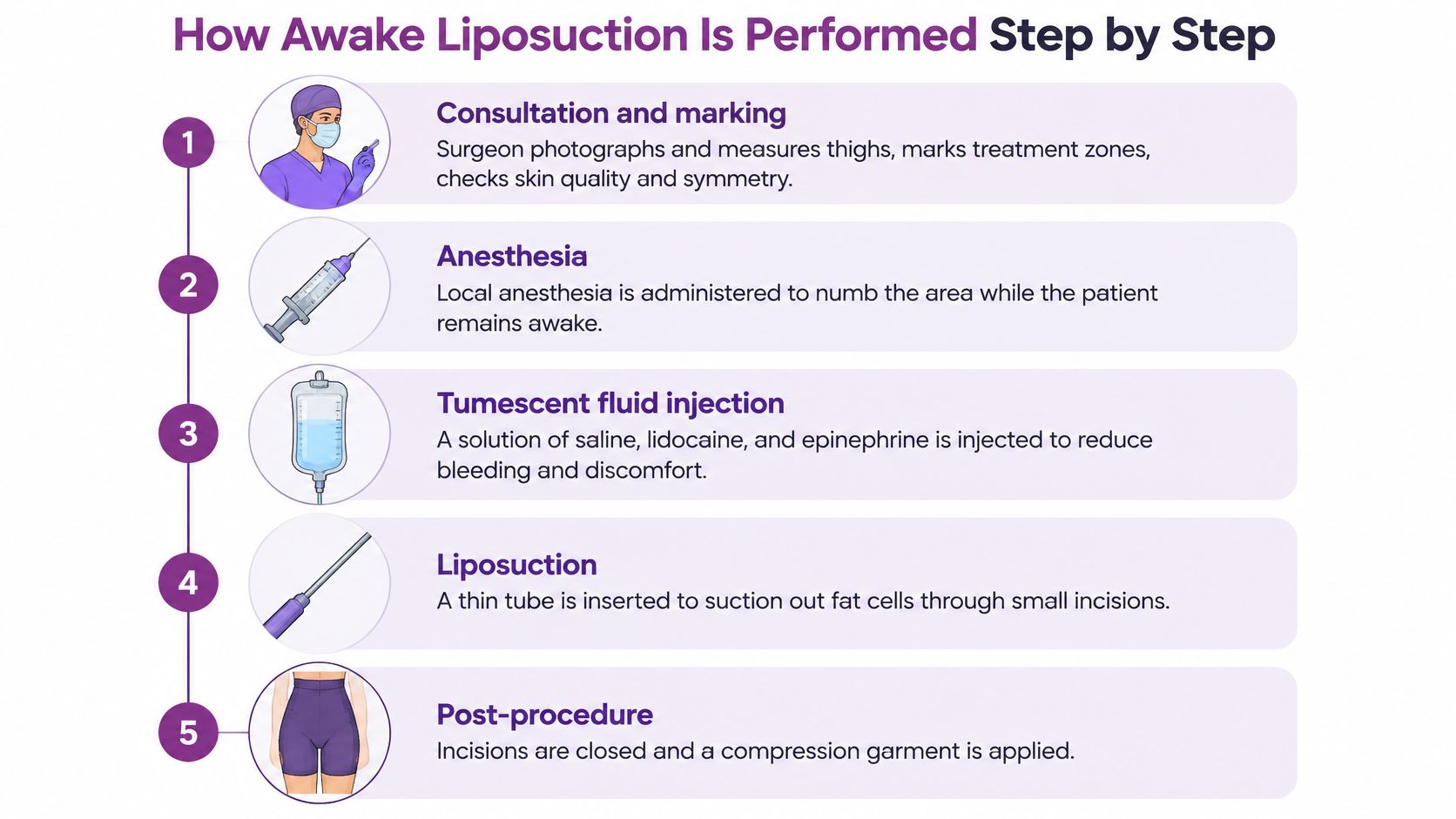
The overview below illustrates the broad process. The exact sequence, incision management, and positioning require an individualized surgical plan.
From marking to aftercare
Consultation and marking. The surgeon photographs and measures the thighs, checks skin quality, and marks treatment zones with the patient standing so natural folds and baseline asymmetry are visible. A planning mistake to avoid is treating both thighs as identical when their starting contours differ.
Tumescent preparation. A solution containing local anesthetic is introduced into the target tissue to numb the area and help reduce bleeding. Adequate assessment of anesthesia effect matters; being awake shouldn't mean proceeding through inadequately controlled pain.
Small incisions. The surgeon places small access openings in positions selected for access and discretion. The trade-off isn't just scar visibility, because poorly chosen access can make it harder to reach the planned fat layers evenly.
Fat removal. A thin suction instrument called a cannula passes through the subcutaneous fat, removing tissue conservatively and blending treatment borders. Over-treating a focal bulge or failing to feather its edges can create a depression rather than a smooth transition.
Contour check. The surgeon reassesses shape and symmetry and adjusts the treatment where appropriate. Standing reassessment may be considered only when clinically safe; it shouldn't be assumed to be routine or suitable for every awake patient, and perfect symmetry isn't a realistic promise.
Closure and dressing. Access sites are managed according to the surgeon's technique, with closure where appropriate, followed by dressings and a prescribed compression garment. An important aftercare error is using excessive compression or a poorly fitting garment without reporting discomfort or skin changes.
Post-procedure plan. Written instructions should address walking, garment wear, wound care, medications, and follow-up. Feeling comfortable isn't permission to resume strenuous activity before clearance, and instructions for a limited treatment shouldn't be borrowed for a more extensive operation.
Understand the anesthesia choice
Local anesthesia still requires medical screening, appropriate dosing, monitoring, and a plan for managing problems. Treatment extent, medical history, and the patient's ability to tolerate the procedure all matter.
For terminology and context, the practice's explanation of what awake liposuction is called can help distinguish awake treatment from a specific device or sculpting technique. Dr. Haimesh Shah has expertise in Hi-Definition Liposuction Surgery, Body Contouring Surgeries, and Venous Disorders.
Before consenting, you should be able to explain back what tissue will be removed, where removal is planned, and how the surgeon will assess symmetry. You should also know what happens if the planned anesthesia approach doesn't provide adequate comfort.
What Cryolipolysis Can and Cannot Change
Cryolipolysis uses controlled cooling of subcutaneous fat, followed by gradual biological clearance, rather than immediately suctioning fat out of the body.
Measured results from inner-thigh cryolipolysis studies
The published review of cryolipolysis evidence describes the fat-thickness, circumference, and treated-versus-control findings below; the FDA's non-invasive body-contouring guidance also explains the treatment's limits as a contouring intervention.
| Measure | Reported result | Time point | Study context |
|---|---|---|---|
| Inner-thigh fat-layer thickness by ultrasound | Mean 2.8 mm reduction | 16 weeks | Prospective study of 42 patients who remained within 5 lb of baseline weight |
| Inner-thigh circumference | Mean 0.9 cm decrease | 16 weeks | Same prospective study |
| Patient satisfaction | 93% reported satisfaction | Not separately specified in the study summary | Same prospective study |
| Treated-side fat thickness | 14.9% reduction, compared with 0.7% on the control side | Not separately specified for this endpoint in the study summary | Inner-thigh study included in a systematic review |
| Treated-versus-control volume difference | Mean 39.5 cm³ | 2 months | Systematic review data |
Interpret the change correctly
These are measurements of modest localized change, not evidence of surgical-level debulking. High satisfaction doesn't mean every participant experienced a dramatic reduction, and a change in fat-layer thickness isn't the same measurement as a change in circumference.
Applicator fit, tissue thickness, and treatment parameters affect what can be treated. Additional sessions may be considered after assessing the initial response, but a package of sessions shouldn't substitute for checking candidacy.
Stable-weight adults with a discrete, pinchable bulge and realistic expectations may be suitable candidates. Hanging skin, larger medial-thigh volume, persistent asymmetry, or friction-related concerns may require a different strategy rather than more cooling.
The comparison of liposuction versus non-surgical fat freezing can help frame the difference between direct removal and incremental reduction.
Measure the change you actually want, not just the number a treatment advertisement emphasizes.
Take baseline photographs, use consistent circumference landmarks, and note clothing fit. Small measurement differences can reflect tape placement or posture, so don't interpret every change as a treatment effect.
For an at-home tracking routine, photograph the area every other week using the same light, clothing, stance, and camera distance. This is a documentation habit, not a schedule for judging whether another treatment is needed.
Skin Removal, Complications and Safety
Removing more fat does not always produce a better thigh. Skin works like a fitted cover over the leg. When that cover is already loose, shrinking what sits underneath can leave it looser and less supported rather than smoother. Whether the plan should remove fat, remove skin, or combine the two depends on this single judgment.
Medial thighplasty removes excess skin and may be combined with liposuction when localized fat is also present. It can be relevant after major weight loss, where it introduces an excision scar and requires a different recovery discussion from isolated liposuction.
What the thighplasty evidence means
A 2025 review of medial thighplasty reported an overall complication rate of 36.75% across 1,113 patients undergoing liposuction-assisted medial thighplasty, compared with 70.68% in the group without liposuction, with p < 0.001. In the same review, infection occurred in 1.77% versus 9.02%, hematoma in 1.30% versus 6.77%, and seroma in 8.95% versus 24.81%, respectively.
Read those numbers as a comparison between two surgical groups, nothing more. Differences in patient selection, operative technique, and study design limit how far the findings generalize to any individual patient.
Treatment volume has no universal target either. A 2024 study of liposuction-assisted medial thighplasty involving 14 patients reported average combined lipoaspirate of approximately 989 cc from both thighs, ranging from 200 to 2,100 cc. A spread that wide reflects treatment matched to each anatomy rather than a recommended amount for your thighs.
Separate contour concerns from medical complications
The NHS liposuction guidance lists risks including contour irregularity, sensory changes, fluid accumulation, infection, bleeding, and serious clot-related events. It also notes that numbness commonly resolves within six to eight weeks, while bruising and swelling can last up to six months.
Separating concerns into two groups matters because the response differs. A contour irregularity can usually wait for a scheduled review; the safety events below cannot, and some are emergencies.
- Contour and sensory outcomes: Uneven or lumpy contours, asymmetry, persistent numbness, and skin-color changes can affect the result and require assessment.
- Medical safety events: Fluid accumulation, infection, bleeding, deep-vein thrombosis, pulmonary embolism, and injury to deeper structures need medical attention.
Conservative removal, preserved supportive structures, and careful blending are the planning principles that protect a natural result. They cannot eliminate complications, and an honest discussion of results includes the possibility of residual laxity or asymmetry.
A good plan defines what should be left in place as carefully as what should be removed.
Questions specific to skin removal
Ask whether isolated liposuction is sufficient or whether excision is needed. If a lift is proposed, discuss the location and length of the scar, wound-healing considerations, and how the surgeon plans to reduce fluid accumulation.
Also ask what would prompt a revision discussion and when a postoperative contour can be assessed meaningfully. Early swelling should not automatically be labeled a poor result, and a persistent concern should be examined rather than dismissed.
If skin hangs when standing, raise excision and combined planning explicitly before agreeing to anything. Removing more fat rarely fixes an oversized skin envelope.
Recovery Timeline From Week One to Month Six
Suppose you undergo inner-thigh liposuction and notice that your thighs look fuller immediately afterward. That can reflect postoperative swelling rather than the finished result, so early photographs aren't a fair measure of contour improvement.
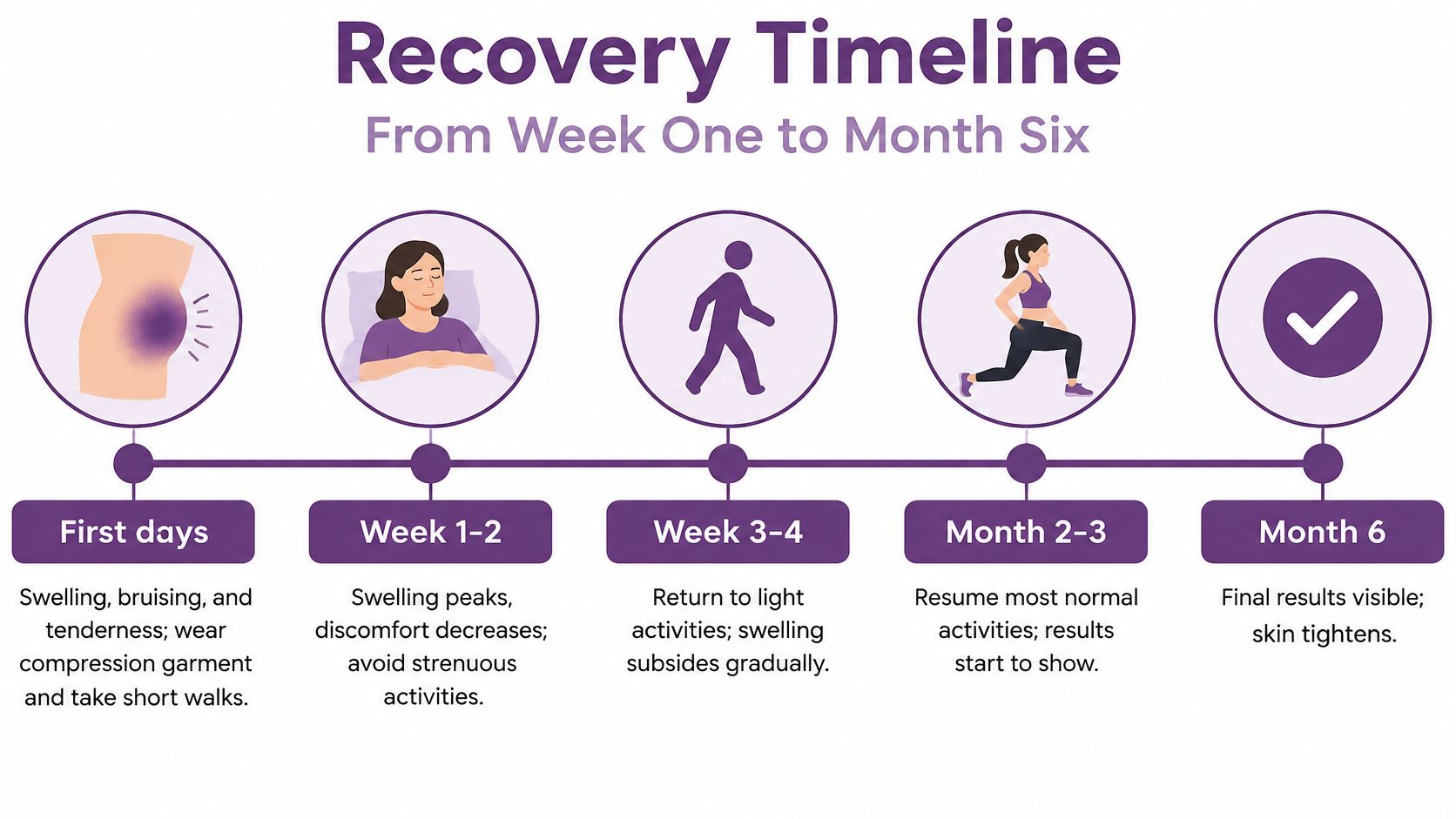
A flexible recovery sequence
First days: Swelling, bruising, and tenderness can occur. Follow the prescribed compression plan and take short walks as directed, while respecting the surgeon's limits on activity.
Early weeks: Discomfort and visible swelling may begin to settle, but improvement isn't always even from side to side. Don't use a generic calendar to decide when to exercise, because treatment extent, skin quality, anesthesia approach, and individual healing affect recovery.
Later weeks and months: Sensation may recover gradually, and residual swelling can obscure the contour. The milestones shown are illustrative, not clearance for exercise or a guarantee that skin will tighten; persistent numbness, worsening swelling, or a lasting contour concern needs review.
For cryolipolysis, the FDA-reviewed clinical evidence describes redness, bruising, and numbness that typically resolved within one month. This differs from surgical recovery and shouldn't be used to predict healing after liposuction or a thigh lift.
Symptoms that shouldn't wait
- Possible infection: Fever or spreading redness needs prompt medical assessment.
- Possible clot: New calf pain or swelling requires urgent evaluation.
- Possible emergency: Sudden shortness of breath or chest pain warrants emergency care.
If you're considering massage, Inner You's lymphatic drainage guide provides background terminology to discuss with your surgical team. Don't begin massage over recently treated tissue without clearance, and don't use it instead of evaluation for new swelling.
Ask for a written recovery timeline specific to your planned procedure, including garment instructions, activity restrictions, follow-up, and whom to contact after hours.
Who Is a Poor Fit and When to Wait
Wait until your weight has been stable for several months, because the contour you plan to alter may still be changing. Loose hanging skin, larger-volume fullness, persistent asymmetry, and friction-related symptoms also deserve assessment rather than automatic enrollment in fat reduction. Each of these signs points toward a skin or anatomy question, and a different procedure may fit better than fat removal alone.
Medical history can change the decision. Conditions affecting clotting, circulation, or healing need physician evaluation before an elective procedure, particularly given the recognized risks of deep-vein thrombosis and pulmonary embolism.
A useful waiting plan
- Stabilize first: Aim for a sustained period of stable weight rather than booking during active weight change.
- Document consistently: Record photographs and measurements using repeatable positions and landmarks.
- Use the self-check: Bring your observations about pinchability, hanging skin, and weight stability.
As covered earlier, neither liposuction nor non-invasive contouring replaces weight management or treats obesity.
For broader lifestyle reading, Maximum Health Products' guide to reduce belly fat naturally covers general habit questions about diet and activity. Those habits shape overall body fat and your candidacy, while the decision about inner-thigh contouring still rests on anatomy: how much is pinchable fat, how much is skin, and how well that skin can retract.
Waiting can be the right treatment decision when your anatomy, health, or goals aren't ready for a procedure.
Confirm Your Candidacy Before You Book a Consultation
A consultation works best when you arrive having already separated the problem into its parts. Fat and skin behave differently, so the clearer your own observations, the faster a surgeon can match your anatomy to the right plan. Four checks cover most of what they will ask.
- Identify the concern: Pinchable fat, loose skin, or both.
- Review stability: Note recent weight changes and your current routine.
- Prepare your history: List medications, prior procedures, clotting concerns, and healing problems.
- Define the goal: Describe a proportionate, natural-looking improvement rather than an exact thigh size.
Bring questions that support a decision
Ask which option fits your anatomy, what degree of change is realistic, what recovery involves, which risks apply to you specifically, and how symmetry will be checked. A candid plan weighs liposuction, cryolipolysis, medial thighplasty, and no treatment against each other, so ask why one approach was chosen over the rest. If skin quality limits what fat removal alone can achieve, the surgeon should explain what tightening or excision would add and what scarring that involves.
If you track body composition, 10 Rx Home's guide to compare body fat measurement methods can help you understand measurement choices, though those readings don't determine candidacy. Confirm current procedure descriptions, pricing, and financing directly with the practice, and bring your question list to the consultation.
Luxe Aesthetic Surgery & Medical Spa offers individualized body-contouring care, including awake liposuction for appropriately selected patients seeking inner-thigh contour improvement. Visit Luxe Aesthetic Surgery & Medical Spa to request a consultation and discuss your fat distribution, skin quality, realistic treatment options, and recovery needs.