
Medical Expertise at Luxe Aesthetic Surgery
Luxe Aesthetic Surgery & Medical Spa is led by Haimesh Shah, MD, RPVI , a physician specializing in cosmetic surgery, body contouring, laser procedures, and venous medicine. Dr. Shah is a Diplomate of the American Board of Laser Surgery, American Board of Venous & Lymphatic Medicine, American Board of Wound Management, and American Board of Internal Medicine. He also holds the Registered Physician in Vascular Interpretation (RPVI) credential and has contributed to peer-reviewed medical research.
Visible change from Kybella usually appears about 6 to 8 weeks after an injection. The full result is judged about 12 weeks after the last session, and a course runs from 1 to 6 sessions.
That is the short version of how long does Kybella take to work, and the trial calendar behind it is longer than one office visit. In two randomized, double-blind, placebo-controlled trials, 1,020 participants were treated in total, 514 received Kybella and 508 received placebo, sessions could be spaced at least one month apart, and the primary effectiveness assessments were made 12 weeks after the last treatment, about 84 days, as described in the FDA structured product labeling.
People often fold three clocks into one question. Swelling can make the chin look fuller before it looks slimmer. Fat reduction after each injection shows up later. The formal look at a finished course comes weeks after the last visit. How fast you move through those stages depends on the amount of fat, the number of sessions, and how swelling settles. None of those milestones is a guarantee.
Table of Contents
- Kybella Timeline Week by Week
- What Happens Under the Skin After Each Injection
- How Many Sessions a Full Course Takes
- Factors That Change How Long Your Results Take
- Normal Swelling Versus Symptoms to Report
- Book a Consultation to Plan Your Sessions
Kybella Timeline Week by Week
A single injection does not show its cosmetic effect on the way home. The American Society of Plastic Surgeons, as cited in DailyMed labeling, reports that fat reduction is typically visible about 6 to 8 weeks after an injection, or about 42 to 56 days. A 2026 American Academy of Dermatology treatment page describes visible contouring as typically beginning 6 to 12 weeks after the first session and continuing to refine over several months. WebMD's 2025 overview notes that visible results generally appear 6 to 8 weeks after treatment, while maximum results may take up to 12 weeks.
Swelling can last roughly 4 to 6 weeks and may make the treated area look fuller before the shape becomes clearer. The same labeling notes that the FDA permits up to six treatment sessions, with at least one month between them. Many patients need at least two sessions, commonly repeated every 4 to 6 weeks, so a noticeable change may start after the first treatment while a more complete result develops over several months. A multi-session course can run from roughly 2 months for early visible change to 6 months or longer for completion.
Reading the milestones
| Time after injection | What you typically notice | What it means |
|---|---|---|
| Days 1-7 | Swelling, tenderness, bruising, numbness | Common early reactions; contour not yet judged |
| Weeks 1-4 | Swelling most noticeable; chin may look fuller | Fat breakdown under way; too early to judge |
| Weeks 4-6 | Swelling starts to settle | Early shape change may begin to appear |
| Weeks 6-8 | Visible fat reduction typically emerges | First clear sign of improvement for many patients |
| Weeks 8-12 | Contour continues to refine | Maximum change for some patients may take up to 12 weeks |
| 12 weeks after final session | Formal assessment point | Judge the completed course here |
Days 1 to 7 are reaction days. Tenderness, bruising, and numbness are common, and the profile is not ready to judge. Weeks 1 to 4 are when swelling is most obvious. A photo at week two mostly records fluid, not fat loss. Weeks 4 to 6 are the first settling window, when an early shape change may start. Weeks 6 to 8 are when visible fat reduction typically emerges for many patients. Weeks 8 to 12 are refinement, and some people do not see their maximum change from that injection until about week 12. The row that matters for a finished series is 12 weeks after the final session.
Practical rule: Write down each injection date, then photograph the chin in the same light at weeks 6, 8, and 12. Compare the photos. Feeling the area in the mirror is a poor way to track a slow change.
Each row is a typical milestone. Swelling and individual response move the dates.
What Happens Under the Skin After Each Injection
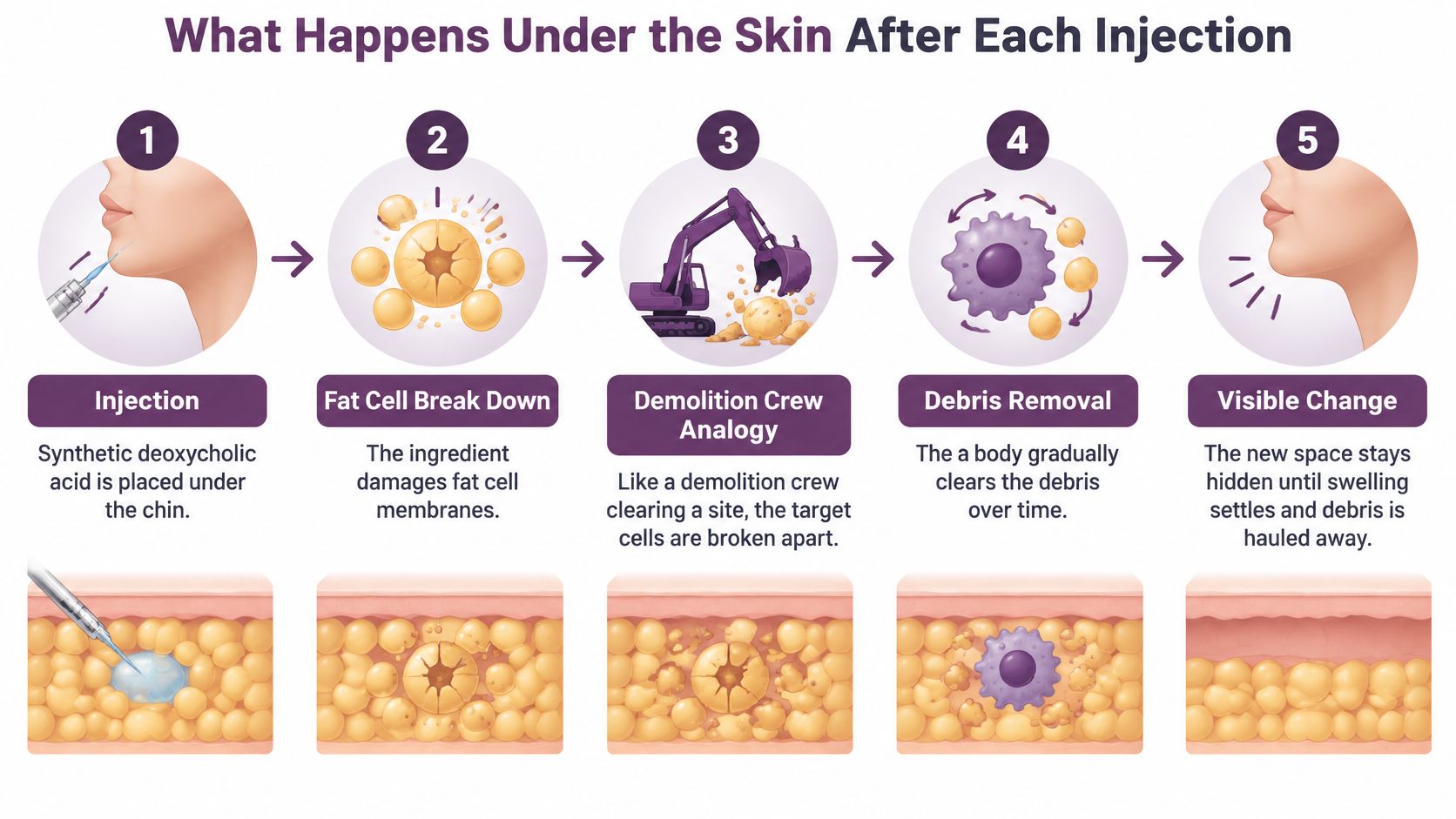
Think of the treated pocket like a building site. A demolition crew can take a structure down in a day, but the cleared lot stays hidden behind rubble until the debris is hauled away. Kybella works on submental fullness, the pocket commonly called a double chin. The active ingredient is synthetic deoxycholic acid, which destroys fat cells in a way that does not reverse.
The American Society of Plastic Surgeons description of injection lipolysis frames the delay as localized fat-cell disruption, then an inflammatory clearance and remodeling phase. Swelling, firmness, bruising, or temporary fullness can hide the improvement while that work is unfinished.
The sequence you cannot see
- The injection disrupts the membranes of fat cells in the submental area. That is the demolition itself.
- The body answers with inflammation. Swelling, firmness, and temporary fullness are the rubble on the site, which is why the chin can look worse before it looks better.
- Over the following weeks the body clears the broken-down cell contents. This haul-away phase is quiet in the mirror and easy to misread as “nothing is happening.”
- The tissue remodels and settles. The new contour becomes visible only after that clearance is well along, once swelling has substantially resolved.
Say someone checks the mirror every morning in week two and decides the injection failed because the chin looks rounder. That reading skips stages two and three. The fuller look is the inflammatory response sitting on top of cells that are already being cleared. Each later session repeats the same cycle in the treated area, so the “worse, then clearer” pattern can return after every visit.
Judge the shape only after swelling has substantially resolved. An early selfie is a picture of the job site, not the finished lot.
How Many Sessions a Full Course Takes
Kybella is injected directly into the fat beneath the chin over the course of between 1 and 6 sessions. Once the desired look is reached, no additional treatments are necessary. The table below assumes four-week spacing and counts forward to a check 12 weeks after the last session, not 12 weeks after the first.
| Sessions planned | Spacing between sessions | Approximate time from first session to assessment |
|---|---|---|
| 1 session | Not applicable | About 12 weeks (roughly 3 months) |
| 2 sessions | 4 weeks apart | About 16 weeks (roughly 4 months) |
| 3 sessions | 4 weeks apart | About 20 weeks (roughly 5 months) |
| 4 sessions | 4 weeks apart | About 24 weeks (roughly 6 months) |
| 5 sessions | 4 weeks apart | About 28 weeks (roughly 6.5 months) |
| 6 sessions | 4 weeks apart | About 32 weeks (roughly 7 to 8 months) |
Why the clock outlasts the visits
A randomized phase III study of ATX-101, the deoxycholic-acid formulation underlying Kybella, gave participants up to four sessions about 28 days apart and evaluated them 12 weeks after the final session. Treatment produced significantly greater clinician- and patient-rated submental-fat improvement than placebo, with responder odds ratios of 4.73 and 6.21 for the two active dose groups, as reported in the phase III ATX-101 trial. FDA labeling for that program also documents follow-up at 4, 12, and 24 weeks after the last treatment, so early inflammation is not treated as the durable contour.
There is no single published percentage of chin fat removed per session. Change arrives in steps. A useful personal check is the look of that session once early swelling has eased, rather than a percent you can apply to every chin.
Worked example. Two sessions four weeks apart put the formal check about 16 weeks after the first injection. The second visit is only a month in, but the assessment waits 12 weeks after that second visit. Four sessions on the same spacing land near 24 weeks, about six months, before that same end point. Someone who stops at two sessions because the profile already matches the goal does not need to fill the rest of the table.
Our Kybella treatment planning starts from the fat under your chin and the profile you want, then sets a session count inside that 1 to 6 range. Ask for the planned number and the date of each visit before the first injection, and ask which date is the 12-week check after the last one.
Factors That Change How Long Your Results Take
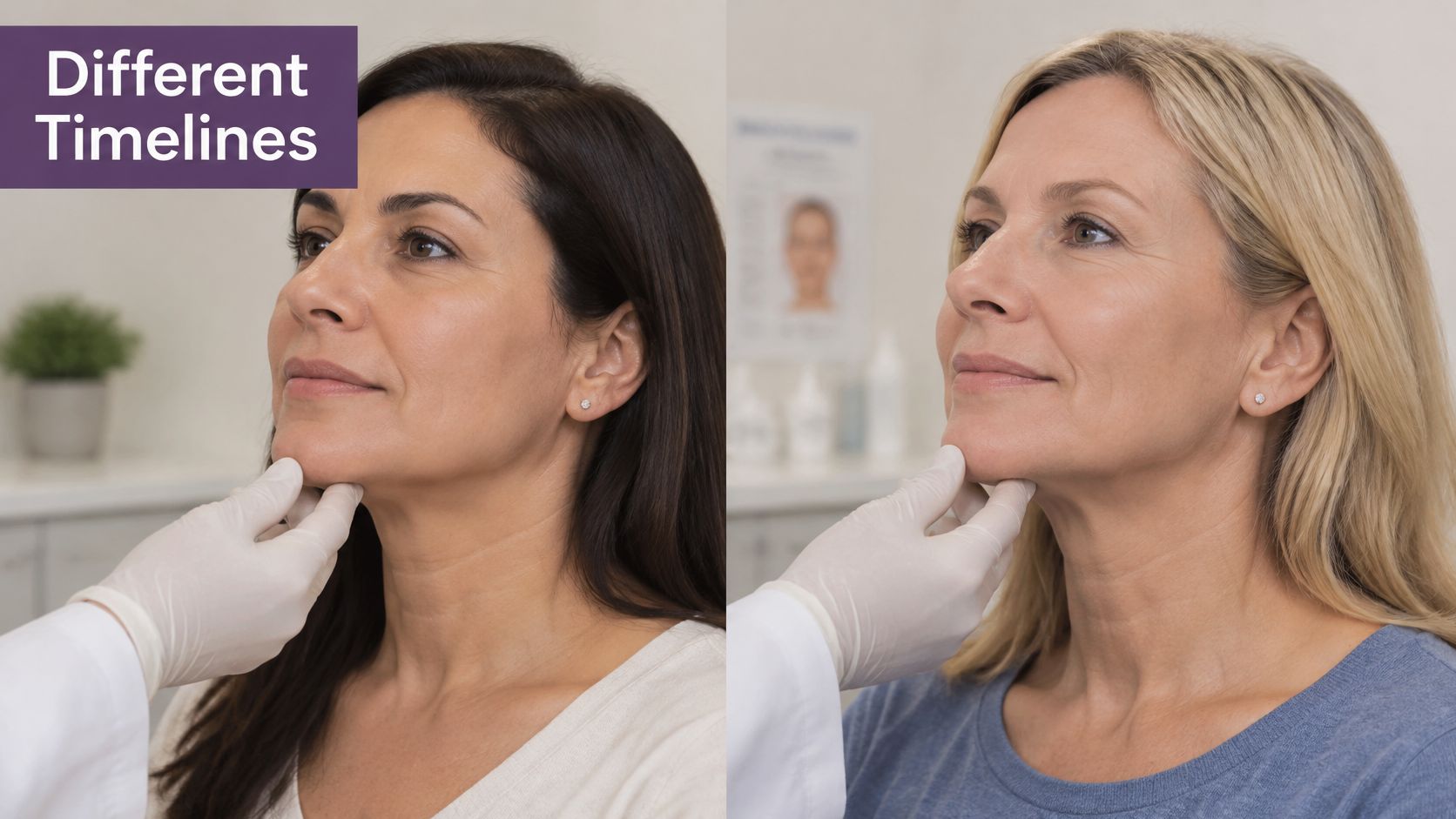
Two people can share a calendar and still not share a result date. The injection schedule is only one input. The tissue under the chin, the skin over it, and how that person clears treated fat all move the finish line.
What shifts the schedule
- Amount of submental fat. A small pocket may need fewer visits. A larger volume usually means more sessions, and each session restarts swelling before the next look at the contour.
- Sessions completed and the gaps between them. Stopping at the desired look shortens the course. Stretching the gaps, or adding visits, pushes the final check later even when each injection follows the same biology.
- Swelling and healing speed. One person settles quickly. Another stays puffy longer, so the slimmer shape stays hidden even though clearance is underway.
- Skin laxity. Reduced fat can reveal looser skin. The profile may look different from what fat volume alone would predict, which is why laxity belongs in the same exam as the fat pocket.
- Age and skin quality. Skin that adapts readily can show a cleaner line sooner. Skin that adapts slowly can make an otherwise similar fat change look unfinished for longer.
- Individual response. Bodies do not clear the same share of treated fat. This is the factor patients cannot see on a calendar.
In the controlled trials, 43% of Kybella-treated participants achieved at least a 10% reduction in submental-fat volume measured by MRI, compared with 5% receiving placebo, according to the FDA prescribing information. That is a group result, not a personal forecast. Some people improve more than that MRI threshold, and some improve less. A promise of one universal “time to work” misses anyone whose response sits away from the average.
Separate three timelines when you talk about results: temporary swelling and a distorted contour, gradual fat reduction after each session, and the clinical endpoint about three months after the last session.
Before the first injection, write down your session count and the look you want. Ask how skin laxity will be judged alongside fat volume. If the chin is only one part of the lower face you hope to balance, our fillers and injectables discussion can sit beside that plan, without treating either option as automatic.
Normal Swelling Versus Symptoms to Report
A fuller chin in week two is not, by itself, proof that treatment failed. It is also not a reason to ignore a symptom that is getting worse. The early weeks are where those two ideas get mixed up.
FDA data reported injection-site edema or swelling in 87% of Kybella-treated subjects, bruising in 72%, pain in 70%, and numbness in 66%, and some injection-site reactions can persist beyond 30 days, per the 2022 FDA label. Expected reactions are common. They are not a blank check for every change you notice.
When a common reaction stops being routine
| Symptom | Usually expected | Contact your clinician if |
|---|---|---|
| Swelling | Common; can last about 4-6 weeks | It worsens after the first week, or stays asymmetric or persistent |
| Bruising | Common, often in the first days | It spreads, becomes very painful, or does not fade |
| Pain or tenderness | Common in the first days | Pain is severe or keeps increasing |
| Numbness | Common and often temporary | Numbness lasts or affects facial movement |
| Swallowing | Not an expected effect | Any difficulty swallowing |
| Injection-site reaction past 30 days | Can occur in some patients | It persists, changes, or affects function |
Swelling that peaks early and then eases fits the usual course. Swelling that worsens after the first week, stays clearly one-sided, or will not settle deserves a call. Bruising in the first days is common. Spreading, very painful, or non-fading bruises are not something to wait out in silence. Pain that is severe or still climbing is different from ordinary tenderness. Numbness is often temporary, but numbness that lingers or changes how the face moves should be reported. Difficulty swallowing is not an expected effect. Any trouble swallowing, and any change in facial movement, should go to the treating clinician promptly.
Contact the clinician about symptoms that are severe, worsening, asymmetric, persistent, or affecting function. Do not file those under “normal swelling.”
Aftercare is individual. The written instructions from your clinician outrank general guidance, including what to avoid and when to come back. In the first month, record the date and type of each symptom. That log gives the clinician a clear record instead of a vague memory of “it felt puffy for a while.”
Book a Consultation to Plan Your Sessions
Use the dates and photos you already planned to keep. They turn a vague feeling about the chin into a decision you can review with a clinician.
Step one. Wait until earlier sessions have settled, then compare photos from about six to eight weeks with the photos from before treatment. If swelling is still the main thing you see, you are looking too early to add or cancel a visit.
Step two. At the check about 12 weeks after the final planned session, compare those photos with the look you wrote down at the start. If that look is reached, no additional treatments are necessary, and the result stands. If submental fullness remains, ask about another session, planned at least one month after the last one, and only if it still fits the original range of visits.
Kybella treats submental fullness, commonly called a double chin. Anyone who has submental fullness is a candidate for Kybella, and Kybella is the only FDA-approved injectable treatment for adults to improve the profile of the chin. Suitability still gets a clinical look at anatomy, medical history, and goals. Dr. Haimesh Shah, a board-certified physician specializing in cosmetic surgery and phlebology, serves as Medical Director of Luxe Aesthetic Surgery & Medical Spa and reviews that plan with patients across Southern California.
A consultation is where session count, spacing, and the week-12 date get written down before the first injection. If you would rather start that booking conversation online, chatbot appointment booking for aesthetic clinics outlines how a clinic chatbot can collect treatment questions and appointment requests without a phone tag loop. When you are ready to talk with our team, use our contact page and bring your photos, your goal, and the dates you hope to protect on the calendar.
Before the first injection, write down every planned session date and the week-12 assessment date. Those two lines keep swelling, gradual change, and the final check from blurring into one impatient question.
Luxe Aesthetic Surgery & Medical Spa plans Kybella for submental fullness as a staged series, with session dates and a later assessment instead of an overnight change. Our team in Southern California can review your chin profile, your photos, and how many visits fit your goal. Visit Luxe Aesthetic Surgery & Medical Spa to request a consultation and put those dates on a real calendar.