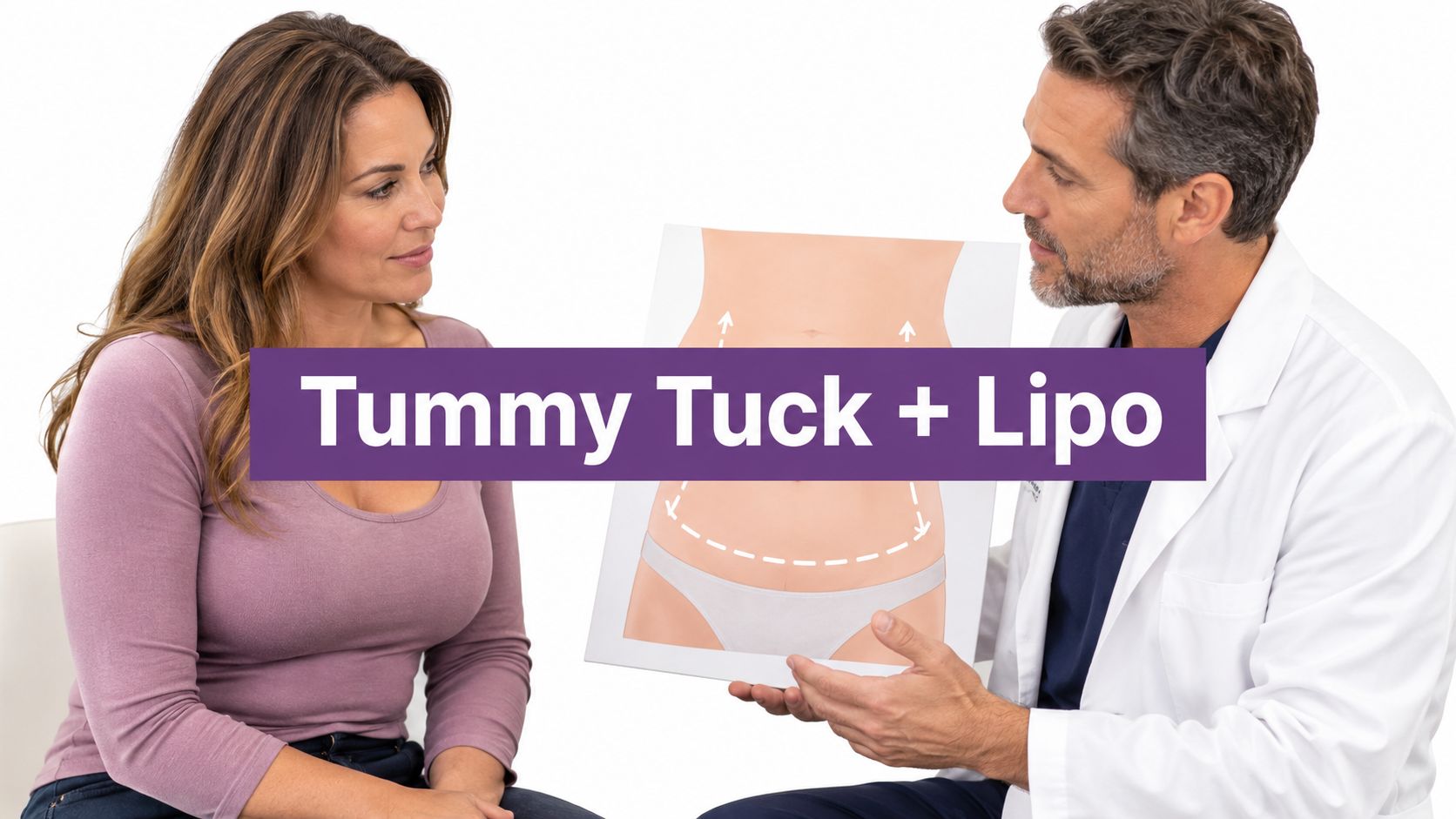
Medical Expertise at Luxe Aesthetic Surgery
Luxe Aesthetic Surgery & Medical Spa is led by Haimesh Shah, MD, RPVI , a physician specializing in cosmetic surgery, body contouring, laser procedures, and venous medicine. Dr. Shah is a Diplomate of the American Board of Laser Surgery, American Board of Venous & Lymphatic Medicine, American Board of Wound Management, and American Board of Internal Medicine. He also holds the Registered Physician in Vascular Interpretation (RPVI) credential and has contributed to peer-reviewed medical research.
If a tummy tuck and liposuction address different concerns, why isn't combining them always the obvious choice? Because a more complete contour change also means a more involved operation, and the safest extent of treatment depends on your anatomy, health, and surgical plan.
Tummy tuck and lipo should be a risk-stratified decision, not an automatic add-on. Understanding what each procedure can accomplish helps you weigh a combined operation against a smaller procedure or treatment in separate stages.
Table of Contents
- Which Procedure Fixes Which Problem
- Who Qualifies for a Combined Procedure
- Combined, Staged or Single Surgery Compared
- Awake or General Anesthesia for Combined Surgery
- Recovery Week by Week After Combined Surgery
- Warning Signs That Need Urgent Care
- Common Questions About Tummy Tuck and Lipo
- Book a Consultation to Confirm Your Plan
Which Procedure Fixes Which Problem
| Concern | Tummy tuck | Liposuction | Combined |
|---|---|---|---|
| Loose skin below the navel | Removes excess skin | Does not remove loose skin | Removes skin and treats fat when appropriate |
| Stubborn fat on flanks, back or waist | Limited fat removal with abdominal tissue | Removes localized fat | Removes skin and localized fat when appropriate |
| Abdominal muscle separation | May tighten the abdominal wall | Does not repair muscles | Tightening plus fat removal when appropriate |
| Waist definition | Improves with skin and wall tightening | Improves with fat removal | May offer the most comprehensive contour change |
| Surgery length and recovery load | Single operation focused on skin and abdominal wall | Generally shorter when treatment is limited to fat | Generally longer and more involved |
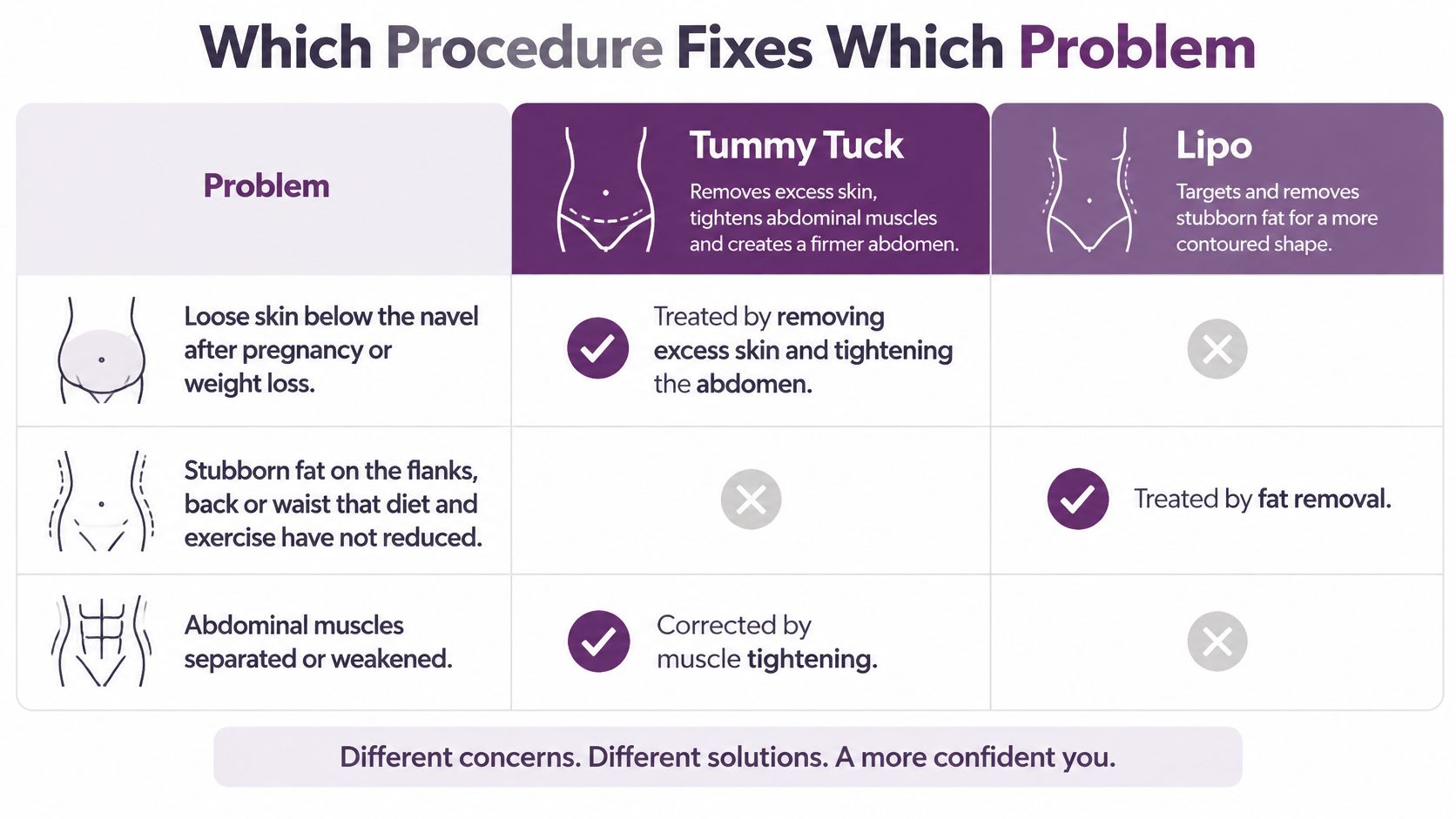
A tummy tuck, medically called abdominoplasty, removes redundant abdominal skin and can tighten the connective tissue over separated abdominal muscles. Liposuction removes localized fat beneath the skin through small access incisions, but it doesn't remove hanging skin or repair abdominal muscle separation.
Say you've lost weight and now have a lower-abdominal skin fold alongside persistent fullness at your waist. Removing skin alone may leave the waist fullness untreated, while removing fat alone may leave the fold. Combining procedures may address both, provided the proposed treatment is medically appropriate.
The visual comparison highlights these different treatment targets.
Body contouring isn't weight-loss treatment
The American Society of Plastic Surgeons reported 347,782 liposuction procedures and 170,110 tummy tucks in 2023 in its procedural statistics report. These are national estimates from participating plastic surgeons, not a complete census of every provider.
ASPS subsequently reported 317,196 liposuction procedures in 2025 in its plastic surgery trends overview, showing continued demand even as annual totals shift. Popularity, however, doesn't determine which operation fits your body.
If you're still considering medical weight management, Trim's comparison of weight loss tablets or injections can help frame a separate conversation with your prescribing clinician. Neither option serves the same purpose as removing excess skin or reshaping a localized fat deposit.
For a closer look at the anatomical distinction, see our guide to choosing between liposuction and a tummy tuck.
Practical rule: Having both excess skin and localized fat creates a reason to consider combination treatment, not proof that you should have it.
Who Qualifies for a Combined Procedure
Candidacy depends on healing capacity; a desired clothing size is not a medical criterion. The surgeon weighs the expected contour benefit against the extent of surgery and the patient's health history.
A review of abdominoplasty complications covering 20,029 procedures reported local complication rates of approximately 20% for traditional abdominoplasty and 10.3% for lipoabdominoplasty. The comparison does not show that adding liposuction makes surgery safer. Patient selection, technique, and perioperative care may differ between groups.
Health factors that change the plan
Each health factor needs to be considered in relation to healing and surgical risk:
- Body mass index and fat distribution: Higher BMI can increase surgical risk, while BMI alone does not show where fat sits or how much treatment is appropriate.
- Smoking and nicotine exposure: These can interfere with circulation and wound healing. Ask the surgeon about cessation requirements before and after surgery.
- Anemia: Low blood counts may reduce reserve for blood loss and recovery, so investigation and correction may be needed first.
- Diabetes: Glucose control matters because poor control can complicate healing and infection prevention.
- Previous abdominal surgery: Existing scars may affect blood supply to tissue that will be lifted and repositioned.
- Clotting history: A personal or family history of blood clots, medications, and mobility limitations can affect prevention planning.
Stable weight and realistic expectations also matter. If weight is still changing, the amount of skin and fat requiring treatment may change with it.
Where fat is removed matters
During abdominoplasty, the surgeon creates an abdominal flap, a layer of skin and underlying tissue that needs adequate blood flow. Liposuction near this flap raises different technical concerns from carefully selected treatment at the flanks.
The plan must account for treatment depth, tissue handling, bleeding control, and preservation of blood vessels. For example, a patient with a history of blood clots may need a different plan or may not be a candidate for a combined operation, depending on the individual assessment.
If you smoke, your weight is still shifting, or your main concern is loose skin without meaningful localized fat, a combined plan may not be the first choice. The consultation can determine whether to proceed, reduce the treatment area, delay surgery, or choose a single procedure.
Combined, Staged or Single Surgery Compared
| Option | When it may fit | Main trade-off |
|---|---|---|
| Tummy tuck alone | Excess skin and abdominal wall laxity with little localized fat | Fat-contour concerns may remain; potentially shorter than adding liposuction |
| Liposuction alone | Localized fat without significant loose skin | Doesn't remove excess skin; generally less wound management |
| Combined in one session | Both excess skin and localized fat in appropriate patients | Longer operation; potentially higher complication risk; full screening needed |
| Staged, separate sessions | Patients who need both but whose health or treatment extent favors smaller steps | Separate recoveries; later treatment follows healing and reassessment |
The appeal of a combined operation is understandable: the surgeon can coordinate abdominal and waist shaping, and you organize a shared recovery period. That convenience must be weighed against the physiological demands of doing more during the same operation.
A nationwide analysis in Aesthetic Surgery Journal associated combined liposuction and abdominoplasty with a 3.7-fold higher complication risk relative to its reference group and reported a 9.3% complication rate for the combined category. Those findings aren't a personal risk calculator, because procedure extent, patient selection, technique, and the comparison group affect the result.
Why fat volume isn't the whole safety calculation
A surgeon doesn't assess safety by asking only how much fat will be removed. Treatment zones, operating time, tissue preservation, fluid management, and the patient's medical reserve also matter.
A technical review of lipoabdominoplasty described a large retrospective comparison in which overall complication rates were 10.5% for lipoabdominoplasty versus 13.0% for abdominoplasty alone, and lipoaspirate volume wasn't associated with increased complication risk in that dataset. This doesn't make unlimited removal safe; it shows why a volume-only rule is incomplete.
Different studies can reach different findings because they aren't necessarily comparing equivalent patients or operations. Neither a favorable study nor an unfavorable one should replace examination and individualized planning.
Matching the extent to the benefit
Consider a patient whose main concern is an abdominal skin apron, with only modest flank fullness. A focused tummy tuck or selective flank treatment may offer a reasonable balance without extensive suctioning.
Someone requesting extensive abdominal, back, and waist contouring may face a different decision. Staging can allow healing and reassessment before further treatment, though it also requires another procedure and recovery.
There's no universal winner. Ask which parts of the proposed operation contribute meaningfully to your goal, and which add surgical burden for a relatively small cosmetic gain.
Awake or General Anesthesia for Combined Surgery
Would the planned tummy tuck and liposuction be appropriate under local anesthesia, or does the operation call for general anesthesia? The answer depends on the specific treatment areas, the extent of surgery, and the patient's health, not on whether liposuction is described as “awake.”
An awake procedure uses local anesthesia to numb the treatment area without general anesthesia. The team still monitors the patient, and the medication and monitoring plan must fit the operation and the individual's health. Luxe Aesthetic Surgery & Medical Spa performs select surgeries under local anesthesia for appropriately selected patients. This does not mean every tummy tuck and liposuction combination can, or should, be performed awake.
What changes for the patient
With local anesthesia, you may still feel pressure, movement, or tugging. During flank liposuction, for example, you might notice a pulling sensation as the treatment area is worked on, even when it is numb. You need to be able to remain still and tell the team if you feel discomfort.
Avoiding general anesthesia means avoiding exposure to that particular anesthetic approach. It does not remove surgical risks, and local anesthetics have their own risks, including adverse reactions and toxicity. General anesthesia may be appropriate when the planned treatment is extensive or requires conditions that local anesthesia cannot reliably provide.
Before choosing, the surgeon should document the exact procedures and areas planned, the proposed anesthesia and monitoring, and why that approach suits the patient. The record should also address what would prompt a change in plan.
Questions to settle before surgery
- Suitability: Can this exact combination be performed awake, and why is that approach appropriate for me?
- Comfort and monitoring: Who will monitor me, and how will the team respond to pain or anxiety?
- A change in plan: What happens if I cannot tolerate the procedure or it needs to stop?
- Recovery arrangements: What supervision, transportation, and postoperative support will I need?
- Alternatives: Would reducing or staging treatment change the anesthesia recommendation?
For background on terminology, read about what awake liposuction is called and how it works. A consultation should establish the anesthesia plan for your actual treatment, rather than assuming one approach fits every body-contouring procedure.
Recovery Week by Week After Combined Surgery
| Phase | Typical experience | Activity guidance |
|---|---|---|
| Days 1 to 3 | Pain, swelling and bruising are common; drains may be in place | Rest; take short walks as advised; follow drain-care instructions |
| Weeks 1 to 2 | Swelling may peak and begin to settle; compression is commonly prescribed | Walk only as directed; stay within the surgeon's lifting limits |
| Weeks 3 to 6 | Many people return to desk work; light activity increases | Resume exercise gradually, with the surgeon's clearance |
| Months 2 to 6 | Shape refines as swelling resolves; scars begin to mature | Keep follow-up visits; protect scars from sun exposure |
| Month 6 onward | A more settled contour may become visible; healing can continue | Review the result and any remaining concerns at follow-up |
Treat this table as a timeline to discuss with your surgeon. Follow your written instructions if they differ, especially if treatment was extensive, your work is physical, or healing is slower than expected.
Make early recovery manageable
Arrange help with children, pets, groceries, and household lifting before surgery. Keep prescribed supplies within reach, and learn how to empty and record drain output if drains are used.
Some surgeons use drains; others use techniques intended to reduce the need for them. A drainless approach does not rule out fluid collections or remove the need for follow-up.
Follow your surgeon's walking instructions and avoid lifting or strenuous activity until cleared. Wear compression only as directed. Contact the team if a garment causes focal pain, skin changes, or excessive pressure.
Swelling isn't the final result
A seroma is a collection of fluid beneath the skin that may require observation, aspiration, or drainage. A prospective study of 551 body-contouring cases reported a 5.4% seroma rate after abdominoplasty, showing why postoperative checks matter even when the incision appears satisfactory.
Early swelling can obscure the contour. Avoid judging the result or starting massage without permission. Scars generally soften and fade, but they do not disappear; assess the result after substantial healing rather than in the first postoperative weeks.
For practical preparation, read our guide to tummy tuck recovery time and note questions about work, help at home, and follow-up.
If your concerns began after a cesarean delivery, postpartum exercise with Venus Health Co. offers background on postpartum movement. Use your surgical team's clearance for abdominoplasty recovery rather than a postpartum exercise calendar.
Recovery priority: Wait for your surgeon's clearance before lifting or resuming strenuous exercise, even if you feel more comfortable.
Warning Signs That Need Urgent Care
Calf pain, warmth, or swelling on one side warrants a same-day call to your surgical team. Sudden shortness of breath, chest pain, or coughing blood can signal a pulmonary embolism. Call emergency services immediately.
Other changes need prompt assessment, too:
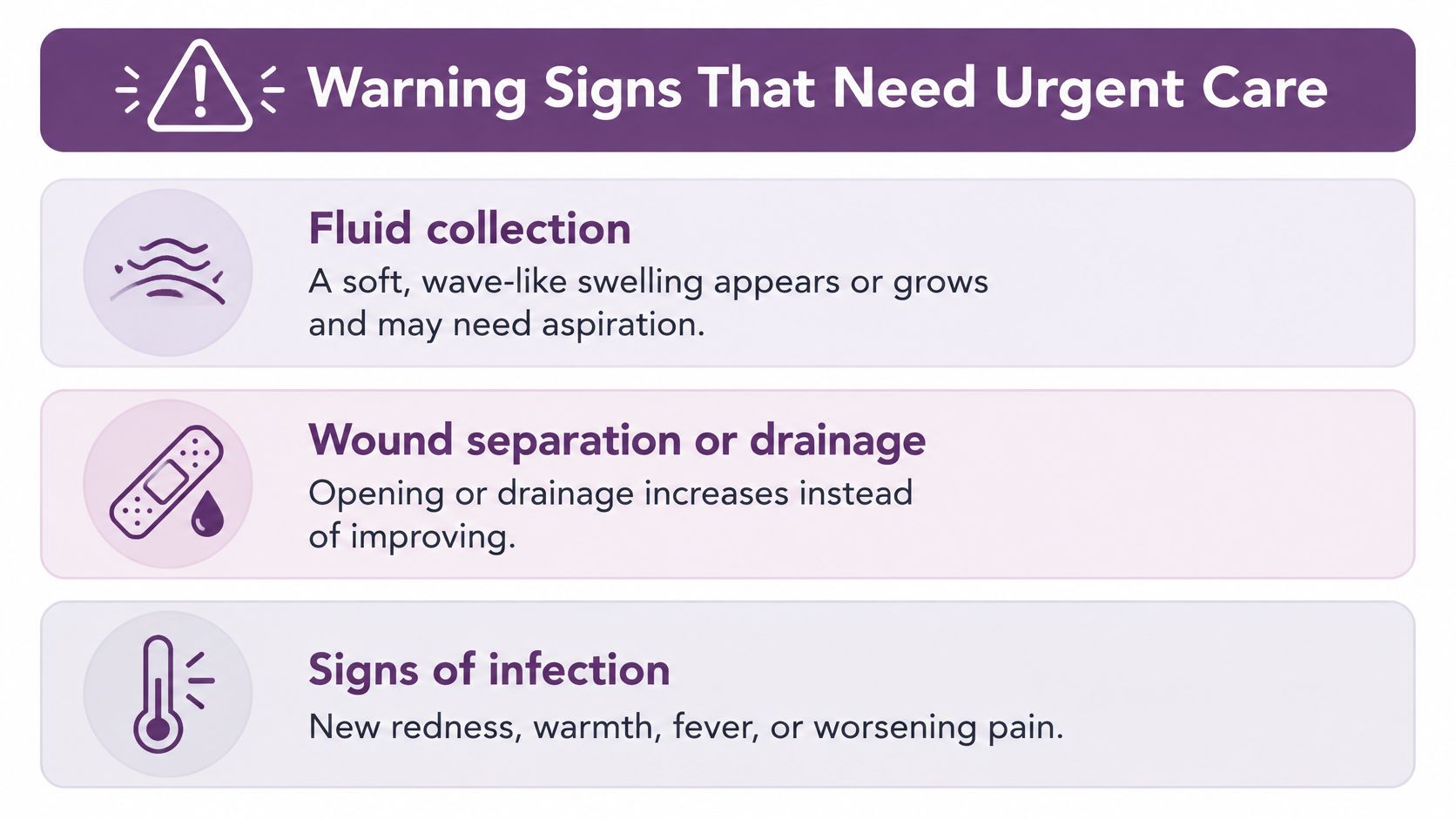
- A new or growing soft, wave-like swelling may be a fluid collection that needs evaluation and possibly aspiration.
- If the incision opens or drainage increases, contact the surgical office for instructions.
- Fever, spreading redness, pus, or worsening pain can indicate infection. Seek urgent medical assessment.
- Dark, cold, or increasingly numb skin may signal impaired blood supply or injury to the tissue. Contact your surgical team promptly.
Don't wait for a scheduled appointment
For emergency symptoms, call emergency services rather than driving yourself or waiting for the surgical office to return a message. For concerning wound changes, contact the team promptly and follow its instructions about where to be assessed.
Later contour irregularity or asymmetry can usually be raised at follow-up. Sudden enlargement, severe pain, or a change accompanied by fever calls for prompt evaluation.
Technique can affect recovery. A 2024 meta-analysis of Scarpa's fascia preservation found a 69% reduction in seroma occurrence, with lower infection and hematoma risk also reported. Ask how the surgeon plans to preserve blood supply and manage tissue layers. The procedure's name alone does not explain how those risks will be addressed.
Before surgery, save the after-hours contact number and identify where to seek urgent care. Keep a simple drainage and temperature log, and photograph the area daily if your team recommends it. These records can help you describe changes when you call.
Common Questions About Tummy Tuck and Lipo
Does insurance cover a tummy tuck and lipo?
Cosmetic contouring is usually self-pay, and documenting a medical concern doesn't automatically establish coverage. If you have symptomatic skin problems after major weight loss, ask your insurer which medically necessary procedures may qualify and obtain written clarification before scheduling.
When can I drive again?
You need to be able to brake, turn, and react quickly without pain limiting your movement. Don't drive while taking impairing medication, and wait for your surgeon's clearance rather than using a fixed date.
Are the results permanent?
Removed tissue doesn't guarantee a permanently unchanged shape. Remaining fat can enlarge with weight gain, pregnancy can stretch the abdominal wall, and aging can change skin quality.
Can I add breast surgery at the same time?
Some patients may qualify, but adding another operation extends treatment and can increase overall risk. Ask whether the added benefit justifies the longer procedure or whether separate treatment would be more appropriate.
Should I lose more weight first?
If you expect further weight loss, postponing contouring may help avoid planning around a body shape that's still changing. Your surgeon should recommend an individualized period of weight stability and coordinate with the clinician managing any weight-loss medication.
Book a Consultation to Confirm Your Plan
A useful consultation should leave you with more than a procedure name. You should understand what the surgeon recommends treating, what will remain unchanged, and why the proposed extent is appropriate for your health.
Realistic results depend on skin quality, fat distribution, healing, and individual anatomy. Asymmetry, visible scars, and contour irregularities can occur, and some patients may need revision.
Evaluate the proposed result
Ask to review before-and-after examples involving a similar starting body type and a comparable procedure. Pay attention to incision placement, waist proportions, and remaining skin texture rather than expecting another person's result.
Be specific about your priorities. If your main concern is a skin fold interfering with clothing, say so; if it's flank fullness visible from behind, make that clear too.
A written goal list helps distinguish essential treatment from optional additions. It also gives you a way to judge whether the recommendation reflects your priorities rather than offering the largest possible operation.
Understand the full cost
Cost drivers include treatment extent, combined versus staged surgery, facility charges, anesthesia, surgeon fees, follow-up care, and compression garments. Request an itemized written estimate rather than comparing headline prices.
The estimate should identify each proposed procedure and clarify what postoperative care is included. Ask how unplanned visits, treatment of complications, or possible revision would be handled financially, without assuming they're covered.
Prepare for an individualized assessment
Our Medical Director, Haimesh Shah, MD, RPVI, is a board-certified physician specializing in cosmetic surgery and phlebology. Dr. Shah has expertise in Hi-Definition Liposuction Surgery, Body Contouring Surgeries, and Venous Disorders.
Bring the information needed to assess both the surgical benefit and medical risk:
- Medication details: Include prescriptions, supplements, weight-management medication, and previous medication reactions.
- Health and surgery history: Note prior abdominal operations, diabetes, anemia, clotting concerns, and anesthesia problems.
- Smoking and weight history: Be candid about nicotine exposure and recent or planned weight changes.
- Practical constraints: Explain your work duties, caregiving responsibilities, transportation, and available recovery support.
- Decision questions: Ask whether a single, combined, or staged approach best matches your goals and health.
We serve Los Angeles, Santa Barbara, and Ventura Counties. Our hours are Monday through Friday, 9am to 6pm, with Saturday appointments available by appointment only, and we're closed on Sunday.
Confirm the current office location and contact details on Luxe's location page before arranging travel. Schedule a consultation when you're ready to discuss your priorities, and ask for the recommended plan, alternatives, risks, and costs in writing before committing.
Luxe Aesthetic Surgery & Medical Spa offers awake liposuction and awake tummy tuck options for appropriately selected patients, with individualized assessment of whether treatment should be single, combined, or staged. Visit Luxe Aesthetic Surgery & Medical Spa to request a consultation and discuss a body-contouring plan that fits your anatomy, health, and recovery needs.