Medical Expertise at Luxe Aesthetic Surgery
Luxe Aesthetic Surgery & Medical Spa is led by Haimesh Shah, MD, RPVI , a physician specializing in cosmetic surgery, body contouring, laser procedures, and venous medicine. Dr. Shah is a Diplomate of the American Board of Laser Surgery, American Board of Venous & Lymphatic Medicine, American Board of Wound Management, and American Board of Internal Medicine. He also holds the Registered Physician in Vascular Interpretation (RPVI) credential and has contributed to peer-reviewed medical research.
If a red line on your cheek looks like a spider vein, does that mean you should book laser treatment for it? Not necessarily, and that distinction matters more on the face than on the legs. Facial spider vein treatment can reduce visible vessels, but the right device, the number of sessions, and even whether treatment is appropriate at all depend on what that vessel is. This guide compares your options first, then explains why diagnosis comes before any device, and why successful treatment usually means vessel reduction with maintenance, not a permanent cure for new veins.
Table of Contents
- Treatment Options for Facial Spider Veins Compared
- When a Facial Vein Needs Medical Evaluation First
- How Laser and Light Clear Facial Vessels
- Why Sclerotherapy Is Usually Ruled Out on the Face
- What Results and Recovery Look Like Over Time
- Serious Risks and Everyday Protection
- Book a Consultation Before Choosing a Treatment
Treatment Options for Facial Spider Veins Compared
Facial Spider Vein Treatment Options at a Glance
| Option | Best suited to | Typical sessions | Key consideration |
|---|---|---|---|
| Nd:YAG laser (1,064 nm) | Facial telangiectasia in included trials | Often more than one, staged over time | High short-term clearance reported in included studies, with limited long-term follow-up |
| Pulsed-dye laser (585 to 595 nm) | Very small, bright-red superficial vessels | Several, often more than one | Dynamic cooling and conservative settings reduce epidermal injury |
| Intense pulsed light (IPL) | Small facial vessels and broader redness | Several staged sessions | Pigment-change risk is higher in darker or recently tanned skin |
| Sclerotherapy | Leg spider veins, generally avoided on the face | Course set by vein number and size | Facial anatomy near the orbit raises the risk of serious injection complications |
| Electrodesiccation | Visible vessels associated with rosacea | One or more targeted sessions | Requires a highly skilled operator to avoid burns and scars |
| Topical and lifestyle care | Supporting skin health and limiting new redness | Ongoing daily care | Sun protection and rosacea control help limit new redness |
Use the table as a starting point; the right device depends on the individual prescription. Two vessels that look similar in the mirror can sit at different depths, carry blood at different speeds, and respond to different wavelengths. Depth matters more than color. A provider needs to examine the vessel directly before choosing a device, because a photograph flattens exactly the details that drive the decision.
The Nd:YAG numbers deserve a closer look, because they're often quoted without their limits. A 2025 systematic literature review of facial telangiectasia treatment evaluated six clinical trials involving 271 people and reported clearance rates of approximately 95% to 100% for 1,064-nanometer Nd:YAG laser treatment in included studies, with few side effects. In that same review, follow-up was short, some studies reported recurrence or only moderate improvement, and long-term effectiveness remains insufficiently established. Read together, those points show the technology can work very well in selected patients while leaving open whether the improvement lasts.
The review also covered intense pulsed light and pulsed-dye lasers, plus combined approaches using different wavelengths or vascular-targeting filters. The practical shift is toward wavelength-specific and anatomy-specific planning: the same face can hold vessels that each respond best to a different device, so some treatment plans combine technologies across sessions.
A high clearance rate in a short study answers one question only: how vessels responded during follow-up. Whether your skin keeps forming new vessels is a separate question.
For general facial telangiectasia, you'll commonly hear about a course of several sessions spaced months apart, then periodic touch-ups if new vessels appear. Topical products sit in a different category. They support skin health and calm redness; physically closing a widened vessel takes a procedure. Supplements you might encounter when you shop HealthAid V Vein belong to that supportive category, alongside sun protection and rosacea control, rather than to procedural care.
Three conclusions should guide your choice. First, the right option depends on vessel size, depth, color, skin type, and cause, which is why a single face may need more than one wavelength. Second, multiple sessions are often necessary. Third, diagnosis comes before any device: the comparison above applies only after a clinician has confirmed what the vessel is.
When a Facial Vein Needs Medical Evaluation First
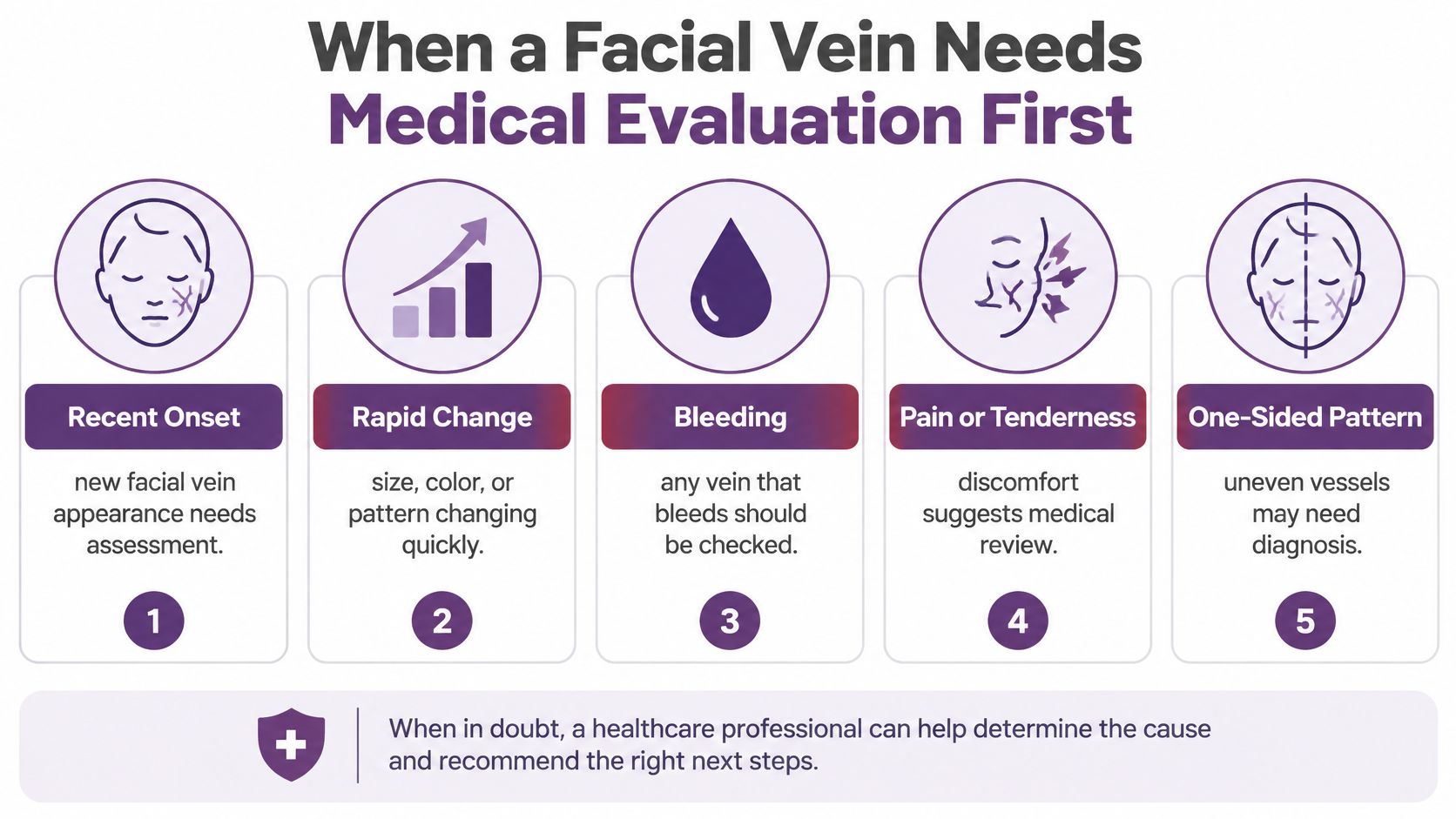
Run through this checklist before you book a cosmetic procedure. Any one item doesn't prove something serious is wrong, but it does mean you should get a diagnostic assessment rather than going straight to laser or injections.
- Recent onset: A vessel or patch of vessels appeared over weeks rather than years.
- Rapid change: The size, color, or pattern is changing quickly.
- Bleeding or ulceration: The area bleeds, crusts persistently, or breaks down.
- Pain or pulsation: The vessel hurts, throbs, or feels tender without an obvious cause.
- An unusual solitary lesion: One spot looks unlike your other vessels, or sits on only one side in an odd pattern.
Not Every Red Line Is the Same Lesion
A fine red line may be a telangiectasia, the clinical term for a small widened superficial vessel. It could also be rosacea-associated redness, an angioma, or a venous malformation. Those conditions don't share one treatment plan, and treating the wrong lesion wastes money at best.
Your personal history changes what's safe, too. A clinical reference on laser and IPL for spider veins identifies pregnancy, blood-thinning medication, photosensitive disorders, hypertrophic or keloid-scarring tendencies, untreated varicose veins, recent tanning, and darker skin types as situations requiring caution or avoidance in some cases. That reference also notes laser and IPL suit veins smaller than a 30-gauge needle, which helps explain why vessel size drives the decision.
Larger varicose veins and symptoms that may indicate underlying venous disease require additional medical evaluation before cosmetic treatment. Aching, swelling, or bulging leg veins alongside facial vessels are a good example of a pattern worth assessing properly.
At a consultation, expect the provider to examine the veins closely, take standardized photographs, and review your medical history and medications. From there, they'll decide whether a cosmetic procedure is appropriate or whether referral makes more sense.
Before your visit, write down four things. Note when the veins appeared, whether they've changed, any pain or bleeding, and every medication and supplement you take. Those details save time and sharpen the diagnosis.
How Laser and Light Clear Facial Vessels
Facial spider veins are superficial blood vessels, not patches of pigment sitting on the skin. That single fact explains why creams can't close them and why energy-based treatment can. Light passes through the skin surface and targets the blood inside the vessel.
Think of a focused beam heating one thin wire without scorching the cloth around it. The pulse has to heat the wire fast enough to damage it, then stop before that heat spreads into the surrounding material. Laser settings follow the same logic, just with skin and blood instead of cloth and wire.
The Three Settings That Matter
- Match the wavelength to the vessel. Very small, bright-red superficial vessels commonly suit a 585 to 595 nm pulsed-dye laser, while a 1,064 nm Nd:YAG laser reaches other targets.
- Match the pulse duration to the vessel. The pulse is timed to the vessel's thermal relaxation time, which is how quickly it sheds heat, so energy stays concentrated where it's wanted.
- Cool the skin surface. Cooling protects the epidermis while the vessel below absorbs the energy.
The mechanism behind those choices is selective photothermolysis. As American Academy of Dermatology licensed content on laser treatment for telangiectasias describes, oxyhemoglobin absorbs the delivered wavelength and converts light into heat that damages the vessel. If you're comparing devices, spider vein treatment insights from Omega Lasers can help you follow how wavelength selection works in practice.
During treatment, a provider watches for an endpoint. The vessel may turn pale, called blanching, or show a transient gray discoloration. Redness, swelling, and bruise-like purpura afterward are expected short-term effects, not automatic signs something went wrong.
Skin type and vessel depth change every setting. Darker or easily pigmenting skin absorbs more energy near the surface, so conservative fluence, stronger cooling, and a test spot help the provider see how your skin responds before treating a full area. Practices that offer light-based facial care, such as an IPL photofacial treatment, should be able to explain those adjustments in plain language.
Ask three questions before you agree to treatment. Which wavelength did you choose, and why for this vessel? How did you adjust the settings for my skin? What endpoint do you expect to see?
Why Sclerotherapy Is Usually Ruled Out on the Face
Patients who have had leg sclerotherapy often assume the same method works on the face, because it is so widely used below the waist. On the face, that assumption breaks down. The anatomy is different, and the stakes of a misplaced injection are higher.
Sclerotherapy works by injecting a specialized solution directly into a targeted vein. The solution irritates the vein lining, so the vein closes and gradually collapses. That mechanism serves the thighs, calves, ankles, and other leg areas well, and you can read how it applies there on the page for sclerotherapy treatment at Luxe Aesthetic Surgery & Medical Spa. Facial vessels call for a different judgment.
The Anatomical Problem
Facial vessels can sit near the orbit, the angular vessels, and other critical arterial connections. An injection that reaches one of these channels can produce serious complications, including visual disturbance, even though severe events are uncommon. Uncommon is not the same as negligible when the structure at risk is your eye.
That is why clinical guidance generally favors vascular laser or light-based therapy for facial lesions when size and depth are appropriate. Light-based treatment also suits people who are allergic to sclerosing agents or who would rather avoid needles. Diagnosis still comes first either way: a provider has to confirm what kind of vessel they are looking at, and whether anything about it suggests deeper circulation, before choosing any device.
How do the two main light options compare? A 2024 meta-analysis comparing IPL and PDL for vascular facial conditions, summarized in a clinical reference on facial telangiectasia, found no statistically significant difference in achieving greater than 50% clearance, with pooled clearance exceeding 50% reported as high as 100% for PDL and 88.89% for IPL. Those figures describe group results across studies. They do not guarantee complete clearance for you, and they do not establish that new vessels will not form later. Facial veins are better understood as vessels to reduce than as a problem to cure permanently, so maintenance sessions are a realistic expectation.
Practical rule: If a provider proposes injecting a facial vessel, ask why laser or light is not the first option, and ask exactly how the injection would be made safe near the eye.
A thoughtful provider will welcome that question. They should also talk through staged sessions, possible residual vessels, and strict sun protection before anyone picks up a device or a syringe.
What Results and Recovery Look Like Over Time
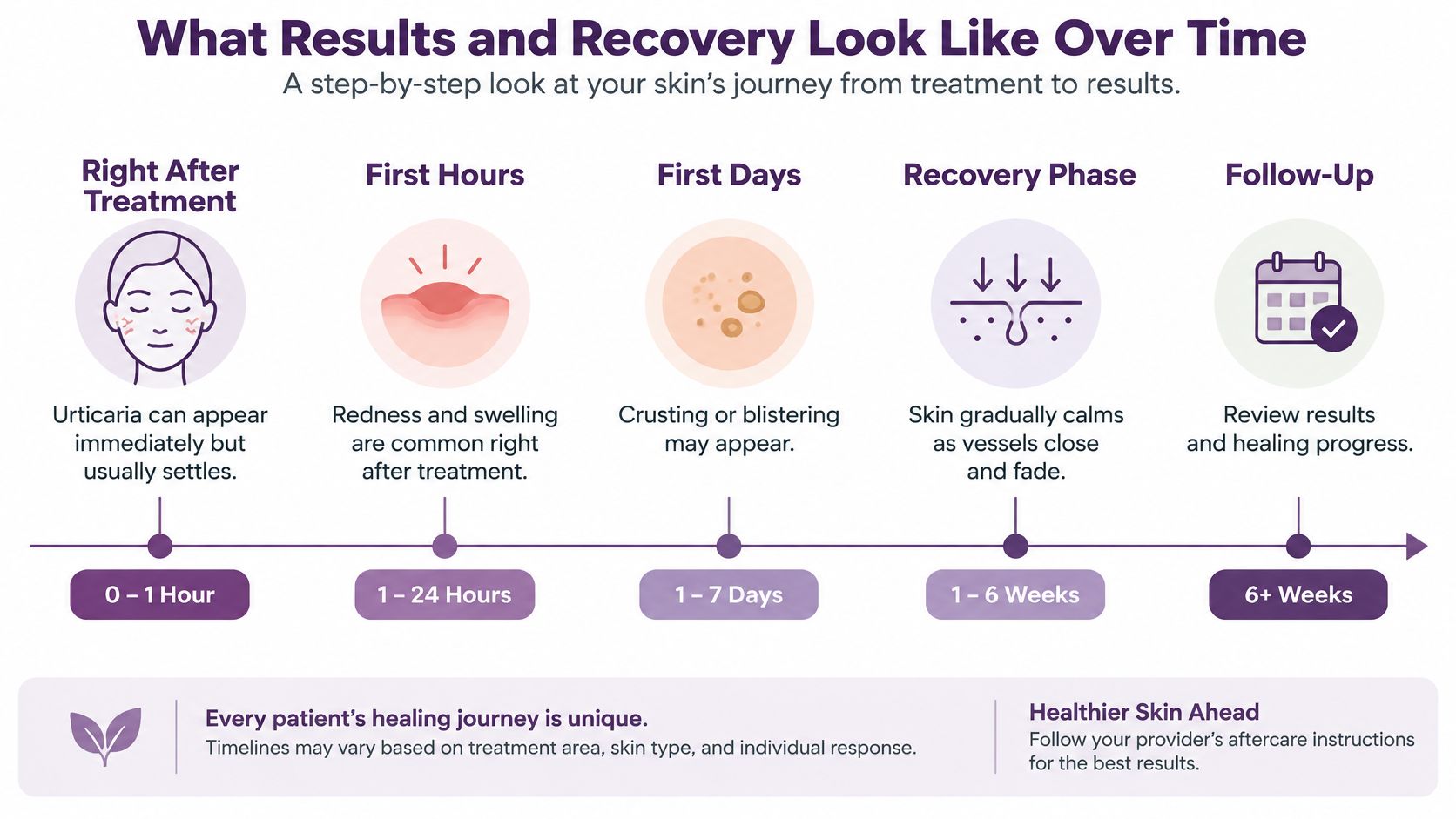
Say you've had your first laser session on a Tuesday morning. What happens next is easier to handle if you've pictured the calendar in advance. Recovery moves in stages, and the vessel doesn't vanish the moment it closes.
The first hours usually bring redness and swelling in the treated area. A hive-like reaction called urticaria can appear right after treatment and typically settles within a few hours.
The first days may add crusting or, less often, blistering as the skin responds to the heat. That doesn't automatically mean the treatment failed, but blistering is always worth reporting.
The Weeks and Months After
Smaller treated veins may begin fading within several weeks, while larger veins can take longer to improve. After a treated vein closes, blood naturally reroutes through healthier surrounding veins, and the body breaks down and absorbs the treated vessel over time. You're waiting on that absorption, which is why results build gradually.
Session planning follows a similar rhythm. Cleveland Clinic guidance on facial spider veins reports that facial telangiectasias commonly require approximately three to four laser sessions spaced three to four months apart, followed by touch-up treatment every six to twelve months as needed. Some veins need more than one session regardless of method, and a sensible plan is built around the number, size, and location of your veins.
There's a longer track record behind this approach. A peer-reviewed review of light-based devices reported that spider telangiectasia treated with flashlamp-pumped pulsed-dye laser produced excellent results in most patients after a single treatment, without permanent sequelae in the cited clinical experience. Even so, several sessions may still be necessary for you, because outcomes depend on the device, your skin type, vessel characteristics, and operator expertise.
Discomfort varies by device. In one comparison summarized by the Cochrane review of interventions for rosacea, the average pain score was 3.1 with a KTP laser (95% CI 2.23 to 3.97) compared with 6.89 with an Nd:YAG laser (95% CI 5.63 to 8.15) on that study's scale, and both treatments were well tolerated with no serious adverse events reported. Ask about comfort measures at your consultation rather than guessing from someone else's experience, and follow sensible aftercare such as the guidance on taking care of your skin after laser treatment.
Judge success three ways. Compare matched photographs taken in the same light, rate your own redness, and notice whether the area still flares. Sketch a twelve-month plan with a first review after your initial course and a second review before deciding on touch-ups.
Serious Risks and Everyday Protection
Serious complications from facial vessel treatment are uncommon in trained hands, but they're real, and each one connects to a specific check or habit. Knowing which risk links to which safeguard turns a vague worry into a short, practical list you can act on before and after treatment.
Risks Paired With the Checks That Reduce Them
- Burns and blistering: Reduced by conservative energy settings, proper cooling, and avoiding treatment on recently tanned skin.
- Ulceration and scarring: Reduced by correct pulse selection, no pulse stacking over the same spot, and honest screening for keloid tendencies.
- Permanent skin-color change: Reduced by skin-type assessment, a test spot when indicated, and asking whether any medication you take increases light sensitivity.
- Eye symptoms after facial treatment: Any unusual eye pain or visual change needs prompt evaluation the same day.
Residual or recurrent vessels are expected limits of treatment, and they do not necessarily reflect a mistake by you or your provider. A closed vessel may partially persist, and your skin can form new vessels over time even after an excellent result.
Report blistering, unusual pain, or any symptom that worries you on the same day you notice it. Early review gives your provider the best chance to help.
Everyday protection lowers the odds of new redness. Use daily broad-spectrum sunscreen, skip tanning beds and deliberate sun exposure, and protect healing skin from heat and friction. Daily sunscreen is one of the few habits you control between sessions, and ultraviolet exposure is a contributor to future redness you can genuinely reduce rather than merely accept.
If rosacea is part of your picture, it needs ongoing management under a dermatologist's guidance, because untreated rosacea can keep producing visible vessels after laser clears the current ones. Heat, alcohol, hormonal changes, ultraviolet exposure, and genetic susceptibility can all contribute to future redness. Managing those factors helps limit new vessels, but lifestyle changes can't erase vessels that already exist, which is why realistic plans include maintenance rather than a single final session.
For topical care during healing, keep it simple. Use gentle, fragrance-free products your provider approves, avoid harsh scrubbing, and introduce anything new slowly. If your skin is reactive at baseline, a calmer approach to plant-inspired skincare can give you a gentler framework to discuss with your provider before you change your routine.
Book a Consultation Before Choosing a Treatment
The most valuable step in this process is a conversation, and it happens before any device is chosen. Book a consultation before you commit to a facial spider vein treatment, because the right technology depends on the diagnosis, and the diagnosis depends on someone examining your vessels up close.
Questions Worth Asking Out Loud
- Diagnosis: Is this telangiectasia, or another vascular lesion?
- Technology: Which device do you recommend, and why for my skin type?
- Test spot: Will you treat a small area first and review my response?
- Session plan: How many sessions do you expect, and what maintenance is realistic?
- Recurrence: What follow-up schedule should I plan around?
- Aftercare: What exactly should I do, and avoid, during healing?
- Operator: Who performs the procedure, and what's their training?
A red facial line can be a simple broken capillary or a different vascular lesion entirely. As DermNet's clinical overview of telangiectasia sets out, telangiectasia must be distinguished from angiomas, vascular malformations, and other vascular lesions before treatment is chosen. That distinction decides which device gets used, or whether treatment should wait.
A good consultation works through the questions in order: what the vessel is, which technology fits it, and what outcome is realistic. The provider examines the vessels you want treated, reviews your skin type and history, and decides whether a light-based device suits the lesion or whether it needs medical review first. For Southern California patients with darker or easily pigmenting skin, rosacea, or uncertain lesions, skin-type assessment, photography, and vascular evaluation when indicated all shape a safer plan. That visit also frames results realistically. Clearing facial veins is vessel reduction with likely maintenance, not a permanent cure.
The American Academy of Dermatology advises choosing a board-certified dermatologist with deep knowledge of skin and procedural technique on its rosacea treatment guidance page. Apply the same standard of questioning to any provider you consider, whatever their specialty. Confirm which facial vessel technologies a practice offers before you book, since services differ.
If visible facial or leg veins are bothering you, Luxe Aesthetic Surgery & Medical Spa offers individualized vein evaluation and treatment planning for patients across Southern California. The practice is led by Medical Director Haimesh Shah, MD, RPVI, whose board certifications include the American Board of Venous and Lymphatic Medicine. A consultation lets our team examine your vessels, confirm the diagnosis, and recommend the next step that fits your skin. Visit Luxe Aesthetic Surgery & Medical Spa to request your consultation.