Medical Expertise at Luxe Aesthetic Surgery
Luxe Aesthetic Surgery & Medical Spa is led by Haimesh Shah, MD, RPVI , a physician specializing in cosmetic surgery, body contouring, laser procedures, and venous medicine. Dr. Shah is a Diplomate of the American Board of Laser Surgery, American Board of Venous & Lymphatic Medicine, American Board of Wound Management, and American Board of Internal Medicine. He also holds the Registered Physician in Vascular Interpretation (RPVI) credential and has contributed to peer-reviewed medical research.
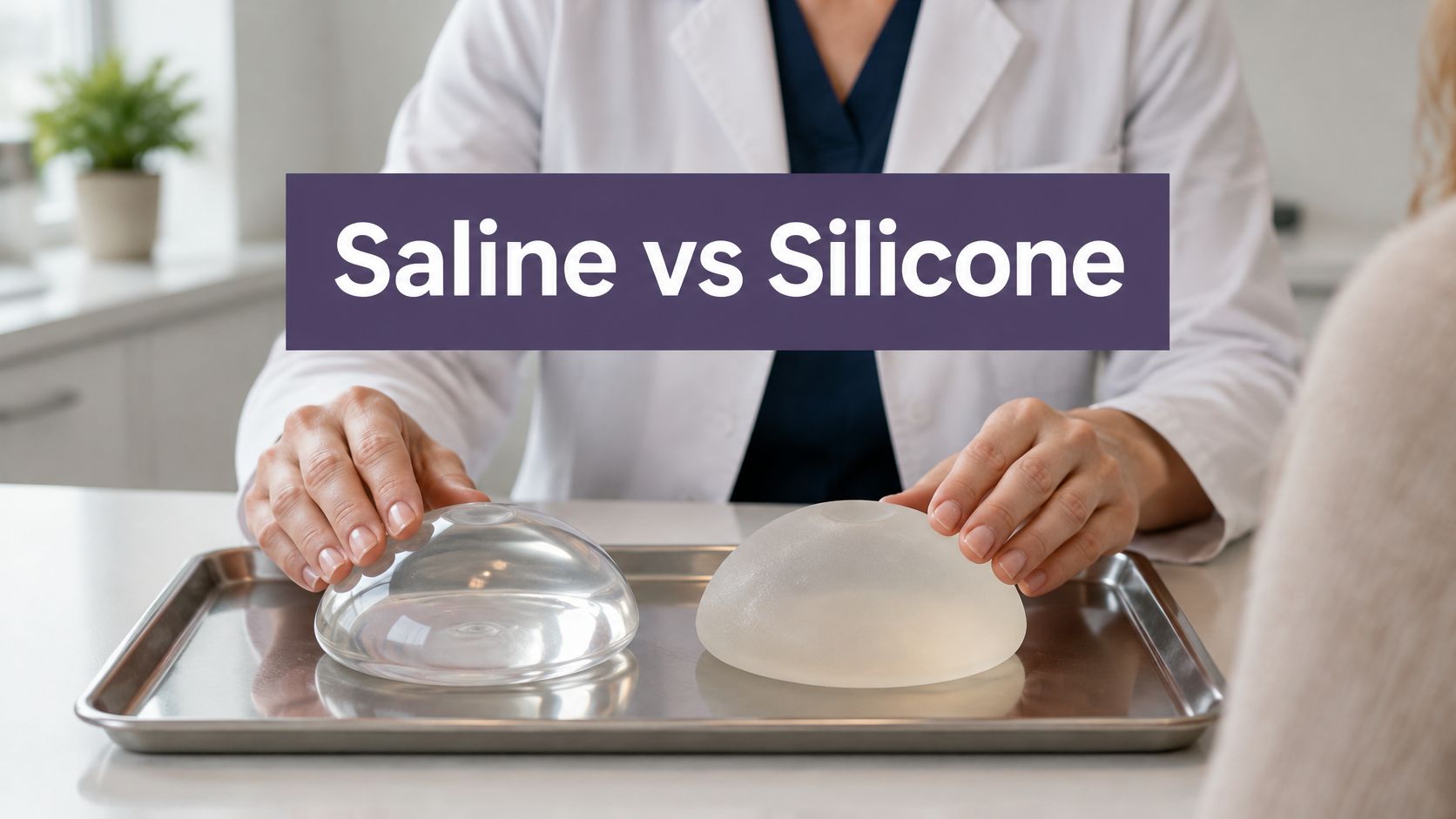
Which implant would you pick after a ten-second squeeze? Two implants sit on the consultation table. The one on the left feels like a water balloon under slight pressure. The one on the right feels like nothing much at all, the kind an active patient could forget is even there. Both are sealed inside a solid silicone shell, so the difference is the filling.
That squeeze is where most saline vs silicone breast implants conversations begin and end. It's a genuine part of the decision, and it's the part you can settle in the room. The parts you can't test with your hand are the ones that shape the next twenty years: how a failure announces itself, how often you'll need imaging, who pays for that imaging, and how likely a second operation becomes.
Table of Contents
- Saline and Silicone Side by Side
- Feel, Shape, Sizing and Placement by Body Type
- How Each Implant Shows a Rupture
- Monitoring Schedules for Each Implant Type
- Complication Rates and Capsular Contracture
- Revision, Implant Exchange and Removal Options
- Choosing Between Saline and Silicone by Situation
- Confirm Your Implant Choice Before Surgery
Saline and Silicone Side by Side
Saline vs silicone gel at a glance
| Feature | Saline | Silicone gel |
|---|---|---|
| Filling | Sterile saltwater | Cohesive silicone gel |
| Typical feel | Generally firmer | Generally softer, closer to natural tissue |
| Rippling in thin tissue | More often visible or palpable | Less often visible, still possible |
| Incision and placement | Often smaller; placed empty, then filled | Pre-filled; usually a larger incision |
| Volume adjustment at surgery | Possible during surgery | Fixed at placement |
The architecture underneath is identical. A solid silicone elastomer shell holds a filling, and the filling is the only thing that changes. Everything downstream, from how the breast moves to how a broken implant is discovered, traces back to that single material decision.
Read the rows top to bottom and you follow the order in which each difference shows up. Feel and rippling appear in the mirror within weeks. Incision size and volume adjustment are settled on the day of surgery, then largely forgotten.
What this table leaves out matters more than what it includes. How a rupture announces itself and how often each filling needs imaging are covered in their own sections, because they arrive years later and carry the main weight of the choice: the cost of scans, the possibility of an exchange, and the prospect of a second recovery. Day-of-surgery feel is the first installment of the decision, not the whole of it.
These patterns describe tendencies across many bodies; your exam determines your result. Tissue thickness, implant placement and implant size all sit between the device and the world, and the same filling can behave differently in two patients.
Three questions the table can't answer
- How much of your own tissue will cover the implant? Thin coverage magnifies every difference in the table, especially feel and rippling.
- Will you keep up imaging for decades if the filling requires it? A schedule you won't follow is worse than no schedule at all.
- Is a revision likely during your lifetime? Planning for one procedure when you may need two changes the financial picture, not just the aesthetic one.
Bring those three to a consultation and the conversation moves quickly from general comparison to your anatomy.
Feel, Shape, Sizing and Placement by Body Type
Feel isn't a property of the filling alone. It's the filling plus everything covering it. Saline transmits pressure the way a sealed bottle does, so a hand on the breast reads the shell and the fluid. Cohesive gel dampens and absorbs, closer to the way your own tissue behaves. Give either implant a thick layer of natural tissue and the difference softens. Strip that layer away and the filling becomes the texture.

Thin coverage is where the two diverge most. A patient with minimal breast tissue and little subcutaneous fat, or someone rebuilding after mastectomy, is the person most likely to feel and see the difference between a saline fill and a gel fill. The same patient is also the most likely to notice rippling along the outer and lower edge of the breast.
Consider two contrasting cases. A slim patient with almost no natural coverage who cares most about softness will usually do better with a gel fill, because she has nothing to hide the shell behind. An active patient who wants a firm, high, athletic shape and accepts a firmer feel may be well served by saline, particularly if she also wants the certainty of a visible warning if the device fails.
Shape is a separate decision that applies to both fillings. Round and anatomic implants come in saline and in gel, and choosing between them is about how the implant is built, not what's inside it. The trade-offs between round vs anatomical implant shapes deserve their own conversation rather than being folded into the filler question.
Sizing comes next. Volume is not chosen from a cup-size wish. Your surgeon measures chest width and base diameter, assesses how much tissue exists and how much stretch the skin has, then narrows to implants whose dimensions fit that footprint. An implant too wide for the chest reads as heavy and unnatural regardless of filling.
Placement explains the incision difference. A saline implant typically goes in empty through a smaller opening and is filled once it's positioned, which also lets the surgeon fine-tune volume side to side. Gel arrives pre-filled, so the opening is usually longer, and firmer form-stable gels need the longest of all because they can't be compressed. One last point people rarely hear early enough: a scar capsule forms around any implant over the first months, so the feel you have at week three isn't the feel you'll have at month six.
How Each Implant Shows a Rupture
A saline implant fails loudly. When the shell develops a tear or the valve gives way, the sterile saltwater leaves the shell and the body absorbs it, so the breast visibly shrinks over several hours or days. The change is unmistakable, and no scan is needed to confirm what happened.
Silicone behaves differently because cohesive gel holds together. It often stays within the scar capsule the body has built around the implant, so a rupture can be clinically silent and hard to identify through physical examination alone. The FDA guidance on breast implants identifies MRI as the most effective method for detecting silent silicone gel rupture and accepts ultrasound as an alternative for screening people without symptoms.
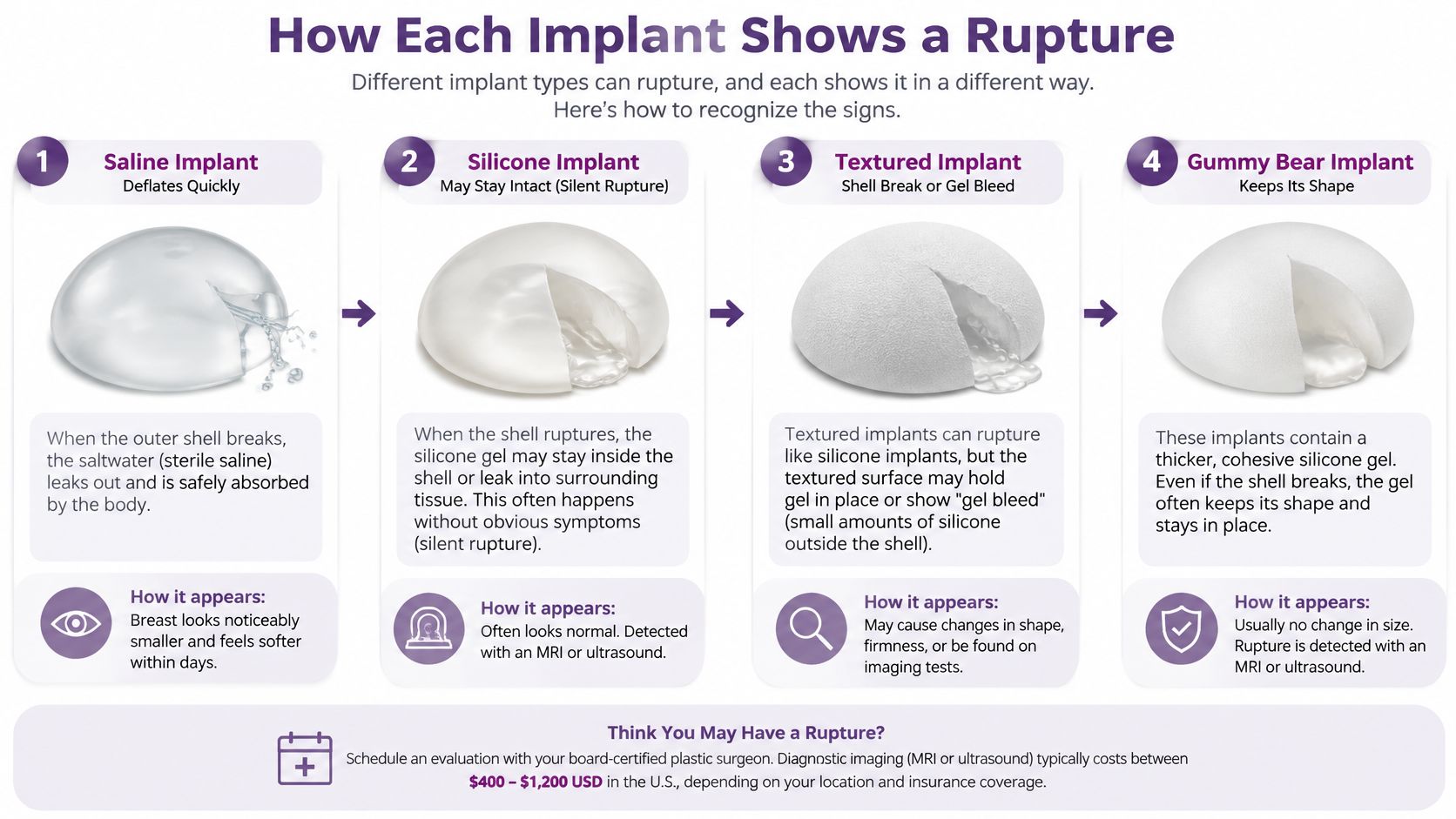
Either filling can fail at any point, including in a breast that has felt normal for years. What changes is how you'd find out.
Signs that warrant a call
Watch for a sudden change in size, new asymmetry between the two breasts, firmness or hardness that wasn't there before, a change in shape, new pain, or swelling that persists. With saline, a deflation is obvious. With gel, any of these signals is the reason imaging exists.
The path after a suspected rupture
- Notice the change or symptom. A visible deflation, a new asymmetry, or discomfort that doesn't settle.
- Contact the surgeon's office promptly rather than waiting for the next routine visit.
- The surgeon examines the breast and reviews what changed and when.
- Imaging is chosen. MRI is used when symptoms are present or an ultrasound result is unclear.
- Replacement or removal is planned if rupture is confirmed.
Saline deflation is self-evident but still needs evaluation, because the shell itself stays behind and has to come out. Silicone may need imaging even when the breast looks exactly as it did last month.
Monitoring Schedules for Each Implant Type
Monitoring by implant type and situation
| Situation | Saline | Silicone gel |
|---|---|---|
| Routine, asymptomatic | No routine rupture imaging recommended | First ultrasound or MRI about 5-6 years after surgery |
| Repeat surveillance | Not routinely scheduled | Repeat ultrasound or MRI every 2-3 years |
| Symptoms at any time | Evaluate for deflation, pain, shape change or capsule changes | MRI |
| Uncertain ultrasound finding | Clinical evaluation | MRI |
| Cost consideration | Usually no routine imaging cost | Coverage varies by plan |
The asymmetry in this table drives the whole plan. Saline usually announces failure through visible deflation, so routine rupture imaging is not recommended. Silicone can stay quiet, so the calendar becomes part of owning the device.
The FDA labeling recommendations for silicone gel implants set the timetable for people without symptoms: a first ultrasound or MRI at 5 to 6 years after the initial surgery, then repeat ultrasound or MRI every 2 to 3 years. If symptoms develop at any point, or an ultrasound result is uncertain, the recommendation is MRI.
Why the calendar matters more than the scan
The schedule works like a maintenance log more than a one-time test. A saline implant may need attention only when something changes, while a silicone implant carries recurring checkpoints for as long as it remains in place. That can stretch across decades, which is why the filler choice is partly a choice about future appointments.
Implant imaging is also separate from breast cancer screening. A mammogram checks breast tissue on the schedule your clinician recommends for your age and risk, while implant-integrity imaging checks the device. Tell the mammography scheduler that you have implants so the facility plans displacement views.
Cost follows the same pattern. When the original surgery was cosmetic, implant surveillance may not be covered by insurance, so a silicone schedule can become a repeated out-of-pocket expense rather than a single bill. That belongs in the decision before surgery, alongside feel and appearance, because the device you choose sets the monitoring you inherit.
Practical habit: Write the surgery date and your surgeon's name on a card, then set a calendar reminder for the first imaging window and recurring reminders every few years after that. A schedule you remember beats a recommendation you were given once.
Recommendations can shift with implant generation and with where you live, so confirm the labeling for your specific device and the follow-up plan your surgeon uses rather than relying on a number you read years ago.
Complication Rates and Capsular Contracture
Reported complication rates in the FDA-cited study
| Outcome | Saline | Silicone gel |
|---|---|---|
| Rupture or deflation reported | 2.5% | 0.5% |
| Capsular contracture grade III or IV | 2.8% | 5.0% |
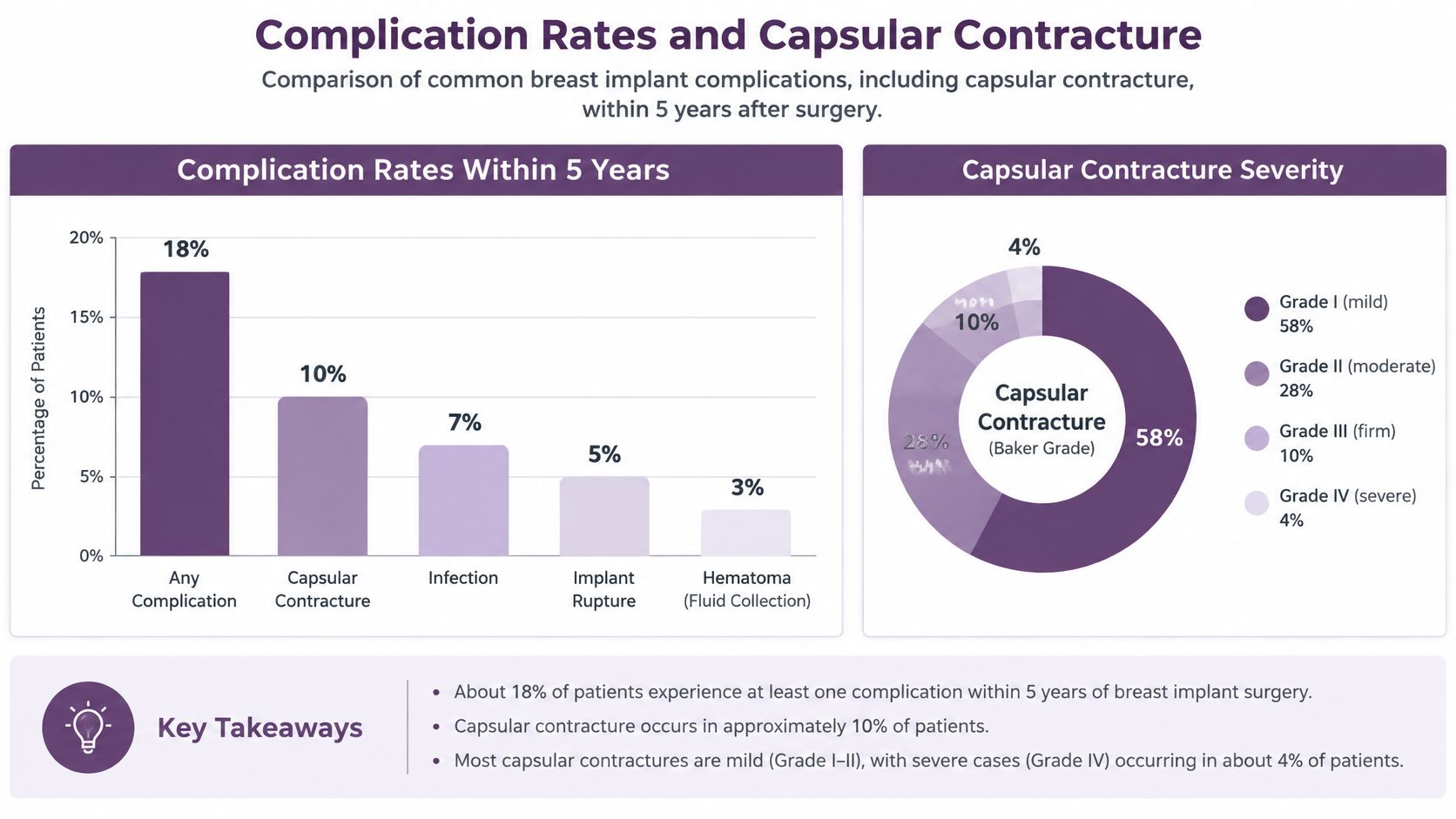
Each column has its own weakness. In an FDA-cited comparison of augmentation study participants, rupture or deflation was reported in 2.5 percent of saline implant participants against 0.5 percent of silicone gel participants. The second row reverses the order: capsular contracture graded III or IV was reported in 5.0 percent of silicone participants versus 2.8 percent of saline participants. Saline carried the higher rupture figure, and silicone carried the higher contracture figure.
Grade III or IV is the clinically meaningful end of the spectrum, where the scar capsule around the implant tightens or hardens enough to distort the breast or cause pain. Lower grades, where the breast feels somewhat firm without visible distortion, are typically monitored over time rather than corrected surgically.
What those percentages do not mean
They are snapshots from specific study cohorts, and they say little about which device is safer overall. Complication percentages shift with the product studied, the indication, the length of follow-up, the surgical technique and the population enrolled, so a figure from one augmentation cohort is a poor prediction for a specific patient with a specific implant and a specific surgeon.
A lower rate of one complication moves weight onto the factors the numbers cannot capture: feel, monitoring demands, and what each failure mode looks like over the years you carry the device.
Regulatory history offers a clue about why the two fillings were studied differently. Silicone gel implants went through a longer premarket evidence path than saline before approval, with extended core-study follow-up behind them. The extra scrutiny reflects the failure mode regulators worried about most: a gel rupture the patient cannot feel.
One finding applies to both columns. Implants are not lifetime devices, and the likelihood of rupture and additional surgery rises the longer an implant stays in place. That sentence should sit in the same mental folder as the price quote, because the choice between saline and silicone is a commitment measured in decades of imaging, possible exchange and follow-up cost. How each filler feels on the day of surgery is only the first line of that decision.
Revision, Implant Exchange and Removal Options
Second operations happen for predictable reasons, and each has a standard response. Knowing them in advance turns a frightening surprise into a scheduled procedure, and it reframes the original decision too. Choosing a filling is also choosing which future operation you'd rather face.
A deflated saline implant. If you want the volume back, the implant is replaced. The leaked saline is absorbed by your body, but the empty shell remains and has to come out surgically. The diagnosis is the easy part, since the mirror usually makes it for you.
A silicone rupture found on imaging. Surgical removal or exchange is the standard recommendation for a confirmed rupture, even when the breast looks and feels unchanged. A rupture that stays in place is a problem deferred, not a problem avoided.
Capsular contracture. Significant tightening is addressed with surgery, often exchanging the implant and removing or releasing part of the capsule. Your surgeon decides the extent based on how the capsule behaves.
Persistent swelling, pain or another change around the implant. This calls for assessment, which may include examination, imaging, and testing fluid or tissue around the device. The FDA's guidance on things to consider before breast implants lists rupture or deflation, wrinkling, asymmetry, scarring, pain and infection among the local risks for both fillings.
The one diagnosis that always means surgery
That same FDA guidance covers breast implant-associated anaplastic large cell lymphoma, or BIA-ALCL, a rare cancer that can develop in the breast or the scar capsule around an implant. It is not breast cancer. When it's diagnosed, treatment generally involves removing the implant and the surrounding capsule.
What implant exchange involves
Implant exchange means removing the existing implants and placing new ones chosen to suit your anatomy and proportions. Luxe's Awake Breast Implant Exchange follows exactly that principle, selecting replacement implants that complement the patient's frame rather than matching the old volume. Switching fillings during an exchange is possible, but it depends on your tissue and the surgical plan, so it isn't a decision to lock in beforehand.
If you're weighing whether the time has come, this guide on when to replace breast implants walks through the triggers. Ask your surgeon directly what replacement interval they'd expect in your case, and treat the answer as part of the cost of the original operation. Each exchange also restarts the clock on monitoring, so the commitment is counted in decades, not in a single surgery date.
Choosing Between Saline and Silicone by Situation
Two patients can sit through the same consultation and leave with different fillings, and both can be right. The deciding factors are anatomy, temperament, and how much monitoring and possible exchange each woman is willing to carry through the decades ahead.

Thin coverage, softness first. As the feel and placement section explains, patients with little natural tissue over the implant generally get the smoother result from gel, and the follow-up imaging schedule is part of that price.
Certainty first. A patient who wants a failure she can see in the mirror, who dislikes the idea of scheduled scans, and who accepts a firmer feel often prefers saline. Her trade is straightforward: less natural softness on day one, fewer obligations afterward.
Adjustment on the table. When one breast sits noticeably smaller than the other, saline can be filled incrementally during surgery, letting the surgeon balance the two sides in real time. It suits a specific kind of asymmetry, and your surgeon will tell you whether yours qualifies.
Age limits come from FDA approval indications. In the United States, saline-filled implants are approved for breast augmentation in women 18 or older, silicone gel-filled implants are approved for augmentation at 22 or older, and both are approved for reconstruction at any age, as the FDA's overview of breast implant types sets out. Approval for an age group is a legal floor. Which filling suits a given patient is a separate question that the physical exam answers.
The same FDA framework requires a patient decision checklist to be reviewed with your health care provider, initialed and signed by you, and signed by the physician who places the device. Treat that document as a working paper. If anything on it is unclear, ask before you sign.
Where awake surgery fits
A filling that suits your body under general anesthesia suits it under local anesthesia too; the anesthesia question runs on a separate track from the filler question. What decides whether an awake approach fits your case is the procedure plan, your anatomy and your medical history, and the surgeon makes that call during the exam rather than over the phone.
If you're also weighing whether you want implants at all, the comparison of breast implants vs fat transfer lays out the alternative path worth understanding before your consultation.
Confirm Your Implant Choice Before Surgery
How an implant feels once placed is only the first part of the decision. The filling can shape imaging needs, possible revision or exchange, and costs for decades, so the visit should end with a written plan covering surgery and follow-up.
Use this checklist to confirm the details:
- Confirm the surgical approach. Ask whether awake augmentation suits your anatomy, what recovery involves, and what discomfort to expect during the first weeks.
- Record the full device plan. Have the filling, size, shape and proposed placement written down with the reasons they fit your body.
- Set the monitoring commitment. Ask which follow-up schedule applies to the selected filling and what imaging it may require.
- Plan for future revision. Include likely imaging costs, the expected replacement interval, and when implant exchange or revision may enter the plan.
- Review the plan before committing. Check that the recovery expectations, follow-up responsibilities and long-term costs are clear while there is still time to adjust the choice.
A written plan based on an exam of your own body gives you something concrete to review. Taking time before committing is reasonable.
Luxe Aesthetic Surgery & Medical Spa offers Awake Breast Augmentation and Awake Breast Implant Exchange, with filling, size and placement selected around your anatomy and proportions. If you're weighing saline vs silicone breast implants, a consultation with Medical Director Haimesh Shah, MD, RPVI, a physician board-certified in venous and lymphatic medicine, laser surgery and internal medicine, turns the comparison into a plan. Visit Luxe Aesthetic Surgery & Medical Spa to request a consultation at a location convenient to you in Southern California.