
Medical Expertise at Luxe Aesthetic Surgery
Luxe Aesthetic Surgery & Medical Spa is led by Haimesh Shah, MD, RPVI , a physician specializing in cosmetic surgery, body contouring, laser procedures, and venous medicine. Dr. Shah is a Diplomate of the American Board of Laser Surgery, American Board of Venous & Lymphatic Medicine, American Board of Wound Management, and American Board of Internal Medicine. He also holds the Registered Physician in Vascular Interpretation (RPVI) credential and has contributed to peer-reviewed medical research.
Botox Cosmetic typically lasts about 3–4 months for frown lines, with effects beginning in 1–2 days. Results develop gradually, so early movement doesn't mean the treatment has failed.
But when you ask, “How long does Botox last?” do you mean when your eyebrows start moving again, when wrinkles become noticeable, or when you stop liking the result? Those are three different clocks, and they don't necessarily run out together.
A useful treatment plan accounts for all three. Instead of treating the calendar as an expiration date, pay attention to how your face moves, which lines return, and whether those changes bother you.
Table of Contents
- How Long Botox Lasts at a Glance
- Why Botox Wears Off
- Your Week-by-Week Botox Timeline
- What Makes Botox Last Longer or Fade Faster
- First Botox Treatment vs Repeat Treatments
- When to Schedule Botox Maintenance
- Book a Botox Consultation at Luxe
How Long Botox Lasts at a Glance
For moderate-to-severe frown lines between the eyebrows, 3–4 months is the established planning range. The FDA prescribing information for Botox Cosmetic states this duration and reports improvement in line severity for up to 120 days compared with placebo.
That benchmark describes temporary improvement, not a promise that every treated muscle will stay equally relaxed until a particular day. It also applies specifically to glabellar lines, the vertical creases between the brows, rather than establishing a separate duration for every facial area.
Typical Botox duration by treatment area
| Treatment area | Typical duration | What studies show |
|---|---|---|
| Frown lines, or glabellar lines | Approximately 3–4 months | The FDA-labeled benchmark is the clearest area-specific estimate. |
| Forehead lines | Use the general cosmetic treatment window as a starting point | The supplied clinical evidence doesn't establish a separate, reliable Botox-only average for this area. |
| Crow's feet | Use the general cosmetic treatment window as a starting point | Dose, treatment pattern, and the way improvement is measured affect the estimate. |
| Several facial areas together | Approximately 12–16 weeks | A clinical review in Dermatologic Surgery describes this median patient-reported response with 4 units per injection site. |
The distinction matters. An estimate from a combined-area treatment study isn't a guarantee for each individual region, and a result with another botulinum toxin formulation shouldn't automatically become a Botox claim.
Say you have your forehead and frown lines treated together. Later, you notice more movement when raising your eyebrows, but the crease between your brows still looks softer than before treatment. Calling the entire treatment “gone” would miss the benefit that remains.
Practical rule: Describe what has returned, not just how long it has been since your appointment.
Your personal duration also reflects the treatment decisions made at the appointment. Dose, muscle strength, anatomy, product, and injection placement all influence what you see. Individual recovery adds another layer that your injector can't predict perfectly from a first visit.
The useful takeaway is a planning window, not an expiration date. Keep the broad average in mind, but judge each treated area separately.
Why Botox Wears Off
Botox doesn't fill a wrinkle or permanently remove the muscle beneath it. It temporarily reduces the signal that tells a targeted muscle to contract.
Normally, a nerve releases acetylcholine, a chemical messenger, at the point where the nerve meets the muscle. Botulinum toxin type A interferes with that release. With less signaling, the muscle contracts less strongly, and the skin over it folds less forcefully.
Think of a temporary road detour
The connection isn't destroyed outright. Nerve endings can develop new branches and functional connections, while neuromuscular transmission gradually recovers.
A road-detour analogy helps: closing a route reduces traffic through an intersection, but traffic can return as alternative routes open and normal access recovers. Similarly, treated muscle activity returns through a biological recovery process rather than an overnight switch.
That's why an expression may reappear before the original crease becomes equally noticeable. A little movement and a fully returned wrinkle aren't the same observation.
What the biology means for your result
Several practical consequences follow from this temporary reduction in signaling:
- Fading is gradual. You may regain part of an expression while still seeing softer lines.
- Muscle strength affects the treatment balance. A strongly contracting muscle may require a different approach from a smaller or less active one.
- Dose matters, but more isn't automatically better. The injector must balance relaxation with expression and the surrounding muscles' function.
- Individual recovery matters. Two people can receive apparently similar treatments and notice different return patterns.
Consider someone who wants to preserve visible eyebrow movement. A conservative treatment may meet that goal beautifully, even though movement is never completely absent. Comparing that result with someone seeking much stronger relaxation would confuse different treatment goals with different product performance.
The biology also explains why increasing the dose just to chase longevity can be the wrong trade-off. An excessively weakened area may look or feel less natural, even if the treatment remains noticeable.
The aim isn't to keep every treated muscle motionless for as long as possible. It's to achieve a useful degree of relaxation without sacrificing the facial function and expression you want to keep.
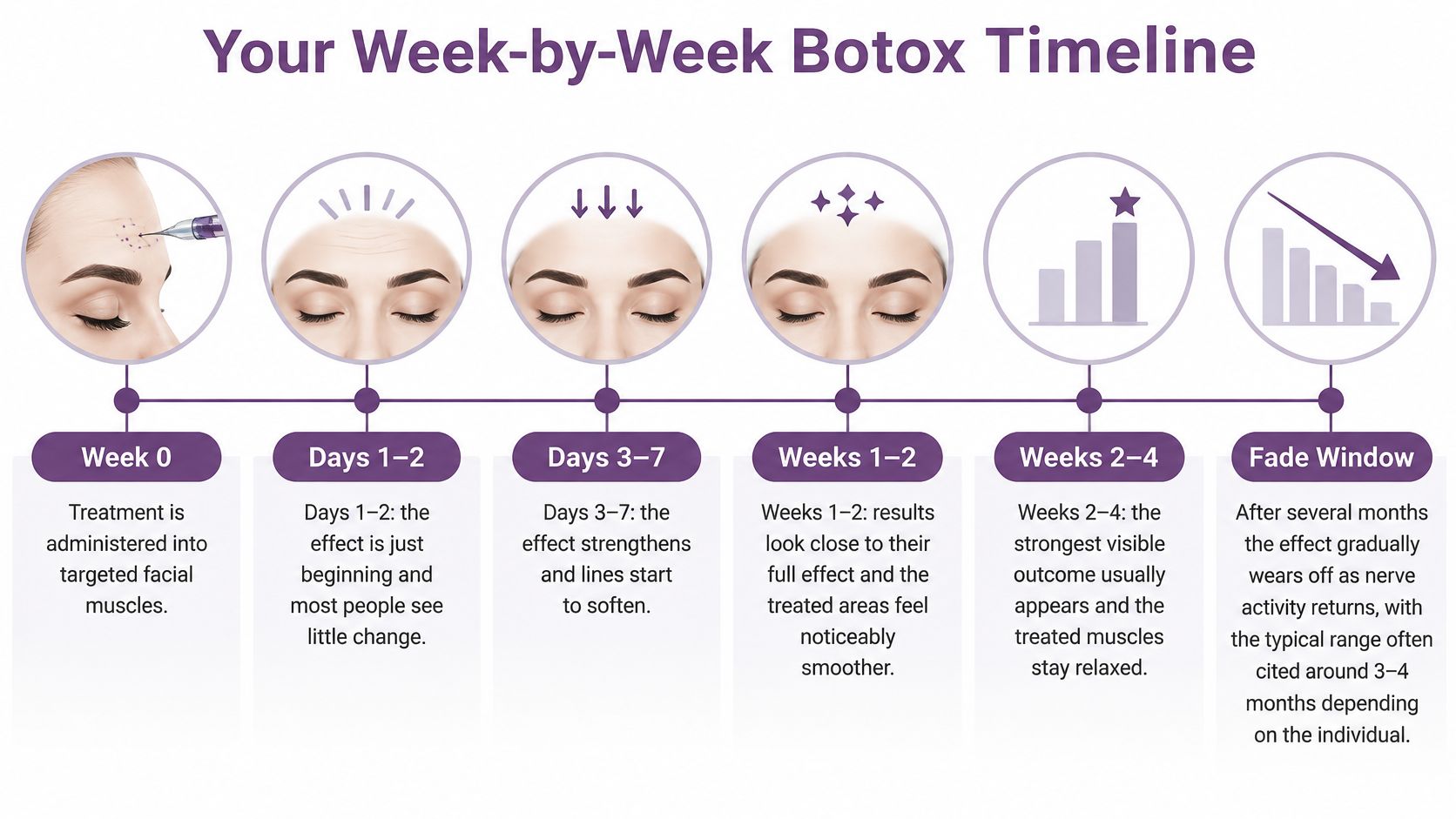
Your Week-by-Week Botox Timeline
The early treatment period is about development, while the later period is about gradual recovery. Neither process follows an identical schedule in every face, so the useful question is what to look for at each stage.
Days 1 to 2: the signal starts
The FDA's Botox Cosmetic labeling states that chemical denervation generally begins 1–2 days after injection and becomes stronger during the first week. An immediate mirror check therefore cannot tell you the final result. Some expressions may soften before others, and repeatedly testing an area can make every small difference feel more meaningful than it is.
Week 1: change is still building
The first week is the treatment settling into the muscle, not a finished result. The effect is still developing, so a line that remains visible now may continue to soften. This is also why comparing one side with the other too early can create unnecessary worry.
Week 2: the practical assessment point
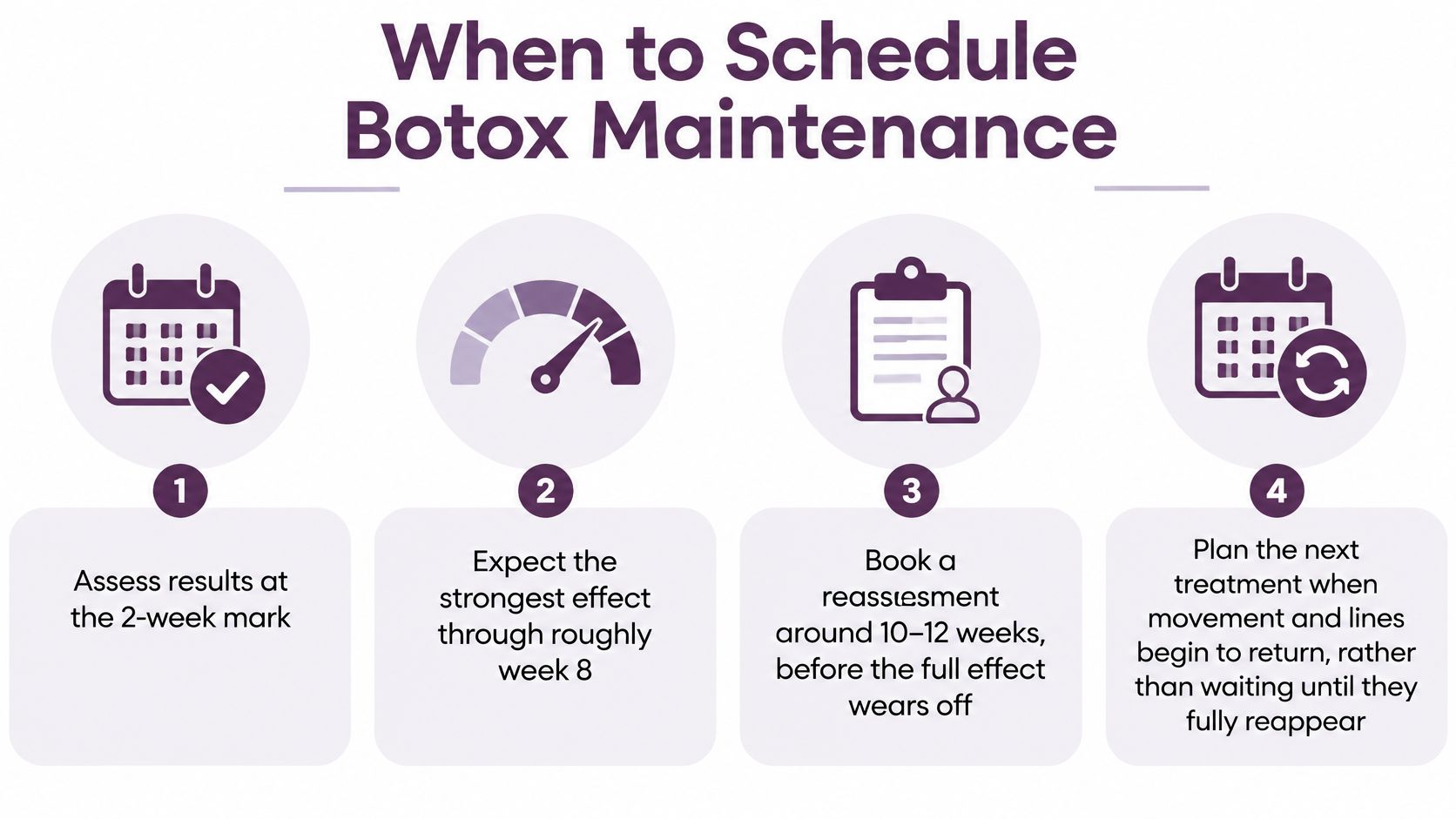
The FDA prescribing information identifies the response as still developing during the first two weeks, which makes the two-week mark a practical assessment point. Treat it as a chance to assess the developing result, not as an automatic invitation for additional injections. Useful questions include whether both sides behave similarly, whether the intended line has softened, and whether your brow position and expression feel acceptable. A line that remains visible at rest may reflect an established skin crease rather than ongoing strong contraction.
The following visual summarizes a possible follow-up rhythm. Its calendar markers are reminders to assess, not guarantees about how long your response will last.
After the settled result: watch what returns first
As weeks pass, the response separates into different signals. Someone may regain part of a frown while the crease still looks softer than before. That person can remain pleased with the result even though movement has returned, because the visible line and the overall look have not faded at the same rate. Another person may notice a small return of a particularly bothersome line and feel ready to act before the rest of the treatment has faded.
Some movement can return while meaningful cosmetic benefit remains.
There's no established rule that muscle relaxation, visible smoothing, and satisfaction must disappear in a fixed sequence. Skin quality, existing creases, expectations, and the treated area all affect how you interpret the change. What matters is whether the movement you see is producing a line you care about, not whether every treated muscle is perfectly still.
What Makes Botox Last Longer or Fade Faster
The most useful factors to review first are dose, muscle anatomy, and treatment placement. These are practical priorities for a consultation, not a scientifically validated ranking that applies to every patient.
A longer result isn't automatically a better result. Your plan must also preserve the expression, brow support, and facial balance you want.
Start with the treatment decisions
Dose relative to the muscle is more informative than total units alone. A treatment spread across several areas can't be compared directly with the same total concentrated in a single region.
Conservative dosing may leave more movement, which can be intentional. If your goal is a softer expression rather than strong immobilization, some visible movement doesn't establish that the treatment has worn off prematurely.
Muscle strength and anatomy also need individual assessment. Stronger muscles don't justify a blanket prediction that every muscular person will have a shorter response.
For example, a review of facial aesthetic botulinum toxin studies hosted by the National Library of Medicine reported Botox Cosmetic effects of approximately 3–5 months in female patients and 4–6 months in male patients in the reviewed studies. Different doses, study methods, and treatment populations mean those ranges shouldn't be used to predict an individual patient's duration based on sex.
Treatment area and placement matter because facial muscles do different jobs. Forehead treatment requires attention to brow elevation, while treatment around the eyes must account for smiling and squinting. Your injector is balancing neighboring muscles, not treating isolated lines on a photograph.
How long major botulinum toxin products last
The clinical analysis of glabellar-line treatment summarizes standard-dose duration information of approximately up to 4 months for onabotulinumtoxinA and incobotulinumtoxinA, and up to 5 months for abobotulinumtoxinA.
| Product and toxin type | Typical duration at standard doses | Notes |
|---|---|---|
| Botox, onabotulinumtoxinA | Approximately 3–4 months | FDA-labeled benchmark for glabellar lines |
| Xeomin, incobotulinumtoxinA | Up to about 4 months | Standard-dose duration summary, not a personal guarantee |
| Dysport, abobotulinumtoxinA | Up to about 5 months | Duration summary doesn't establish superiority for every patient |
These are not interchangeable promises or a head-to-head ranking. Product-specific dosing and the definition of response affect comparisons.
Individual neuromuscular recovery also contributes to duration. You can't measure it at home, and labeling yourself as someone with a fast metabolism doesn't establish why a treatment seemed brief.
Useful controllable steps include keeping accurate treatment records, documenting your response, and avoiding unnecessary product changes before you understand your current pattern. Consistency makes it easier to distinguish a dosing issue from a change in expectations.
Finally, identify the right problem. Botox addresses muscle-driven lines, not every form of facial aging. If your concern is volume loss or tissue laxity, understanding thread lifts versus fillers can help you separate those concerns from wrinkles caused by expression.
First Botox Treatment vs Repeat Treatments
Repeated Botox treatment doesn't lead to tolerance. A 2025 long-term observational cohort followed 50 patients through 1,098 onabotulinumtoxinA treatment cycles over an average of 15 years and found no evidence of treatment failure or reduced duration of aesthetic benefit.
That's reassuring, but it isn't proof that biological resistance can never occur. It does challenge the assumption that ordinary fading means your body has become immune to treatment.
Ordinary wearing-off isn't resistance
Secondary nonresponse means a previously effective treatment no longer produces the expected response. Neutralizing antibodies are one possible explanation, but a slightly shorter period of satisfaction doesn't establish that diagnosis.
Before increasing doses or shortening intervals, the clinician should review:
- Treatment records. Was the same product used, and were the same muscles treated?
- Dose and placement. Did the plan change to preserve more expression or accommodate anatomy?
- The original concern. Is the returning line movement-related, or is it now visible at rest?
- The actual response. Was there meaningful initial improvement, followed by ordinary recovery, or very little improvement from the start?
A better question: Did the treatment fail to work, or did an effective treatment gradually fade?
First-time patients have a different challenge: they don't yet have a personal reference point. The first cycle helps establish how the chosen dose and pattern affect their expression, not just how their face compares with someone else's.
Two different planning situations
Say a first-time patient is considering treatment three weeks before a wedding, as a hypothetical planning scenario. The priority is discussing realistic expectations and whether that timing allows a comfortable assessment period, rather than promising an event-day result.
Now consider a hypothetical patient who has maintained treatment for ten years with a stable dose. A newly bothersome crease doesn't automatically call for more toxin; changes in skin, volume, or facial anatomy may require a different discussion.
For broader rejuvenation goals, non-surgical facelift before-and-after information can help frame that conversation. The relevant question is whether the current concern still matches the treatment being used, not whether every visible change should be managed with additional injections.
When to Schedule Botox Maintenance
Schedule an assessment around your response, then decide whether treatment is appropriate. A review is an information visit. An injection is a separate treatment decision. Maintenance works like tuning an instrument: you adjust when a note goes flat, not because a calendar page turns.
The FDA-approved prescribing information is the safety reference for glabellar-line dosing. It describes an approved schedule, not a target date for your next visit. Use it to understand the boundaries around treatment, then judge your own response.
Build a response-based rhythm
Maintenance involves three clocks: returning muscle movement, visible lines, and your satisfaction with the result. They do not always align. Start by assessing the settled result with your injector. If you are comfortable with the outcome, the next decision is when returning movement or a particular line becomes meaningful to you. The goal is to decide which clock matters now.
A scheduled review as the effect softens can identify returning movement, without obligating you to proceed if you are still satisfied. The review documents what changed; the treatment decision comes after.

An earlier top-up should not become a routine calendar step. A clinician needs to assess the concern, the original treatment, and what another dose would mean for your expression.
Bring observations, not just a preferred date
A useful pre-visit record includes:
- Returning movement. Note which expression became stronger first.
- The first bothersome line. Identify the location and whether it appears at rest or only during expression.
- Health and medication changes. Include new medications, supplements, and relevant symptoms.
- Lifestyle changes. Mention changes in exercise or routine without assuming they explain a shorter response.
For an important event, discuss timing before committing to an appointment. A first treatment deserves more flexibility than a familiar maintenance visit because you do not yet know your individual response.
Some patients prefer maintaining partial smoothing rather than waiting for the untreated appearance to return fully. That is an individualized preference to discuss, not a proven requirement for everyone.
If you skip a session, the treated lines generally move back toward their untreated pattern as muscle activity recovers. You do not need to rush into another appointment merely because a calendar reminder appeared.
New eyelid drooping or concerning weakness warrants contact with your clinician rather than a routine maintenance booking. Trouble breathing, swallowing, or speaking requires urgent medical attention.
Book a Botox Consultation at Luxe
Your consultation is where the three clocks, movement, visible lines, and satisfaction, get measured against your own face. Dose, muscle strength, treatment area, product, and individual recovery all shift how long results hold. The three clocks rarely move together, so your own pattern decides whether another appointment is warranted.
At Luxe Aesthetic Surgery & Medical Spa, individualized treatment planning weighs anatomy, goals, and lifestyle considerations. Medical Director Haimesh Shah, MD, RPVI holds board certifications from the American Board of Venous and Lymphatic Medicine, the American Board of Laser Surgery, and the American Board of Internal Medicine.
Make the consultation specific
Bring your previous treatment details if you have them, plus photographs and a description of what you liked or wanted to change. New to injectables? Explain which expressions concern you and how much movement you want to preserve.
Our Botox treatment information covers the essentials: a quick, minimally invasive, FDA-approved injectable that temporarily softens moderate to severe facial lines, commonly used on frown lines, forehead lines, and crow's feet.
You should leave knowing the intended effect, relevant risks, and how to judge your response. The goal is a natural-looking result and a maintenance plan that fits your face, not a race to the next injection. Visit Luxe Aesthetic Surgery & Medical Spa to schedule a consultation and map out your timeline.