Medical Expertise at Luxe Aesthetic Surgery
Luxe Aesthetic Surgery & Medical Spa is led by Haimesh Shah, MD, RPVI , a physician specializing in cosmetic surgery, body contouring, laser procedures, and venous medicine. Dr. Shah is a Diplomate of the American Board of Laser Surgery, American Board of Venous & Lymphatic Medicine, American Board of Wound Management, and American Board of Internal Medicine. He also holds the Registered Physician in Vascular Interpretation (RPVI) credential and has contributed to peer-reviewed medical research.
The usual advice to choose whichever treatment lasts longer misses the most important question: what changed in your face? A hollow cheek and a descended cheek can look similarly tired, but they don't need the same correction. Comparing thread lift vs fillers starts with separating tissue descent from volume loss, then asking what happens if the result is uneven, uncomfortable, or unwanted.
Neither treatment earns a universal recommendation. Your anatomy, skin quality, medical history, and willingness to accept maintenance or corrective care matter more than an advertised lifespan.
Table of Contents
- Thread Lift vs Fillers at a Glance
- How Threads and Fillers Change the Face
- How Long Each Result Actually Lasts
- Risks Downtime and What Can Be Undone
- Which Facial Concern Points to Which Treatment
- Cost Maintenance and Combining Treatments
- Questions to Ask Before You Book
Thread Lift vs Fillers at a Glance
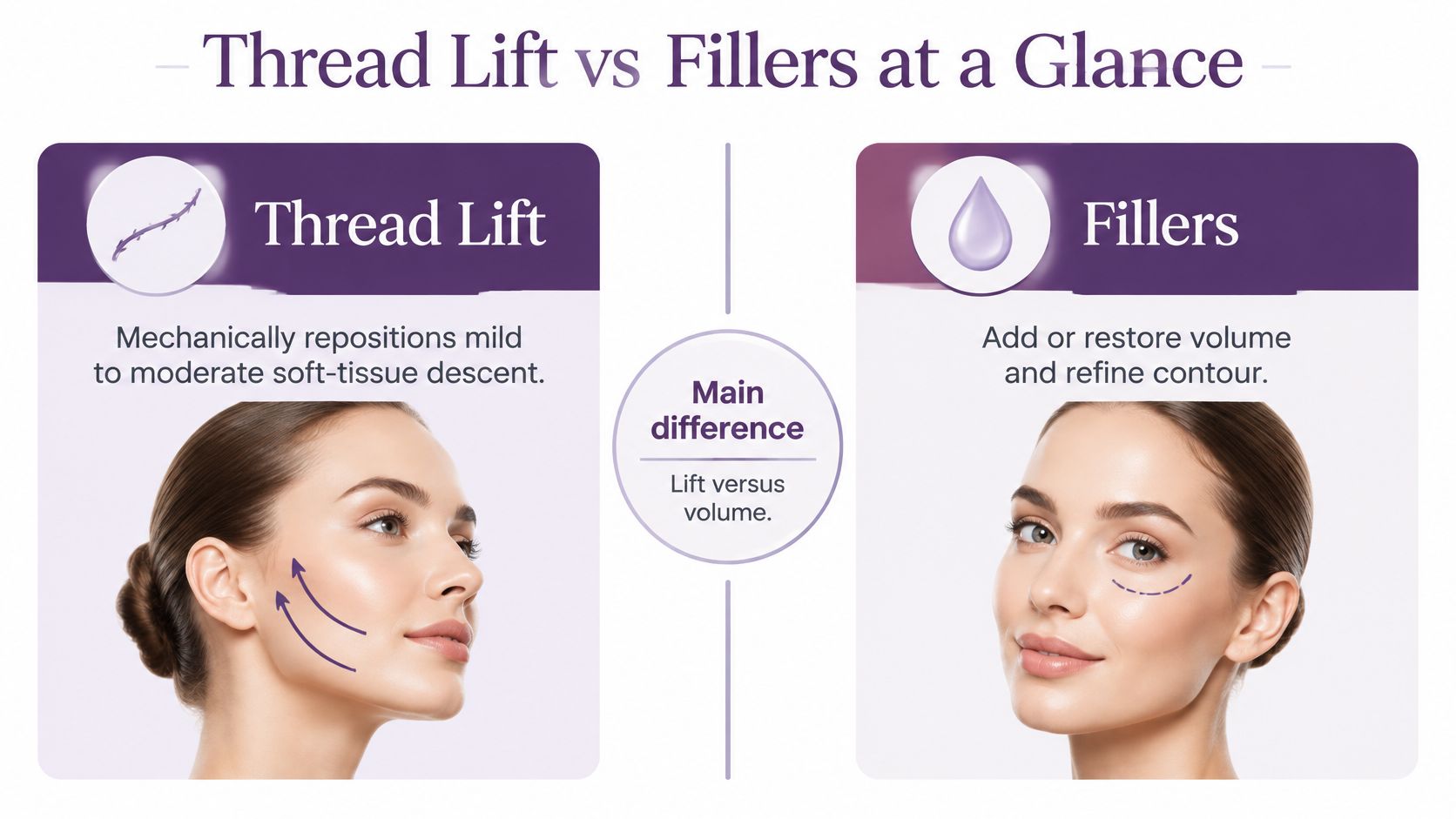
A thread lift mechanically repositions selected soft tissue. Dermal fillers add or restore volume and refine contour. They're different tools, not stronger and weaker versions of the same procedure.
Thread lift vs fillers by the problem they solve
| Option | Main problem | What changes | Social downtime | If the result is wrong | Poor match |
|---|---|---|---|---|---|
| PDO thread lift | Mild to moderate tissue descent | Immediate mechanical repositioning, followed by a collagen response as polydioxanone absorbs | Bruising, swelling, tenderness, and possible temporary surface irregularities | Observation, medical care, or mechanical removal, not enzyme dissolution | Heavy laxity, very thin skin, or a need for true volume |
| Hyaluronic-acid filler | Volume loss, folds, or lack of projection | Gel placed in or under the skin restores or shapes contour | Redness, swelling, or bruising may affect social plans | Hyaluronidase can often reduce unwanted HA, but it cannot reliably reverse established vascular injury | Using filler only to hoist heavy descended tissue |
| Biostimulatory filler, such as CaHA or PLLA | Gradual volume or collagen support | Injected material provides volume and/or stimulates collagen | Early injection effects, with gradual aesthetic change afterward | Not instantly reversible like HA; nodules or inflammation need medical management | Someone seeking immediate, easily adjustable lip or fold correction |
Social downtime means the time until you feel comfortable being seen, not just when you can answer emails or return to a desk. Ask about visible bruising and irregularities in your particular treatment area, especially before an important event.
Filler is a category, not one product
The FDA's guide to approved dermal fillers explains that many fillers are temporary because the body absorbs them, with some materials providing effects for approximately 6–12 months, while PLLA effects develop over several weeks and may last up to 2 years. The exact formulation, placement, and intended correction matter.
That distinction changes the consultation. Someone seeking a more defined chin needs a discussion about projection and facial proportion, not just a generic filler appointment.
Practical rule: Identify the treatment category that matches your primary complaint before comparing longevity, recovery, or price.
Heavy jowls, marked neck laxity, and a desire for surgical-level repositioning belong in a surgical consultation. Choosing a minimally invasive procedure doesn't make those anatomical limits disappear.
How Threads and Fillers Change the Face
Think of the face as layered tissue supported by bone, ligaments, fat compartments, and skin. A change in contour may reflect reduced volume, downward movement, reduced elasticity, or a combination. The surface appearance alone doesn't establish the cause.
Threads change tissue position
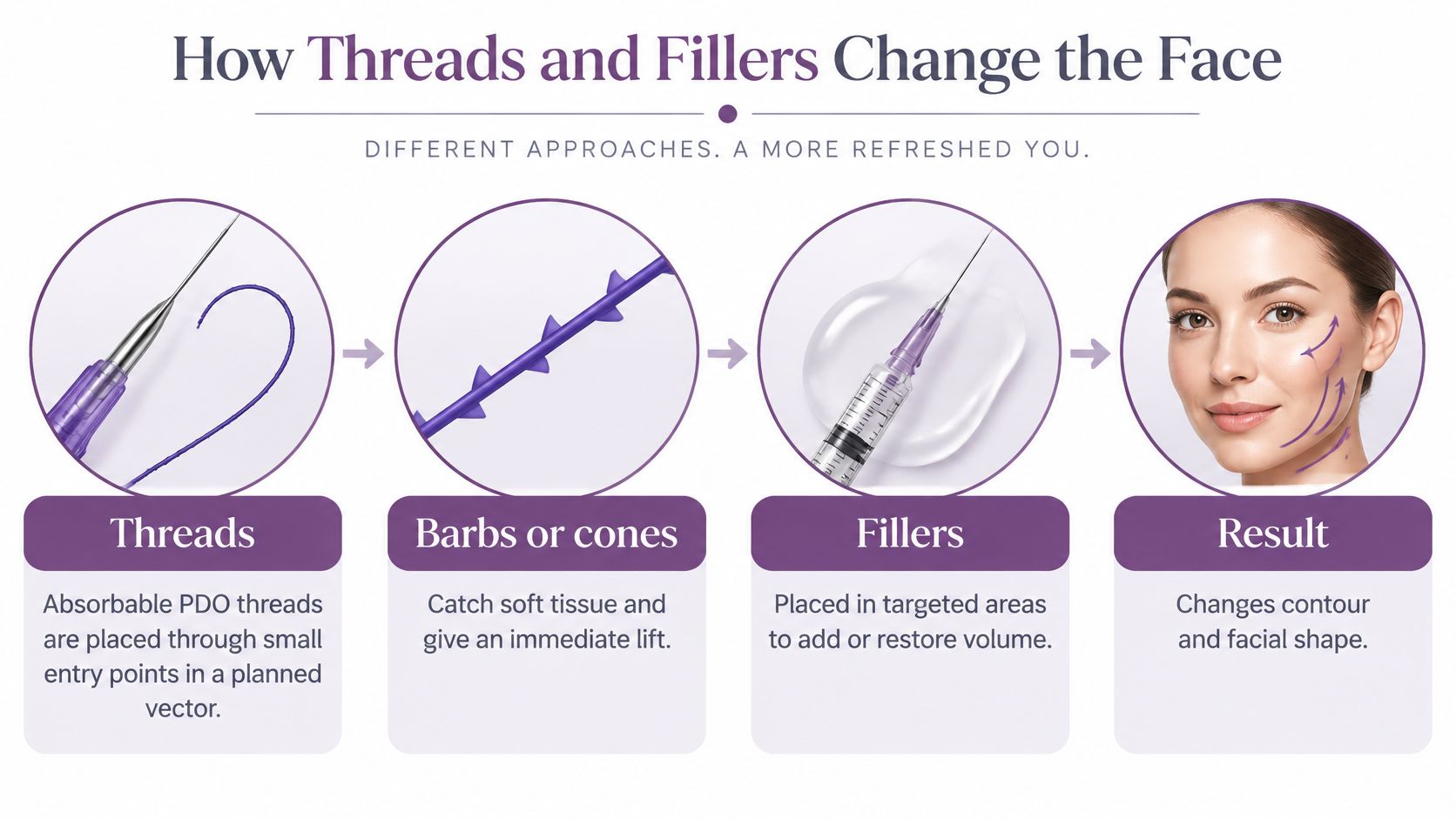
During a lifting procedure, absorbable polydioxanone, or PDO, threads enter through small access points and follow planned directions called vectors. Barbs or cones engage the soft tissue so the clinician can create a limited repositioning effect.
As the material degrades, the surrounding healing response can include collagen formation. A clinical review of facial thread lifting describes this combination of mechanical support and a collagen-associated tissue response, which differs from adding injectable material to replace volume.
That distinction matters when looking at a hollow cheek. Making tissue somewhat firmer doesn't necessarily replace the volume that gave the cheek its projection.
Fillers change volume and contour
Hyaluronic-acid filler occupies space. Clinicians select a gel and placement depth suited to the goal, whether that's lip shaping, cheek projection, temple hollowing, a fold, or chin definition.
Biostimulatory fillers require a separate conversation. Calcium hydroxylapatite, or CaHA, and poly-L-lactic acid, or PLLA, support volume and collagen-related change, but neither behaves like a suture that suspends descended tissue. They're also not interchangeable with HA when planning adjustment or removal.
Consider these contrasting assessments:
- Adequate cheek volume with mild jawline descent: A clinician may consider a directional thread vector rather than adding unnecessary fullness.
- A flat midface with reasonably preserved support: Targeted volume restoration may address the missing projection more directly.
Threads don't fill lips, and filler doesn't reliably lift a heavy neck. These are limitations of the mechanisms, not failures of branding or technique.
Both procedures are commonly performed in an office setting with local anesthesia or other local numbing measures for appropriate candidates. Comfort, placement, and eligibility still require an individualized assessment. A PDO thread-lift consultation should establish what needs repositioning before discussing the procedure itself.
How Long Each Result Actually Lasts
Expected duration by thread and filler material
| Material | Typical visible window | What that window means | Maintenance expectation |
|---|---|---|---|
| PDO threads | About 6–12 months; some reports up to 2 years | Modest repositioning, not a structural facelift | Repeat only if laxity returns and candidacy remains appropriate |
| PCL or PLLA copolymer threads | Roughly 12–15 months of material persistence | Absorbable support duration, not a proven visible-lift window | Request product-specific outcome evidence |
| PLLA threads | About 18–24 months of material persistence | Extended material presence, not guaranteed correction | Plan follow-up rather than assuming a fixed endpoint |
| Hyaluronic-acid filler | Often 6–12 months clinically | Volume or contour correction | Reassess when the intended correction softens |
| Calcium hydroxylapatite | About 24 months | Volume and collagen-related effects | Review the remaining correction before retreatment |
| PLLA filler | Builds over weeks; may last up to 2 years | Gradual collagen-related volume | A series of sessions may be part of the plan |
The PDO benchmark and reports of longer benefit come from a consensus review of thread-lift evidence, which describes typical effects of approximately 6–12 months and limited support for durable structural rejuvenation. A clinical review discussing materials and treatment longevity reports approximately 12–15 months of persistence for PCL/PLLA copolymers, 18–24 months for PLLA threads, 6–12 months of effect for HA filler, and approximately 24 months for CaHA.
Separate the three clocks
Material persistence, visible improvement, and the timing of maintenance are different measurements. A thread can remain present without maintaining the original tissue position. Filler can remain detectable after the contour no longer looks sufficiently corrected.
That distinction also prevents a misleading comparison between a thread's absorption time and a filler's clinical effect. Ask what each number measures before treating it as a forecast.
A peer-reviewed commentary on a dissolvable barbed-suture series describes 160 patients whose initial lifting or contouring improvements were absent at the one-year assessment. That finding doesn't predict every outcome, but it does challenge promises based on an attractive immediate photograph.
Persistence isn't the same as satisfaction
Volumetric imaging can detect residual filler without showing that the patient still has the desired facial balance. Conversely, a subtle improvement might remain worthwhile even after some correction has faded.
For maintenance planning, ask:
- What will fade first? Projection, fold correction, and tissue elevation aren't identical endpoints.
- What would justify another treatment? A calendar reminder alone isn't a reason to add material.
- What remains already? Residual product should inform the next dose and placement.
Compare the useful benefit you expect from each visit, not the longest lifespan mentioned in an advertisement.
Risks Downtime and What Can Be Undone
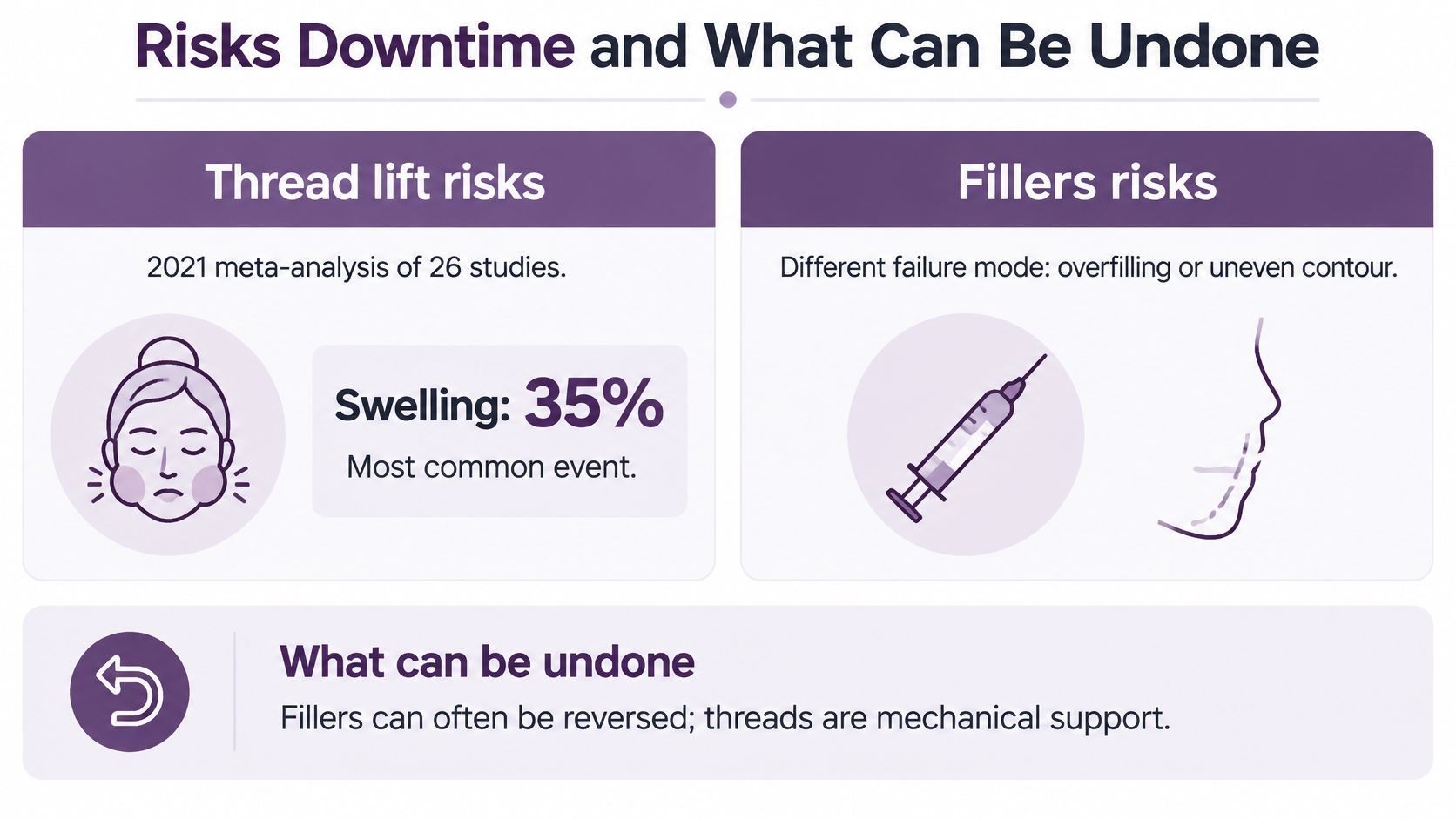
Before consenting, ask what the clinician would do if the result were wrong. A palpable thread, an overfilled cheek, and a blocked blood vessel require very different responses. Correctability is part of safety, but it isn't a guarantee of safety.
Thread risks include mechanical problems
A 2021 systematic review and meta-analysis of 26 facial thread-lift studies reported pooled rates of 35% for swelling, 10% for dimpling, 6% for paresthesia, 4% for visible or palpable threads, 2% for infection, and 2% for extrusion. In the same analysis, absorbable versus nonabsorbable threads were associated with paresthesia rates of 3.1% versus 11.7% and extrusion rates of 1.6% versus 7.6%.
Age also affected the pooled findings: patients older than 50 had dimpling rates of 16% versus 5.6% among younger patients and infection rates of 5.9% versus 0.7%. These study-level estimates aren't personal predictions, and they shouldn't be added together to calculate an individual's overall risk.
Other reported concerns include hematoma, granuloma, migration, and uncommon nerve or parotid-gland injury. Some problems settle with observation; others require medication, revision, or removal.
Filler risks range from bruising to permanent injury
The FDA's dermal-filler safety guidance lists bruising, redness, swelling, pain, tenderness, itching, and rash as common effects that generally resolve within days to weeks, while some adverse effects can appear weeks, months, or years later. Delayed problems include nodules, migration, infection-related issues, and inflammatory reactions.
The most concerning risk is unintended injection into a blood vessel. Although uncommon, it can cause tissue necrosis, vision abnormalities including blindness, or stroke, and some consequences can be permanent.
Hyaluronidase may reduce unwanted HA, but it doesn't reliably undo established tissue injury. It also isn't an equivalent reversal option for CaHA or PLLA.
Plan recovery and escalation
Filler often involves less social downtime than thread lifting, but a small injection can still produce noticeable bruising. Thread patients should also discuss tenderness, dimpling, and temporary asymmetry before scheduling public-facing commitments.
- Get written aftercare: Use the practice's facial-rejuvenation recovery guidance alongside your procedure-specific instructions.
- Check home devices: Solawave's guide to restarting light therapy after cosmetic injections can help frame questions, but your treating clinician should clear device use.
- Know urgent warning signs: Unexpected severe pain, unusual skin discoloration, or visual symptoms after filler require immediate medical assessment, not a routine follow-up message.
Which Facial Concern Points to Which Treatment
Describe the change you want corrected, rather than arriving committed to a procedure. For example, a softened jawline may reflect weak chin projection, displaced soft tissue, or substantial skin laxity. Each explanation leads to a different plan.
| What you notice | Path to discuss | Why the alternative may miss the goal |
|---|---|---|
| Early jowling with adequate facial volume and reasonable skin quality | Limited PDO thread repositioning | Extra filler can add width without correcting descent |
| Hollow cheeks or temples | Carefully selected volume restoration | Threads don't replace the missing volume |
| Thin lips or insufficient chin projection | Anatomy-specific HA filler | A lifting vector doesn't create the required shape |
| Nasolabial folds | Assess volume loss, tissue movement, and suitability for conservative filler | Treating every fold as a lifting problem overlooks local contour deficits |
| Gradual cheek deflation with acceptance of slower change | A biostimulatory filler discussion | Threads aren't a substitute for volume support |
| Hollowing together with mild descent | A staged, combined assessment | Either treatment alone may leave a separate problem untreated |
| Heavy jowls, prominent neck bands, or substantial loss of elasticity | Surgical evaluation | Neither option provides surgical-level correction |
Precision matters more than a fuller face
A 2025 systematic review of 24 studies involving 1,410 patients found approximately 60–86.4% filler persistence at 12 months and 50–86% at 24 months on volumetric assessment, with substantial differences across products, areas, imaging methods, and patients. Those findings support careful planning around residual material, not automatic repeat injections.
For a Southern California patient considering fillers and injectables, the useful question is where a small amount of correction would improve proportion. A weak chin doesn't necessarily need broader cheeks, and a hollow temple doesn't establish a need for jawline treatment.
Account for mixed problems and edge cases
When hollowing and mild descent coexist, the physician may first restore selected missing volume or support, then reassess whether a limited thread vector is still appropriate. The sequence isn't universal; existing filler, tissue thickness, swelling, and future surgery can change it.
Very thin skin deserves particular caution with threads because palpability and surface irregularity may be harder to conceal. Prior filler complications, vascular history, and upcoming facial surgery should also influence the product and treatment plan.
If you're also reading about regenerative treatments for facial aging from Dream Body Clinic, ask what specific intervention is being proposed and what evidence supports it. The regenerative label doesn't establish that a treatment can replace lost volume or reposition descended tissue.
Choose filler for a measurable volume or projection deficit, threads only for limited repositioning, and neither as a replacement for surgery in advanced laxity.
Cost Maintenance and Combining Treatments
A treatment quote isn't meaningful until you know what it includes. Thread lifting may be priced by thread count, material, or facial zone; filler is commonly priced by syringe or treatment plan. A lower initial estimate may describe a smaller correction.
Ask the clinician to separate the desired endpoint from the amount of treatment proposed. You should understand whether the quote aims for subtle improvement, fuller correction, or a staged starting point.
Compare complete plans
| Estimate detail | What to clarify |
|---|---|
| Thread material | Whether the plan uses PDO, a PCL/PLLA copolymer, or PLLA |
| Filler identity | The exact material and formulation, not just the word filler |
| Treatment amount | Planned threads, syringes, and facial zones |
| Partial correction | What the face may look like if treatment stops at the initial stage |
| Follow-up | Which reviews are included and how concerns are assessed |
| Corrective care | How adjustment or complication-related care is handled financially |
Don't assume each facial area requires the same amount. Cheeks, temples, lips, folds, and the chin differ in anatomy and intended outcome. Adding more just to use a package can conflict with balanced proportions.
Maintenance also deserves a written plan. Rather than booking automatic top-ups, arrange reassessment when the benefit changes and ask whether enough product or support remains to delay another procedure.
Combine treatments only for separate needs
A reasonable combined scenario might involve cheek filler for genuine hollowing and a conservative thread vector for residual early jowling. The rationale should identify what each component contributes, not merely promise a more complete result.
Staging can be useful when swelling from the initial procedure would obscure the endpoint of the next. It also gives you a chance to decide whether the first correction was enough.
- Set a stopping point: Agree on the desired proportion before adding treatment.
- Discuss future surgery: Tell the clinician if you may pursue a facelift so prior threads or retained filler can be considered.
- Request contingency details: Your written estimate should explain follow-up, touch-ups, and who to contact if healing doesn't follow the expected course.
The practical comparison is ongoing treatment burden: visits, recovery, adjustment options, and the consequences of a disappointing result. Purchase price alone doesn't capture those obligations.
Questions to Ask Before You Book
Use the consultation to test whether the proposed treatment matches your anatomy. A clinician should be able to explain the problem in plain language, identify the limits of the plan, and describe what would happen if the outcome needed correction.
A review of thread-lift safety and complications reinforces the importance of discussing mechanical complications and their management, rather than treating a minimally invasive procedure as consequence-free. Your medical history, previous treatment records, and examination should guide that conversation.
Bring information that changes the plan
Bring the names of prior injectable products if available, the areas treated, and any history of prolonged swelling, nodules, infection, or unexpected pain. Mention medications, allergies, relevant medical conditions, and plans for future facial surgery.
Photographs can help communicate the change you notice, but they shouldn't substitute for examination. Ask the clinician to explain what is realistic for your current tissue quality rather than promising to recreate an earlier face.
Your consultation checklist
- What is my primary anatomical problem? Ask whether the concern is hollowing, weak projection, mild descent, a combination, or substantial laxity.
- Which named product would you use, and why? The answer should connect the material to volume, projection, collagen support, or a limited lifting vector.
- What visible duration do you expect in this area? Ask how the clinician distinguishes material persistence from useful correction and when reassessment makes sense.
- How would you manage unwanted HA or a vascular emergency? Discuss adjustment, immediate recognition, emergency access, and the limits of dissolving.
- What happens if a thread dimples, migrates, or becomes palpable? Understand when observation is appropriate and when removal or referral might be needed.
- Could existing or proposed treatment affect later surgery? Ask what records should be retained and shared with a future surgeon.
Dr. Haimesh Shah, MD, RPVI, is a board-certified physician specializing in cosmetic surgery and phlebology and serves as Luxe's Medical Director. The physician should match any recommendation to your anatomy, goals, and medical history. Not everyone is a candidate, and no particular outcome should be promised.
Luxe Aesthetic Surgery & Medical Spa offers PDO thread lifts and dermal fillers for individualized facial-rejuvenation planning in Southern California. Visit Luxe Aesthetic Surgery & Medical Spa to request a consultation focused on your facial concerns, appropriate treatment options, and a clear plan for recovery and follow-up.