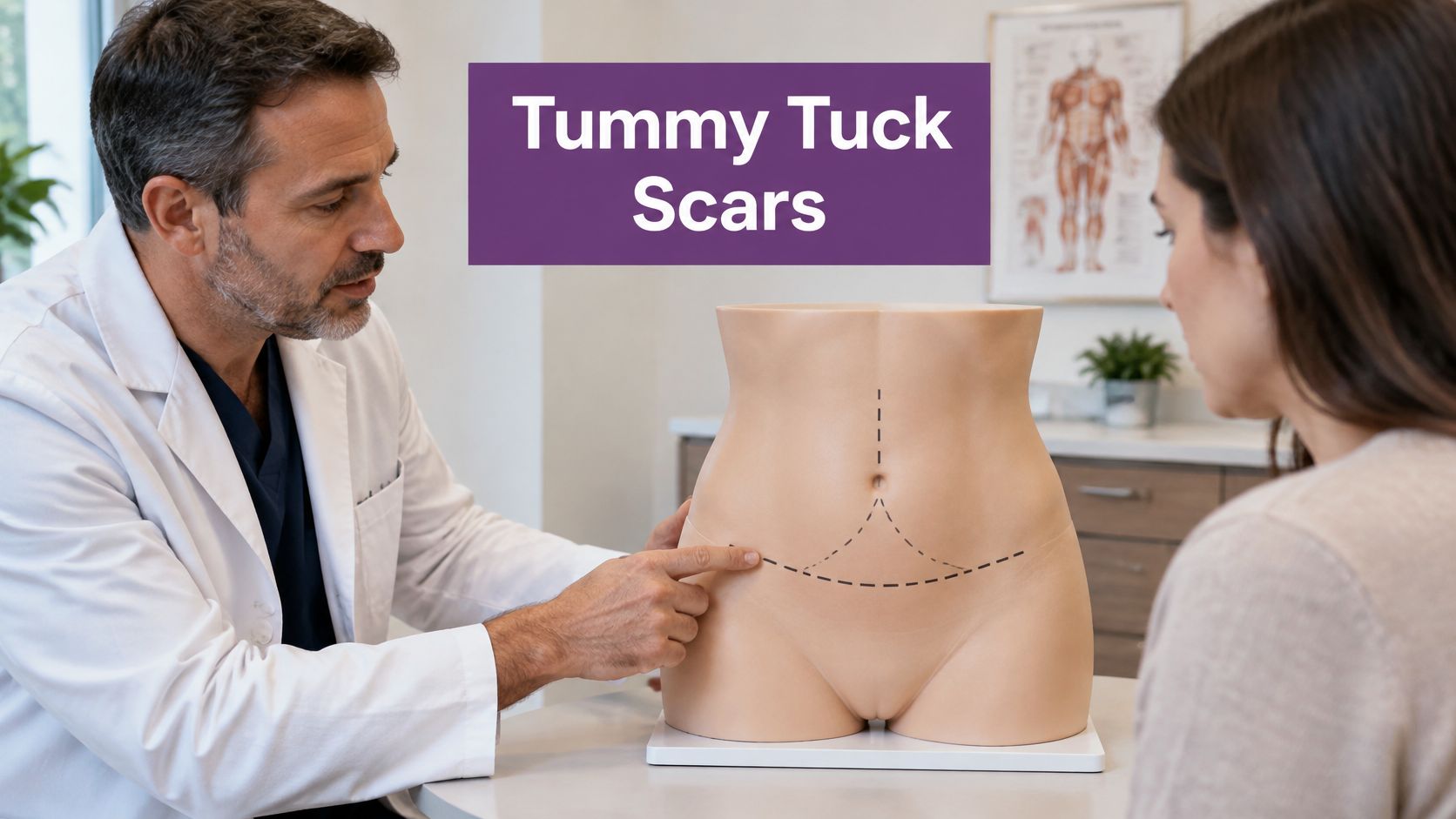
Medical Expertise at Luxe Aesthetic Surgery
Luxe Aesthetic Surgery & Medical Spa is led by Haimesh Shah, MD, RPVI , a physician specializing in cosmetic surgery, body contouring, laser procedures, and venous medicine. Dr. Shah is a Diplomate of the American Board of Laser Surgery, American Board of Venous & Lymphatic Medicine, American Board of Wound Management, and American Board of Internal Medicine. He also holds the Registered Physician in Vascular Interpretation (RPVI) credential and has contributed to peer-reviewed medical research.
You've probably already done the mirror test: stood in the underwear you wear, pushed the waistband down an inch, and tried to picture where a scar would land. Or you've scrolled through before-and-after photos and found yourself looking past the flat stomach to the thin horizontal line underneath it, wondering what that will look like on you in year three. Both instincts are correct. The tummy tuck incision decides two things at once, how much skin the surgeon can remove and where you'll carry the mark of it.
Many patients arrive at a consultation asking a version of the same question. Can it be hidden? Can it be short? Can it be both?
The honest answer is that an incision is a design decision with trade-offs, and once you can see those trade-offs clearly, the conversation with a surgeon becomes far more useful. Here's the walkthrough in the order it sticks: the types first, then placement, then what the scar does over a year, then what can go wrong, then how to protect it, and last how to choose.
Table of Contents
- Tummy Tuck Incision Types Compared
- Where the Scar Sits Against Your Underwear Line
- How a Tummy Tuck Scar Changes Over Time
- Healing Problems That Change the Final Scar
- How to Minimize Tummy Tuck Scarring
- Choosing the Incision That Fits Your Goal
Tummy Tuck Incision Types Compared
Four patterns cover most tummy tucks. They differ in where the scar runs, how much skin the surgeon can take, and how much scar burden you accept in exchange.
| Incision type | Scar pattern | Correction it targets | Scar burden |
|---|---|---|---|
| Mini tummy tuck | Short low transverse scar below the pubic area | Limited excess skin and fat in the lower abdomen | Smallest |
| Full abdominoplasty | Low horizontal scar from hip bone to hip bone | Excess skin and fat below and above the navel | Moderate |
| Extended abdominoplasty | Low horizontal scar extended toward the flanks | Lax skin reaching the sides and back | Larger |
| Fleur-de-lis abdominoplasty | Horizontal scar plus vertical scar from lower breastbone to pubic bone | Laxity in both horizontal and vertical directions, often after major weight loss | Largest |
The full pattern, in detail. A full abdominoplasty uses a horizontal incision between the pubic hairline and the belly button, and its shape and length follow how much excess skin has to come out, which is why it isn't identical from one patient to the next (American Society of Plastic Surgeons). In many full tummy tucks the scar runs from one hip bone to the other. A second incision around the navel comes into play when the surgeon removes skin above the belly button: the navel stays attached to the abdominal wall in its original position and is brought out through a new opening, so it keeps its natural stalk and its blood supply.
Where the fleur-de-lis fits. Someone carrying a large apron after bariatric surgery doesn't just have loose skin side to side. They have it top to bottom, and a purely horizontal pull can't correct that. The American Society of Plastic Surgeons describes the fleur-de-lis pattern as appropriate when laxity extends both horizontally and vertically, including after weight loss exceeding 100 pounds. It adds a vertical incision running from the lower breastbone toward the pubic bone. That's the heaviest scar burden of any option, and what it buys is removal of central vertical excess a horizontal incision alone can't reach.
Why a shorter scar isn't automatically the better one
People sometimes talk themselves into the wrong operation. A shorter incision removes less skin, and less skin removed means less correction. That's arithmetic, not opinion. A partial tummy tuck can limit the incision and the recovery burden, yet it can't deliver what a full or extended procedure does.
The better question isn't "how short can my scar be." It's "how much skin has to come off, and in which direction." Incision length and design depend on skin excess, abdominal laxity, torso proportions, whether your flanks are involved, and whether you need muscle repair or the navel repositioned, as a review of abdominoplasty incision planning sets out.
Practical rule: Match the incision to the map of your loose skin, not to the shortest line you've seen in a photo. Skin that hangs in the lower abdomen only, skin that sits above the navel, and skin that wraps the flanks each point to a different pattern.
Length also isn't a fixed number you can plan around in advance. Any single figure you read online is a starting point for a conversation, not a specification.
Where the Scar Sits Against Your Underwear Line
Imagine checking your incision against your underwear while standing, then sitting down and seeing the waistband shift. That is why placement is judged against both your anatomy and the clothes you wear, rather than by a single measurement alone.
| Measurement | Reference value | What it means for planning |
|---|---|---|
| Lower incision distance from the labial commissure | 4–9 cm | A reference range, adjusted for anatomy and risk factors |
| Inferior incision distance above the vulvar commissure | At least 5–7 cm | Placing the incision lower can raise or distort external genitalia |
| Mean vertical scar position at one month | 9.9 cm (range 6.1–12.9 cm) | Position can be assessed in standing and flexed positions |
The measurements in the first two rows come from the sources cited below. The third row's study is linked in the paragraph reporting its figures.
The first number is a range, not a target. A 2024 review of abdominoplasty techniques reported a lower incision position 4–9 cm from the labial commissure, with placement varying according to anatomy and risk factors. The same distance may sit differently on a short torso than on a long one.
The second number is a floor. A clinical reference chapter on abdominoplasty recommends keeping the inferior incision at least 5–7 cm above the vulvar commissure. Placing it lower can displace or distort the external genitalia. Removing too much skin can also leave a shortage that forces the closure under tension.
The third number describes a measured position. A 310-patient clinical series used a concave transverse incision inside the bikini line, raised the abdominal flap toward the costal margins, and preserved the lateral perforating blood supply. The study reported a mean vertical scar position of 9.9 cm at one month, with measurements from 6.1 to 12.9 cm. The authors avoided a midline vertical scar and used patient flexion and deep fascial anchoring sutures to keep the line inside clothing. The 310-patient series recorded an overall complication rate of 35.8%, including minor scar deformities in 17.1%.
Why flexion changes the answer
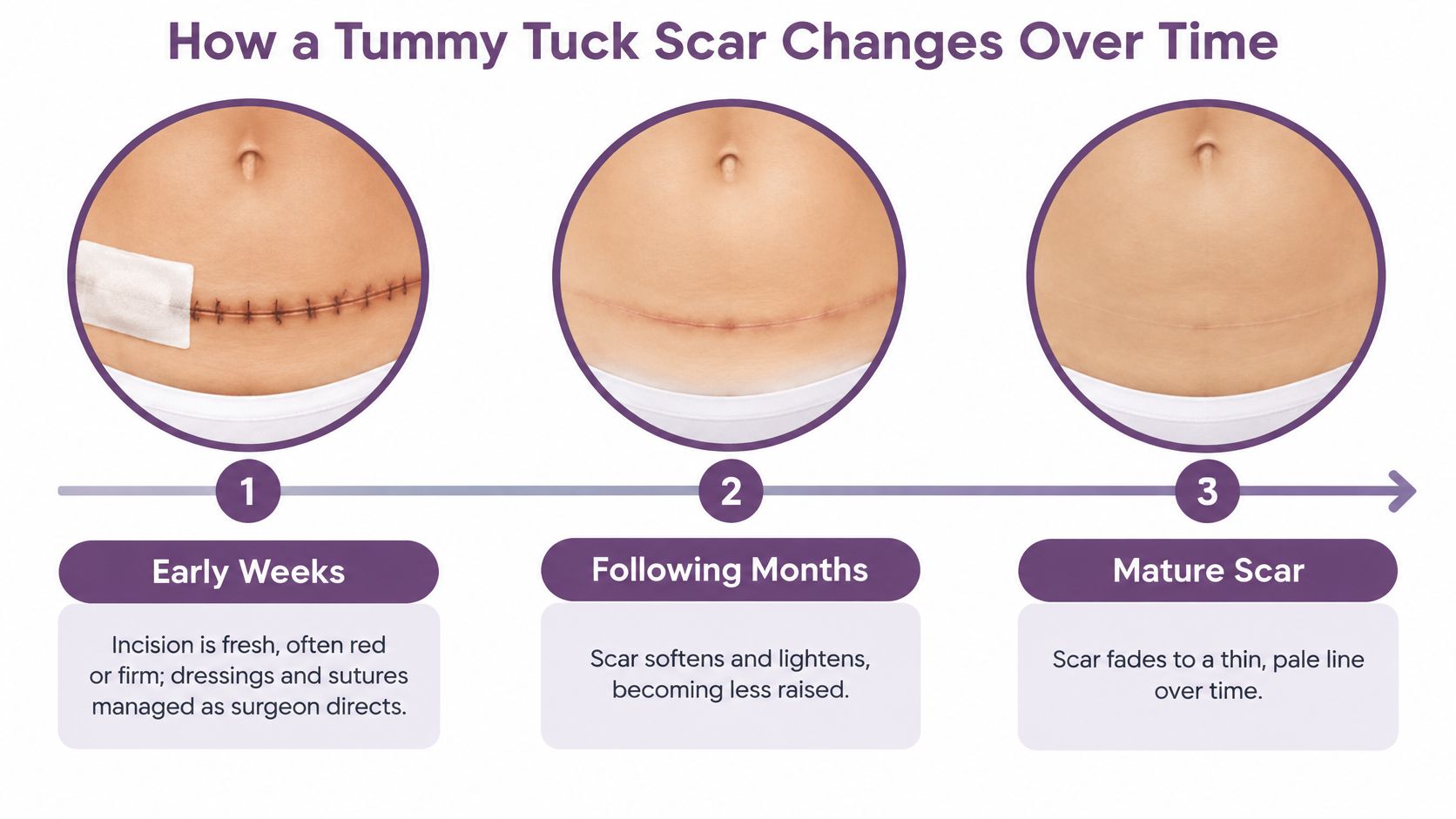
Skin shifts with posture. A line that sits at the top of your underwear while standing may ride upward when you sit. If the surgeon marks the incision only while you are upright, the final position may differ once you bend and closure tension is applied. Poor marking, uneven flap traction, irregular undermining, or excessive closure tension can shift parts of the scar and distort the pubic region.
Bring your clothing preferences into the consultation. Nuage Wears high-rise fit advice explains how waistband rise is measured, which can help you describe where you want the scar to sit relative to your underwear.
A well-planned scar is checked standing, sitting, and against the clothes you actually wear.
Ask the surgeon to mark the proposed line on your skin. Stand, sit, and bend, then check its position against underwear or swimwear you brought with you.
How a Tummy Tuck Scar Changes Over Time
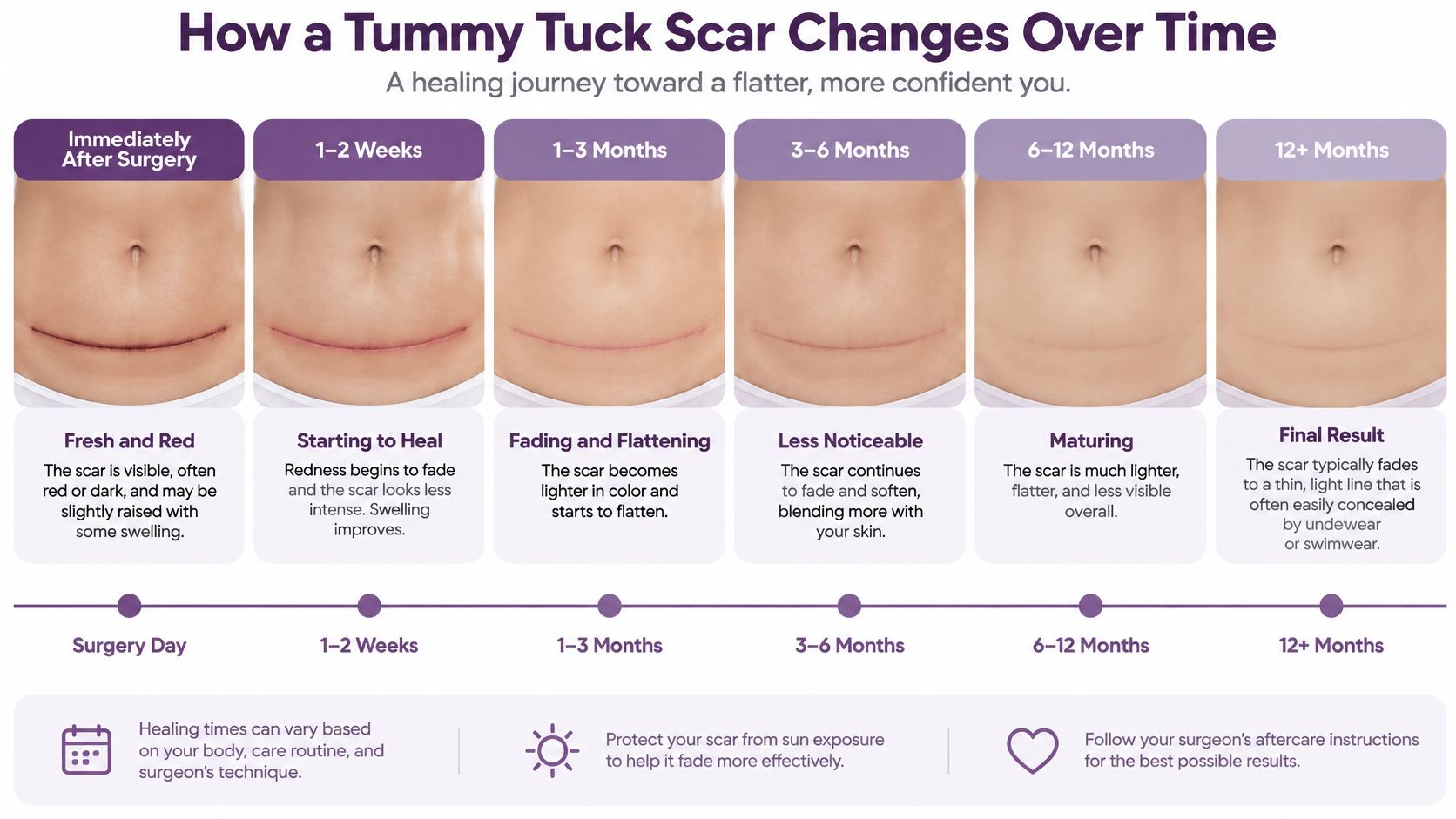
Say your surgery is on a Tuesday in March. Here's roughly what that line does in the mirror over the following year, and what to expect at each stage.
In the early weeks the incision is fresh, often red or firm, and your dressings and sutures are managed exactly as the surgeon directs. Some people find the area numb, and a tight pulling sensation when standing fully upright is common while the tissues settle.
Over the following months, the scar typically softens and lightens. It may still look raised or pink, and that's within the normal range. The change is gradual enough that day-to-day comparison tells you nothing useful.
The one-year benchmark
Scars mature on their own schedule, and the American Society of Plastic Surgeons guidance on tummy tuck safety notes that a scar may take a full year to completely fade, with the final appearance varying by surgical technique, genetics, skin type, and sun exposure. Even after a horizontal scar softens and lightens, it may stay visible for years. That's worth hearing before surgery, not after.
The same guidance lists the incision-related problems patients should know about: unfavorable scarring, poor wound healing, skin loss, infection, numbness or altered sensation, prolonged swelling, and the possibility of revision surgery. Knowing they exist isn't pessimism. It's the difference between reporting something early and hoping it settles.
Sun exposure and the monthly photo log
Sun is the one variable in that list you control directly. Keep the healing scar out of direct sun and use sunscreen during the first several months as directed, since ultraviolet exposure darkens a fresh scar and can make the difference permanent.
For tracking, don't judge the scar daily. Photograph your abdomen once a month, in the same spot, the same light, and the same posture, phone at the same height. Real change shows up across months. Daily inspection shows you lighting differences and your own anxiety.
Take the long view: the scar you have at eight weeks isn't the scar you'll have at two years, and the timeline above is a general expectation rather than a promise for any individual patient.
Healing Problems That Change the Final Scar
Two patients can have similar incisions yet end up with different scars. The incision sets the starting line, while blood supply, tissue repair, and complications during healing affect how that line settles.
Abdominoplasty complications vary with the procedure and patient. A 2024 systematic review on abdominoplasty complications reports overall rates of about 10%–20%, rising to 30%–50% after massive weight loss. Reported problems include seroma, infection, hematoma, skin necrosis, and umbilical complications. A literature review of 20,029 abdominoplasty procedures found local complication rates of 20% for traditional abdominoplasty, 10.3% for lipoabdominoplasty, and 13.5% for limited or mini-abdominoplasty, with systemic complications under 0.1% across all three.
What raises the risk
Smoking and nicotine exposure narrow blood vessels, limiting oxygen delivery to healing tissue. Diabetes and poorly controlled blood sugar can interfere with tissue repair. Obesity, unstable weight, and previous abdominal incisions may also affect the blood supply to the abdominal flap. Together, these factors can make it harder for the incision to heal well. Each is a reason to give the surgeon an honest medical and surgical history.
The surgeon's technique can influence healing, too. The 2024 systematic review on abdominoplasty complications found that preserving Scarpa's fascia was associated with a 69% reduction in seroma occurrence, as well as lower odds of infection and hematoma. The review's authors noted that more randomized trials are needed before this approach can be considered settled practice.
When to call rather than wait
| Warning sign | Why it matters | What to do |
|---|---|---|
| Worsening pain | May signal infection or fluid collection | Contact your surgeon the same day |
| Spreading redness or warmth | Can indicate infection | Contact your surgeon promptly |
| Fever | May indicate a systemic response to infection | Seek urgent medical care |
| Foul-smelling or persistent drainage | May indicate infection or persistent fluid, such as a seroma | Call your surgeon for review |
| Darkening skin along the incision | May indicate reduced blood supply | Seek prompt surgeon review |
| Wound separation | Can delay healing and widen the scar | Call your surgeon right away |
These signs call for medical attention rather than waiting to see how the scar settles. A different concern may be a small puckered fold at the end of the incision. Learning what a dog ear after a tummy tuck can look like may help you describe the change at a follow-up visit.
The honest question: assess both the incision's appearance and how it heals. No one can promise an invisible scar.
How to Minimize Tummy Tuck Scarring
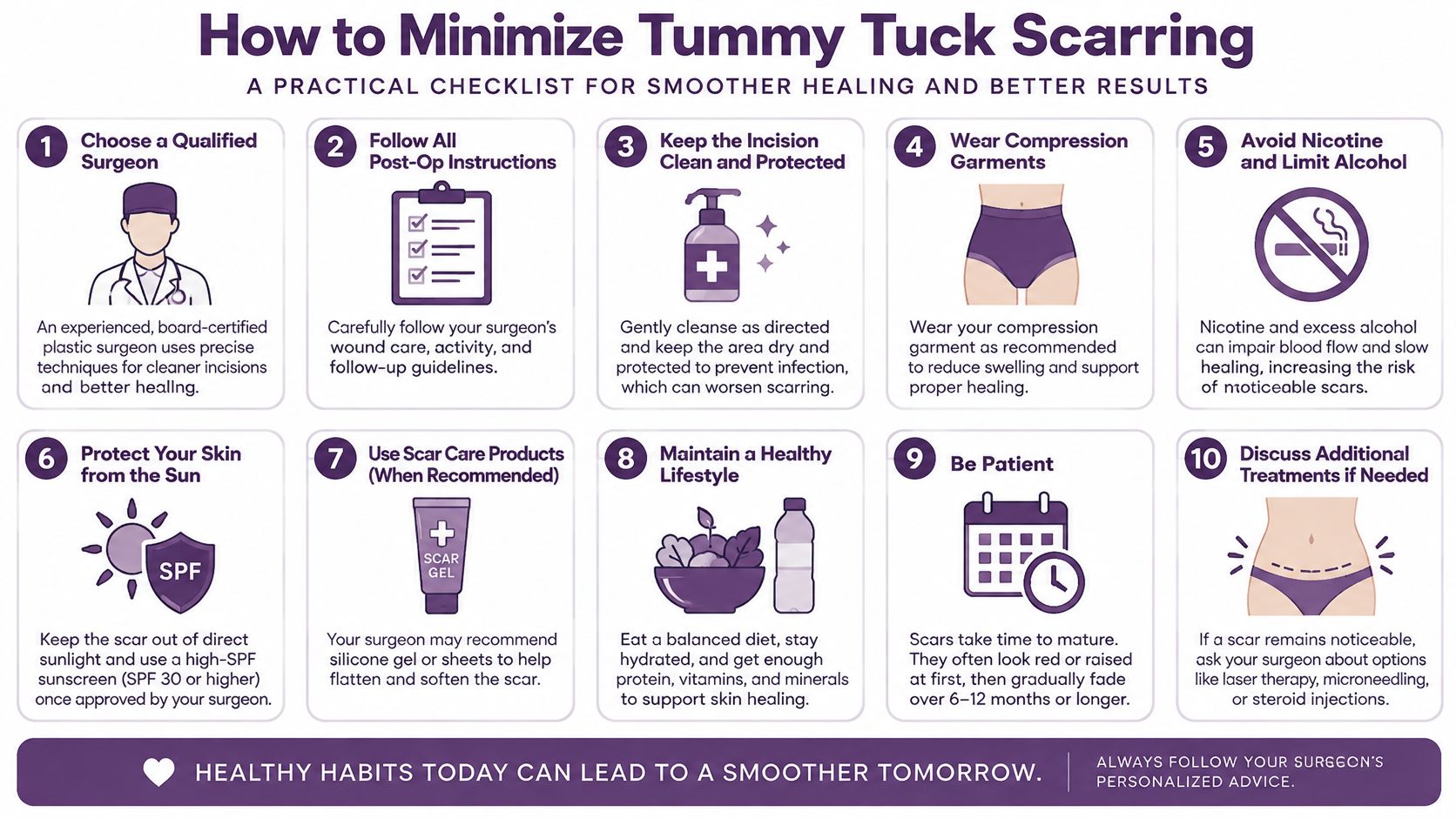
A scar's final appearance depends partly on choices made before surgery and partly on how the incision is protected as it heals. The incision plan is the starting point; steady care helps protect the result over time. No approach can guarantee an invisible scar.
Before surgery
- Ask your surgeon how long to avoid nicotine before surgery, and confirm when to stop. Follow the timing they recommend.
- Bring your diabetes management plan and recent blood sugar information to the consultation. Ask whether any adjustments are needed before surgery.
- Discuss your weight plans with your surgeon before choosing a surgery date. This helps you understand how changes to your body could affect the result.
- Show your surgeon every prior abdominal incision or scar, including cesarean and vertical scars. Make sure these are considered when planning the new incision.
- Ask for the incision to be marked while you are standing and flexing. A 2025 clinical study of abdominoplasty incision marking in 147 patients reported good or excellent scar-shape results in 95% of cases under the Strasser grading system.
- Ask whether the closure will use multiple tissue layers. Layered closure distributes force beneath the skin, rather than making the skin-level suture line bear the full load.
After surgery
- Follow your surgeon's aftercare instructions, including guidance on dressings, drains, and compression garments. If instructions are unclear, ask before changing your routine.
- Protect the scar from direct sun and use sunscreen as directed. Sun exposure can darken a scar as it matures.
- Avoid heavy lifting, twisting, and strenuous exercise until your surgeon clears you. Pulling on a healing incision can widen it.
- Take a monthly photo in consistent lighting and position. Comparing images over time gives you a clearer view of gradual changes than checking the scar from day to day.
- Report warning signs promptly. Spreading redness or other concerning changes warrant a call to your surgeon, rather than waiting to see whether they resolve.
Scar care is consistency over a year. Follow the plan, protect the incision as it heals, and give changes time to emerge.
Choosing the Incision That Fits Your Goal
A practical choice starts with the incision types, then weighs what each can correct, how it heals, and where the scar may show. Ask yourself where the loose skin sits: only below the navel, above it as well, or around the flanks? Then consider whether your goal is a flatter lower abdomen, a tighter waist, or a broader change to the midsection. The amount of scarring you are prepared to accept also matters.
The pattern generally follows the area being corrected. A mini tummy tuck may suit limited excess skin and fat in the lower abdomen. A full abdominoplasty can address laxity both above and below the navel. An extended incision reaches farther toward the flanks and back, while a fleur-de-lis pattern addresses loose skin in both vertical and horizontal directions, often after major weight loss.
Visibility depends on closure tension, healing, pigmentation, sun exposure, and individual scar biology as much as on length. A longer line that heals flat and pale may draw less attention than a shorter scar that widens. The final appearance changes as the scar matures, so ask how placement and closure relate to your priorities.
What to ask, and what to bring
- Where will the scar sit in relation to the underwear or swimwear you wear?
- Could it migrate upward as the incision is closed under tension?
- Would an extended incision be needed to address loose skin at my flanks?
- How might existing scars, including a cesarean scar, affect placement and blood supply?
- What is the scar-care plan after surgery, including sun protection and follow-up timing?
Bring a photo showing your preferred underwear or swimwear line, plus a list of prior abdominal surgeries and relevant health history, including smoking, diabetes, and weight changes. These details can help guide a discussion about placement and healing.
For more prompts to take to your appointment, review these tummy tuck questions to ask your doctor, which cover expectations, recovery, and candidacy. Luxe Aesthetic Surgery & Medical Spa offers an awake tummy tuck that may involve removing excess skin and fat, tightening and reshaping the abdominal area, and improving the contour of the waist and midsection. During a consultation, the surgeon can discuss which incision may fit your anatomy and goals.
The right incision balances the correction you want with scar placement and healing. If you are considering an awake tummy tuck at Luxe Aesthetic Surgery & Medical Spa, request a consultation to discuss your goals and questions.