
Medical Expertise at Luxe Aesthetic Surgery
Luxe Aesthetic Surgery & Medical Spa is led by Haimesh Shah, MD, RPVI , a physician specializing in cosmetic surgery, body contouring, laser procedures, and venous medicine. Dr. Shah is a Diplomate of the American Board of Laser Surgery, American Board of Venous & Lymphatic Medicine, American Board of Wound Management, and American Board of Internal Medicine. He also holds the Registered Physician in Vascular Interpretation (RPVI) credential and has contributed to peer-reviewed medical research.
The most repeated advice about marionette lines on face is also the least useful: fill the crease. That single instruction explains a lot of disappointing results. A marionette line isn't a wrinkle sitting in empty skin. It's a fold shaped where a small muscle pulls down from above, a ligament tethers from below, fat padding shifts, and the bone underneath has changed shape. Treat only the visible groove and you can end up with a fuller mouth corner that still turns down.
So start somewhere else. Before any product, work out what's producing the line: lost volume, muscle pull, tissue descent, loose skin, or reduced bony support. That answer decides whether filler, a neuromodulator, a thread lift, a tightening treatment, or a surgical conversation is even relevant. What follows is the anatomy in the order a careful consultation takes it, with the imaging and trial numbers that show what treatment can and can't do.
Table of Contents
- What Marionette Lines on the Face Look Like
- Why the Lines Deepen as the Lower Face Ages
- Match the Cause to the Right Approach
- How Dermal Fillers Soften the Crease
- When Threads or Muscle Treatment Fit Better
- Realistic Improvement and Warning Signs
- Plan Treatment at a Facial Consultation
What Marionette Lines on the Face Look Like
Look closely and marionette lines behave less like a wrinkle than like a puppet string. Two creases curve downward from the corners of the mouth toward the chin or the jaw border, and when they're deep the whole lower face reads as if a hand is pulling the mouth shut from below. Clinicians call them melomental folds or labiomandibular folds. The puppet nickname has outlived most of the explanations attached to it.

Dynamic first, static later. Many people see the fold only while they talk, frown, or concentrate, and it smooths when the face goes quiet; that's a dynamic crease, driven mostly by muscle. Others find the line in a relaxed, straight-on photo with nothing happening on the face. That's a static line, and it usually means the support beneath the skin has changed, not just the muscle.
The fold is measurable too. An artificial-intelligence analysis of more than 500,000 facial images compared European and Chinese women and found severity scores climbing across six age categories, from a mean of 0.76 to 2.36 in European women and 0.54 to 1.64 in Chinese women, with differences between the populations statistically significant at every reported comparison, P values below 0.00001, in the Aesthetic Plastic Surgery imaging study. Two things follow. These lines are a quantifiable sign of facial aging, and they don't keep the same schedule in every population.
The same body of work adds timing. 38% of Indian women older than 30 had moderately to severely pigmented marionette lines, visible development was commonly observed around ages 40 to 45, and in a 200-participant analysis age correlated strongly with line length (r = 0.86), maximum color depth (r = 0.88), and line angle (r = 0.90).
The two-view test to run tonight
Sit at a mirror in even light with your jaw soft and lips together, and that's view one. Then stretch your mouth into a long e sound, hold it, and watch whether the folds sharpen or barely move. That's view two. Photograph both and keep them.
What the photos tell you: a line that appears only in the second picture points toward muscle pull. A line that's already deep in the first points toward structure.
Bring both images to any consultation. They say more than a description can.
Why the Lines Deepen as the Lower Face Ages
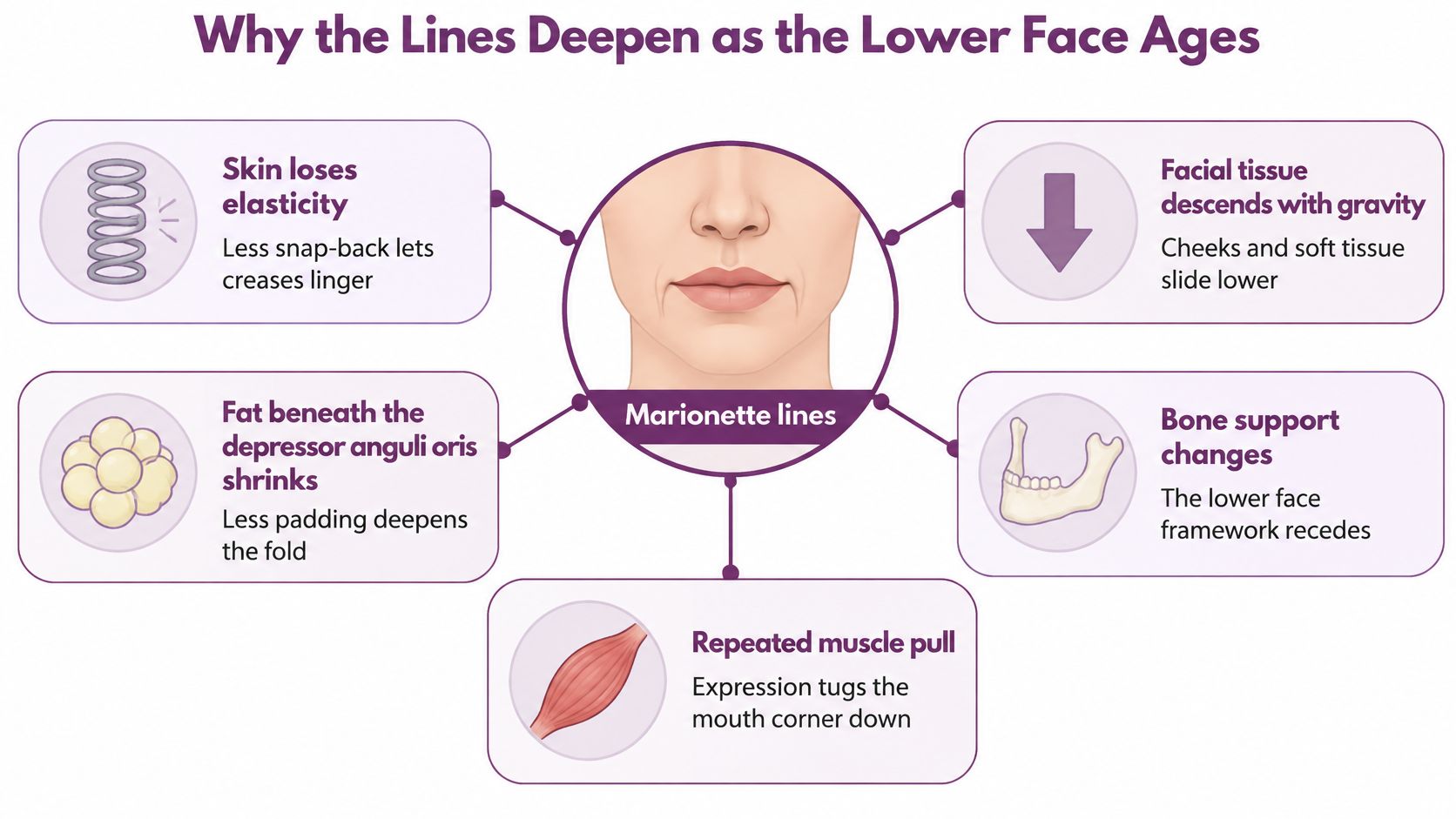
The fold isn't one change wearing a crease. It's five changes stacked from the surface down to bone, and they arrive at different speeds. A review of lower-face anatomy and rejuvenation planning lists them plainly: reduced skin elasticity, descent of facial tissues, loss or displacement of fat beneath the depressor anguli oris, mandibular ligament tethering, and resorption of the underlying facial bone.
The diagram below shows how those five forces converge on one crease.
Skin, fat, and the slow slide downward
Start at the surface. Skin with less collagen and elastin doesn't snap back, so a crease that faded by mid-morning at 35 is still there at dinner at 50. Skincare won't restructure a fold, but it's the cheapest lever on the surface quality that makes one look sharper, and a routine built on affordable retinol and vitamin C swaps covers the two ingredients with the most evidence behind them.
One layer down, gravity does its work. Cheeks and soft tissue slide lower, and the fat beneath the depressor anguli oris thins or shifts, so the mouth corner loses the padding that once held it out. That shift is one form of facial volume loss, and it changes the shape of the corner rather than only the line beside it.
Two hooks decide where the fold lands
Anatomy gives the crease two fixation points. Above, the cutaneous insertion of the depressor anguli oris anchors it, and below, the mandibular ligament tethers it. Tissue sliding past those fixed points bunches into a groove, which is why the line runs where it does instead of wandering across the cheek.
The bone underneath changes too. The maxilla and mandible resorb with age, so the shelf supporting everything above it shrinks. A curtain hung on a rod that's slowly retracting, caught on two hooks and sagging between them, is close to what's happening.
Muscle sits on top of all of it. The depressor anguli oris pulls the corner down, the platysma adds downward and lateral traction, and the mentalis shapes the chin. During speech and expression those muscles make the fold obvious, while volume loss and descent are what turn a passing crease into a line that stays put at rest.
Why the mouth corner matters
At the corner sits the modiolus, a fibromuscular knot where several muscles converge. Its position, and how it changes with age, influences how far the commissure droops and which way the wrinkle runs. The prejowl sulcus and early jowls usually deepen on the same timeline, which is the giveaway that you're looking at broader lower-face aging rather than a lone surface defect.
Filling the visible groove and nothing else can leave the area heavy when descent, not emptiness, is the main problem.
Match the Cause to the Right Approach
Marionette lines are not automatically a filler problem. The crease sits over muscle and nearby facial vessels, while changes in fat, ligaments, and bone can also shape its depth. Matching the approach to the cause matters: filler, a neuromodulator, threads, skin care, or another plan may be relevant in different situations.
| Main driver | Clue at the mirror | Approach that may fit |
|---|---|---|
| Volume loss under the corner | Hollow crease at rest that looks less deep when tissue is gently supported | Conservative hyaluronic acid filler in selected planes |
| Downward muscle pull | Corners drop more while talking or frowning than at rest | Neuromodulator to the depressor anguli oris, sometimes with filler |
| Tissue descent and early jowl | Fold continues into a prejowl sulcus with mild to moderate laxity | Supportive threads or a nonsurgical lift plan for suitable candidates |
| Advanced skin and tissue laxity | Heavy fold and jowl that filler would only make fuller | Surgical discussion rather than repeated crease filling |
| Loose or crepey skin without a deep hollow | Long surface line and thin skin, little empty space to fill | Skin-quality care or tightening, not high-volume filler |
| Lost bony or ligament support | Chin looks less projected and the lower fold feels tethered | Assessment of chin projection and ligament region before treating the crease |
Why the crease has to be read as a map
The visible line gives a clue, but anatomy beneath it helps explain why treatment must be chosen carefully. In an ultrasound study of 80 perioral regions, the depressor anguli oris sat directly beneath the marionette line in 100% of the cases examined. The line's projection across the skin split the muscle into medial and lateral portions, as described in the Aesthetic Surgery Journal ultrasound analysis. The crease marks an area over muscle and nearby facial vessels, so the underlying structures need to be respected during treatment.
The rows you can spot in the mirror
Volume loss appears as a hollow that is visible at rest and softens when you gently support the tissue beside it. That pattern may respond to a small, conservative amount of hyaluronic acid filler in selected planes. Adding more product over repeated sessions is not automatically the answer; the hollow must be the main cause.
Muscle pull changes with expression. The mouth corner drops more while you speak or frown, then sits closer to level when your face is relaxed. A clinician may discuss a neuromodulator aimed at the depressor anguli oris, alone or alongside filler. Because this muscle also contributes to mouth movement, the goal has to account for normal smiling, speaking, and eating.
Descent shifts the discussion from replacing volume to supporting tissue. When the crease continues into a prejowl sulcus and a soft jowl, the lower-face tissues may have moved downward. Mild to moderate laxity may make thread support or a nonsurgical lift worth discussing, while advanced laxity calls for a surgical conversation.
Practical rule: treat the driver you can demonstrate, not the line you can see.
The rows that change the plan
Crepey skin without a deep hollow is a poor target for high-volume filling. Long surface lines on thin skin may be better addressed with skin-quality care or tightening. At home, a simple routine that includes natural wrinkle-care shower steamers can support hydration, though it does not replace an assessment of the crease's cause.
Lost bony or ligament support is another clue to consider. A chin that looks less projected, or a lower fold that feels tethered rather than hollow, points toward the underlying frame. In that situation, chin projection and the ligament region deserve assessment before the crease itself is treated.
Very early changes may call for observation, sun protection, and a basic skin-care routine. Choosing among the other approaches requires an in-person examination of facial movement, tissue support, and the mouth-corner knot. A photograph can show the crease, but it cannot show how the tissues move or feel.
How Dermal Fillers Soften the Crease
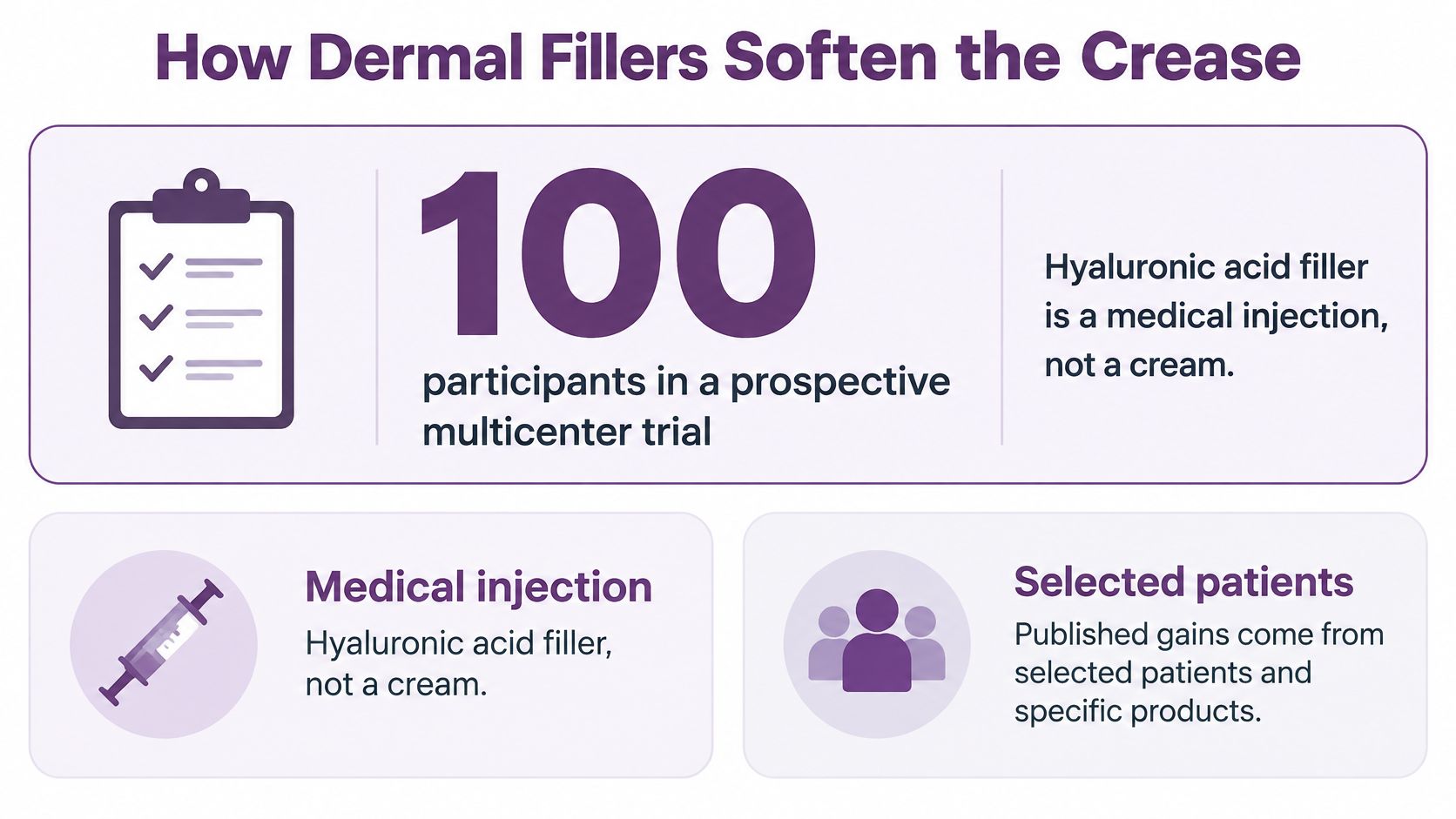
Hyaluronic acid filler is a medical injection, not a cream, and the published numbers come from selected patients treated with specific products. Published evidence tracks two things at once: the resting dent and the way the fold behaves in motion. In a prospective multicenter trial of 100 subjects using a cross-linked hyaluronic acid filler at 25 mg/mL with 0.3% lidocaine, the marionette-line success rate was 94.4% at 3 weeks after one session with no touch-up, and 88% still met the study's success criterion at 18 months, per the published trial and dynamic assessment of hyaluronic acid filler.
A companion three-dimensional assessment in the same report compared 30 women aged 41 to 65 who had moderate-to-severe lines with 20 untreated women aged 25 to 35. The older untreated participants showed significantly greater fold stretch during expression (p ≤ 0.05), and after filler the peak strain dropped across tested expressions toward the younger profile.
Here's the scale of that evidence before the technique.
The goal isn't a filled groove
Those findings point to an aim narrower than most marketing suggests. The objective is to ease the resting depression and the abnormal stretch together, while the mouth still moves the way it did before. Filler placed superficially, or in volumes meant to erase the line entirely, can look heavy beside a mouth that has to keep moving.
Durability and reversibility
How long a result lasts depends on the product, the amount used, how quickly you metabolize it, and how much the area moves; a mouth corner moves constantly. Hyaluronic acid has one practical advantage over structural alternatives. It can often be adjusted or dissolved if the shape is wrong, which is a smaller commitment than surgery and a different kind of decision.
None of it works if the diagnosis is wrong. A consultation has to confirm that volume, rather than sagging alone, is driving the line before anyone agrees to fill it.
When Threads or Muscle Treatment Fit Better
Not every line responds to volume. Some need the muscle eased, some need tissue lifted, and some need the whole lower face planned together. These are the options that sit outside a filler-only plan, each with a real candidate limit.
When the corner drops with expression
If the fold sharpens while you talk and fades when you stop, the depressor anguli oris is doing much of the work. A neuromodulator such as Botox or Xeomin may be considered to soften that pull; both are FDA-approved injectables that temporarily reduce the appearance of moderate to severe dynamic facial lines. Doses near the mouth are small and deliberate, because the same muscles handle speech, eating, and a natural smile. A flattening smile is a complication of overtreatment, not a goal.
When tissue has loosened rather than hollowed
A PDO thread lift works on a different problem, which is why the two approaches get compared so often; the thread lift vs fillers comparison sets out where each belongs. Absorbable polydioxanone threads are placed beneath the skin into the subcutaneous tissue using fine needles or cannulas, with a local anesthetic used to keep you comfortable, and they give immediate support to areas where skin has begun to loosen.
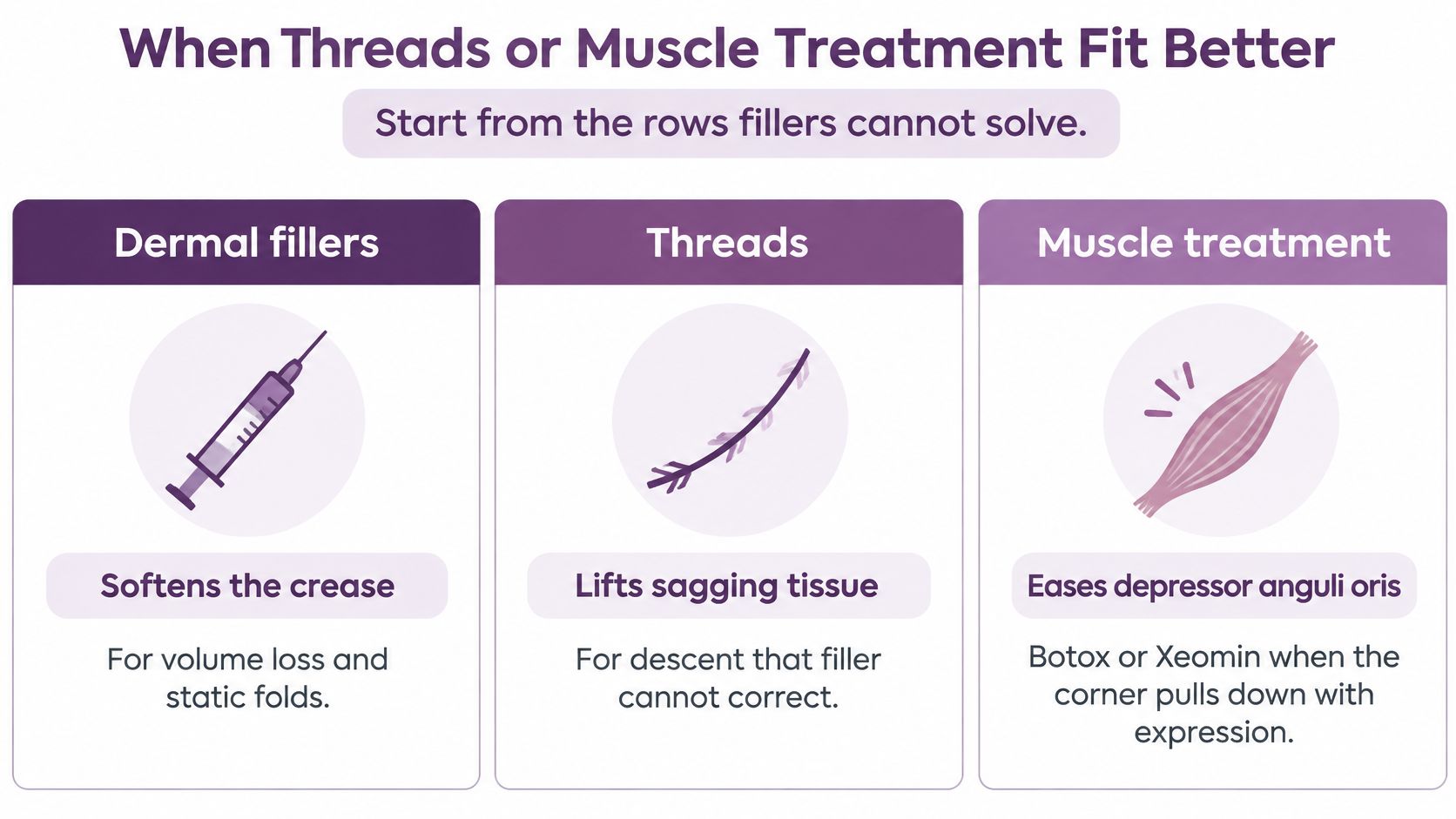
A lifting effect may be noticeable shortly after treatment, with results continuing to develop over the following weeks and months as swelling resolves and collagen production increases. A typical procedure takes 15 to 30 minutes, depending on how many areas are being addressed. The candidates who do best generally have mild to moderate skin laxity and realistic expectations about what a minimally invasive procedure can achieve.
Swelling, tenderness, tightness, minor bruising, or soreness around the treated areas can follow, and aftercare instructions cover when exercise and facial treatments can resume safely. Longevity varies with age, skin quality, degree of laxity, lifestyle, area, and the number and type of threads used.
When the whole lower face needs a plan
For a broader refresh, a nonsurgical facelift approach can combine volume restoration, wrinkle softening, and skin tightening without surgery. For some patients, combining PDO threads with dermal fillers, neuromodulators, or other skin rejuvenation procedures can produce a more balanced result than any single method alone.
Threads don't replace a facelift when laxity is advanced, and they aren't the answer to crepey skin with no descent; energy-based tightening or skin-quality care does more there. Bring the mirror clue and both photos to a consult rather than stacking treatments on your own.
Realistic Improvement and Warning Signs
A softer line is a real result. Erasure, permanence, and zero downtime are marketing. The distinction matters most when you're reading a consent form and deciding what you'd accept.
A prospective study of a hyaluronic acid filler formulated for marionette lines reported that 69.9% of 83 completed participants reached at least a one-point improvement on the Allergan Marionette Line Scale at one month, and the treatment was well tolerated, as summarized in a 2025 systematic review of facial wrinkle-filler evidence. One point on a validated scale means a visible change, not a blank lower face. That same review, spanning 38 articles and 3,967 participants, logged 8,795 complications across facial wrinkle-filler studies. Most were mild and self-limited, though persistent nodules and vascular complications did occur.
The table below separates ordinary healing from the findings that need a call or an emergency department.
| What you notice | What it usually means | What to do |
|---|---|---|
| Mild swelling, bruising, or tenderness for days | Expected tissue response | Follow aftercare and call if it worsens instead of easing |
| Uneven look in the first days | Often swelling rather than the final shape | Wait for swelling to settle before adding product |
| About a one-point softer line, not a blank lower face | Typical study-level improvement | Discuss a touch-up or a combined plan if the goal needs more |
| Heavier fold after repeated filler | Volume was added to a descent problem | Stop stacking filler and reassess support or surgery |
| A lump that remains after healing | Uncommon nodule or product collection | Return for evaluation; don't massage or treat it yourself |
| Severe pain, skin color change, or vision change | Possible vessel blockage | Seek emergency care immediately |
If you're weighing options, non-surgical facelift before and after results show a range of outcomes rather than one idealized photo, which is a better reference point for setting expectations.
The rare risks, named precisely
Facial filler can enter a blood vessel. The FDA's dermal filler safety information states that intravascular injection may cause embolization, vessel occlusion, ischemia, or infarction, and reported serious complications include temporary or permanent vision impairment, blindness, cerebral ischemia or hemorrhage leading to stroke, skin necrosis, and damage to underlying facial structures.
Timing is the part people don't expect. In the vision-impairment cases the FDA summarizes, symptoms began immediately in 58% (53 of 92) and within 1 to 24 hours in another 20% (18 of 92). That window is why severe pain, a change in skin color, or any change in vision after an injection means emergency care, not a message to the office the next morning.
Ask what happens if you dislike the result. Hyaluronic acid has an exit; threads and surgery mostly don't, which is a reason to be conservative with the irreversible options first. Consent and an injector who knows perioral vessels are part of the treatment, not paperwork around it.
Plan Treatment at a Facial Consultation
Bring a diagnosis, not just a wish. Your two photos tell a clinician where to start, and the answers decide which conversation you're having.
- Faint and only dynamic: ask about observation, skin care, or a cautious neuromodulator before any filler.
- A hollow is the main finding: ask whether a small hyaluronic acid correction could soften it, and how much is enough.
- Mild to moderate laxity: ask whether PDO threads, filler, a neuromodulator, or a nonsurgical facelift combination fits, since some patients do better with more than one method.
- Heavy jowls: ask whether injectables would only add weight.
At Luxe Aesthetic Surgery & Medical Spa, Medical Director Haimesh Shah, MD, RPVI, a board-certified physician specializing in cosmetic surgery and phlebology, leads individualized planning. During the consultation, the team evaluates facial anatomy, skin quality, and aesthetic goals to determine whether PDO threads or another facial rejuvenation treatment is best. Monthly payment plans are available for surgical procedures, injectables, skin rejuvenation, and other treatments, so the full fee isn't required upfront.
Finding a provider is its own filter. Directories blend medical spas with unrelated businesses, so it helps to distinguish facial services from workspace listings before you book anything.
Bring photos at rest and smiling, your health history, the dates of any prior filler or thread treatment, and one sentence describing the result you want. Results vary, and no plan is guaranteed. Patients in Los Angeles, Santa Barbara, and Ventura counties can request a consultation directly.
Luxe Aesthetic Surgery & Medical Spa treats lower-face aging as a diagnosis before it becomes a treatment plan, so the recommendation matches your anatomy instead of a default syringe. Whether your marionette lines call for a conservative filler correction, a neuromodulator, a PDO thread lift, or a combined nonsurgical facelift approach, the team led by Medical Director Haimesh Shah, MD, RPVI builds the plan around what's driving the fold. Request a consultation at Luxe Aesthetic Surgery & Medical Spa to find out which cause is behind your lines.