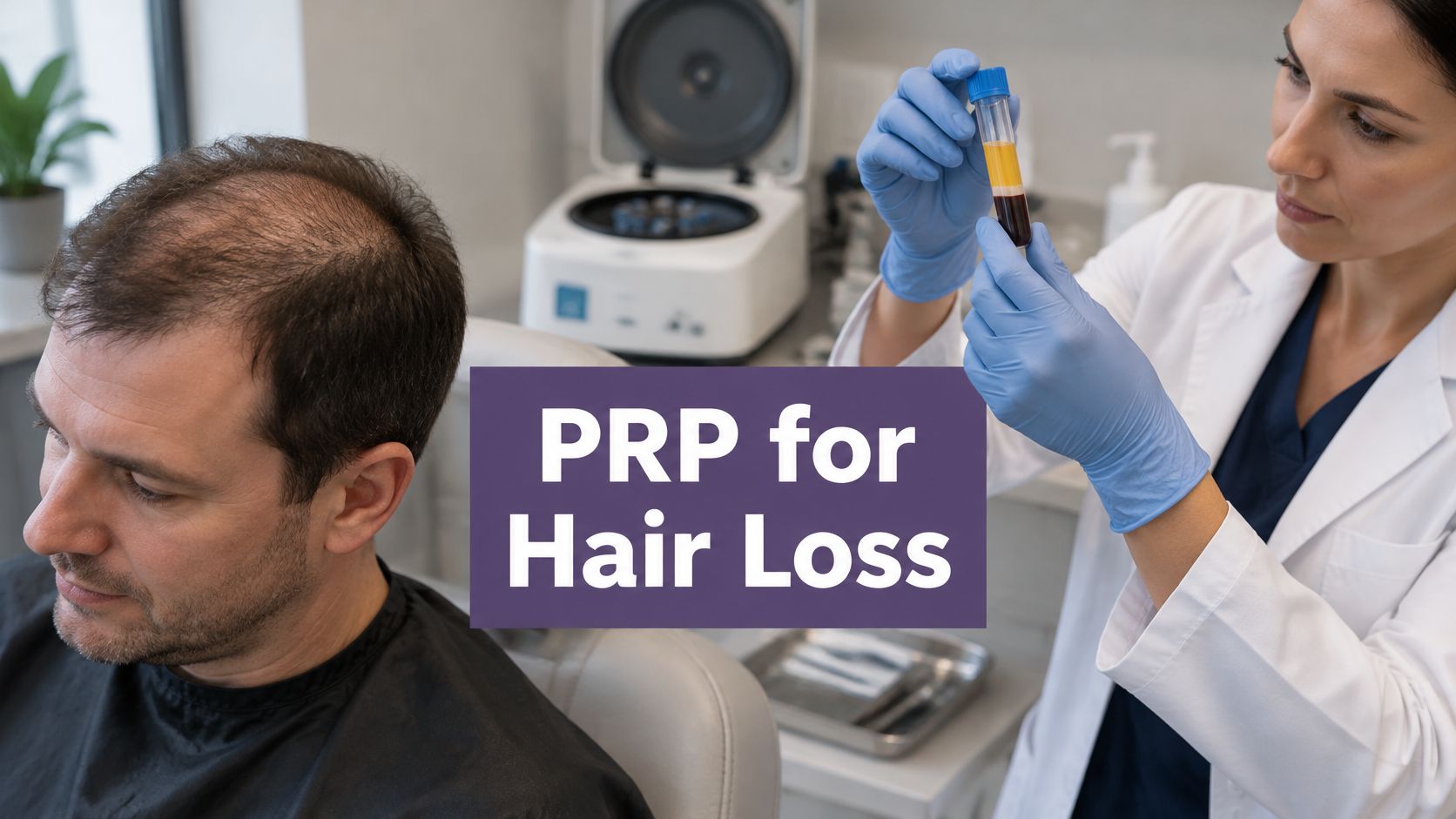
Medical Expertise at Luxe Aesthetic Surgery
Luxe Aesthetic Surgery & Medical Spa is led by Haimesh Shah, MD, RPVI , a physician specializing in cosmetic surgery, body contouring, laser procedures, and venous medicine. Dr. Shah is a Diplomate of the American Board of Laser Surgery, American Board of Venous & Lymphatic Medicine, American Board of Wound Management, and American Board of Internal Medicine. He also holds the Registered Physician in Vascular Interpretation (RPVI) credential and has contributed to peer-reviewed medical research.
The most useful number in the PRP conversation isn't a regrowth percentage. In a 2024 systematic review and meta-analysis of randomized trials for androgenetic alopecia, pooled results favored platelet-rich plasma by an average of 27.55 hairs per cm², yet statistical heterogeneity reached I² = 95.99% and the authors rated the certainty of the evidence as low. Read that pairing carefully: a real average benefit, sitting on top of studies that disagreed with each other almost as much as studies can disagree.
That's the honest frame for PRP for hair loss. It's an injection series made from your own blood, it can improve measured hair density for some people with pattern thinning, and it isn't a cure, a substitute for diagnosis, or a replacement for maintenance medication.
Table of Contents
- Does PRP Regrow Hair? What the Density Studies Show
- Who Is a Candidate and What Is Causing the Loss
- PRP Versus Minoxidil as an Add-On or First Step
- How a PRP Session Works, From Blood Draw to Injection
- How Many Sessions Are Typically Needed
- Side Effects and How Long Results Take
- Decide Whether to Book a PRP Evaluation
Does PRP Regrow Hair? What the Density Studies Show
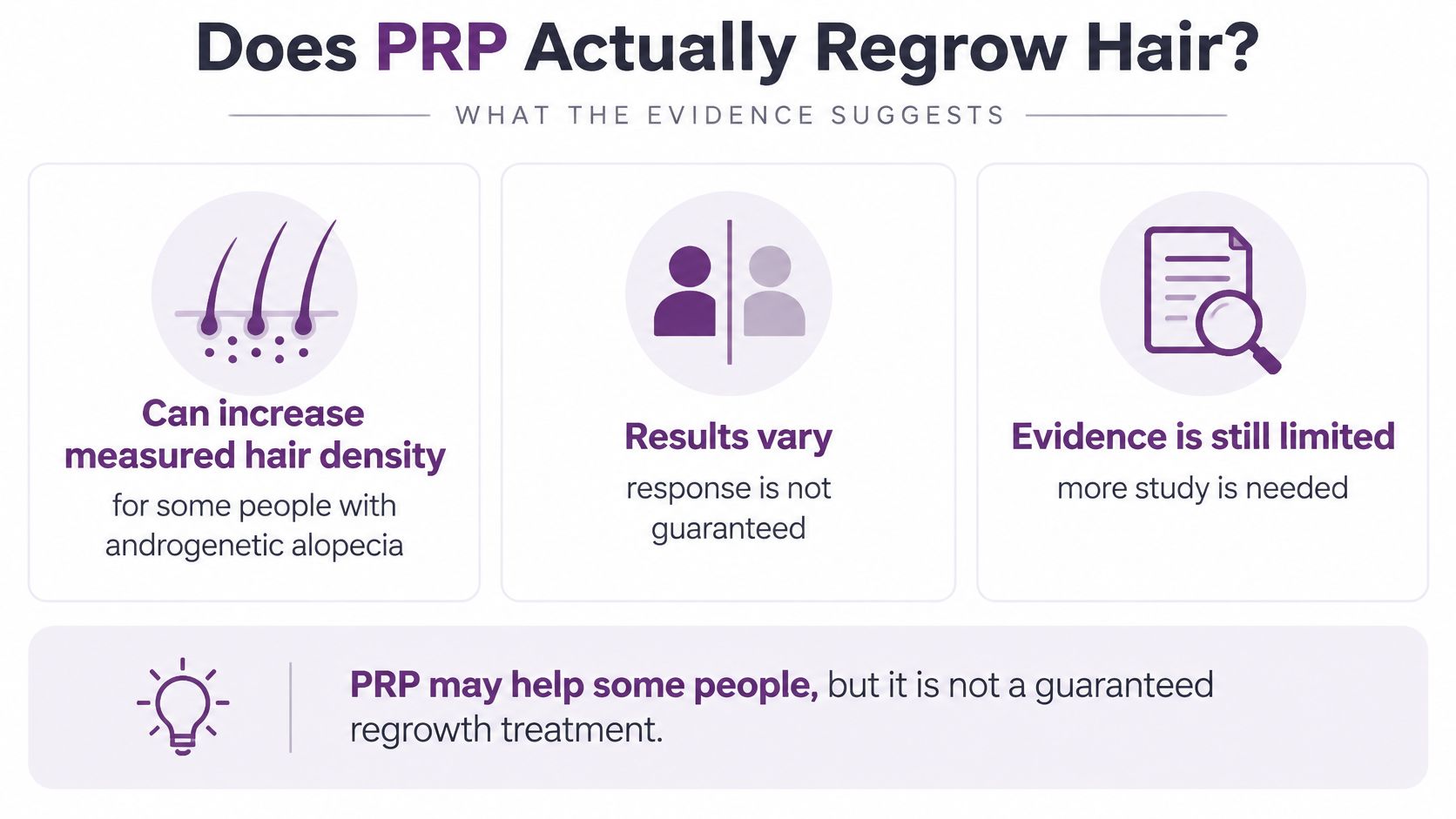
PRP can raise measured hair density for some people with androgenetic alopecia, but the size of that gain varies and the evidence base is still limited. Before the numbers mean anything, it helps to know what is being counted. Hairs per square centimeter is exactly what it sounds like: a count taken inside a small marked window on the scalp, roughly the area of a pencil eraser, usually with a dermatoscope or a tattooed reference dot so the same spot gets counted again at follow-up. A gain of 25 hairs in that window is meaningful under magnification. It isn't a full head of hair, and it won't necessarily show in a bathroom mirror.
Key PRP hair density studies and what they found
| Study | Participants | Hair density result | Key limitation |
|---|---|---|---|
| 2017 meta-analysis | 6 controlled studies, 177 patients | +17.90 hairs/cm² vs control (95% CI 5.84 to 29.95) | Small samples and inconsistent protocols |
| 2021 systematic review | A broad pool of controlled trials across two diagnoses | Trials split between androgenetic alopecia and alopecia areata, with no single pooled density figure | Mixed conditions and varied protocols |
| 2023 meta-analysis | 10 randomized trials, 318 participants | +25.09 hairs/cm² (95% CI 9.03 to 41.15) | Hair diameter not significantly improved |
| 2024 meta-analysis | 14 studies, 431 patients (13 pooled) | +27.55 hairs/cm² pooled advantage (I² = 95.99%) | Certainty of evidence rated low, with very high heterogeneity |
| 2025 meta-analysis | 18 prospective controlled studies, 883 participants | +28.4 hairs vs placebo or control | Heterogeneity of 94.4%, plus device and preparation differences |
Read the table top to bottom rather than fixating on one row. Early work pooled a handful of small studies. Later reviews gathered far more trials, and the average density advantage grew as the sample grew. Consistency is the part that never improved: the same "PRP" label covered different centrifuge settings, platelet concentrations, injection schedules and measuring techniques. A heterogeneity figure near 95 percent means the pooled averages rest on trials that disagreed sharply with one another, so two clinics offering "PRP" may be delivering meaningfully different treatments under one name.
Density is not the same as thickness
That same 2023 meta-analysis reported a pooled mean difference of 25.09 additional hairs per square centimeter (95% CI 9.03 to 41.15, p = 0.002), with the effect more pronounced in male participants. Hair diameter told a different story: the standardized mean difference was 0.57 (95% CI −0.23 to 1.38, p = 0.16), which isn't statistically significant. More hairs counted inside the window doesn't establish that each hair grew thicker.
A pooled average describes a group of study participants. It doesn't predict your scalp, and it can't tell you how long a response lasts.
The defensible expectation stays modest: possible improvement in measured density, unsettled durability, no agreed best protocol. Judge any course of treatment with standardized photographs and repeat counts at a fixed interval rather than a promised percentage.
Who Is a Candidate and What Is Causing the Loss
The most studied case is androgenetic alopecia, the inherited pattern thinning that widens a woman's part and recedes a man's temples and crown. Under magnification, its signature is miniaturization: the follicle is still alive and still producing hair, but each shaft grows back finer and shorter than the one before. A regenerative signal needs living follicles the way fertilizer needs roots already in the ground. A long-standing, smooth, shiny patch is a different problem, because advanced follicular loss leaves little behind to stimulate.
Cause comes before injection, every time. A 2025 review of PRP for hair loss reported statistically significant improvements in hair density and count with generally mild adverse effects, while cautioning that results are hard to compare across clinics because platelet concentration, centrifugation, activation, injection technique, treatment interval and outcome measurement all differ. The same review draws the candidacy line plainly: thinning with miniaturized but viable follicles is one situation, advanced follicular loss is another, and inflammatory or scarring conditions call for diagnostic evaluation before any cosmetic injection.
Hair loss causes and how PRP evidence applies
| Cause of hair loss | PRP evidence | Clarify first |
|---|---|---|
| Androgenetic alopecia | Most studied, with several meta-analyses | Diagnosis, then whether PRP is an add-on to minoxidil or finasteride |
| Alopecia areata | Some trial evidence, though the pool is smaller than for pattern loss | Specialist diagnosis and immune context |
| Scarring alopecia | Not the focus of PRP trials | Diagnostic evaluation before any cosmetic injection |
| Postpartum shedding | Limited, since evidence centers on androgenetic alopecia | Whether shedding is still active and likely to resolve |
| Thyroid-related or medication-related loss | Not the focus of PRP trials | Treat the underlying cause first |
How the cause gets sorted out in clinic
History does most of the work. Abrupt, diffuse shedding that began weeks after an illness, a surgery, a crash diet or childbirth points toward telogen effluvium, which often settles once the trigger passes. Injecting that scalp would hand the credit for natural recovery to the needle. A gradually widening part with miniaturized hairs on trichoscopy points toward pattern loss. A scalp examination, a careful medication review and basic laboratory work are the usual companions to that history, and they cost far less than a course of injections aimed at the wrong diagnosis.
Supplements come up in almost every consultation, and they deserve a review of their own rather than a dismissal. An overview built to help readers compare hair loss supplements for men can be a reasonable starting point for a conversation with your physician about which ingredients have evidence behind them and which do not.
Before any scalp injection is planned, a sound assessment covers:
- Diagnosis and dermoscopic assessment: name the condition, not just the symptom.
- Baseline standardized photographs: same lighting, same parting, same angles.
- Bleeding review: anticoagulants, antiplatelet medicines and known bleeding disorders.
- A written protocol: preparation method, session count and spacing.
- An outcome timeline and stopping rule: when density gets measured, and what counts as no response.
PRP Versus Minoxidil as an Add-On or First Step
Two different questions get tangled together here: is PRP better than minoxidil, and is PRP useful on top of minoxidil? The evidence answers them differently, and the answer changes what you should buy first.
PRP instead of a first-line medication
Head-to-head, PRP hasn't earned the substitution. A 2023 randomized controlled study of 64 participants reported that at week 24, 38% responded to PRP compared with 56% in the minoxidil group. A 2025 systematic review and meta-analysis pooling randomized trials reached a similar conclusion, finding no clear PRP advantage over topical minoxidil for hair density, terminal hair count or moderate-to-high regrowth. When a first-line topical already holds the stronger comparative record, replacing it with an injection series needs a specific clinical reason rather than a preference for something "natural." At Luxe, medical treatment options for hair loss are discussed in that order: confirm the diagnosis, establish first-line therapy where it's indicated, then weigh adjuncts after an in-person evaluation.
PRP plus a first-line medication
The add-on case looks better. A 2024 meta-analysis of comparative studies found that combining PRP with minoxidil produced larger gains in hair density and hair-shaft diameter than either treatment used alone. Read alongside the head-to-head data, that pattern places PRP alongside first-line medication rather than in front of it. The framing to carry into a consultation is simple: PRP earns its keep as a second layer on therapy that is already working, and its value rises or falls with the quality of the diagnosis, the preparation and the protocol underneath it.
A workable decision rule to apply with your clinician:
- Start with the proven first-line medication if the diagnosis supports it, and give it months of consistent use.
- Add PRP when you want more density than medication alone is delivering and your expectations are modest and measurable.
- Keep maintenance therapy in place unless your clinician identifies a clear reason to change it, because stopping a maintenance medication usually lets the underlying loss resume.
Nutraceuticals sit in a third category, and readers often ask where they belong. Product pages such as the one for Nutrafol Women hair growth capsules from Supplemynts Inc. show what's in a formula, which is useful for reviewing ingredients with your physician, though a supplement label isn't evidence of regrowth and doesn't replace a diagnosis or a first-line treatment.
How a PRP Session Works, From Blood Draw to Injection
PRP works like a reduction sauce. Two kitchens can start with the same ingredient and end with very different textures, strength and balance, depending on how far it is reduced and how carefully it is handled. The same applies to platelet-rich plasma. The label tells you almost nothing about what is in the syringe.
The biology is dose- and preparation-dependent. According to a technical review of PRP preparation in aesthetic practice, concentrated platelets release alpha-granule mediators, including growth factors, after activation, which may support dermal-papilla signaling, perifollicular angiogenesis and the transition of miniaturized follicles toward the anagen growth phase. That review also notes that protocols differ in centrifugation force and duration, anticoagulant, activation with calcium or thrombin, platelet concentration, injected volume and delivery depth.
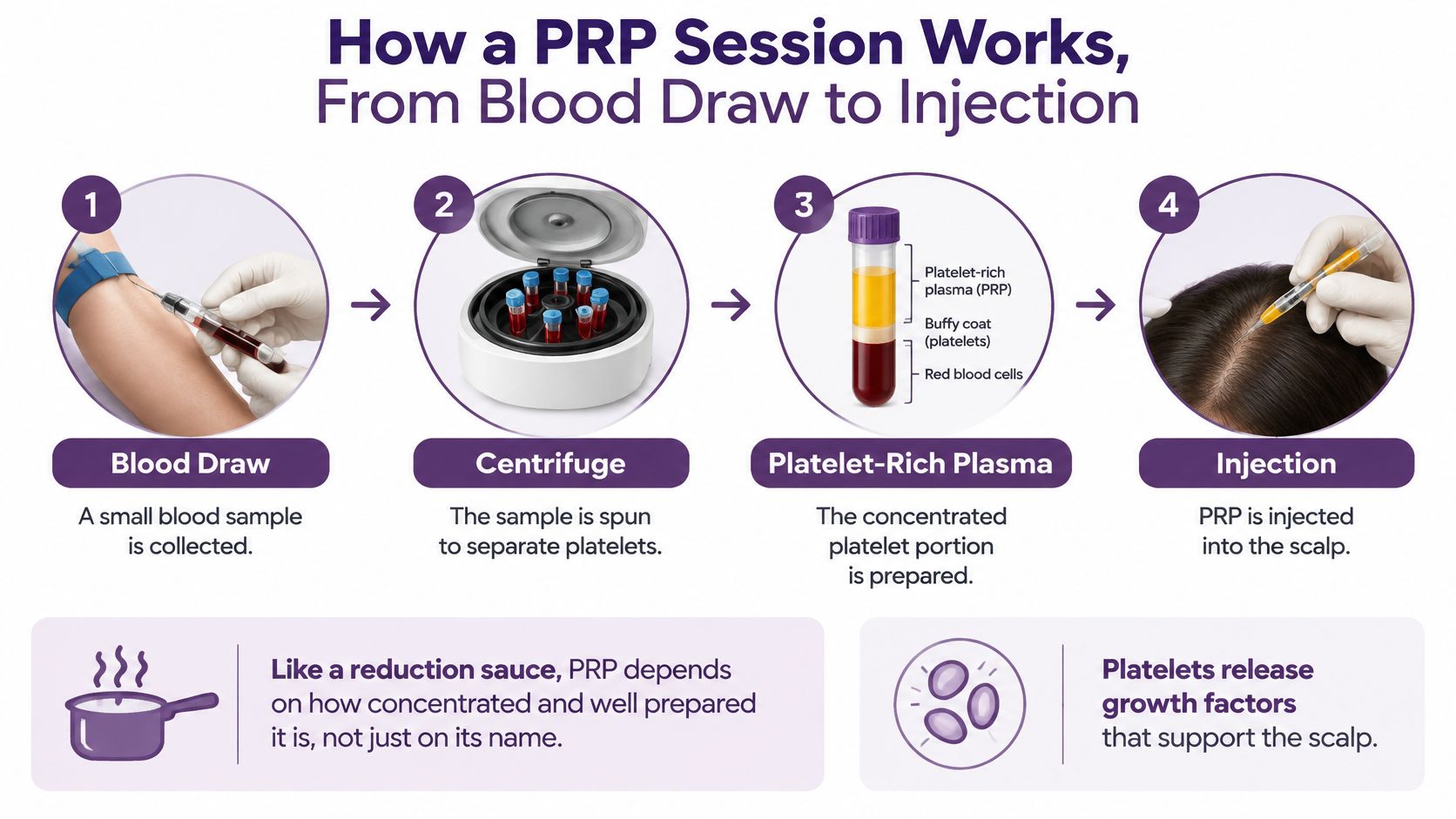
The session, step by step
- Consultation and diagnosis. Confirm what's causing the loss before anything is drawn, since the evidence applies mainly to pattern thinning.
- Baseline documentation. Standardized photographs and a hair-density count in a marked window, so later comparisons mean something.
- Blood draw. A small sample from a vein in your own arm, collected into an anticoagulant tube in a way that follows the preparation protocol.
- Centrifugation. The spin separates red cells from plasma and concentrates the platelet layer, which is the fraction that gets collected.
- Preparation and activation. Some protocols activate with calcium, others with thrombin, others not at all. That choice changes what gets released and when.
- Numbing and injection. Topical anesthetic or a local block comes first, then a grid of small injections into the deep dermis or scalp subcutaneous tissue at depths around 1.5 to 2.5 mm, as described in a clinical trial of PRP for pattern hair loss.
- Aftercare and follow-up. Written instructions for washing, heat and exercise, plus a booked review date rather than an open-ended "call if you notice anything."
How Platelet Concentration Changes the Result
A technical review of PRP preparation in aesthetic practice describes approximately 3 to 5 times baseline platelet concentration as a practical goal. The same review explains why the number matters: platelet dose can influence inflammatory signaling and growth-factor release, while preparation methods change the final product. That means two clinics using the word PRP may be offering treatments that look similar on a menu but behave differently in the scalp.
Ask for the numbers, not the brand: platelet concentration or fold enrichment, leukocyte content, activation method, injected volume per scalp area, and the treatment interval. A provider who documents those five things is giving you something you can compare.
How Many Sessions Are Typically Needed
A PRP course works a bit like an antibiotic course: the label stays the same, but the dose, interval and length are what define the treatment. A 2024 systematic review and meta-analysis of PRP protocols for androgenetic alopecia reported that most included studies used monthly scalp injections of approximately 0.1 to 0.2 mL of PRP per square centimeter, while one randomized study in that review used four sessions spaced three weeks apart and another used five sessions at two-week intervals. Across the regimens documented in the two reviews cited here, an initial series runs from two to six sessions at intervals of roughly two to three weeks, after which maintenance is set by what the follow-up measurement shows rather than by a fixed calendar.
Reported PRP hair-loss protocols and what each one involved
| Reported protocol | Sessions | Interval | Where it was reported |
|---|---|---|---|
| Monthly scalp injections, 0.1 to 0.2 mL per cm² | Ongoing monthly course | Monthly | Most common protocol across the 2024 systematic review |
| Four sessions | 4 | Every 3 weeks | One randomized study in the 2024 review |
| Five sessions | 5 | Every 2 weeks | Another randomized study in the 2024 review |
| Three sessions, then a fourth | 4 | Every 3 weeks, fourth 2 months later | Randomized clinical trial summarized in earlier review literature |
| Six injections | 6 | Every 3 weeks | Regimen described in an earlier systematic review |
| Four injections | 4 | Every 15 days | A second regimen described in the same earlier review |
| Two monthly sessions | 2 | Monthly | Comparative schedule reported in earlier research |
Seven rows, seven different courses, all sold under the same three-letter name. A result reported for five sessions at two-week intervals should not be assumed to transfer to two monthly sessions, because injected volume, preparation and technique shift along with the calendar.
Questions that make a plan concrete
Bring these to the visit and write the answers down:
- Which regimen are you planning, and why that one for my pattern and stage of loss?
- How many sessions does the quoted fee cover, and what happens if the follow-up measurement shows I need more?
- When is the first measurement, and will it use the same marked window, lighting and camera distance as the baseline photo?
We recommend a treatment schedule only after evaluating your scalp in person, and maintenance is discussed after the initial series based on the measured response rather than promised up front.
Cost follows the same variables. The total depends on the number of sessions, whether PRP is combined with microneedling, and what follow-up measurement is included, so ask for the price of the full course rather than the per-session figure. Monthly payment plans are available for injectables and other treatments, which makes it easier to weigh the course total against the ongoing cost of a first-line topical you would otherwise keep buying.
Side Effects and How Long Results Take
The reported effects are local and temporary. Across the controlled studies, the adverse effects described were pain, erythema, swelling, bruising or minor bleeding, and the pooled safety data did not show a statistically significant excess of side effects versus controls. That record is reassuring on paper, and needles, numbing agents and sterility still carry their own considerations, so screening and sterile technique remain part of what you are paying for.
Expected in the first days:
- Injection-site pain and tenderness, strongest early and easing after.
- Redness and mild swelling, including a tight feeling across the treated area.
- Bruising or pinpoint bleeding at individual injection points.
Reasons to contact us promptly:
- Swelling that keeps worsening instead of settling, or a firm lump.
- Pain that builds after the first couple of days rather than fading.
- Signs of infection such as spreading redness, warmth, discharge or fever.
- Bleeding that restarts or doesn't stop with pressure.
Judging progress in months, not weeks
Early sessions usually produce no visible change, and that is normal hair-cycle timing rather than failure. A follicle shifting back into growth works on a delay, the way a seed spends weeks under the soil before anything shows above it. Response is generally assessed after several months using standardized photographs or hair-density counts, because eyeballing your part in different bathroom lighting is unreliable. If you're also using microneedling as part of your plan, our overview of the benefits of derma roller treatment explains what that adjunct targets and how it differs from an injection series.
A response that fades after the series ends is still useful information. Follicles that improved while supported and thinned once treatment stopped are showing you the ceiling of a single course, which is what the maintenance discussion is for.
Durability is the weakest part of the picture. The included trials generally lacked long-term follow-up, so how long a response holds after the initial series isn't established, and maintenance sessions are a discussion rather than a promise. There's a practical trap here too: if you stop minoxidil in the same month your last PRP session lands, shedding that appears a few months later can't be credited to either change. Keep one variable steady while you judge the other.
Decide Whether to Book a PRP Evaluation
Book the diagnostic consultation before you buy a course of injections. PRP only makes sense once someone has named the cause of your loss, and a package purchased first tends to commit you to a treatment that may not match the diagnosis.
Come prepared, because the history is where the diagnosis usually surfaces:
- A timeline: when shedding started, how fast it's progressed, and any illness, surgery, childbirth or diet change in the preceding months.
- A full medication and supplement list, including any blood thinner or antiplatelet product.
- Known lab results, particularly thyroid testing and iron or ferritin.
- Scalp photographs from the past year, even casual ones, since they show progression your memory can't.
The visit itself should include a scalp examination with a dermatoscope, a review of the pattern of miniaturized hairs, and a straightforward discussion of whether a first-line medication, PRP, or both fit what's found. One appointment should answer everything below, so ask these questions out loud at any provider:
- What cause do you suspect, and how did you reach it?
- What does the evidence say for my specific pattern and stage of loss?
- What protocol do you plan, and how many sessions does the quoted fee cover?
- When will density be measured, and what change would count as a response?
- What would make you stop the plan instead of extending it?
Luxe Aesthetic Surgery & Medical Spa is a cosmetic surgery and medical aesthetics practice serving Los Angeles, Santa Barbara and Ventura counties in Southern California. Dr. Shah is a Registered Physician in Vascular Interpretation (RPVI) and serves as medical director. He meets each patient to discuss their goals, then creates a customized treatment protocol to suit those goals, and the team recommends a treatment schedule only after evaluating you in person. Candidacy for PRP is confirmed at that consultation, which is also where you can learn how the practice's hair restoration services fit your diagnosis. If cost is a factor, monthly payment plans are available for injectables, skin rejuvenation and other treatments, so ask what the quoted fee covers and how payment can be spread.
If your part is widening or your crown is thinning, the most valuable next step at Luxe Aesthetic Surgery & Medical Spa is a hair loss evaluation that names the cause before anyone talks about injections, followed by an individualized plan that may combine first-line medical treatment with PRP where it fits. We'll document baseline photographs, explain the protocol and session count in plain terms, and set a measurement date so you can judge the result yourself. Visit Luxe Aesthetic Surgery & Medical Spa to request a consultation at the Southern California location most convenient for you.