Medical Expertise at Luxe Aesthetic Surgery
Luxe Aesthetic Surgery & Medical Spa is led by Haimesh Shah, MD, RPVI , a physician specializing in cosmetic surgery, body contouring, laser procedures, and venous medicine. Dr. Shah is a Diplomate of the American Board of Laser Surgery, American Board of Venous & Lymphatic Medicine, American Board of Wound Management, and American Board of Internal Medicine. He also holds the Registered Physician in Vascular Interpretation (RPVI) credential and has contributed to peer-reviewed medical research.
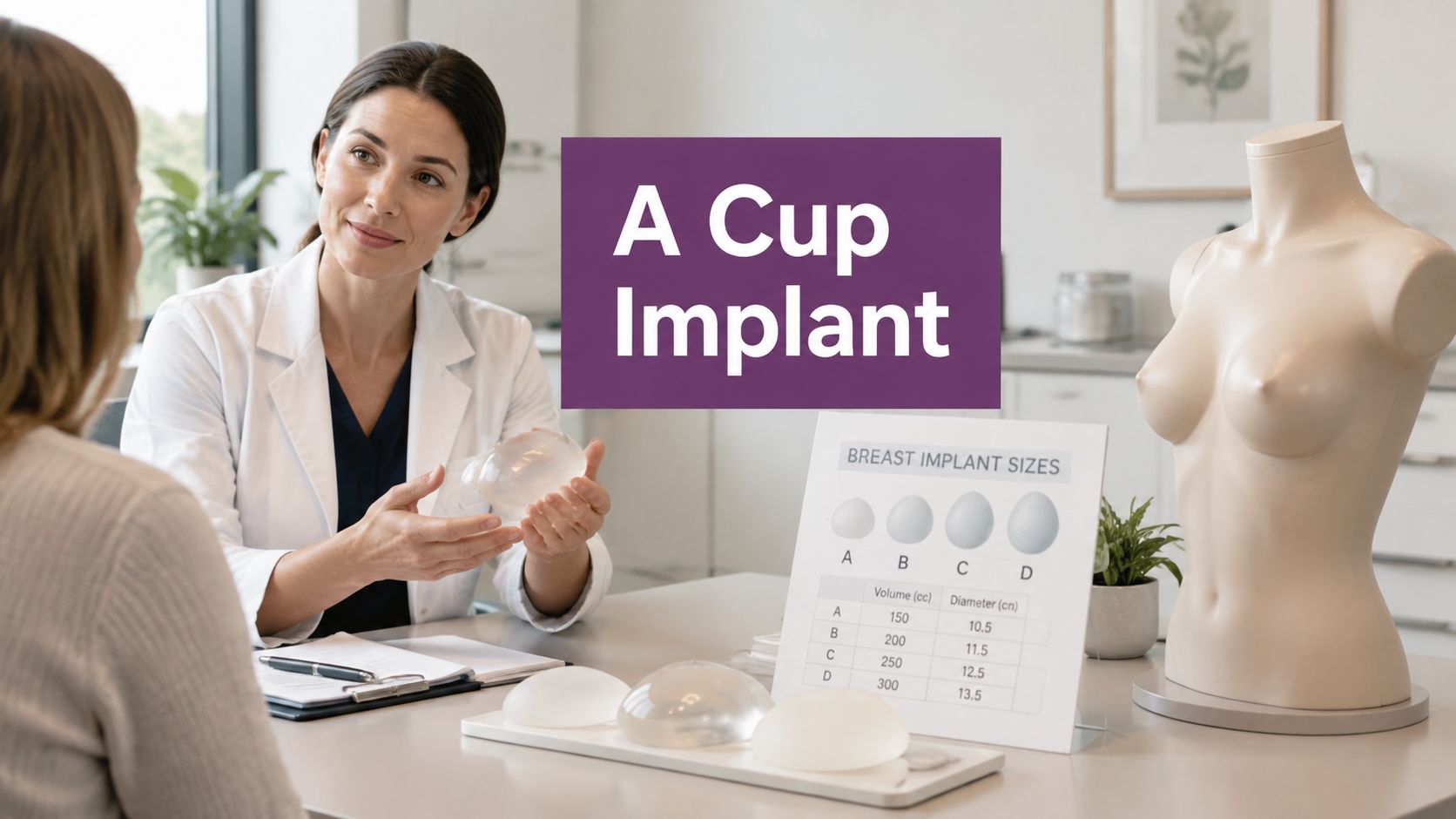
Have you ever wondered whether an A cup breast implant is a specific implant size? Many patients search for this phrase because they want a subtle enhancement, a little more proportion, or restoration of volume without changing their petite frame dramatically. The difficulty is that A cup describes a bra label, not a surgical measurement, and bra labels vary between brands, band sizes, and styles.
A patient beginning with a small breast volume may imagine that choosing the smallest available implant will automatically create an A cup result. Another patient may already wear an A cup but want more upper-pole fullness or a better fit in certain clothing. Those goals can require different implant plans, even when the starting bra size appears similar.
The more useful question is not, “Which implant guarantees an A cup?” It's, “What volume, width, profile, and placement fit my anatomy and create the amount of change I want?” This guide explains how surgeons think about small-volume breast augmentation, why the same implant can look different on different bodies, and how to approach consultation with realistic expectations.
Table of Contents
- Introduction What an A Cup Goal Really Means
- How Breast Implant Sizing Works in Cubic Centimeters
- Why the Same Implant Looks Different on Every Body
- What Volume Range Typically Aligns With an A Cup Result
- Common Misconceptions About Choosing a Very Small Implant
- How Surgeons Personalize an A Cup Implant Plan at Consultation
- Making a Confident and Proportionate Choice
Introduction What an A Cup Goal Really Means
An A cup goal can represent several different preferences. You may want a barely noticeable enhancement, a balanced shape after pregnancy or weight change, correction of breast asymmetry, or a result that remains understated in fitted clothing. Wanting a small change is a valid aesthetic choice, and it deserves the same careful planning as a larger augmentation.
The challenge begins with the word “cup.” Bra cup size depends on both ribcage circumference and breast volume, and cup sizing isn't standardized across manufacturers. A bra that fits as an A cup in one brand may not fit identically in another, which means a surgeon can't promise that a particular implant will produce one exact label. A medical source also explains why choosing an implant for a goal such as a 34C is difficult, because there's no universal standard for cup sizing. Read more about why cup size doesn't translate directly to implant volume.
The goal behind the label matters
Consider two patients who both describe themselves as an A cup. One has a narrow chest, very little natural tissue, and wants a discreet contour. The other has a wider ribcage, some existing breast volume, and wants visible cleavage while still looking proportionate. The same implant could create noticeably different results for these patients.
An A cup goal may also mean “I don't want to look dramatically larger,” rather than “I want to wear an A cup afterward.” That distinction is important. The ideal result may be a natural-looking breast shape that fits the patient's proportions, even if the postoperative bra label changes or varies by brand.
Practical rule: Bring your surgeon examples of the shape, projection, and overall proportion you like, not only a target cup letter.
Planning should therefore begin with your anatomy and your desired degree of visibility. Implant volume, base width, profile, existing tissue, skin quality, and implant placement all contribute to the final appearance. A consultation can turn a vague A cup request into a more precise conversation about subtle fullness, projection, symmetry, and lifestyle.
How Breast Implant Sizing Works in Cubic Centimeters
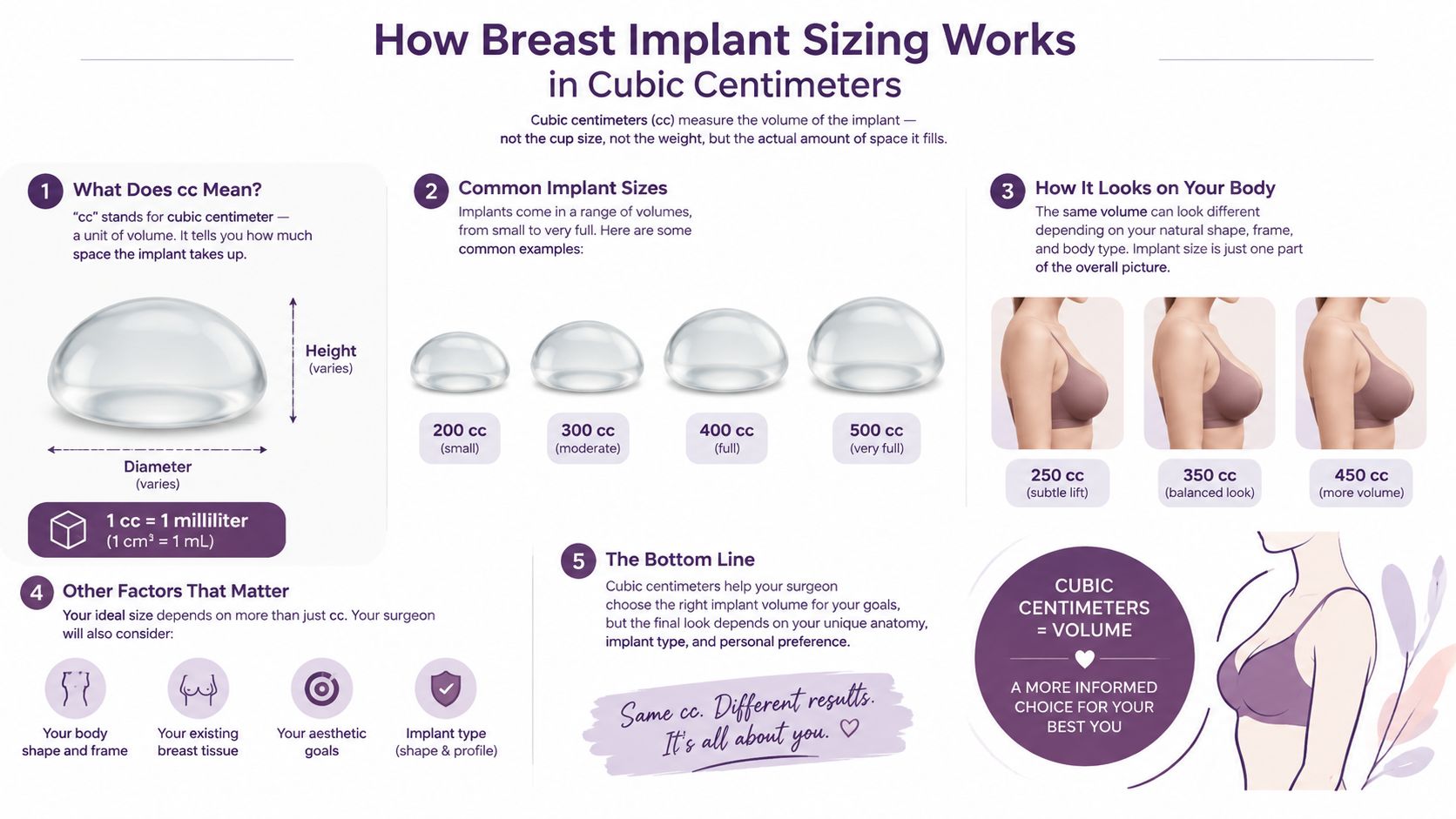
Breast implants are measured by volume in cubic centimeters, written as cc, rather than by bra cup size. This gives the surgical team a consistent measurement. Cup sizing changes with band circumference and manufacturer, while a specific cc volume represents the implant's physical capacity.
Think of cc as the amount of space the implant occupies. A smaller volume adds less material to the breast envelope, while a larger volume adds more. But volume alone doesn't describe the implant's shape. Two implants can contain the same amount of material and still have different widths and forward projection.
Why surgeons use cc instead of cup letters
A common clinical rule of thumb is that approximately 200 cc may increase breast size by about one cup, although the result varies with band size, chest width, tissue thickness, and implant profile. Another clinical reference places the usual estimate closer to 130 to 150 cc for roughly one cup-size increase, with narrower bands tending toward the lower end and wider bands toward the higher end. Review the clinical discussion of implant volume and cup-size change.
These figures are planning estimates, not guarantees. They help establish a shared language, but they can't account for every body. An implant that looks visibly full on a narrow chest may create a more restrained change when spread across a wider chest.
Common implant volumes span roughly 150 cc to more than 800 cc, while many patients choose volumes from 200 cc to 600 cc, depending on body frame and desired change. See an overview of breast implant sizing and volume ranges. For a modest enhancement, a patient may discuss a lower volume range. A more noticeable enlargement generally requires a greater volume, but the right choice still depends on the available tissue envelope and implant dimensions.
Shift the question from cup to volume
Instead of asking, “What cc is an A cup?” try asking:
- How much visible change do I want? Subtle shape improvement and noticeable cleavage aren't the same goal.
- How should the breast fit my frame? Chest width and ribcage proportions help define a suitable implant base.
- What kind of fullness do I prefer? A softer slope and pronounced upper-pole projection may require different profiles.
- What should happen if my breasts aren't identical? Different implant volumes may be considered when asymmetry is present.
For more background on implant choices beyond volume, you can read Luxe's guide to the different types of breast implants available for augmentation surgery. The key point is simple: cc gives the surgeon a measurable starting point, but anatomy determines how that volume is expressed.
Why the Same Implant Looks Different on Every Body
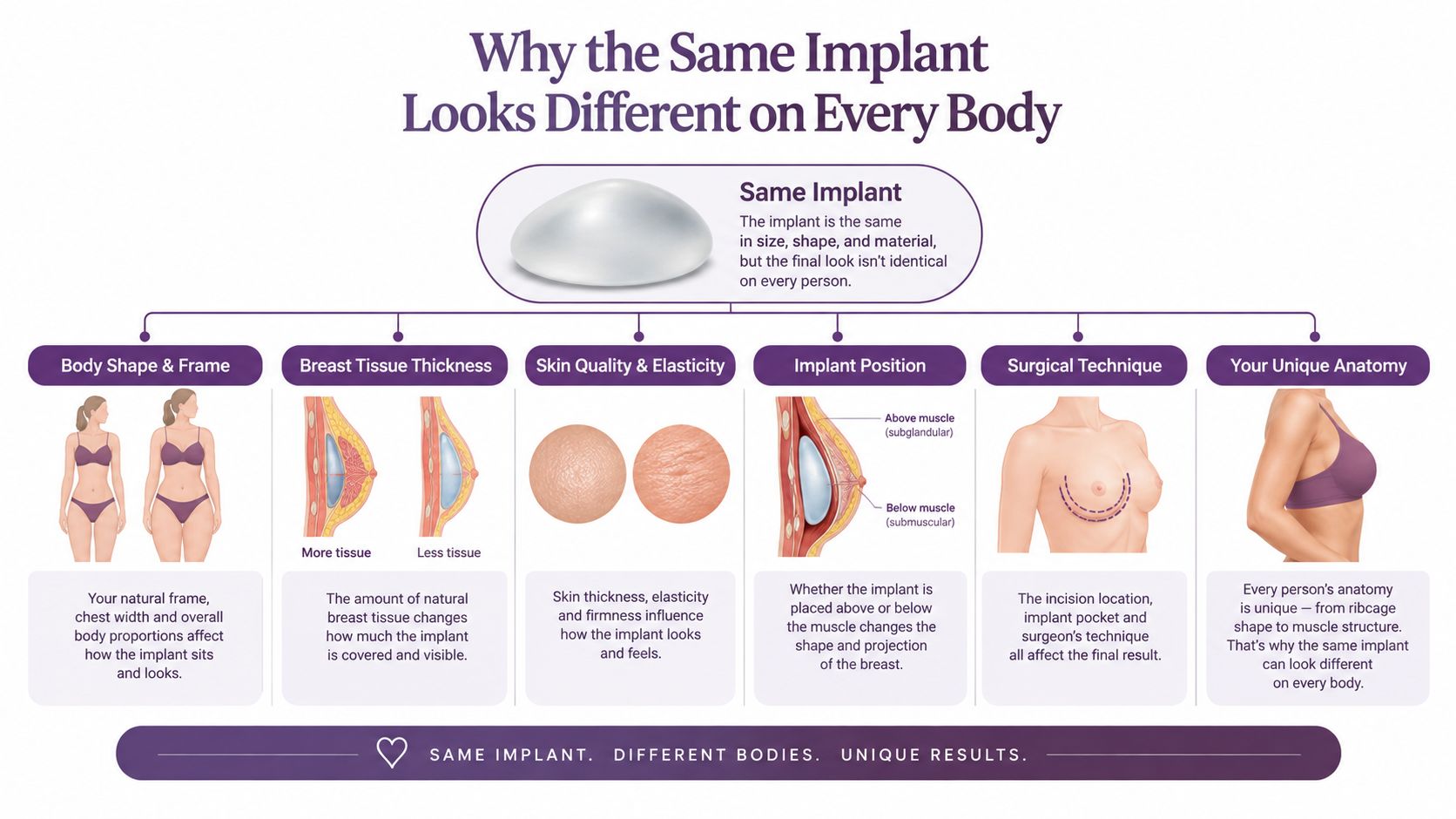
A 250 cc implant doesn't create one universal appearance. Its visual effect depends on how that volume sits within the chest, how much natural tissue covers it, and how the implant's base and projection relate to the patient's proportions.
Chest width changes the visual impact
A narrow chest can make a given volume appear more prominent because the implant occupies a greater share of the available breast base. A wider chest may distribute the same volume across a broader area, producing less forward projection. Ribcage circumference and bra band size also influence how much added volume may correspond to a visible cup-size change.
This is why two patients with the same starting bra label may need different implant plans. The label doesn't reveal the width of the chest wall, the distance between the breasts, or the amount of tissue available to cover the implant.
Existing tissue affects coverage and contour
Natural breast tissue acts as part of the final breast envelope. A patient with more tissue may have greater coverage over the implant, while a patient with minimal tissue may show the implant's shape more clearly. Skin elasticity also matters because the skin and soft tissue must accommodate the added volume.
The implant's profile describes how much it projects forward from the chest. A lower profile generally spreads volume over a broader base with less forward projection. A higher profile uses a narrower base and creates more projection from the chest wall. Neither is automatically better. The surgeon selects a profile by balancing chest width, tissue coverage, desired fullness, and the overall contour the patient wants.
Read before-and-after photos carefully
Before-and-after images can help you communicate preferences, but they shouldn't be treated as a promise of your own result. Look beyond the implant label and ask:
- How similar is the patient's chest width to mine?
- Does the person have comparable starting tissue?
- Is the desired fullness concentrated in the upper pole or spread more softly?
- Does the overall body proportion resemble my own?
- Could the photo reflect a different profile or placement?
A patient who wants an A cup result may be especially sensitive to small differences in projection. A modest volume with a more projecting profile may look more noticeable than a similar volume with a wider, lower-profile design. Luxe's discussion of why breast implants can look smaller at first also addresses how the early appearance may differ from the settled result. The plan should account for anatomy and healing, not just the number printed on the implant.
What Volume Range Typically Aligns With an A Cup Result
There's no implant volume that guarantees an A cup, but practical size ranges can help frame the conversation. For a patient seeking a subtle change, a surgeon may discuss approximately 150 cc to 250 cc, while a more noticeable enlargement often falls around 300 cc to 500 cc. These ranges describe planning possibilities, not fixed outcomes, and the starting breast volume remains essential.
A patient who already has some natural tissue may appear fuller with a smaller implant than a patient beginning with minimal tissue. The implant's profile can also change how visible the result feels, even when the volume stays similar.
Illustrative implant volume ranges by cup change
| Desired Cup Change | Illustrative Volume Range | Why It Varies |
|---|---|---|
| A to B | 250 to 300 cc | Band width, existing tissue, and implant profile affect how much volume creates a visible change. |
| A to C | 300 to 350 cc | A wider chest may require more volume than a narrower chest for a similar apparent increase. |
| B to C | 250 to 350 cc | The amount of pre-existing breast tissue changes the final contour. |
| B to DD | 400 to 450 cc | A larger visual change depends on tissue coverage, chest dimensions, and projection. |
These ranges are commonly used in patient education, but they shouldn't be interpreted as a conversion chart. See published educational ranges for implant volume and cup-size changes. Another patient-facing guide describes approximately 150 to 200 cc as a common estimate for one cup-size increase and maps an A-to-C goal to roughly 300 to 350 cc and an A-to-D goal to about 370 to 450 cc. Review the implant-size guide and its illustrative ranges.
What “A cup” can mean in practice
For some patients, maintaining an A-like appearance means preserving a discreet silhouette while improving roundness or symmetry. For others, the phrase means starting at an A cup and moving toward a small B or C, with the final goal being clothing fit rather than a literal label.
The most useful planning conversation describes the intended change in plain language:
- Subtle enhancement: A small increase that prioritizes proportion and restraint.
- Visible but balanced fullness: More shape under clothing without seeking a dramatic result.
- Upper-pole emphasis: A preference for more fullness in the upper part of the breast.
- Symmetry correction: Different volumes may be considered when the breasts begin with unequal size or shape.
Your surgeon may recommend a range rather than one exact implant. That flexibility allows the plan to respect chest width, tissue limits, and the desired level of projection.
Common Misconceptions About Choosing a Very Small Implant
The smallest implant isn't automatically the safest, most natural-looking, or most satisfying choice for every patient. A small implant may be appropriate, but “small” only makes sense in relation to the chest, soft-tissue envelope, desired visibility, and lifestyle.
Some patients choose a very conservative volume because they fear looking overaugmented. Later, they may feel disappointed because the change is difficult to see in clothing, doesn't create the projection they expected, or doesn't produce the balance they wanted. That can lead to consideration of revision, not because the implant was medically wrong, but because the original expectation and the final appearance didn't match.
Subtle doesn't mean invisible
In a prospective augmentation study, 85.5% of patients achieved satisfactory size overall and 91.1% reported improved self-esteem. Later work linked smaller-than-expected changes with lower satisfaction, which supports a more nuanced conversation about conservative sizing rather than assuming that less volume always produces more contentment. Review the study on satisfaction and self-esteem after augmentation.
A patient who says, “I want an A cup,” may want a specific neckline, a balanced waist-to-chest proportion, or a modest but visible enhancement. If the surgeon hears only the cup label, the plan may undershoot the patient's real goal.
Bra fit can remain complicated
Bra fit doesn't become perfectly predictable after augmentation. Changes in breast shape, particularly in the upper pole, may require adapting cup shape and bra construction. Standard bras may not accommodate a new contour comfortably, even when the overall volume feels right.
A smaller implant can still feel too small if the patient wanted visible projection, a particular clothing fit, or stronger proportional balance.
The right decision balances restraint with satisfaction. A surgeon should ask what “natural” means to you, how noticeable you want the change to be, and whether you're comfortable with a result that may look understated in some clothing. Those answers are more informative than a cup letter alone.
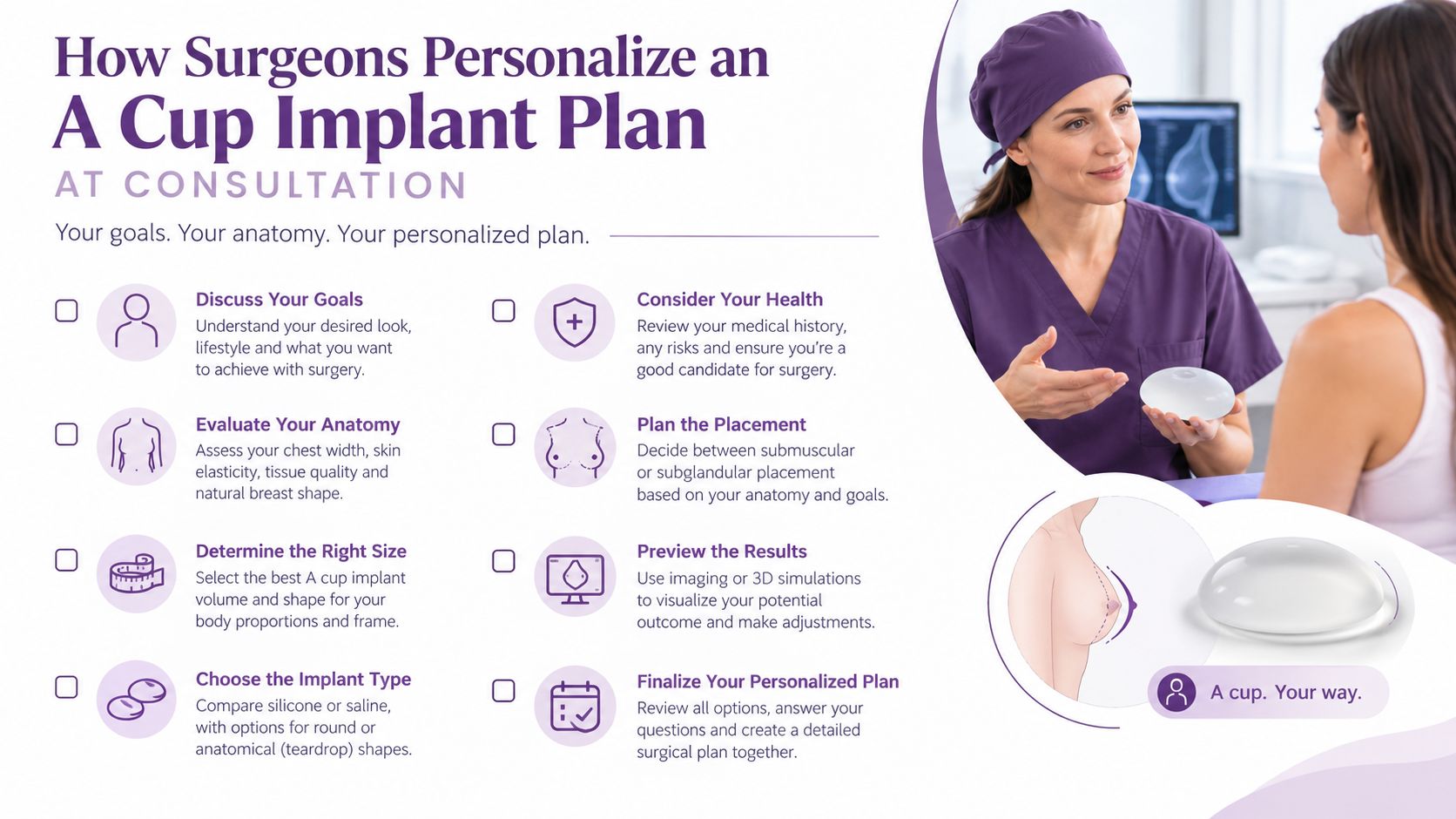
How Surgeons Personalize an A Cup Implant Plan at Consultation
A thoughtful consultation turns the phrase “A cup breast implant” into a detailed anatomical plan. The process usually begins with measurements of the chest and breast base, followed by an assessment of existing tissue, skin quality, breast position, asymmetry, and the space available for an implant.
Questions the consultation should answer
Your surgeon may use implant sizers, photographs, or available imaging tools to help you compare subtle differences in volume and projection. These tools can't guarantee the final result, but they can make an abstract cc discussion easier to understand.
Discuss:
- Desired visibility: Do you want a discreet change or a result that shows clearly in fitted clothing?
- Projection preference: Would you rather have a gentle slope or more forward fullness?
- Proportion: How should the breasts relate to your shoulders, ribcage, waist, and hips?
- Asymmetry: Does one breast need a different volume or a separate adjustment?
- Placement and incision: How might the selected approach affect coverage, contour, and recovery?
- Long-term planning: What monitoring, potential changes, and future implant considerations should you understand?
Implant shape and profile also deserve a direct conversation. Luxe provides an educational resource comparing round and anatomical breast implants, which can help you prepare questions about how shape influences the appearance of a small-volume augmentation.
Anesthesia and candidacy
Some procedures may be performed using local anesthesia for appropriately selected patients. Luxe offers awake breast augmentation, but candidacy depends on the procedure, anatomy, medical history, and clinical assessment. Awake surgery doesn't eliminate discomfort or complications, and it isn't suitable for everyone. Your physician should explain the available anesthesia approach, risks, recovery expectations, and alternatives during consultation.
The plan should leave room for questions. Ask how the proposed volume fits your tissue envelope, why a particular profile is being considered, what result may be visible without a bra, and what limitations apply to cup-size predictions.
Making a Confident and Proportionate Choice
Choosing an A cup breast implant is less about finding the smallest number and more about translating an aesthetic intention into an anatomy-matched result. Start by describing the change you want to see. “Subtle,” “balanced,” “more projected,” and “still petite” can guide planning more effectively than a bra label alone.
Use the following decision framework during consultation:
- Define the visual goal. Decide whether you want shape refinement, visible fullness, improved symmetry, or a combination.
- Understand your anatomy. Chest width, tissue thickness, skin quality, and breast position set practical boundaries.
- Compare volume and profile together. The same cc can look restrained or prominent depending on how it projects.
- Test your expectations. Consider how the result should look in everyday clothing, swimwear, and bras from different brands.
- Discuss long-term considerations. Ask about monitoring, possible changes over time, revision considerations, recovery, and the risks associated with surgery.
A confident choice doesn't require you to know the exact implant before your appointment. It requires enough understanding to explain what you want and enough trust in the consultation process to evaluate the recommendation. The most satisfying result may not carry the exact cup label you imagined, but it should reflect your proportions and your intended degree of change.
Luxe Aesthetic Surgery & Medical Spa offers breast augmentation, including awake breast augmentation for selected patients, along with individualized planning based on anatomy and aesthetic goals. Visit Luxe Aesthetic Surgery & Medical Spa to learn about your options and request a consultation focused on proportion, implant sizing, and realistic expectations.