Medical Expertise at Luxe Aesthetic Surgery
Luxe Aesthetic Surgery & Medical Spa is led by Haimesh Shah, MD, RPVI , a physician specializing in cosmetic surgery, body contouring, laser procedures, and venous medicine. Dr. Shah is a Diplomate of the American Board of Laser Surgery, American Board of Venous & Lymphatic Medicine, American Board of Wound Management, and American Board of Internal Medicine. He also holds the Registered Physician in Vascular Interpretation (RPVI) credential and has contributed to peer-reviewed medical research.
A successful modern total hip replacement can look deceptively simple in a photograph, yet the evidence behind that visible change is substantial. For a primary hip replacement performed in 2014, the estimated revision rate at 10 years was 2.7%, with a 95% confidence interval of 2.6% to 2.8%, according to national registry evidence summarized by the National Center for Biotechnology Information. That figure reframes “before and after hip implants” as more than a pair of images. It's a story about pain, walking, sleep, rehabilitation, implant fixation, and how the result holds up over years.
Your recovery won't follow a photograph's schedule. Some patients stand with a walker shortly after surgery, while others need more time because of age, muscle weakness, medical conditions, or the complexity of the procedure. The most useful way to read before-and-after images is to pair them with realistic milestones and long-term outcome data.
Table of Contents
- What Before and After Hip Implants Photos Really Show
- Main Categories of Hip Implant Procedures
- Total Hip Replacement Before and After Results
- Partial and Minimally Invasive Hip Implant Results
- Revision and Complex Hip Implant Cases
- Recovery Timeline You Can Expect After Hip Implant Surgery
- Patient-Reported Outcomes and Satisfaction Data
- How Durable Modern Hip Implants Really Are
- Fixation Choices and Long-Term Implant Performance
- Activity Precautions in the First Weeks After Surgery
- Variables That Shape Your Own Before and After Results
- Questions to Ask at Your Hip Implant Consultation
What Before and After Hip Implants Photos Really Show
A photo captures one moment. Hip replacement recovery unfolds across days, weeks, and years. Before-and-after images may show a guarded stance, tilted pelvis, bent hip, or cane use before surgery. A later photograph may show a more upright posture, improved leg alignment, a healed incision, or standing without handheld support.
Those changes can suggest better function, yet they cannot confirm normal endurance, complete pain relief, or the result you will have. The image usually does not identify the implant, fixation method, surgical approach, rehabilitation plan, or possible complications. It is closer to a single frame from a film than the whole story.
Read the image as one moment
Check four details:
- Posture: Is the pelvis more level? Is weight shared similarly between both legs?
- Support: Has the patient progressed from a walker to a cane or unaided standing?
- Incision: Is the wound covered, closed, or still visibly healing?
- Movement: Is the later position relaxed, or carefully arranged for the camera?
A photograph also leaves out sleep quality, stair confidence, walking distance, swelling, and the effort needed for everyday tasks. A resource on gluteal fold photo interpretation illustrates why body position and camera angles can change how an external result appears. The same caution applies here.
Practical rule: Use a photo to ask better questions, not to predict your exact recovery.
Public PROMs findings provide a broader population view. In England's 2021/22 report, 95% of hip replacement patients said they felt better after surgery. This included 86.6% who felt “much better” and 8.3% who felt “a little better.” 93% rated their result as excellent, very good, or good, according to the NHS PROMs results.
These figures describe groups of patients, not a guarantee for one person. Your day-to-day progress may change with healing, strength, pain, activity, and rehabilitation. A useful comparison is a travel log: the photograph shows the destination, while recovery milestones explain the route.
Main Categories of Hip Implant Procedures
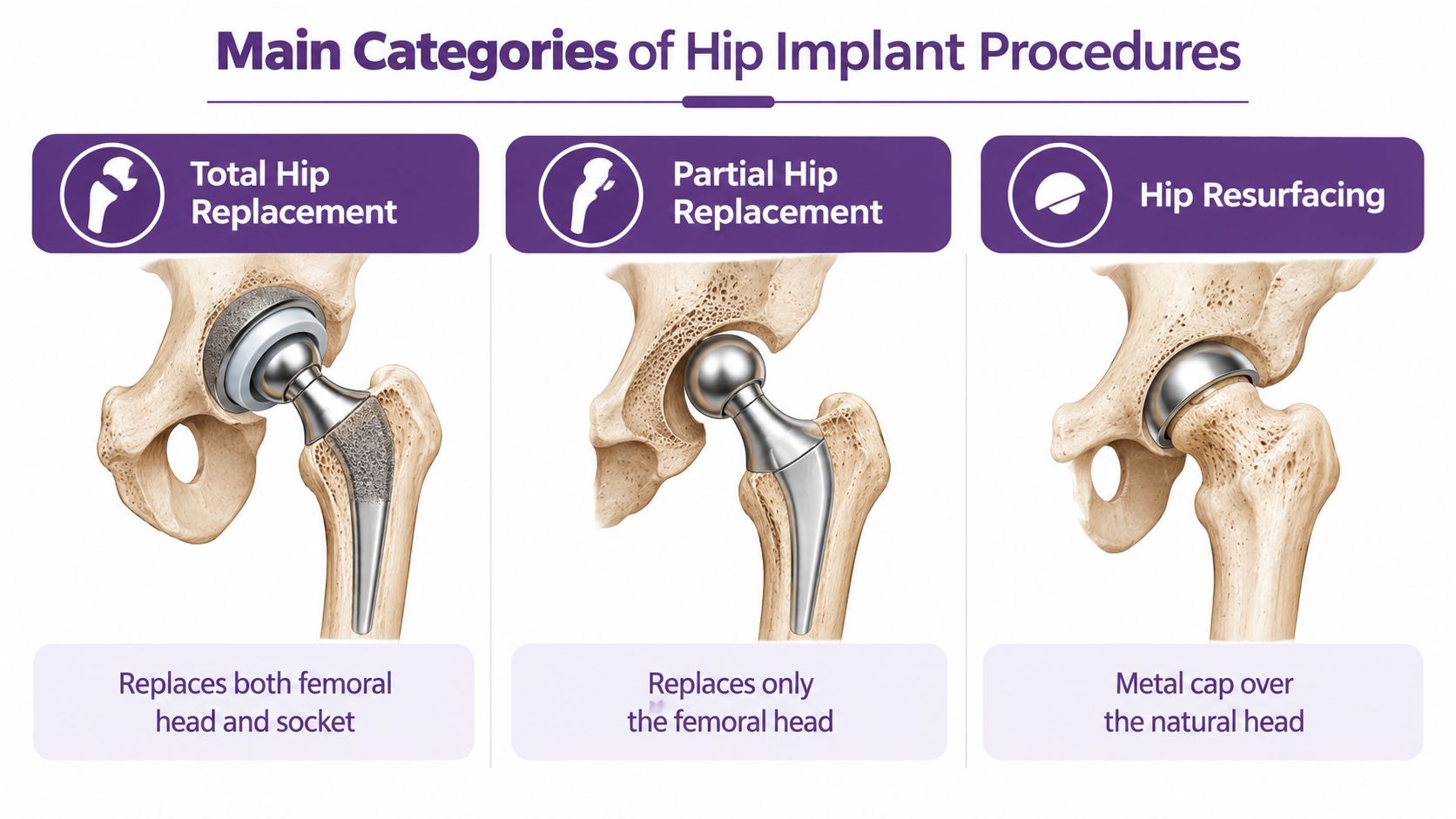
The first question to ask about any image is, what procedure does it represent? A total hip replacement, partial replacement, resurfacing procedure, and revision operation can all appear under the same broad search phrase, but they involve different implants and recovery demands.
Match the image to the operation
- Total hip replacement: Replaces the femoral head and the acetabular socket. Most online galleries showing an artificial ball and socket represent this procedure.
- Partial hip replacement: Also called hemiarthroplasty, it replaces only the femoral head. It's commonly used in selected fracture cases, and the native socket remains.
- Hip resurfacing: Places a cap over the femoral head instead of removing the entire head. Patient selection is more specific, and the follow-up image has a distinctive component shape.
- Revision replacement: Removes or replaces an earlier implant. The scar, bone reconstruction, and rehabilitation may look substantially more involved.
Approach also affects the visible scar. Direct anterior, posterior, and anterolateral procedures place the incision in different locations, so comparing photographs without knowing the approach can mislead you.
For readers working on mobility before or after surgery, a hip flexion test guide may help explain the movement clinicians assess. It shouldn't replace an orthopedic examination, particularly if a movement causes sharp pain or instability.
Total Hip Replacement Before and After Results
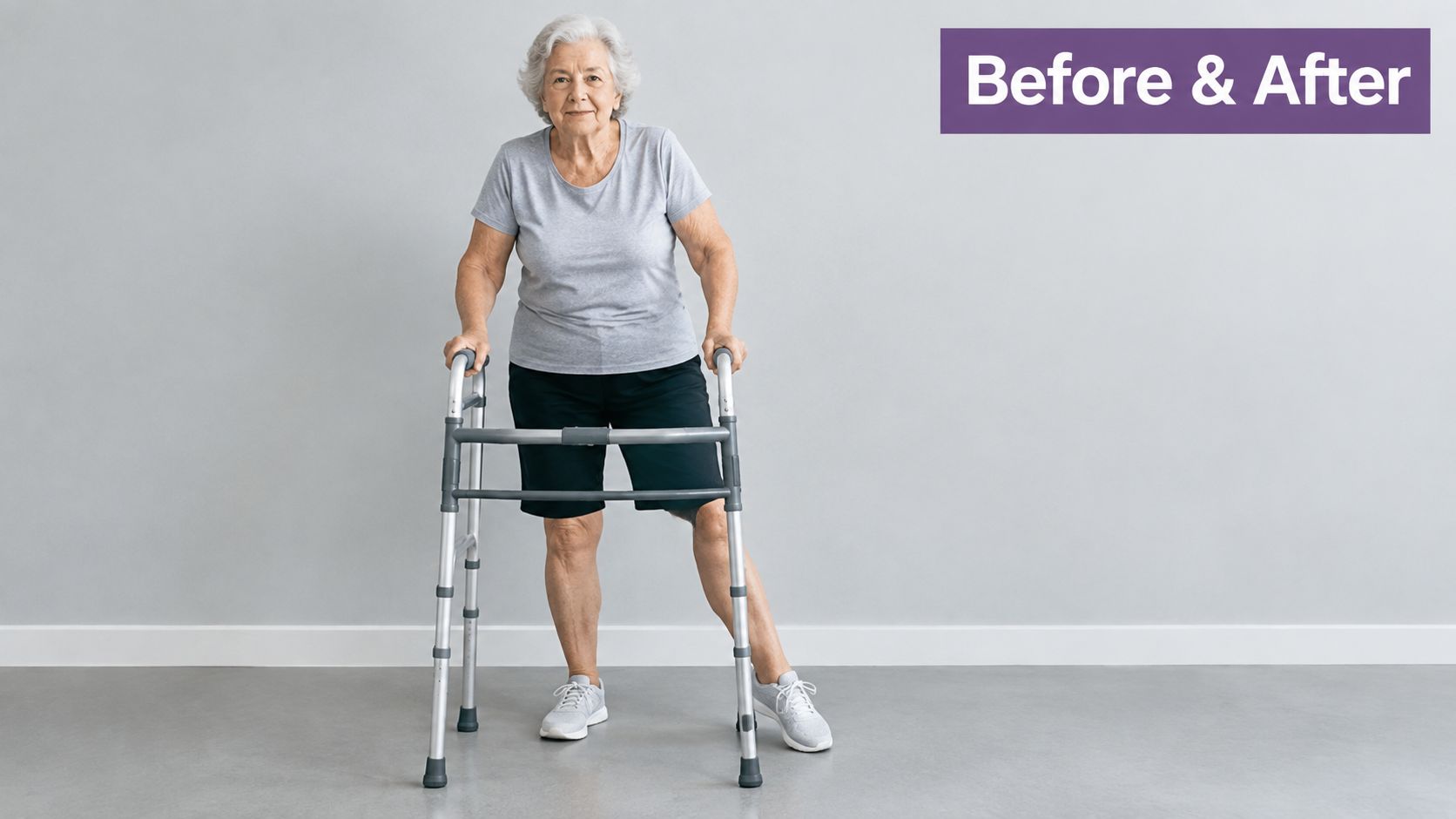
A photograph captures one moment. Total hip replacement recovery unfolds across many. Before surgery, a patient may protect the painful side, stand with the pelvis shifted, or rely on a walker for balance. In the early postoperative picture, swelling, dressings, and an assistive device can still be visible. Months later, the stance may look more level, although walking endurance and strength can continue to develop.
What the replacement changes
During total hip replacement, the surgeon removes the damaged femoral head, prepares the acetabulum, and inserts an artificial socket and femoral component. A metal or ceramic head moves against a polymer or ceramic liner, recreating the ball-and-socket motion.
The operation aims to improve how the joint works:
- Restore a stable ball-and-socket joint.
- Improve leg length and offset as safely as possible.
- Reduce painful bone-on-bone contact.
- Create a foundation for smoother walking and rehabilitation.
The scar's location reflects the surgical approach, such as anterior, posterior, or lateral. That detail helps explain differences between photographs, but the incision itself cannot predict the final result. Muscle condition, surgical complexity, implant position, and the preoperative walking pattern also shape what appears in later images.
Recovery is better understood as a sequence than as a single reveal. A prospective study of 95 total hip arthroplasty patients found that self-reported physical function improved by a mean of 37.9 points at four months, while performance-based function improved by 2.9 points, according to the prospective functional recovery study. In practical terms, patients may feel substantially better before measured mobility has fully caught up.
Partial and Minimally Invasive Hip Implant Results
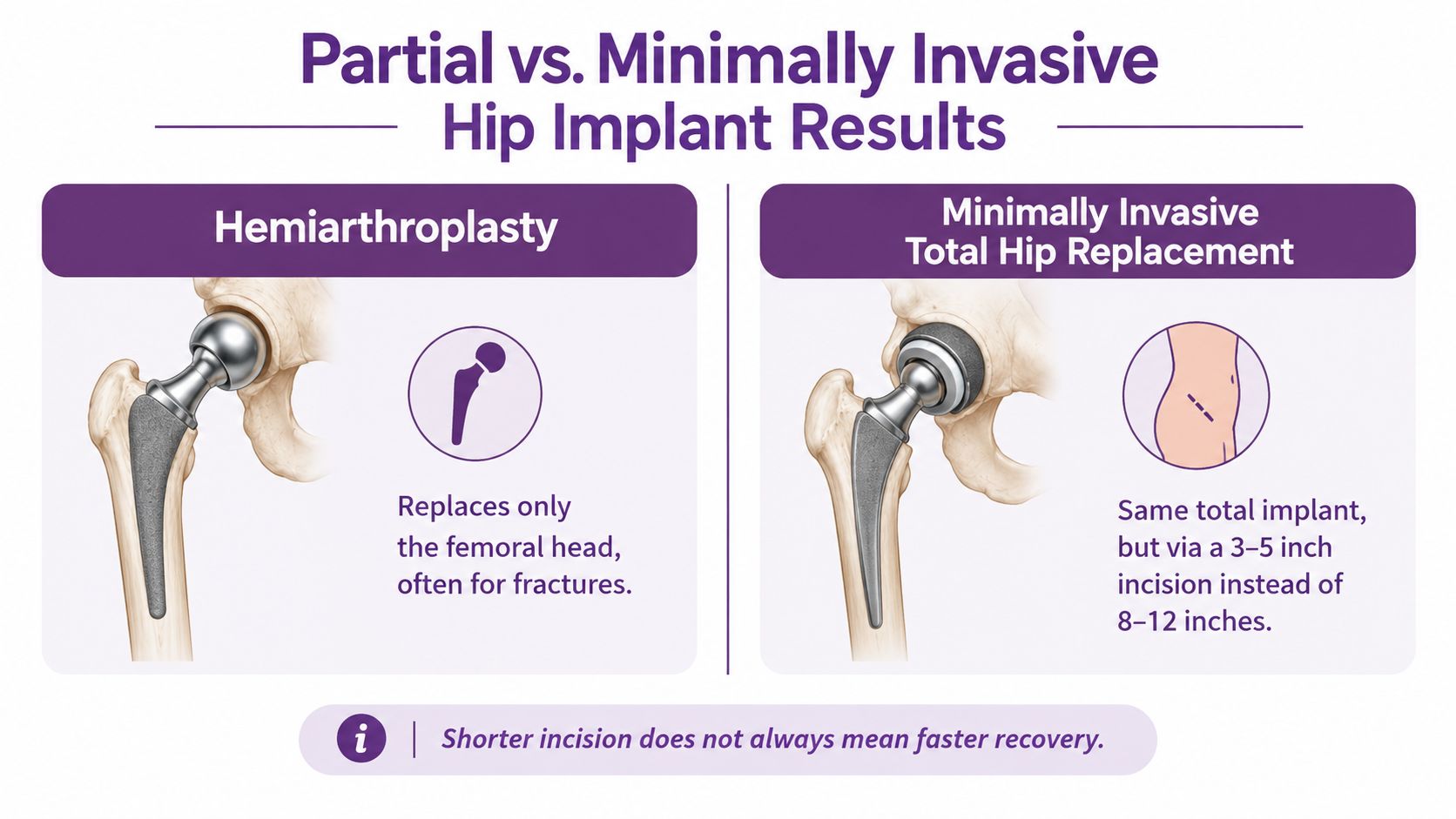
Partial hip replacement changes only the femoral side of the joint. The natural socket remains, so its implant outline and photographic goal differ from those of a total hip replacement. Images may show a patient recovering after a fracture, with the operated side receiving most of the dressing and weight-bearing gradually returning.
A cane may still appear in later photographs. That does not automatically indicate a poor result. Strength, balance, pain, and confidence can improve at different rates, particularly after a fracture-related operation.
Minimally invasive total hip replacement uses a smaller or tissue-sparing approach, but it remains a total replacement. A follow-up image may show an anterior incision, earlier upright positioning, or less visible soft-tissue disruption. Incision length alone cannot predict recovery speed or final function. The underlying diagnosis, muscle condition, implant position, general health, and rehabilitation plan also influence the day-by-day result.
Photographs provide checkpoints, not a complete recovery record. Early images may capture swelling, dressings, or guarded walking. Later images may show improved stance while a patient still needs strengthening and supervised practice.
The practical goals are a stable implant, safe walking, manageable pain, wound monitoring, and rehabilitation suited to the patient's health and home environment. A smaller scar can look reassuring, yet careful movement and progressive strengthening still matter.
Revision and Complex Hip Implant Cases
Revision photographs can look more dramatic because the surgeon is working around an existing implant, altered bone, scar tissue, or a previous complication. The preoperative image may show a shortened or uneven leg, guarded walking, or reliance on an assistive device. The postoperative image may show a longer scar and a more involved reconstruction, while still reflecting meaningful functional improvement.
Common reasons for revision include infection, dislocation, loosening, device fracture, and local or systemic reactions to implant metals, according to FDA information for orthopedic surgeons and FDA guidance on soft-tissue imaging and metal-ion testing. The FDA also explains that another operation may be considered if a replacement hip dislocates or wears out.
| Feature | Primary | Revision |
|---|---|---|
| Starting point | Native joint with no prior implant | Existing implant or prior reconstruction |
| Photographic appearance | Usually a single surgical scar | May show longer or multiple scars |
| Main objective | Replace the damaged joint | Restore stability, fixation, alignment, or bone stock |
| Recovery pattern | Often more predictable | Frequently depends on bone quality and reconstruction |
| How to judge success | Pain relief and improved gait | Stability, corrected alignment, function, and infection control |
A useful revision comparison follows the patient across time, not just from one photograph to the next. Early images may document swelling, protected movement, or a walker. Later images can show improved alignment while strength and confidence continue to develop. The meaningful questions are whether the patient stands more evenly, walks more safely, and manages daily activities with fewer limitations.
Revision surgery is not a repeat of the original operation. Bone quality, fixation, alignment, infection control, and the reason for the first implant failure all shape the plan and the day-by-day recovery. Patients should ask the orthopedic team which problem the revision is intended to correct and how progress will be assessed.
A related implant replacement discussion also highlights the need to consider device age, symptoms, imaging, and personal goals together. The same careful reasoning applies here, although hip revision decisions require orthopedic examination and individualized imaging.
Recovery Timeline You Can Expect After Hip Implant Surgery
Recovery is easier to understand when you connect each stage to a function rather than a photograph. The exact sequence varies, and your surgeon's restrictions take priority.
Early movement
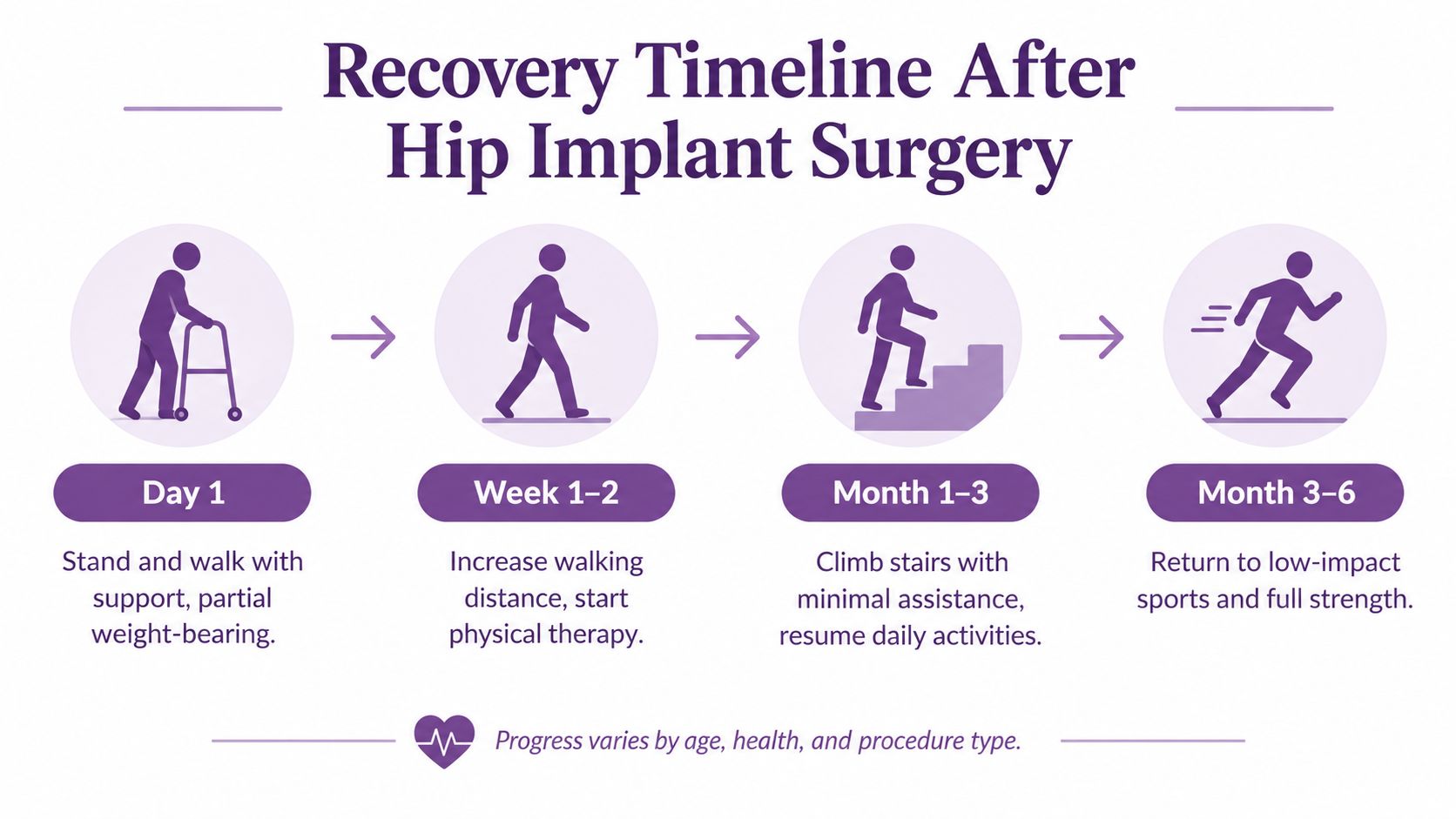
On the first day, many patients begin standing and walking with a walker, often with weight-bearing determined by the procedure and the surgeon's instructions. The first several days may bring soreness, swelling, fatigue, and uncertainty, even when the preoperative arthritis pain has already improved.
During the first couple of weeks, the focus is usually safe transfers, short walks, wound care, and prescribed exercises. A walker may gradually give way to a cane, but using an aid longer than someone pictured online isn't a failure. It may be the safer choice.
Building daily confidence
By later weeks, many patients work toward easier stair climbing, longer walks, driving clearance, and a return to household tasks. Driving depends on the operated side, vehicle controls, reaction ability, pain medication, and surgeon approval. Work timing depends heavily on whether the job is sedentary, physically demanding, or safety-sensitive.
Physical therapy can support strength, balance, gait retraining, and confidence. This overview of the benefits of PT for hip replacement may help you understand why rehabilitation addresses more than the incision.
A patient-reported improvement may arrive before measurable endurance returns. That difference is why a four-month photo can look encouraging while the patient still needs to build walking distance, stair control, and hip strength. For related recovery-planning ideas, see this recovery guide after liposuction, while remembering that hip replacement rehabilitation follows a different surgical plan.
Patient-Reported Outcomes and Satisfaction Data
A photograph captures one moment. Patient-reported outcome measures follow the changes that matter during ordinary days, including pain, function, mobility, sleep, and quality of life. They add information that an X-ray or clinic examination cannot provide alone.
Common measures include the Oxford Hip Score, HOOS, and HOOS-12. A patient might report getting dressed more easily, sleeping without hip pain, or walking to the mailbox without stopping. Those gains may be invisible in a posed before-and-after image. A stronger result combines the photograph with the patient's day-by-day account.
England's national PROMs results offer a population-level reference. In 2021/22, 95% of patients reported feeling better after hip replacement, and 93% rated the outcome excellent, very good, or good, according to the NHS patient-reported outcomes report. The 2018/19 report showed a similar pattern, with 95% reporting improvement and 93.2% rating their results excellent, very good, or good.
| Outcome measure | Preoperative focus | Early follow-up focus | Longer-term focus |
|---|---|---|---|
| Oxford Hip Score | Pain and everyday function | Changes in walking and daily tasks | Continued comfort and independence |
| HOOS | Symptoms, pain, and quality of life | Functional recovery and activity tolerance | Sustained function and patient priorities |
| HOOS-12 | A shorter patient-reported baseline | Key symptom and function changes | Ongoing quality-of-life assessment |
These results describe groups, not a guaranteed personal timeline. Pain may improve before strength and endurance return, while back pain, muscle weakness, or nerve symptoms can limit progress. Some patients also expect surgery to correct problems the hip implant cannot address. During consultation, ask which symptoms are likely to improve, which may remain, and how progress will be assessed over time.
How Durable Modern Hip Implants Really Are
A clear one-year photograph shows recovery at one moment. Implant durability is measured year by year. For a primary hip replacement performed in 2014, the estimated revision risk at 10 years was 2.7%, according to the national registry summary. The same evidence base recorded 50,946 first revisions linked to primary hip replacements recorded between 2003 and 2024. These figures describe population patterns, not a personal guarantee.
Longer follow-up changes the question from “How does it look now?” to “How is it performing over time?” Registry-based survivorship evidence indicates that approximately 85% of total hip replacements last 15 years, while 58% last 25 years. A separate long-term cohort reported revision-free survival of 98.7% at five years and 94.6% at 10 years, described in this long-term total hip arthroplasty cohort.
What can cause later failure
Revision may be considered when a problem affects comfort, stability, fixation, or the surrounding tissues:
- Infection: Bacteria may affect the joint or nearby tissues.
- Dislocation: The ball moves out of the socket.
- Loosening: A component no longer remains securely fixed.
- Device fracture or wear: Structural or bearing problems may develop.
- Metal-related reactions: Local or systemic reactions may require evaluation.
Modern implants are designed to last at least 15 years, yet wear can develop and later contribute to pain or swelling, according to the FDA's orthopedic implant information. Longevity depends on implant design, fixation, activity, bone quality, patient factors, and follow-up care. A good early result is encouraging. It does not establish a particular lifetime for the implant.
Fixation Choices and Long-Term Implant Performance
Fixation explains how an implant remains attached to bone. Cemented fixation uses bone cement to secure a component. Cementless fixation uses a press-fit design, allowing bone to grow onto its porous surface. Hybrid fixation combines cemented and cementless components.
Registry patterns show that surgeons' fixation choices have shifted over time. In 2023, 41.6% of primary hip replacements used hybrid fixation, and hybrid use increased by more than 2.5 times between 2006 and 2023. Cemented hips accounted for 17.1%, according to the registry evidence summarized by NCBI.
| Fixation type | Typical consideration | Mechanism | Long-term indicator |
|---|---|---|---|
| Cemented | May suit selected bone-quality and patient profiles | Cement holds the component in prepared bone | Stable position without progressive loosening |
| Cementless | Common in many modern primary replacements | Press-fit fixation followed by bone integration | Secure ingrowth and maintained alignment |
| Hybrid | Combines two fixation strategies | One component is cemented and another is press-fit | Component-specific stability over follow-up |
The choice is individualized. Age, bone quality, fracture risk, anatomy, surgeon experience, and implant design all influence the recommendation. A cementless component may need time for bone integration, while a cemented component depends on the cement-bone interface from the start.
Follow-up images provide a year-by-year record rather than a single before-and-after snapshot. Clinicians assess component position, alignment, leg-length maintenance, and changes that could suggest loosening. The meaningful result is stable function over time, not appearance alone.
Activity Precautions in the First Weeks After Surgery
Early recovery photographs often show raised seats, reachers, firm chairs, and pillows between the knees. These aids reduce the need to bend or twist while the muscles and soft tissues heal.
AAOS guidance says many patients can resume most common precautions after 6 to 8 weeks, while advising patients during early recovery to avoid crossing the legs at the knees, bending beyond 90 degrees, or bringing the operated-side knee higher than the hip, as described in this FDA-hosted AAOS activity guidance. Your own surgeon may give different instructions based on the surgical approach and stability of the reconstruction.
Translate precautions into daily actions
- Sitting: Choose a firm, higher seat rather than a low sofa.
- Sleeping: Follow the recommended position and pillow use.
- Turning: Move your feet instead of twisting sharply through the hip.
- Stairs: Use the rail and the pattern taught by your therapist.
- Driving: Wait for medical clearance and confident emergency braking.
A walker or cane is a safety tool, not evidence that surgery failed. Assistive devices should be reduced when your gait is controlled, your pain is manageable, and your clinical team agrees.
Variables That Shape Your Own Before and After Results
Two people can receive similar hip implants yet show different before-and-after photographs. The visible result reflects the starting point, recovery day by day, and function years later, not surgery alone.
Use this checklist during planning
- Baseline walking capacity: Preoperative mobility can influence the level you regain. A registry-based analysis found that patients who walked longer than 10 minutes before surgery were more likely to later exceed 60 minutes than those who started below 10 minutes, as reported in the registry-based walking capacity study.
- Age and health: Medical conditions, muscle reserve, balance, and bone quality can slow or support recovery.
- Preparation: Prehabilitation may improve strength, objective function, quality of life, and self-reported function, with gains concentrated in the first six months.
- Home support: Stairs, transportation, caregiver help, and therapy access can affect how consistently rehabilitation progresses.
- Surgical details: The approach, fixation, implant design, and reconstruction complexity influence healing and rehabilitation.
Your preoperative activity also matters. Guidance on safe strategies for hip arthritis can help you maintain movement without worsening symptoms. Match any exercise plan to your diagnosis and clinician's advice.
Photos capture one moment. Your practical result unfolds through early walking, rebuilding strength, and longer-term activity. Expect a range, shaped by baseline function, health, preparation, surgical details, and support, rather than a guaranteed week for “normal” walking.
Questions to Ask at Your Hip Implant Consultation
Bring the photographs that influenced you, but bring questions too. A surgeon can explain which visible changes are realistic for your anatomy and which differences are the result of camera angle, clothing, posture, or timing.
Clarify the operation
Ask which approach is recommended, such as posterior, anterior, or anterolateral, and how it will affect the incision, movement precautions, and early walking. Ask whether the planned procedure is a total replacement, partial replacement, resurfacing procedure, or revision.
Discuss the implant system and fixation strategy in plain language. You can ask about the bearing surface, the reason a particular component is appropriate, and how the surgeon evaluates alignment, leg length, and stability.
Clarify the recovery
Ask:
- What should walking look like during the first few days?
- When might you use a walker, cane, or no aid?
- When can you shower, drive, work, climb stairs, and sleep comfortably?
- What support will you need at home?
- Will outpatient or home-based therapy be recommended?
- Which activities should wait until strength and balance return?
The prospective evidence discussed earlier shows why self-reported improvement and objective mobility may move at different speeds. Ask how your baseline walking capacity, age, medical conditions, and home setup could affect that gap.
Clarify safety and follow-up
Request specific warning signs that require an urgent call, such as increasing wound drainage, fever, new calf swelling, chest pain, sudden shortness of breath, or a hip that feels unstable. Confirm who to contact after hours and when follow-up imaging is planned.
Ask how the practice tracks revisions and complications, but interpret any outcome figure in context. Results depend on patient selection, procedure complexity, follow-up duration, and how the data were collected.
A strong consultation connects the image you hope to see with the function you want to regain. Instead of asking only whether you'll look better in a later photograph, ask whether the plan addresses walking, sleep, stairs, work, recreation, and long-term implant reliability.
Luxe Aesthetic Surgery & Medical Spa provides individualized cosmetic surgery, body contouring, breast, facial, vein, and medical spa care rather than orthopedic hip replacement services. Visit Luxe Aesthetic Surgery & Medical Spa to learn about the practice's consultation process and the aesthetic procedures available for your personal goals.