Medical Expertise at Luxe Aesthetic Surgery
Luxe Aesthetic Surgery & Medical Spa is led by Haimesh Shah, MD, RPVI , a physician specializing in cosmetic surgery, body contouring, laser procedures, and venous medicine. Dr. Shah is a Diplomate of the American Board of Laser Surgery, American Board of Venous & Lymphatic Medicine, American Board of Wound Management, and American Board of Internal Medicine. He also holds the Registered Physician in Vascular Interpretation (RPVI) credential and has contributed to peer-reviewed medical research.
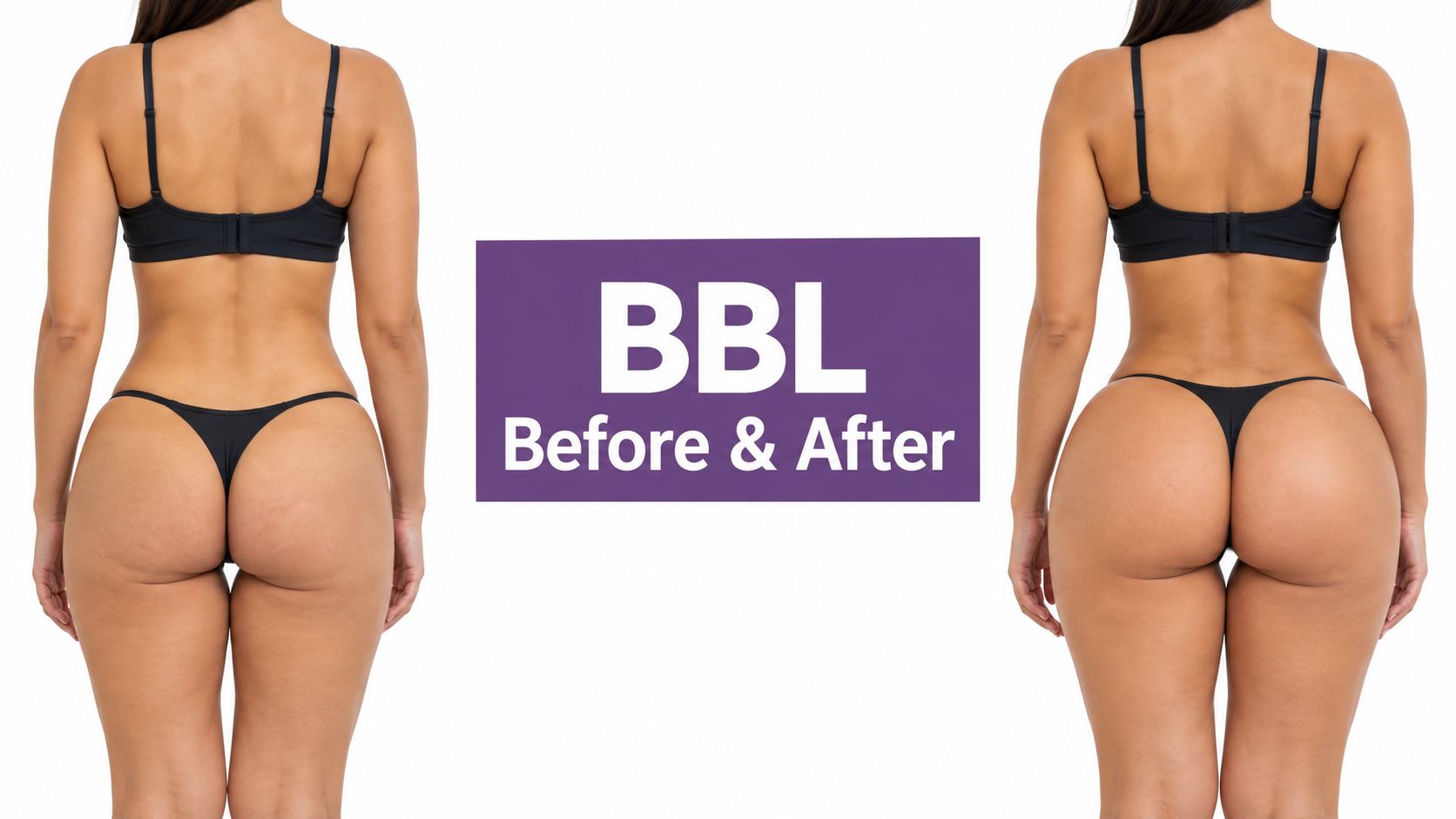
Most Brazilian butt lift surgery before-and-after galleries answer the wrong question. They show you whether a photograph looks attractive, but not whether the comparison is fair, how much of the transferred fat survived, or whether the fat was placed in a safe anatomical plane. A dramatic silhouette can reflect liposuction, posing, lighting, swelling, and a carefully selected angle as much as gluteal enhancement.
Read every gallery as evidence, not entertainment. Check the starting anatomy, the time between photographs, the waistline, the technique, and the safety information that the image can't show. A responsible comparison should help you understand the recovery timeline, fat retention, injection-plane safety, and the questions worth taking to a consultation.
Table of Contents
- Why a Pretty Photo Is Not the Whole Story
- What a Brazilian Butt Lift Actually Is
- How to Read a BBL Before-and-After Image
- Three Patient Archetypes You Will See in Galleries
- The First Six Weeks of Recovery
- Fat Retention and the Twelve-Month Result
- The Safety Layer Hidden in Every Gallery
- Questions to Ask Before You Trust a Gallery
- How BBL Longevity Compares With Implants
- Key BBL Terms You Will Hear in a Consultation
- A Smarter Way to Judge a Before-and-After
Why a Pretty Photo Is Not the Whole Story
A good BBL result isn't the largest-looking result. It may be a balanced contour with improved waist definition, proportionate projection, and a shape that suits the patient's anatomy. A photograph can't tell you whether that balance was achieved, whether the image was taken before swelling settled, or whether the patient required a revision.
The evidence supports careful documentation rather than visual hype. A 2025 systematic review of ultrasound-guided gluteal fat grafting found that median satisfaction rose from 48 before surgery to 93 afterward on a 0 to 100 scale, with included studies reporting postoperative scores from 80 to 100. The review reported no deaths or fat-embolism events in the ultrasound-guided series it analyzed, but those findings apply specifically to that technique and setting, not to every BBL. Read the systematic review of ultrasound-guided gluteal fat grafting.
Practical rule: A beautiful after photo is evidence of appearance. It isn't evidence of safe technique, stable fat retention, or a result you can reproduce on your own body.
Start with four questions. When was the after photo taken? What changed at the donor sites? What was the injection plane? What risks and follow-up details were disclosed? If a gallery can't answer those questions, treat it as marketing material, not a complete clinical record.
What a Brazilian Butt Lift Actually Is
A Brazilian butt lift, or BBL, combines liposuction with autologous fat grafting. Your surgeon removes fat from a donor area such as the abdomen, flanks, back, or thighs, processes it, and transfers selected fat to the buttocks to improve volume and contour. The result depends on both sides of that operation. A narrower waist can make the buttocks appear more prominent, even before considering the amount of transferred fat.
This differs from gluteal implants, which use manufactured devices to create volume. It also differs from fillers and nonsurgical treatments, which don't remove donor fat and follow a different longevity and risk profile. A BBL uses your own tissue, but that doesn't mean every transferred cell survives or that the result remains unchanged through weight fluctuations.
Candidacy depends on anatomy
Adequate donor fat matters. So do skin elasticity, stable weight, reasonable expectations, and overall health. A lean patient may be suited to a subtle contour change rather than dramatic enlargement, while someone with more available donor fat may have greater flexibility. Neither patient should be promised a particular silhouette from a gallery.
The procedure may sometimes be performed using local anesthesia for appropriately selected patients, depending on the operation, anatomy, medical history, and the surgeon's plan. Luxe Aesthetic Surgery & Medical Spa offers Brazilian butt lift and autologous fat-grafting procedures, with treatment planning based on individual anatomy and goals. A consultation is still necessary to determine whether the procedure, anesthesia approach, and achievable volume are appropriate for you.
How to Read a BBL Before-and-After Image
Start with the photography, not the buttocks. The before and after images should use comparable lighting, background, camera distance, clothing, and posture. A patient standing with an arched lower back may show more projection without any surgical change, while a darker tan or directional light can deepen shadows around the waist and gluteal curve.
Look for front, oblique, and side views. The side view helps you assess projection, but the front and oblique views reveal whether the waist, hips, and buttocks form a coherent proportion. Ask whether liposuction was performed around the abdomen, flanks, or back. Removing fat from the trunk can change the waist-to-hip relationship and make the buttocks appear more prominent.
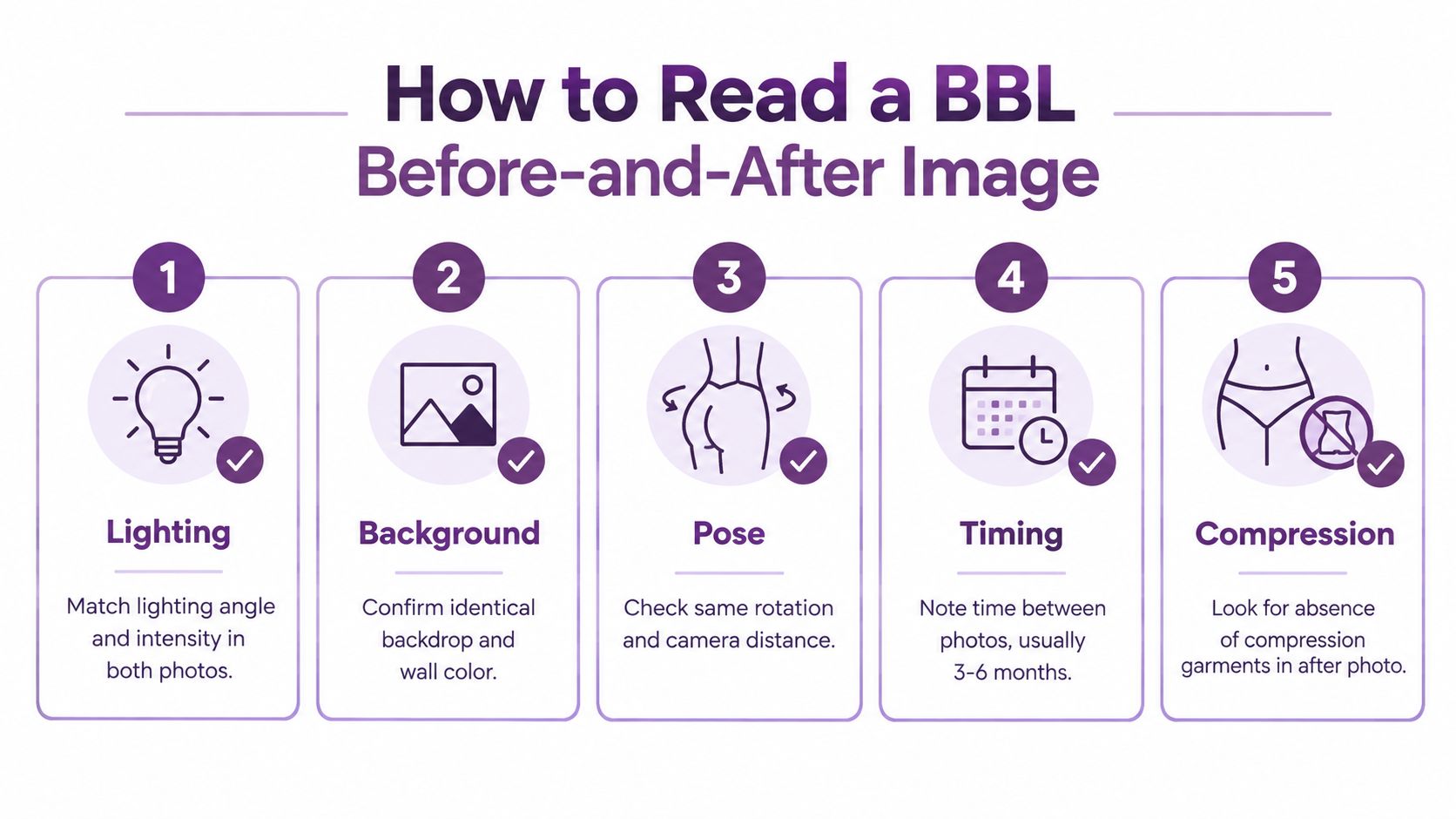
Your gallery checklist
- Lighting: Match the direction and intensity of light in both images.
- Background: Confirm that the wall, floor, and backdrop remain consistent.
- Pose: Check the same rotation, leg position, camera height, and distance.
- Timing: Identify the interval between surgery and the after photograph.
- Compression: Ask whether either image was taken in a compression garment.
A credible gallery should also state the patient's starting anatomy and, where relevant, weight or body-mass index. A useful companion to this review is guidance on interpreting gluteal fold photographs, because small changes in stance and fold position can alter what the image appears to show.
Three Patient Archetypes You Will See in Galleries
Consider three patients viewing the same gallery. The first is lean, with limited donor fat and firm skin. Her realistic result may involve modest projection, a smoother hip contour, and sharper waist definition. The gallery image may look subtle compared with a high-volume result, but that doesn't make it unsuccessful. It means the surgeon worked within the available tissue.
The second patient has adequate fat across the abdomen and flanks, with stable weight and reasonably elastic skin. Her result may show a clearer waist-to-hip transition because liposuction changes the donor areas while grafting adds gluteal contour. If the gallery doesn't identify combined trunk liposuction, you're missing an important part of the explanation.
The third patient has lost substantial weight and has looser skin. Fat transfer may improve fullness, but it can't guarantee that added volume will create a taut, lifted appearance. Skin quality, asymmetry, and the amount of tissue that can safely accommodate grafted fat influence the final shape.
Read the patient, not just the silhouette
The amount transferred should be individualized. A peer-reviewed safety review reported a mean grafted volume of 422 mL, with a range from 210 to 850 mL, demonstrating how widely surgical plans can differ by anatomy and goals. Review the evidence on graft volume and BBL safety.
That range isn't a target or a promise. It illustrates why copying a photo is unreliable. Compare your donor areas, skin elasticity, starting proportions, and desired degree of change with the patient shown. A similar body type still doesn't guarantee a similar outcome.
The First Six Weeks of Recovery
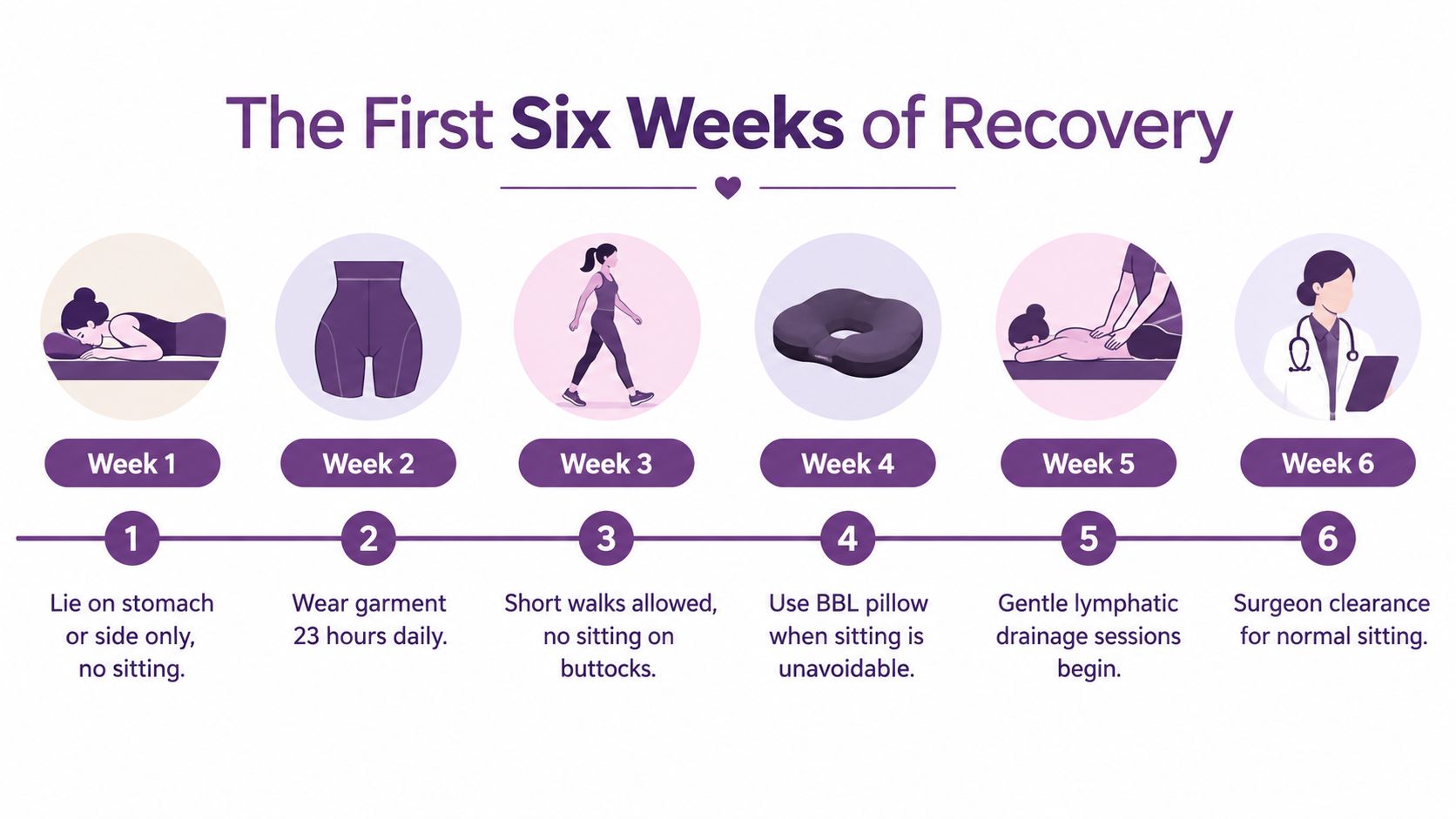
The early BBL image is usually the least reliable image in the gallery. Swelling affects both the buttocks and the liposuctioned areas, while compression garments can temporarily shape the waist and conceal uneven swelling. Direct pressure on the grafted area also needs to be limited according to the surgeon's instructions.
Recovery is staged, not defined by one universal milestone. Patients may need to lie on their stomach or side, avoid direct sitting, use a pillow that shifts pressure toward the thighs, and walk lightly when cleared. Drainage, bruising, firmness, numbness, and changing swelling can make the body look different from week to week.
Plan around the restrictions
A desk job, childcare, driving, and exercise all require individualized clearance. Don't use a gallery caption or another patient's schedule as your medical instruction. If you're preparing a recovery space or support plan, a practical guide to healing gifts for loved ones can help family members choose useful comfort and support items.
For broader planning around swelling, movement, garments, and incision care, review what to expect during liposuction recovery. Your surgeon's instructions take priority, especially if your procedure combines liposuction with other surgery.
Fat Retention and the Twelve-Month Result
Early projection is not the settled result. In a study of subcutaneous-only grafting, immediate postoperative gluteal subcutaneous thickness increased by a mean 56.51%, then decreased by a mean 18.16% from the immediate postoperative measurement at 12 months, corresponding to reported retention of approximately 81.84% of the injected volume. Review the study on subcutaneous-only grafting and long-term thickness.
Treat that number as a benchmark, not a promise. Fat survival depends on graft handling, recipient-site blood supply, pressure during recovery, smoking, weight changes, technique, and how the volume was measured. A separate 3,000-patient study reported approximately 70% survival of transferred fat and 86% patient satisfaction, which reinforces the same lesson: early volume is not stable volume. Read the 3,000-patient fat-survival study.
This is why the date on an after photo matters as much as the photo itself. A gallery that labels an image only "after" is hiding the single variable that determines how much fat survived.
| Time After Surgery | Expected Visual Change | Caution for Photo Comparison |
|---|---|---|
| One month | Swelling and temporary fullness may still dominate the shape. | The image can overstate final projection. |
| Three months | The contour begins to settle and look more natural. | Residual swelling and ongoing fat remodeling may remain. |
| Six months | The surviving grafted fat and donor-site contour are easier to assess. | Compare only with images using similar views and conditions. |
| Twelve months | The result is generally more stable for long-term comparison. | Weight change or revision can still alter the appearance. |
When you compare galleries, demand the timestamp. A surgeon who photographs patients at twelve months is showing you retention. A surgeon who photographs at six weeks may only be showing you swelling.
The Safety Layer Hidden in Every Gallery
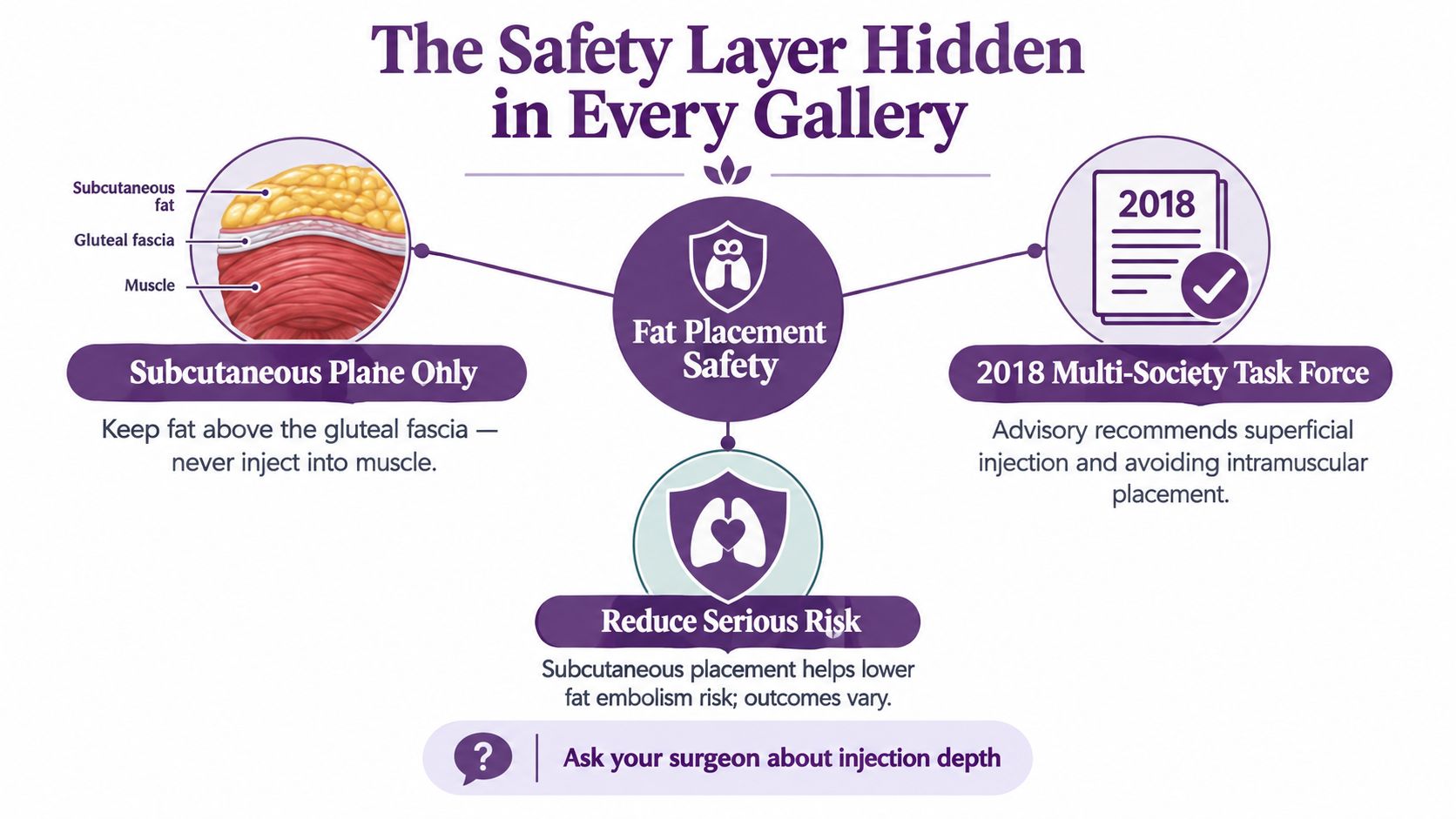
The most important hidden detail is the injection plane. The 2018 Multi-Society Task Force recommendation clarified that fat should never be injected into the gluteal muscle. It should be placed only in the subcutaneous tissue above the muscle fascia, because deep or intramuscular injection can allow fat to enter large vessels and cause pulmonary fat embolism. Read the review of gluteal fat-grafting safety and injection depth.
The safety history is serious. A South Florida mortality analysis recorded 25 BBL-related fat-embolism deaths from 2010 through 2022, including 14 after 2018 safety guidance and Florida's 2019 subcutaneous-plane rule. During 2019 through 2022, the analysis recorded 13 BBL-related deaths from fat embolism and other causes. Florida regulations adopted in 2022 required ultrasound guidance to confirm placement above the deep gluteal fascia and limited surgeons to three BBL procedures per day. Review the South Florida mortality analysis.
What the photograph cannot prove
The American Society of Plastic Surgeons later summarized safety estimates at approximately one death per 15,000 procedures, while emphasizing subcutaneous-only injection, suitable cannula design, controlled injection, and ultrasound use. Review the professional safety advisory on gluteal fat grafting.
A photo cannot show the cannula position, the injection depth, the anesthesia protocol, facility standards, or emergency readiness. Ask specifically whether real-time ultrasound was used and how the surgeon confirms that fat remains above the muscle. For a fuller explanation of risks, see this guide to BBL safety.
Questions to Ask Before You Trust a Gallery
Bring the gallery to the consultation, but don't stop at “Can I get this result?” Ask questions that expose the clinical details behind the image.

Questions about technique
- Injection plane: “Will all fat be placed in the subcutaneous tissue above the muscle fascia?”
- Ultrasound verification: “Will you use real-time ultrasound during injection, and what exactly will you monitor?”
- Cannula and direction: “What cannula design and injection approach do you use to reduce the chance of deep entry?”
- Planned volume: “How much fat do you realistically expect to transfer for my anatomy?”
- Combined procedures: “Will liposuction or another procedure change how my before-and-after images should be interpreted?”
Questions about the setting
Ask who will perform the surgery, what credentials and relevant experience they have, and how often they perform BBL procedures. Confirm that the facility is appropriately accredited, ask how thromboembolism risk is assessed, and find out what happens if an emergency requires transfer.
Finally, ask about follow-up. You need a clear contact route, planned postoperative assessments, warning signs, and a process for evaluating asymmetry, fluid collections, infection, or unexpected pain. Vague answers about safety deserve caution, regardless of how impressive the gallery looks.
How BBL Longevity Compares With Implants
A long-lasting result and a stable result are not the same thing. BBL volume comes from living fat, so the outcome changes with fat survival, weight shifts, and the way your tissue settles over time. That matters when you judge before-and-after photos. A great early image can still soften, shrink, or look different months later.
Implants follow a different logic. The device creates the projection, which makes volume less dependent on donor fat or postoperative fat retention. That can sound simpler, but implants bring their own tradeoffs, including displacement, firmness, and capsular contracture. A BBL avoids implant-specific issues and adds body contouring through liposuction, but it does not give you fixed, device-based volume.
The smart comparison is not which option looks better in a gallery. It is which type of change fits your anatomy and your tolerance for revision. If you are lean and want a stronger size increase than your donor fat can realistically provide, implants may offer more structure. If you want a result that feels like your own tissue and also improves the waist-to-hip transition, fat grafting may make more sense.
Touch-ups can happen with either path. Treat that as part of the decision, not a surprise after the photos.
Key BBL Terms You Will Hear in a Consultation
- Subcutaneous plane: The tissue layer above the gluteal muscle where fat should be placed under current safety recommendations.
- Intramuscular injection: Placement into the muscle. This is a safety concern and should not be used for BBL fat grafting.
- Retrograde injection: Depositing fat while withdrawing the cannula rather than injecting in one deep stationary point.
- Cannula: A slender tube used to harvest or transfer fat.
- Fat embolism: A potentially life-threatening event in which fat enters the bloodstream and travels to the lungs.
- Seroma: A collection of fluid that can form after surgery.
- Donor site: The area where liposuction removes fat for transfer.
- Fat retention: The proportion of transferred fat that remains after healing and resorption.
- Jackknife position: A surgical position used in some gluteal procedures to help the surgeon access and monitor the treatment area.
- Awake surgery: A procedure performed with local anesthesia for selected patients, not a promise of zero discomfort or zero risk.
Use these terms to make the consultation more precise. If a surgeon explains a different technique, ask what tissue plane, imaging method, and safety protocol support it.
A Smarter Way to Judge a Before-and-After
A BBL gallery becomes useful when you read the image alongside its missing context. Ask four questions every time:
- How much time passed? An image taken soon after surgery may show swelling and temporary fullness.
- What technique was used? Look for subcutaneous-only placement, real-time ultrasound, and the role of liposuction.
- What was the starting anatomy? Donor-fat availability, skin elasticity, asymmetry, and weight stability shape the result.
- What safety information accompanies the photo? A responsible presentation should discuss injection depth, facility standards, credentials, complications, and follow-up.
Don't compare your body with a curated outlier and call the difference a promise. Compare photography conditions, patient anatomy, timing, and technique. Then use the image to start a consultation, not to make the decision for you.
A credible surgeon should explain what can be achieved, what can't, and how the result may change as swelling resolves and fat retention becomes clearer. The best gallery isn't necessarily the one with the most dramatic transformation. It's the one that gives you enough information to judge whether the transformation is relevant to your body and whether the procedure was approached responsibly.
Luxe Aesthetic Surgery & Medical Spa offers Brazilian butt lift and autologous fat-grafting consultations for patients evaluating body contour, donor-fat availability, and realistic before-and-after expectations. Visit Luxe Aesthetic Surgery & Medical Spa to review the practice's body-contouring services and request a personalized consultation.