
Medical Expertise at Luxe Aesthetic Surgery
Luxe Aesthetic Surgery & Medical Spa is led by Haimesh Shah, MD, RPVI , a physician specializing in cosmetic surgery, body contouring, laser procedures, and venous medicine. Dr. Shah is a Diplomate of the American Board of Laser Surgery, American Board of Venous & Lymphatic Medicine, American Board of Wound Management, and American Board of Internal Medicine. He also holds the Registered Physician in Vascular Interpretation (RPVI) credential and has contributed to peer-reviewed medical research.
You notice it when a bra cups one side neatly but gaps on the other, or when a photograph makes one breast look higher, fuller, or more projected. You may have started by searching for a larger implant for the smaller side, only to find that breast augmentation for uneven breasts involves more than choosing two volumes. The breast fold, chest wall, nipple position, skin envelope, and tissue thickness can all shape the result.
The right plan begins by identifying what differs. From there, a surgeon may consider unequal implants, a lift, reduction, fat grafting, fold adjustment, or a staged combination. You'll also need to weigh candidacy, awake surgery under local anesthesia, recovery, implant monitoring, and the attainable goal of improved proportion rather than biological perfection.
Table of Contents
- Why Uneven Breasts Are Normal and Worth Evaluating
- What Causes Breast Asymmetry Beyond Size
- Surgical and Nonsurgical Ways to Improve Symmetry
- How Surgeons Measure and Plan Balanced Results
- Are You a Candidate and Is Awake Surgery an Option
- Risks Recovery Longevity and What Symmetry to Expect
- Reviewing Before and After Photos and Choosing Next Steps
Why Uneven Breasts Are Normal and Worth Evaluating
You may notice the difference while adjusting your bra: one strap slips, a neckline sits unevenly, or padding seems useful on only one side. A photograph can make the contrast look stronger because posture and lighting change how the breasts appear. A small anatomical difference can then become a daily source of self-consciousness.
Asymmetry itself is common. In a 2024 study of 2,051 patients undergoing primary augmentation mammoplasty, 1,008 patients, or 49.1%, had noticeable differences in breast size. The left breast was larger in 638 patients, or 31.1% of the full cohort, while the right was larger in 370 patients, or 18.0%. The same study found chest-wall or rib prominence in 274 patients, or 13.3%, showing that uneven appearance may involve the underlying structure as well as breast tissue. The published study on breast and chest-wall asymmetry puts the issue in context: asymmetry is an anatomical planning concern, not an unusual complication.
A useful change in perspective: asymmetry is a feature to measure and plan around, not a personal failure or proof that your body is abnormal.
A consultation should clarify what differs on each side. Is one breast smaller, or is its base also narrower? Is one fold lower? Are the nipples at different heights? Does one side of the chest wall project farther forward? These measurements explain why identical implants rarely create identical-looking breasts. An implant follows the pocket, fold, chest wall, and available tissue on its side, much like the same cushion can sit differently on two differently shaped chairs.
The goal is improved balance in a bra, swimsuit, clothing, and often without clothing. Surgery cannot erase every skeletal or soft-tissue difference. Careful planning instead guides choices such as side-specific implants, fold adjustment, lifting, fat grafting, or a staged approach. The broader evaluation also considers awake surgery under local anesthesia, recovery, implant monitoring, and the practical goal of improved proportion rather than biological perfection.
What Causes Breast Asymmetry Beyond Size
A patient may notice that one breast fills a bra differently, yet the underlying difference may involve position, shape, skin, or the chest wall. These factors often overlap, which is why placing identical implants on both sides rarely produces identical-looking breasts.
Volume is only one part of the picture
One breast may have less tissue, but measured volume does not describe the whole breast. Base width matters. A broad breast footprint can look fuller across the chest even when total volume is similar, while a narrower base can make the same implant appear more projected.
Position creates another mismatch. One nipple may sit higher, one breast may rest lower, or one inframammary fold may be higher than the other. The fold is the crease beneath the breast where it meets the chest. If the folds differ, matching implants can still finish at different heights because each implant follows the pocket and lower boundary on its own side.
The chest wall can change the visual result
The ribs and chest wall form the foundation beneath the breast. The 2024 cohort study cited above found chest-wall or rib prominence in 13.3% of patients, with the left side more prominent in 9.8% and the right side in 3.5%. A surgeon may palpate the ribs along the inner and outer breast borders, compare how far each side projects, and check whether the fold sits over a different part of the chest. This examination helps separate a breast-tissue difference from a structural difference.
A patient may see the result as an outer contour change, a shifted fold, or a breast that points in a different direction. Posture can make the difference look stronger in photographs, but it does not create the underlying anatomy.

Skin and nipple position influence matching
Thinner tissue or stretched skin may respond differently to an implant than firmer, more constrained tissue. For each side, the consultation should record soft-tissue thickness, breast-base width, nipple-to-fold distance, nipple height, and the position of the fold. These measurements guide whether the plan should address volume, implant profile, fold position, lift, or more than one factor.
A clear description helps: “The left side has more volume, the right fold is higher, and the nipples are not level.” Side-specific examination turns that observation into practical choices. It also sets a realistic expectation: surgery can improve proportion, but it cannot erase every difference in bone, muscle, skin, or breast tissue.
Surgical and Nonsurgical Ways to Improve Symmetry
The best correction depends on the pattern, not on a standard implant package. Some patients need more volume on the smaller side. Others need the larger side reduced, a lower breast lifted, or both sides adjusted to account for different folds and tissue envelopes.
| Asymmetry pattern | Common approach | Consideration |
|---|---|---|
| One breast has less volume | A larger implant on the smaller side, or fat grafting | Implant dimensions still need to respect each breast's base width |
| One breast sits lower | Lift on the lower side, sometimes with augmentation | Nipple and fold position may need separate attention |
| One breast is larger and heavier | Reduction of the larger side, with or without implants | Removing tissue can change both volume and breast position |
| Different width or projection | Different implant profiles or volumes | Matching cup size alone may create an unnatural footprint |
| Mild contour difference | Fat grafting | The result is incremental and may require repeat treatment |
| Several mismatches together | Combination or staged surgery | More than one procedure may be needed to address volume, skin, and position |
Implants, lift, reduction, and exchange
Unequal implants can provide a predictable volume change when the main problem is size. The surgeon may select different volumes, widths, or profiles rather than placing identical devices.
A breast lift addresses position and excess skin. It doesn't replace volume in the same way an implant does, so a lift may be paired with augmentation when one side is lower and less full.
A reduction can bring the larger breast down toward the smaller one. The final target might match the smaller side, or both breasts might be adjusted toward a size between the two.
An implant exchange may be considered when existing implants contribute to the difference through size, position, pocket changes, or age-related tissue changes. The plan still requires a fresh examination, because replacing implants alone won't necessarily correct an uneven fold or nipple position.
Fat grafting and supportive camouflage
Fat grafting uses your own tissue to add volume or refine contour. It can be useful when the difference is modest or when a patient wants incremental shaping without relying only on an implant. A small retrospective study of 32 patients with congenital breast asymmetry reported 93% breast symmetry in both the implant and lipografting groups, with no statistically significant difference in satisfaction or perceived symmetry. However, the lipografting group averaged 2.9 procedures, compared with 1.3 procedures for implant augmentation. The study comparing implants and autologous lipografting was small and retrospective, so it's best used for expectation-setting rather than as a universal rule.
For everyday clothing, a professionally fitted bra or padded bras for daily wear can camouflage a difference without changing your anatomy. That can be useful before surgery, during recovery, or if you decide that a nonsurgical solution meets your needs.
For an overview of implant shape and profile considerations, you can also review round versus anatomical breast implants. The decision should remain tied to your measurements, tissue, and desired proportions.
How Surgeons Measure and Plan Balanced Results
A careful consultation doesn't begin with “What cup size do you want?” It begins with a side-by-side anatomical assessment. Cup size varies among bra manufacturers and doesn't describe base width, projection, fold height, or chest-wall shape.
The measurements that change the plan
The surgeon should assess each breast independently, including:
- Base width: This helps determine how wide an implant can be without extending too far toward the armpit or sternum.
- Soft-tissue thickness: This affects how much implant contour may be visible or palpable.
- Nipple-to-fold distance: A difference can signal that the lower breast shape or fold requires separate attention.
- Inframammary-fold position: A higher or lower fold can make matched implants appear uneven.
- Nipple position: The nipple and areola may need a lift or repositioning when volume correction alone won't align them.
- Chest-wall shape: Rib prominence and thoracic contours can influence projection and the apparent direction of each breast.
FDA-reviewed implant information states that implant size should correspond to chest-wall dimensions, including base width, tissue characteristics, and projection. It also emphasizes individualized discussion of implant shape, size, surface, and placement. The FDA-reviewed implant documentation supports choosing implants by anatomy rather than by a target cup size.
Sizers and three-dimensional planning
During a consultation, physical sizers can show how different widths and projections change the balance. Three-dimensional imaging can add another layer by allowing you and the surgeon to compare height, width, projection, and volume relative to each side.
In one published asymmetric-breast case, a handheld imaging system and planning software helped select a 140-mL, full-height, low-projection, anatomically shaped cohesive-silicone implant for one breast. The case report on three-dimensional simulation illustrates the value of side-specific visualization, but simulation isn't a promise of the final result. Implant settling, scar formation, muscle movement, skin stretch, pregnancy, and weight changes can all alter the outcome.
Ask to see how the left and right sides were measured separately. You should understand why the proposed plan uses equal or unequal implants, whether a fold adjustment or lift is included, and what residual difference may remain.
Are You a Candidate and Is Awake Surgery an Option
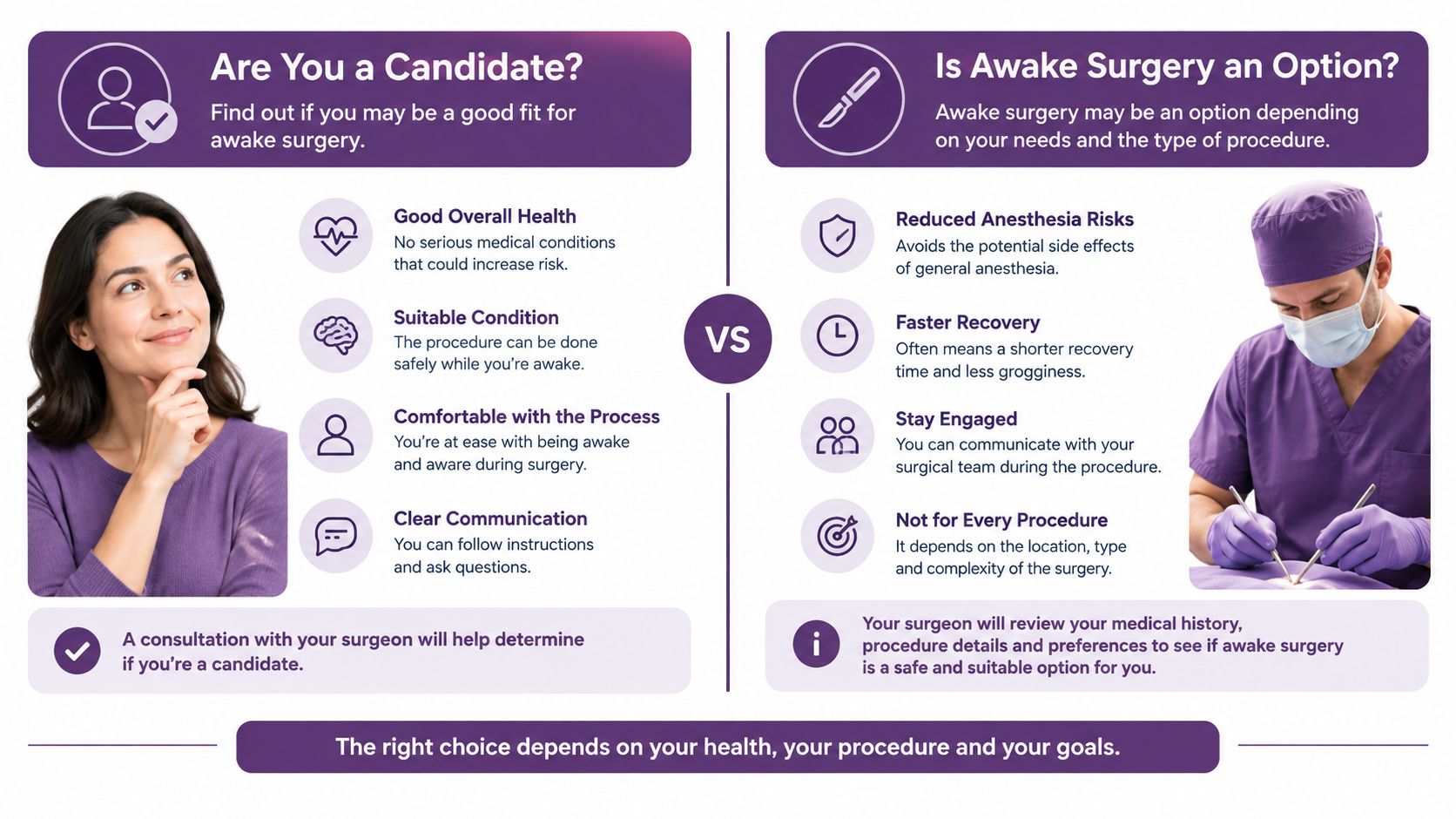
Candidacy depends on more than wanting a particular implant size. A surgeon will review your general health, breast development, weight stability, smoking or nicotine use, medications, prior operations, pregnancy plans, and expectations. If your breasts are still changing, or if major weight fluctuation is likely, waiting may make planning more reliable.
You should also be comfortable with a goal of proportion rather than perfect identity. Someone who expects the breasts to become mirror images may feel disappointed even after a technically appropriate correction. Someone who understands the limits of the chest wall, folds, nipples, and skin is better prepared to evaluate the result fairly.
What awake surgery means
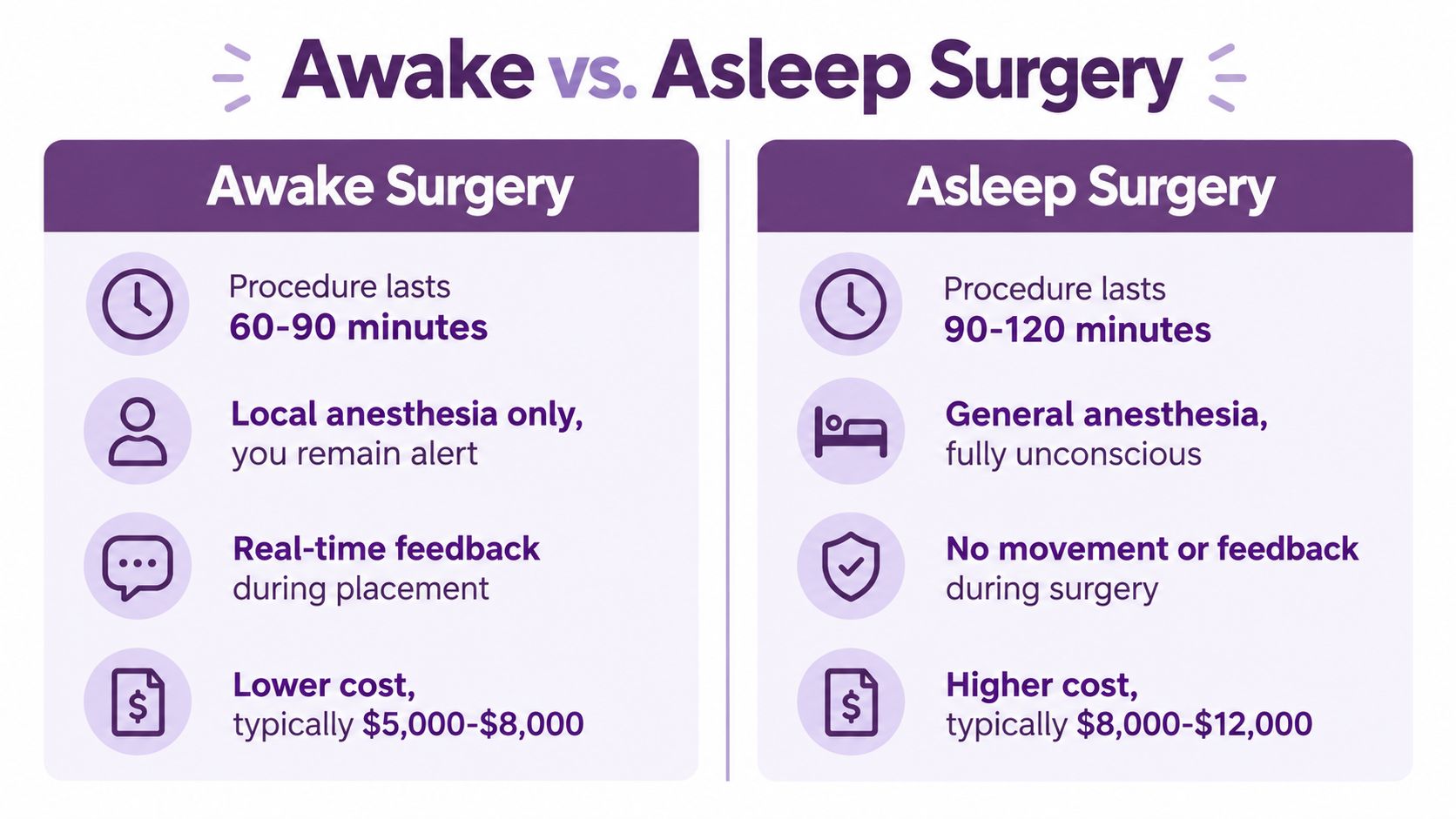
Luxe Aesthetic Surgery & Medical Spa offers awake breast augmentation for selected patients, with treatment planning adapted to anatomy and goals. In this context, “awake” means the procedure may be performed using local anesthesia while you remain alert, rather than receiving general anesthesia. That option isn't suitable for everyone, and the choice depends on the procedure, your anatomy, medical history, comfort, and the surgeon's assessment.
Local anesthesia doesn't mean risk-free or discomfort-free. It also doesn't eliminate the need for careful monitoring, sterile technique, emergency planning, and an honest discussion of whether the planned correction can be performed appropriately in that setting. A more involved combination of augmentation, lift, reduction, or fold adjustment may require a different anesthesia plan.
Before choosing an anesthesia approach, ask:
- Medical history: Which conditions, medications, allergies, or prior reactions affect eligibility?
- Surgical scope: Can the full asymmetry correction be completed appropriately under local anesthesia?
- Comfort plan: What sensations should you expect, and how will discomfort be managed?
- Facility and monitoring: Where will the procedure occur, and what monitoring and aftercare are provided?
- Contingency planning: What happens if the planned approach needs to change?
For more background on this option, read the guide to breast augmentation under local anesthesia. Dr. Haimesh Shah is a board-certified physician specializing in cosmetic surgery and phlebology, and an in-person consultation is necessary to determine whether awake care is appropriate for your situation.
Risks Recovery Longevity and What Symmetry to Expect
Improved balance doesn't mean every difference disappears. A higher fold, a prominent rib, a nipple that sits differently, or unequal skin quality can leave a small residual variation. Healing can also occur at different rates on the two sides, especially when each breast receives a different procedure.
The FDA lists asymmetry among local complications of breast implants, alongside capsular contracture, reoperation, implant removal, rupture or deflation, wrinkling, scarring, pain, and infection at the incision site. FDA patient information on breast implants explains why augmentation should be viewed as a long-term medical decision rather than a permanent guarantee of identical appearance.
Recovery requires patience
Early swelling, tightness, soreness, and uneven settling can make the breasts look more different before they look more balanced. Follow your surgeon's instructions about incision care, supportive garments, sleeping position, lifting, exercise, and follow-up visits. Don't judge the final match while tissues are still changing.
Contact your surgeon promptly if you notice an unexpected change, increasing pain, marked swelling, redness, drainage, a new lump, or a sudden change in shape. A new or rapidly developing difference shouldn't automatically be attributed to normal healing.
Implants need ongoing management
Silicone-gel implants can rupture without obvious symptoms. For asymptomatic patients, FDA labeling recommendations state that the first ultrasound or magnetic-resonance imaging examination should occur 5 to 6 years after surgery, followed by repeat imaging every 2 to 3 years. If symptoms develop or ultrasound findings are uncertain, MRI is recommended. The FDA's implant risk and complication guidance identifies MRI as the most effective method for detecting silent silicone-implant rupture.
Implants aren't lifetime devices, and the chance of complications increases as implantation time lengthens. Future surgery may involve removal, replacement, or correction of a later change in shape. For a broader discussion of maintenance and expected implant lifespan, see this guide to how long breast implants last.
Reviewing Before and After Photos and Choosing Next Steps
Before and after galleries are most useful when you compare patients with a similar starting pattern. Look for differences in breast volume, fold height, nipple position, chest-wall shape, skin quality, and the type of procedure performed. A result from symmetrical breasts may not tell you much about what's realistic for a patient whose folds or rib projection differ substantially.
How to read examples carefully
Check whether the photographs use similar lighting, posture, camera angle, and distance. Look at the breast outline, lower fold, nipple level, upper-pole fullness, and outer contour rather than focusing only on cup size. Ask whether the example involved implants alone, a lift, reduction, fat grafting, or a staged plan.
You can also review personal portrait and body-image photography, such as a boudoir photography gallery, to think about how posture, lighting, and perspective affect the way bodies appear. That kind of visual awareness can help you describe what bothers you, but it isn't a substitute for clinical measurements.

Bring photographs that show your concern clearly, along with a list of medications, prior breast procedures, pregnancy history, weight changes, and your preferred level of intervention. Ask for a written explanation of the differences between the two sides and why the proposed plan addresses each one.
A useful consultation checklist includes:
- Anatomy: Which differences involve volume, fold, nipple position, tissue, or chest wall?
- Procedure: Will the plan use implants, a lift, reduction, fat grafting, or a combination?
- Side-specific choices: Will implant volume, width, or profile differ between breasts?
- Staging: Is one operation appropriate, or might refinement require another procedure?
- Anesthesia: Is awake surgery suitable, and what are the alternatives?
- Follow-up: What monitoring and future implant care will be required?
Luxe Aesthetic Surgery & Medical Spa provides cosmetic surgery and aesthetic treatment planning for patients in Southern California, including breast augmentation, breast lift, and breast implant exchange options. Visit Luxe Aesthetic Surgery & Medical Spa to request a consultation focused on your measurements, realistic symmetry goals, and whether an awake or combined approach fits your needs. Bring your questions and ask for a plan that treats each side as its own anatomical structure.