Medical Expertise at Luxe Aesthetic Surgery
Luxe Aesthetic Surgery & Medical Spa is led by Haimesh Shah, MD, RPVI , a physician specializing in cosmetic surgery, body contouring, laser procedures, and venous medicine. Dr. Shah is a Diplomate of the American Board of Laser Surgery, American Board of Venous & Lymphatic Medicine, American Board of Wound Management, and American Board of Internal Medicine. He also holds the Registered Physician in Vascular Interpretation (RPVI) credential and has contributed to peer-reviewed medical research.
You are standing in the bathroom the night after surgery, shirt off, trying to decide whether the swelling on one side looks worse than it did at lunch. That question is the heart of gynecomastia surgery post op care. Most of the rules exist so you can tell ordinary healing from a problem that needs a same-day call, and your surgeon's written plan overrides any general schedule below.
Table of Contents
- Recovery Timeline From Surgery Day to Month Twelve
- Pain Control and Drain Care in the First Days
- Compression Garment and Incision Care at Home
- Activity Limits and the Return to Exercise
- Normal Healing Versus Warning Signs to Act On
- Follow-Up Visits and Changes After Month Three
- Confirm Your Post-Op Plan Before Your Surgery Date
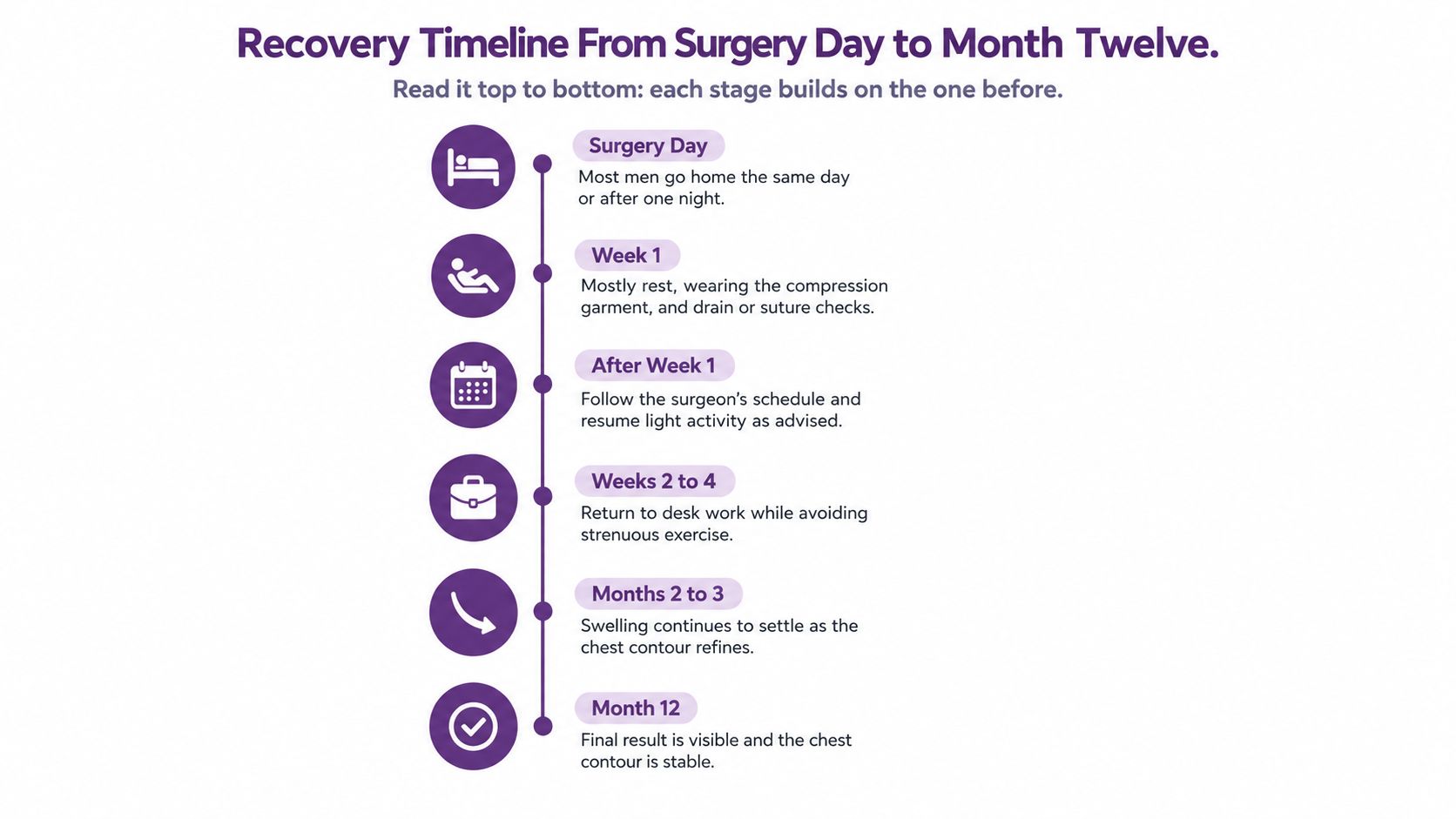
Recovery Timeline From Surgery Day to Month Twelve
Read the milestones top to bottom. Each phase builds on the one before it, and none of them is the day the chest looks finished.
| Phase | Activity Milestone | Visit or Drain Milestone | Garment Milestone |
|---|---|---|---|
| Surgery day to day 1 | Same day or after one night; rest and no strenuous activity | First check around day 1; drains may be in place | Garment worn continuously |
| Days 2 to 7 | Ordinary daily activities; many men return to work if the job is not physically demanding | Drains and sutures removed once output is low, often around day 7; one-week visit | Garment worn continuously until the first postoperative visit |
| Weeks 2 to 4 | Lower-body and cardio activity may be cleared after about 2 weeks | 1-month visit | Garment reduced to about 18 hours a day after week one |
| Weeks 4 to 8 | Chest and upper-body workouts added gradually after about 4 weeks | Exam schedule set by the surgeon | Garment usually continued for 6 to 8 weeks in total |
| Month 3 | Contour still settling and scars still maturing | 3-month visit | Garment use complete for most patients |
| Month 12 | Final contour assessment and long-term review | 12-month visit | Not applicable after garment phase |
How to place yourself on the table
Find today's date, then read across that row only. If you are on day 3, you are still in rest, garment wear, and drain or suture checks. You are not at the stage where the chest should look final.
A 2026 study of 82 men with grade III gynecomastia scheduled follow-up at about 1 day, 1 week, and 1, 3, and 12 months. Sutures and drainage tubes could generally come out at about 7 days when drainage was below 10 mL in the prior 24 hours. Recovery and drain removal were no longer than 7 days for 98.8% of those men. One man, about 1.2%, needed drainage for 15 days, with recovery extending to 2 months. Most went home the day of surgery or stayed 1 day.
Practical rule: Treat those numbers as typical ranges from that series, not a promise for your chest. Bleeding, fluid, technique, and how much tissue was removed change the clock, and the written schedule from your surgeon wins.
If liposuction was part of your operation, the early swelling pattern has a lot in common with what to expect while healing after liposuction. Firmness and symmetry keep changing through the later visits, long after the skin has closed.
Pain Control and Drain Care in the First Days
The first nights are a short routine, not a test of toughness. Each step has a reason.
- Take pain medicine on the schedule you were given. Waiting until soreness is severe makes the next dose work harder, and you should tell the surgeon about every medicine and supplement you already use.
- Ask before aspirin, ibuprofen, or other products that thin the blood. Bleeding risk is the reason. A product that felt harmless last month can matter this week.
- Expect tightness, soreness, and bruising. Those are common in the first days. Pain that grows worse instead of easing is the warning, not the bruise itself.
- Ask which sleeping position is safe for your incisions. If you are told to stay propped, use pillows so the upper body stays supported and you don't roll onto a fresh wound.
- Keep a simple drain log. Write the time and the amount, then bring the log to every visit so the team can see the trend, not a single reading.
- Never pull, slide, or stop a drain on your own. The tube is there to move blood or fluid out. Stopping it early can leave that fluid under the skin.
Why the tube isn't on a fixed day
Drains aren't placed after every gynecomastia operation. When a surgeon does use one, an ASPS patient-planning note says it may stay about 24 to 48 hours, but removal follows output and the surgeon's check, not a calendar date. In a systematic review of 7,294 patients, hematoma was the most common documented complication at 5.8% and seroma at 2.4%. Studies that routinely used drains reported hematoma or seroma in 9.78% of cases, versus 8.36% without drains, a gap that may reflect more severe cases getting drains rather than the tube itself causing trouble.
A helper for the first night makes the log and the medicine schedule much easier. Ask when you may drive, because prescribed pain medicine can dull alertness, and don't drive until you are cleared. Ask the same person about showering so those answers come from your own surgeon.
Compression Garment and Incision Care at Home
The garment is medical equipment, not a fashion layer. It limits swelling and helps the new chest contour stay supported while tissue planes stick down.
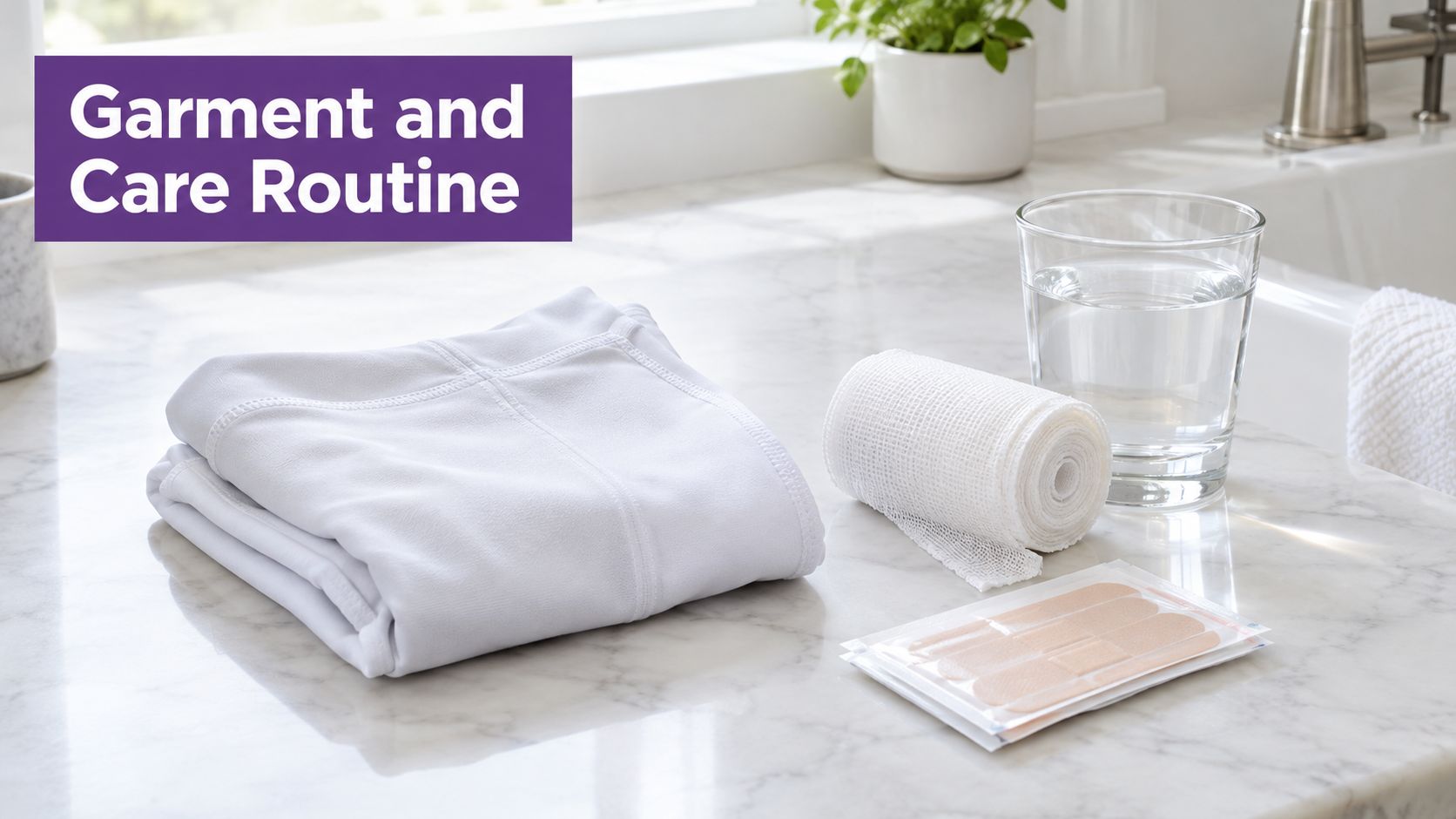
Published postoperative guidance recommends continuous wear until the first visit, then about 18 hours a day after the first week, commonly for 6 to 8 weeks. Duration shifts with how much tissue was removed, whether liposuction was done, skin laxity, and any complication.
The wear sequence
- Wear it continuously until the first postoperative visit. Brief removal only if your instructions allow it for hygiene.
- After week one, follow the hours you were given, commonly about 18 a day, not a guess based on comfort.
- Keep the total course the surgeon set, often 6 to 8 weeks, longer if swelling or skin laxity calls for it.
- Check the fit every morning. Snug and even is the target. Rolling edges, bunching under the arms, or a band that causes numbness, color change, or trouble breathing means the fit is wrong.
- Leave foam dressings alone until the team takes them off. They spread pressure and limit empty space under the skin.
- Keep a spare so one can be washed and fully dry while the other stays on.
- Keep incisions clean and dry. Follow the shower rules you were given, skip soaking, and don't add cream or tape unless it was approved.
Early redness along a closed line can be ordinary. A gap that opens, thick raised scar tissue, or drainage that won't stop should be reported rather than covered up.
Scars take months to fade, which is why early judgment is a poor one. The same patience shows up in how liposuction scars are prevented and cared for. If the garment leaves a deep groove, call before you "fix" it by leaving it off for the afternoon.
Activity Limits and the Return to Exercise
Limits are timed, not a ban on all movement. Walking around the house is useful. A set of push-ups is not.
ASPS guidance on a gynecomastia postop routine describes a staged return, and one protocol defines strenuous activity as anything that raises blood pressure.
- Days 1 to 2: Many men resume ordinary tasks and desk work if the job isn't physical. The reason is circulation, not fitness.
- First 2 weeks: Skip anything that spikes blood pressure. A calm chest can still bleed or fill with fluid when effort climbs.
- After about 2 weeks: Lower-body work and more cardio may be cleared. Arms stay quiet.
- After about 4 weeks: Chest and upper-body training, including push-ups, bench press, and heavy lifting, comes back in small steps unless you were told otherwise.
What stays off the list until you are cleared
Contact sports, heavy lifting, sit-ups, planks, hot tubs, and saunas wait for a yes. Heat and impact aren't "light" just because the walk to the gym felt easy.
Feeling well is a poor test. Earlier exertion can increase bleeding, swelling, or fluid even when the mirror looks calm. The same staged logic appears in when exercise is reasonable after breast surgery. If swelling, tightness, or new soreness shows up after a session, stop, rest, and mention it at the next contact.
Normal Healing Versus Warning Signs to Act On
The early problems that change the plan are hematoma (a blood collection), seroma (a fluid collection), infection, and wound trouble. Firmness, bruising, and mild uneven swelling can look like those problems. Speed, which side, and the company the symptom keeps are what sort them.
| Symptom | What It May Mean | What to Do |
|---|---|---|
| Mild firmness, bruising, and tenderness in the first weeks | Common early healing | Follow the schedule and keep the garment on |
| Even swelling that gradually improves | Expected; swelling can persist for weeks | Continue compression and attend visits |
| One-sided swelling that grows quickly | May signal a blood or fluid collection | Contact the surgeon urgently, the same day |
| Severe or worsening pain, tight skin, or active bleeding | May signal bleeding or fluid build-up | Urgent surgical assessment |
| Fever, wound opening, pus, or persistent drainage | Possible infection or wound problem | Contact the surgeon the same day |
| Dusky, dark, or blue-tinged nipple | Possible circulation problem | Urgent assessment |
| Shortness of breath, chest pain, or sudden calf pain | Possible serious medical complication | Seek emergency care immediately |
| Numbness or unevenness still present after several months | Often part of healing; needs documented follow-up | Discuss at the scheduled visit |
How to use a symptom that isn't on the list
Ask three questions. Did it appear fast or over days? Is it one side or both? Is there pain, fever, color change, or bleeding with it? Slow, even, and mild points toward the first two rows. Fast, one-sided, and painful points toward urgent contact.
In a 2024 study of 81 patients with severe grade 4 gynecomastia, seromas were treated with aspiration and compression, hematomas needed evacuation, and partial nipple-areola hypopigmentation faded on its own within 3 to 6 months. Seven of those patients later wanted a second-stage correction. A normal look in week two is not the final contour. Persistent firmness can be watched for months before anyone talks about revision.
Wound redness with fever or pus is a same-day call, in the same spirit as learning how a skin injury can become infected and which signs shouldn't wait.
If you won't be near the office
Save the after-hours number before you leave the surgical site. Photograph the chest each morning in the same light and the same pose so a change is obvious in the message you send. If you travel between Southern California sites, confirm who answers after hours and where you should go in person. Decide the threshold now: rapid one-sided swelling, active bleeding, or tight shiny skin with severe pain means you call, you don't wait for the next booked visit.
Follow-Up Visits and Changes After Month Three
After the early checks, the questions shift from "is this bleeding?" to "is this the chest I'm going to live with?"
Sensation. Some men notice less feeling at the nipple. A 2025 comparative study found that 11% reported reduced nipple sensation, and every patient surveyed said keeping the nipple mattered. Numbness or extra sensitivity can still be settling at month three, so write it down rather than assuming it is permanent.
A second procedure. In that same study, 9% of patients had a revision. That is uncommon, not vanishingly rare. Residual gland, extra skin, weight change, hormones, medicines, and anabolic-androgenic steroid use can all push toward recurrence or a staged correction.
Scars and mood. Judge scars at later visits, not in week two. In a study of adolescents and young adults, 36% of breasts had at least one recorded complication within a median 8.6 months, most often residual tissue, contour irregularity, or hematoma, yet self-esteem and several quality-of-life measures were better at a median 33.3 months. A flatter chest isn't a promise of a perfect one.
Bring dated photos and a short sensation diary to the 3-month and 12-month visits. Ask which findings are still expected, and when a revision talk would be reasonable. Results aren't a permanently perfect contour.
Confirm Your Post-Op Plan Before Your Surgery Date
The safest recovery starts before the operating day, when you can still change the plan.
- Get written instructions and save the after-hours number before surgery morning.
- Arrange a driver and an adult for the first night. You shouldn't manage drains and medicine alone while still groggy.
- Fill prescriptions early, including the pain medicine that was ordered.
- Review aspirin, ibuprofen, blood thinners, and supplements and follow the stop dates you are given.
- Order the compression garment, have it fitted, and buy a spare.
- Put visits on the calendar. A common pattern is about day 1, week 1, then months 1, 3, and 12.
- Plan the drive if you live far from the site or move between Southern California locations.
- Name who takes the morning photos and who sends them.
Before you book, confirm on the live site which locations offer this surgery, because that page is the source of truth for services. Haimesh Shah, MD, RPVI, Medical Director of Luxe Aesthetic Surgery & Medical Spa, is a board-certified physician specializing in cosmetic surgery and phlebology. At the visit, ask which provider performs your operation, who takes after-hours calls, what happens if drain output rises, and how the plan is matched to your anatomy and health history. Patients who take part in treatment decisions tend to leave with instructions they can follow at 2 a.m.
Luxe Aesthetic Surgery & Medical Spa offers gynecomastia surgery with individualized postoperative instructions for men across Southern California. If you are weighing surgery or already have a date, bring your activity limits, garment questions, and after-hours plan to a consultation. Visit Luxe Aesthetic Surgery & Medical Spa to request a time and confirm the location that fits your recovery.