Medical Expertise at Luxe Aesthetic Surgery
Luxe Aesthetic Surgery & Medical Spa is led by Haimesh Shah, MD, RPVI , a physician specializing in cosmetic surgery, body contouring, laser procedures, and venous medicine. Dr. Shah is a Diplomate of the American Board of Laser Surgery, American Board of Venous & Lymphatic Medicine, American Board of Wound Management, and American Board of Internal Medicine. He also holds the Registered Physician in Vascular Interpretation (RPVI) credential and has contributed to peer-reviewed medical research.
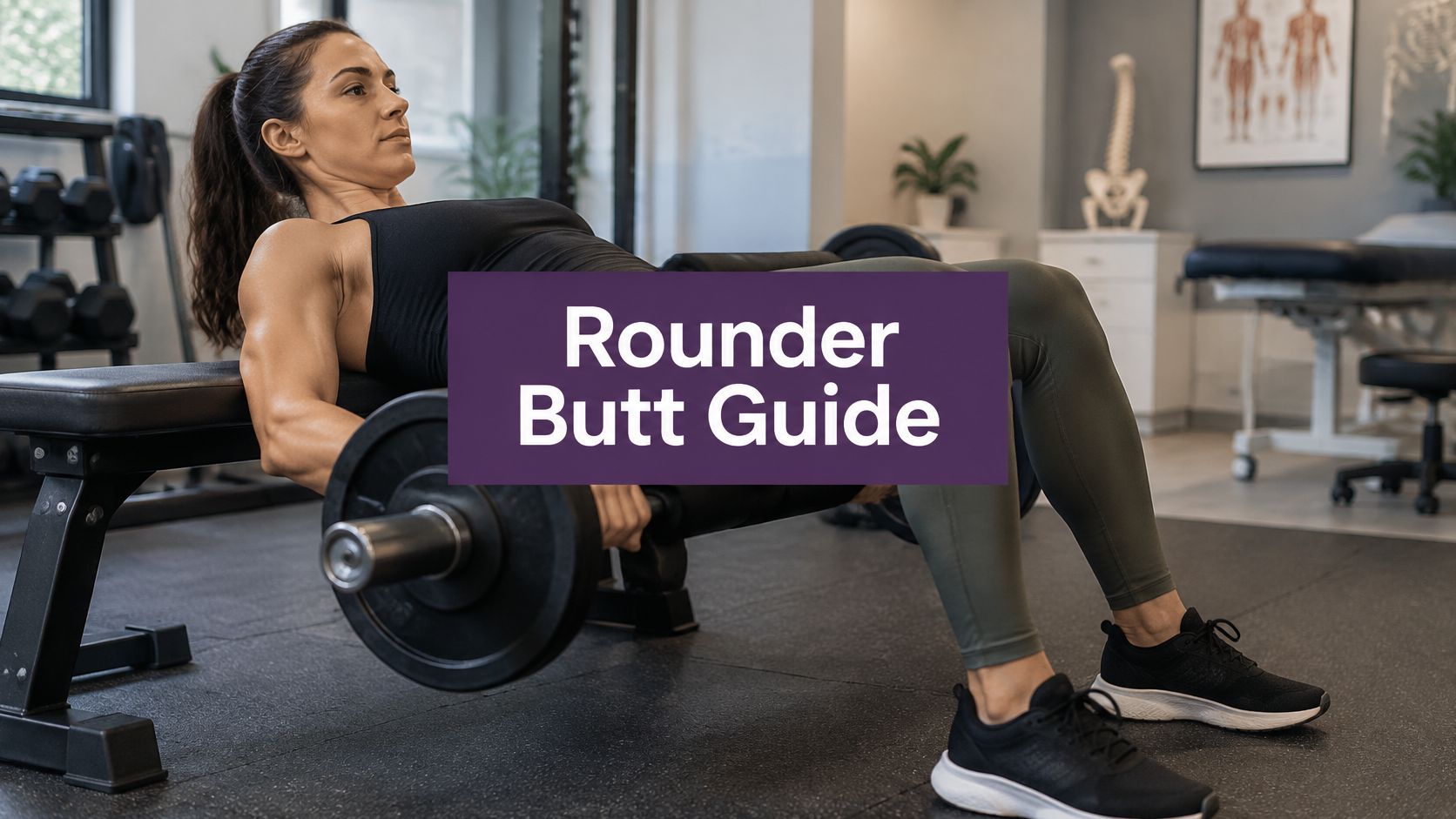
Endless squats, booty bands, and cardio won't reshape one specific area by “burning” fat there. If you're wondering how to get a rounder butt, it helps to separate three different goals: building glute muscle, changing the amount or distribution of fat, and adding volume through a cosmetic procedure. Each works differently, and none guarantees a particular shape.
Your starting point matters. A person with less muscle projection may benefit most from progressive strength training, while someone focused on losing fat elsewhere needs a plan that preserves muscle. If training has stopped producing the change you want, a procedure may be a separate option to discuss with a qualified clinician. Genetics, hip structure, skin quality, posture, and how fat sits over the muscles all influence appearance. You can explore how anatomy and positioning affect appearance in this guide to gluteal-fold photos.
Table of Contents
- What Makes a Butt Look Rounder
- Training Glutes for Visible Size
- Picking Movements You Can Progress
- Protein Sleep and Recovery Habits
- How to Choose Fillers Fat Transfer or Implants
- Timelines Risks and a Consultation Plan
What Makes a Butt Look Rounder
A rounder appearance isn't created by one exercise or one body-fat target. The gluteus maximus, the large muscle that contributes much of the buttocks' projection, is one important factor. Fat distribution, the width and shape of the pelvis, skin quality, and posture also affect how the area looks from the side and back.
That's why two people can follow the same squat routine and see different results. One may build visible projection, while the other notices more strength but little change in silhouette. Genetics and individual anatomy influence where muscle and fat sit, so the same training approach can't promise the same shape for everyone.
Three different goals
If your butt looks flat from the side, building glute muscle may be the most relevant starting point. Progressive resistance training can enlarge the muscle over time, although it can't change the underlying width of your pelvis or dictate where your body stores fat.
If you're aiming to reduce fat in another area, remember that fat loss doesn't happen selectively. Squats, bands, and cardio don't target fat loss from the butt or hips. A calorie deficit may reduce fat overall, but the areas that change first vary by person. If preserving glute size matters to you, maintaining resistance training while losing weight is more relevant than adding more cardio.
A third goal is added volume when training hasn't delivered the change you want, or when your desired change isn't just about muscle. Fillers or biostimulatory products, fat grafting, and implants involve different mechanisms and medical considerations. They're not interchangeable with exercise, and whether any option is appropriate depends on an individual assessment.
A useful starting point: Identify whether you want more muscle projection, a change in overall body composition, or volume added through a procedure. Those goals call for different plans.
No method guarantees a particular shape, a painless experience, or permanent results. Training, nutrition, and recovery can support muscle development, while cosmetic options require a separate discussion of candidacy, expected outcomes, and risks.
Training Glutes for Visible Size
For visible muscle growth, choose lifts that load the glutes through hip extension and lower-body patterns, then gradually make those lifts more challenging. You don't need a crowded circuit of novelty exercises. A 2025 systematic review and meta-analysis of 12 studies found a moderate effect of resistance training on gluteus maximus growth, with a standardized mean difference of 0.71 and a 95% confidence interval of 0.50 to 0.91; the reported p-value was less than 0.00001, and inconsistency between studies was low at I² = 22% (systematic review of gluteus maximus hypertrophy).
The review found that single-exercise protocols and combined routines were both effective. Single-exercise protocols produced an SMD of 0.74, while combined protocols produced an SMD of 0.68. The practical message isn't that you need to train with one lift only. It's that a focused, repeatable plan can work without a long list of exercises.
Build the week around progression
Useful options include barbell hip thrusts, parallel or full-range squats, leg presses, and kneeling hip extensions. Hip thrusts may suit people who want to emphasize hip extension and glute work. Pick movements you can perform with control and repeat consistently, then leave enough recovery between hard sessions.
About 10 sets per muscle group per week is a practical hypertrophy target in American College of Sports Medicine guidance, and those sets can use free weights, machines, body weight, or bands. Beginners may need less at first; more experienced lifters should increase training only when recovery allows.
For example, you might divide glute work across two sessions. One session could include hip thrusts and squats; another could use a leg press and kneeling hip extensions. When your current repetitions feel controlled and manageable, add a small amount of weight or complete another repetition. If your form breaks down or soreness keeps interfering with the next session, hold steady rather than forcing an increase. A progressive squat plan for beginners can help you think about gradual advancement instead of rushing to heavier loads.
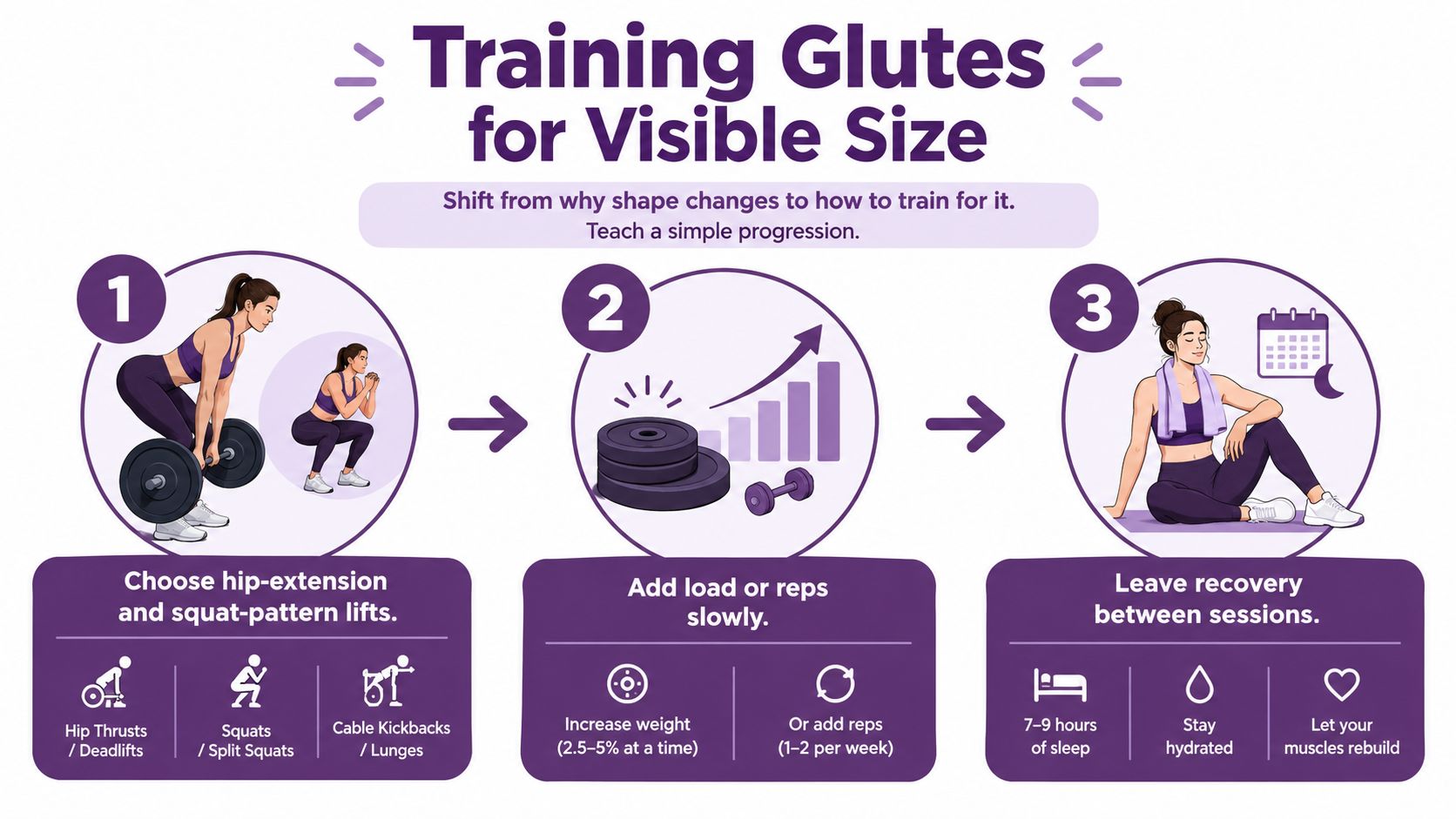
Muscle growth generally takes several weeks or longer, not an immediate change in shape. Genetics, nutrition, training history, recovery, and adherence all affect what you notice and when. Treat the routine as a progressive practice, not a short-term challenge with a guaranteed outcome.
Picking Movements You Can Progress
The exercise with the highest muscle-activation reading isn't automatically the best choice for you. In a study reviewing 24 strength-exercise variations in 231 participants, including 90 women and 141 men, step-up variations produced the highest average gluteus maximus activation at 125.09% of maximum voluntary isometric contraction (MVIC), with observed values from 104.19% to 169.22% (study of glute activation across strength exercises). Loaded deadlifts, hip thrusts, lunges, and squats also produced high activation.
Those figures describe activation during measured exercises, not guaranteed long-term growth. They don't establish a universal “best” movement, and they don't mean every person should prioritize step-ups. Equipment, experience, comfort, and the ability to increase resistance safely matter more when you're choosing exercises to repeat over time.
Match the movement to your body and setup
Step-ups or split squats can add single-leg work and challenge stability. Hip thrusts are an option when you want to emphasize hip extension with less emphasis on the quadriceps. Squats and leg presses can fit well if they feel stable and let you use a controlled range of motion.
Think about what you want to emphasize, too. Someone seeking more overall volume might prioritize a few loadable hip-extension and squat-pattern lifts. Someone working on left-to-right balance may include unilateral movements, performed with a manageable load and controlled technique. Exercise choice can support a goal, but it can't guarantee a specific distribution of muscle growth.
If a movement makes your knees or low back take over, reduce the load, shorten the range, or swap it for a variation you can control. You don't need to push through pain to prove an exercise is effective. Keep a personal menu of two to four movements that you can perform safely and make more challenging over time, rather than changing your plan every week to follow a new viral workout.
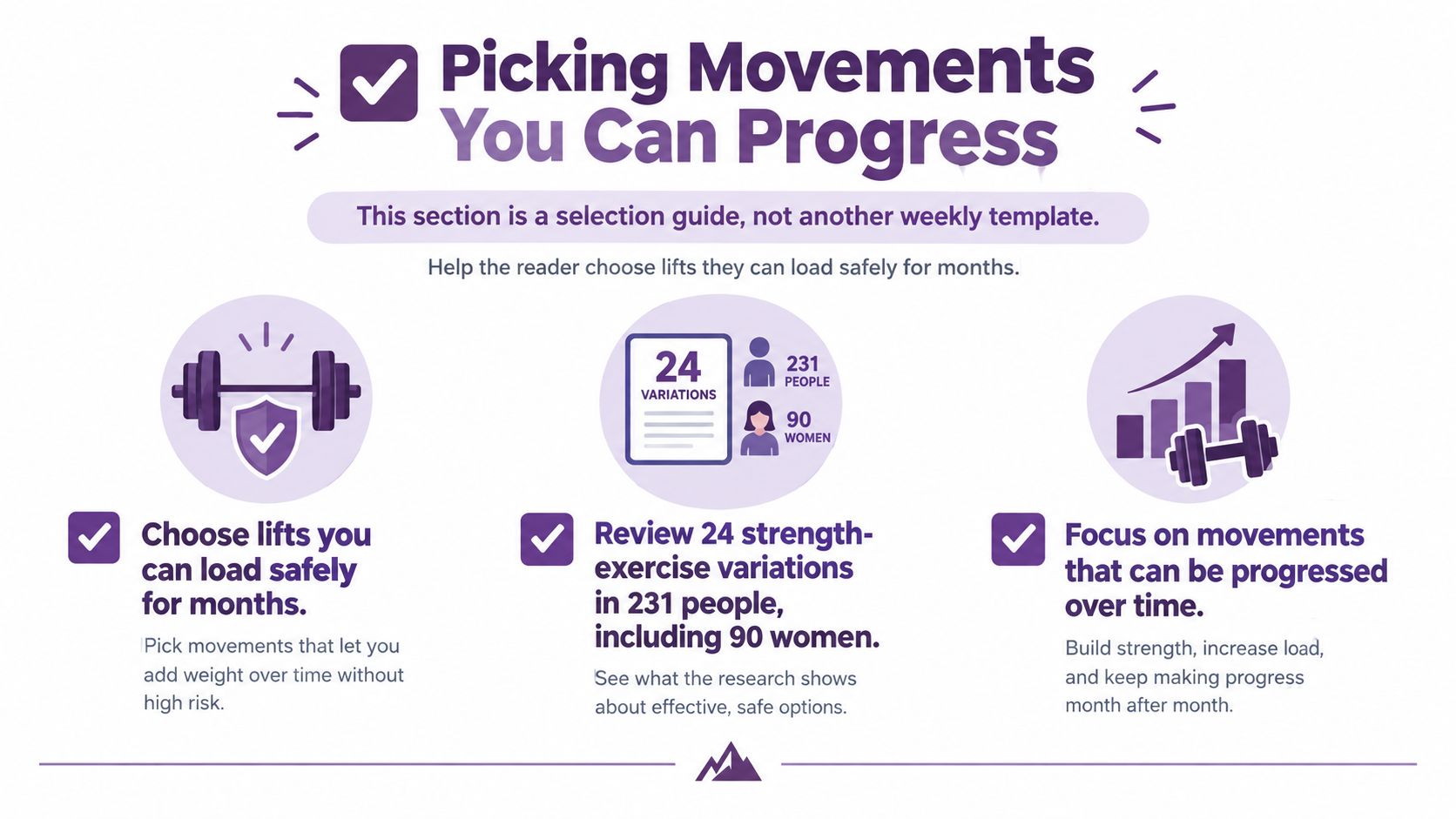
The useful question isn't “Which exercise wins?” It's “Which movements can I do consistently, with sound technique, and progress without aggravating my joints?” That approach lets training experience and recovery guide the plan.
Protein Sleep and Recovery Habits
Training gives your body a reason to adapt; food and recovery help support that process. Protein supplies building blocks for tissue remodeling after resistance exercise, but protein alone won't enlarge your buttocks. Muscle growth still depends on a suitable training stimulus and enough overall energy to support recovery.
The International Society of Sports Nutrition states that exercising individuals generally need about 1.4 to 2.0 grams of protein per kilogram of body weight per day. For a 70-kilogram adult, that works out to roughly 98 to 140 grams daily (protein guidance for exercising individuals). That range is a reference point, not an individualized prescription.
Make the basics practical
You can get protein from ordinary foods such as eggs, dairy, fish, poultry, tofu, and beans. Spread protein across meals in a way that suits your appetite and routine; a nutrition professional can help if you're unsure how to estimate your intake. For accessible ideas about including protein in a muscle-building routine, see this guide to protein and muscle building.
Your body also needs enough total food to train and recover. If you're aggressively dieting while trying to build muscle, the calorie deficit may work against that goal, even when your workouts are well designed. Carbohydrates can help fuel training, while sleep and easy or rest days help you return to hard sessions ready to perform.
Age, training load, protein quality, diet, and medical conditions can all affect individual needs. If you have kidney disease or another health condition, ask a clinician before deliberately raising protein intake.
Before you adjust your plan, check whether you're getting enough protein, enough food to recover, adequate sleep, and time between hard sessions. If soreness or joint pain keeps increasing, reduce training stress and consider a deload rather than trying to push through every workout.
How to Choose Fillers Fat Transfer or Implants
Training changes muscle. A cosmetic procedure may add or reshape volume through a different route, but options aren't interchangeable, and they don't replace the work of resistance training. Nonsurgical products such as fillers or biostimulatory treatments may be considered for selected patients where a qualified clinician offers them. Product choice, candidacy, expected duration, and potential risks need to be discussed during a medical visit.
Fat grafting transfers a person's own fat, typically collected through liposuction, to another area. Implants add a device and require their own discussion of suitability, possible complications, and long-term considerations. Whether either approach fits depends on anatomy, health, goals, and clinician assessment.
A retrospective series of 7,000 fat-grafting cases reported about 70% estimated fat-graft survival and a mean injection volume of about 1,200 cc per buttock. The reported protocol used strict subcutaneous-only placement, avoiding injection into the gluteal muscle, with multimodal venous-thromboembolism prevention; the series reported no pulmonary fat embolism, fat-embolism syndrome, deep-vein thrombosis, or pulmonary embolism (retrospective fat-grafting series). The series reported minor events including seroma (23%), anemia (6.6%), fat necrosis (1.9%), infection (0.43%), hematoma (0.14%), asymmetry (0.29%), and revision surgery (0.21%). These figures describe one retrospective series, not universal complication rates.
Compare the type of change
| Approach | What it changes | Planning point |
|---|---|---|
| Progressive resistance training | Builds glute muscle | Requires sustained training and recovery; shape change varies by person. |
| Fillers or biostimulatory products | May add or stimulate volume in selected patients | Product, candidacy, duration, and risks require a clinician's assessment. |
| Fat grafting | Transfers the patient's own fat to the buttocks | Retention varies, and safety depends on careful surgical planning and technique. |
| Implants | Adds volume using a device | Involves a distinct surgical and device-related risk discussion. |
Luxe Aesthetic Surgery & Medical Spa serves Southern California patients considering body contouring, including Brazilian butt lift and autologous fat grafting. Its Medical Director, Haimesh Shah, MD, RPVI, is a board-certified physician specializing in cosmetic surgery and phlebology, with experience in body contouring and fat grafting. Awake liposuction under local anesthesia is an option only for appropriate candidates; that doesn't mean every buttock procedure is performed awake or that local anesthesia is risk-free. Individualized planning, financing, and current procedure details should be confirmed directly with the practice. If you're weighing a Brazilian butt lift, this discussion of whether a Brazilian butt lift may be right for you can help you prepare questions for a consultation.
Timelines Risks and a Consultation Plan
Muscle shape usually takes several weeks or longer of progressive training to change, and the pace varies. Injectable treatments, if used, have separate timelines that depend on the product and the individual. With fat grafting, the volume seen immediately after treatment shouldn't be treated as the final result; swelling and fat retention affect the appearance as healing progresses.
Maintenance also differs. If you want to preserve training-related muscle, keep resistance work, nutrition, sleep, and recovery in your routine. After a procedure, follow the clinician's instructions and attend follow-up visits so concerns can be assessed rather than guessed at.
Know when to seek care and what to ask
Don't try to manage certain changes on your own. Seek prompt medical care for sudden one-sided swelling, shortness of breath, chest pain, fever, worsening redness, or uncontrolled pain. A history of clotting problems should also be discussed with a clinician before considering surgery.
For a surgical consultation, ask how the clinician will assess:
- Body and skin factors: available body fat, weight stability, skin quality, and existing asymmetry.
- Health considerations: smoking status, medical history, and clotting history.
- Technique and placement: where transferred fat or an implant would sit, and how placement safety is checked.
- Recovery and follow-up: compression, walking or mobility instructions, and how fluid collections or infection will be monitored.
If you're in Los Angeles, Santa Barbara, or Ventura County and considering fat grafting or body contouring, you can request a consultation with Luxe Aesthetic Surgery & Medical Spa to discuss whether an option may fit your goals. The physician determines candidacy after reviewing your health, anatomy, and preferences. You can also review this guide to Brazilian butt lift surgical risks as you prepare questions.
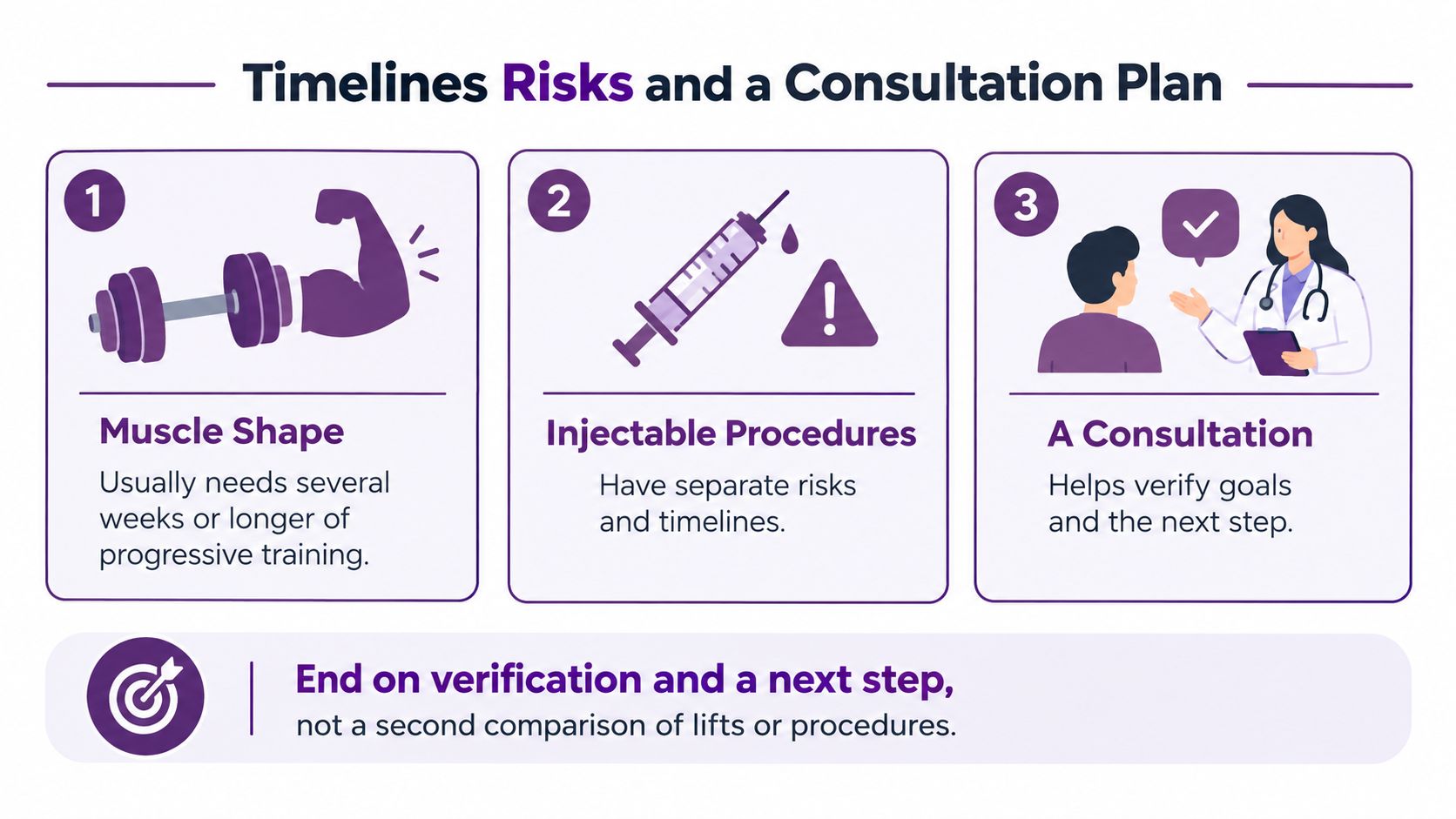
Takeaway: Train consistently, recover well, and treat cosmetic procedures as medical decisions. Your results will depend on your individual body and the option you choose.
Luxe Aesthetic Surgery & Medical Spa offers body contouring consultations, including discussions of Brazilian butt lift and autologous fat grafting for appropriate candidates. If you're weighing muscle growth against added volume, visit Luxe Aesthetic Surgery & Medical Spa to request a consultation and discuss a plan suited to your anatomy and goals.