Medical Expertise at Luxe Aesthetic Surgery
Luxe Aesthetic Surgery & Medical Spa is led by Haimesh Shah, MD, RPVI , a physician specializing in cosmetic surgery, body contouring, laser procedures, and venous medicine. Dr. Shah is a Diplomate of the American Board of Laser Surgery, American Board of Venous & Lymphatic Medicine, American Board of Wound Management, and American Board of Internal Medicine. He also holds the Registered Physician in Vascular Interpretation (RPVI) credential and has contributed to peer-reviewed medical research.
You're home after surgery, reclined carefully on the sofa, wearing support garments, with drains secured beneath your clothing. Getting to the bathroom takes planning, and even a short walk can feel like a significant achievement. That first day can be unsettling, especially when the mirror shows swelling, bruising, and a shape that looks very different from the result you imagined.
Mommy makeover recovery isn't a single “back to normal” date. It's a sequence of functional milestones. Early movement, pain control, drain management, lifting restrictions, and gradual exercise come first. The breasts and abdomen then continue settling for several months, often after you've already returned to work and ordinary routines.
Table of Contents
- What Mommy Makeover Recovery Actually Looks Like
- Week-by-Week Recovery Timeline
- Managing Pain, Drains, and Incisions
- Daily Life at Home with Children and Work
- Returning to Exercise and Full Activity
- Warning Signs and When to Call Your Surgeon
- Optimizing Healing for the Final Result
What Mommy Makeover Recovery Actually Looks Like
A mommy makeover commonly combines a tummy tuck with breast surgery, such as augmentation, a lift, or both. Some patients also have additional contouring procedures, but the recovery is usually governed by the abdominal operation when muscle tightening or extensive skin removal is involved.
On the first day, the practical goal isn't to stand straight or admire your contour. It's to rest, take medication as prescribed, drink fluids, make short assisted walks, and protect the incisions. The early phase is typically hardest during the first one to two weeks, when discomfort, swelling, and bruising are most noticeable. Guidance from the University of Utah's mommy makeover recovery information describes a staged pathway that may include help at home, drainage tubes for two to four weeks, a restriction against lifting more than 10 pounds for at least six weeks, and a return to usual activities around 12 weeks.
Functional recovery comes first
Your first meaningful improvements are functional. You may walk more easily, need less help, sleep more comfortably, and tolerate longer periods upright before your final contour looks settled. Many patients resume light activity within two to three weeks, return to non-strenuous work around three to six weeks, and see much of the contour develop between three and six months, according to this clinical recovery guide for mommy makeover patients.
That difference matters. Feeling capable of desk work doesn't mean the abdominal wall is ready for heavy lifting. A flatter appearance at an early follow-up doesn't mean swelling has finished resolving. Recovery is progressing even when the final aesthetic result is still changing.
The variables that change your timeline
The number and type of procedures matter, but they aren't the only factors. Muscle repair can make the abdomen feel tighter and movement more guarded. Pain tolerance, baseline fitness, incision length, breast implant or lift work, sleep quality, and reliable help at home can all influence the experience.
Practical rule: Plan your recovery around what you'll need help doing, not only around how many days you expect to miss from work.
The sections below use milestones rather than promises. Your surgeon's examination remains more important than any calendar because the safest progression depends on how your incisions, swelling, drains, and movement are developing.
Week-by-Week Recovery Timeline
The first six weeks usually move from protection to controlled independence. Progress can feel uneven. You may have a good morning followed by increased tightness or swelling after doing too much.
Days 1 through 3
Expect fatigue, abdominal tightness, breast soreness, bruising, and slow movement. If a tummy tuck was included, you may naturally walk slightly bent forward at first because standing fully upright can pull on the lower abdominal incision.
Short, supported walks are encouraged early, but they should remain brief. The purpose is circulation and safe mobility, not exercise. Keep drains secured, record their output as your surgical team directs, and ask your caregiver to help with meals, medication organization, bathing logistics, and getting in and out of bed.
Acute pain is commonly most intense during the first one to five days, and bruising and swelling often improve substantially over six to eight weeks, as described in postoperative breast augmentation guidance from the American Society of Plastic Surgeons.
Week 1
Your first follow-up visit allows the team to inspect the incisions, review drain output, and adjust the care plan. Some patients have a drain removed during this period, while others need drainage for longer. Don't treat removal as permission to lift, stretch, or exercise.
Indoor walking should remain frequent and easy. You may still need substantial help at home, especially if your procedure included abdominal tightening. Support garments, a surgical bra, and abdominal compression may be part of your postoperative plan because they help support treated areas and manage swelling.
For additional practical context, Luxe's guide to breast augmentation recovery discusses why breast healing also needs a gradual return to normal movement.
Week 2
Stiffness often begins to ease, although swelling can fluctuate after activity. Light desk work may be possible for some patients, provided they can change position, take short walks, and avoid lifting or reaching.
This is still a protection phase. A patient who feels better can accidentally overdo it by preparing meals, carrying laundry, caring for children, or spending too long upright. Improvement in comfort is useful information, but it isn't the same as clearance for strenuous activity.
Weeks 3 and 4
Many patients can stand more upright and move around the home with greater confidence. Light household tasks may be reintroduced if they don't involve bending repeatedly, lifting, pushing, pulling, or straining the core.
Work demands become important here. Sitting-based work may be manageable before a job that requires prolonged standing, walking, or lifting. Driving should wait until you can move comfortably, react quickly, and take medication that doesn't impair alertness.
Weeks 5 and 6
Your surgeon may begin expanding activity, but the 10-pound lifting restriction commonly remains in place for at least six weeks after a mommy makeover, based on the University of Utah guidance linked above. This includes children, grocery bags, laundry baskets, and pets, not just gym weights.
Light activity can progress only when the incisions remain calm and swelling doesn't increase afterward. Core work, heavy lifting, and impact exercise usually remain off the table until later clearance.
Around 12 weeks and beyond
Many patients reach a broader return-to-routine benchmark around 12 weeks, although the exact timing depends on the operation and healing examination. Full cosmetic settling takes longer. A useful mindset is to separate being functional from being finished.
Managing Pain, Drains, and Incisions
Early care works best when it's organized before surgery. Keep medications, water, a phone charger, tissues, snacks, and your surgeon's instructions within easy reach. A waist-height recovery station reduces unnecessary bending and reaching.
Pain control without guesswork
Take prescribed medication exactly as directed by your surgical team. Some patients use prescription pain medication during the most uncomfortable early days and then transition to over-the-counter options when appropriate. Muscle relaxants may be prescribed for abdominal tightness, and gabapentin may sometimes be used for nerve-related discomfort.
Don't add aspirin, anti-inflammatory medication, supplements, or leftover prescriptions without asking your surgeon. The right choice depends on your medical history, procedure, other medications, and bleeding risk.
If you want a more detailed discussion of abdominal discomfort, this guide to tummy tuck recovery pain can help you prepare for the difference between expected soreness and symptoms that deserve a call.
Drains need a routine
Drain care is easier when you use the same process each time. Empty the bulb as instructed, measure and record the output, keep the tubing secured so it doesn't tug on the incision, and follow your team's instructions for stripping or clearing the tubing.
Clear or pinkish fluid can occur during normal healing. A sudden change in volume, bright red drainage, foul odor, pus-like fluid, increasing pain, or a drain that slips out prematurely should prompt a call to the office.
Compression and incision care
The American Society of Plastic Surgeons explains that postoperative support can include gauze or bandages, an elastic bandage or support bra, and compression for areas such as the abdomen, waist, and buttocks. Wear your prescribed garments according to your surgeon's schedule. They should feel supportive, not dangerously tight, numb, or associated with skin discoloration.
Keep incisions clean and dry according to your written instructions. Don't soak in a bath or swim until you're cleared. Ointments, silicone products, or dressings should be used only when your team recommends them.
For patients also managing postpartum tenderness or perineal concerns, this postpartum perineal care guide offers separate hygiene and comfort information. It doesn't replace instructions for abdominal or breast incisions.
Daily Life at Home with Children and Work
The home setup can determine whether recovery feels controlled or chaotic. Before surgery, place the items you'll use most at waist height. Include medication, water, a phone charger, the remote, tissues, simple food, and a notebook for drain measurements.
A recliner or a bed arranged with your upper body raised and pillows under your knees can reduce tension across the abdomen. Many patients find that a protected, slightly flexed position feels easier during the earliest phase. Side sleeping may become comfortable later, but wait until your surgeon says your incisions and drains allow it.
Childcare requires a real plan
Children often want to climb into your lap precisely when you're unable to lift them. Arrange help for toddlers and young children, and explain in advance that they can sit beside you rather than being carried.
The lifting limit matters here. If your instructions restrict lifting above 10 pounds for at least six weeks, that restriction includes children and should be treated seriously, as outlined in the University of Utah recovery guidance. Use a step stool or ask another adult to lower a child into a crib. Let older children climb up to a seated adult rather than lifting them.
Work and transportation
Many patients need about two weeks away from work, while return to ordinary activities often occurs around the three-month mark, according to American Society of Plastic Surgeons recovery information. Desk work may resume sooner or later depending on comfort, medication use, and the ability to take walking breaks. Jobs involving standing, lifting, or physical care usually require more time.
Driving must wait until you're off impairing pain medication, can turn and brake comfortably, and can respond safely in an emergency. Arrange school transportation, meal preparation, pet care, groceries, and laundry before the operation. These details are not minor. They prevent unnecessary strain when your attention should be on healing.
Returning to Exercise and Full Activity
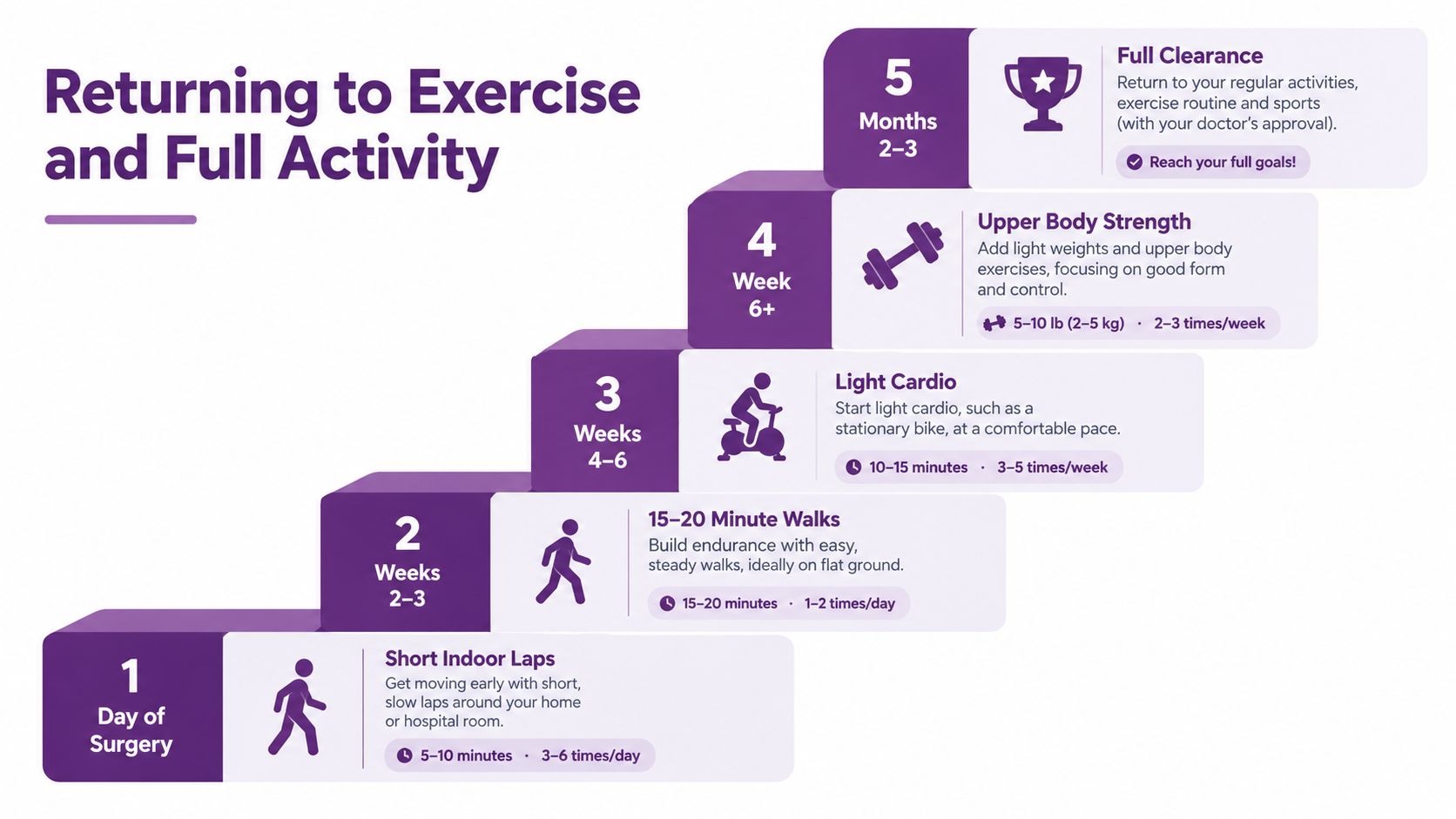
Exercise should return in layers, not as one dramatic release. Walking is usually the first activity because it supports circulation without loading the abdominal repair or breast incisions.
Start with movement, not training
Begin with short, frequent walks as directed by your surgeon. Increase duration gradually when your body responds without a lasting increase in soreness, drainage, or swelling. By the time you're ready for outdoor walks, the pace should still allow you to remain comfortable and upright.
Light cardio may be introduced later, often before resistance training. Stationary cycling can be appropriate for some patients once cleared, but the position should not create abdominal pressure or pull on the incisions.
Add resistance carefully
Upper-body work needs particular caution after breast surgery. Even light weights can create tension through the chest and breast incisions, especially with pushing, pulling, or overhead movement. Core exercises such as planks, crunches, and twisting should wait until the abdominal wall has adequately healed and your surgeon approves them.
Stop and scale back if an activity causes pulling at an incision, new breast or abdominal swelling, worsening soreness, or drainage changes.
Moderate exercise may resume after about eight weeks, while vigorous exercise may wait until approximately 12 weeks, according to the postoperative guidance from the American Society of Plastic Surgeons. Those are useful reference points, not automatic clearance dates.
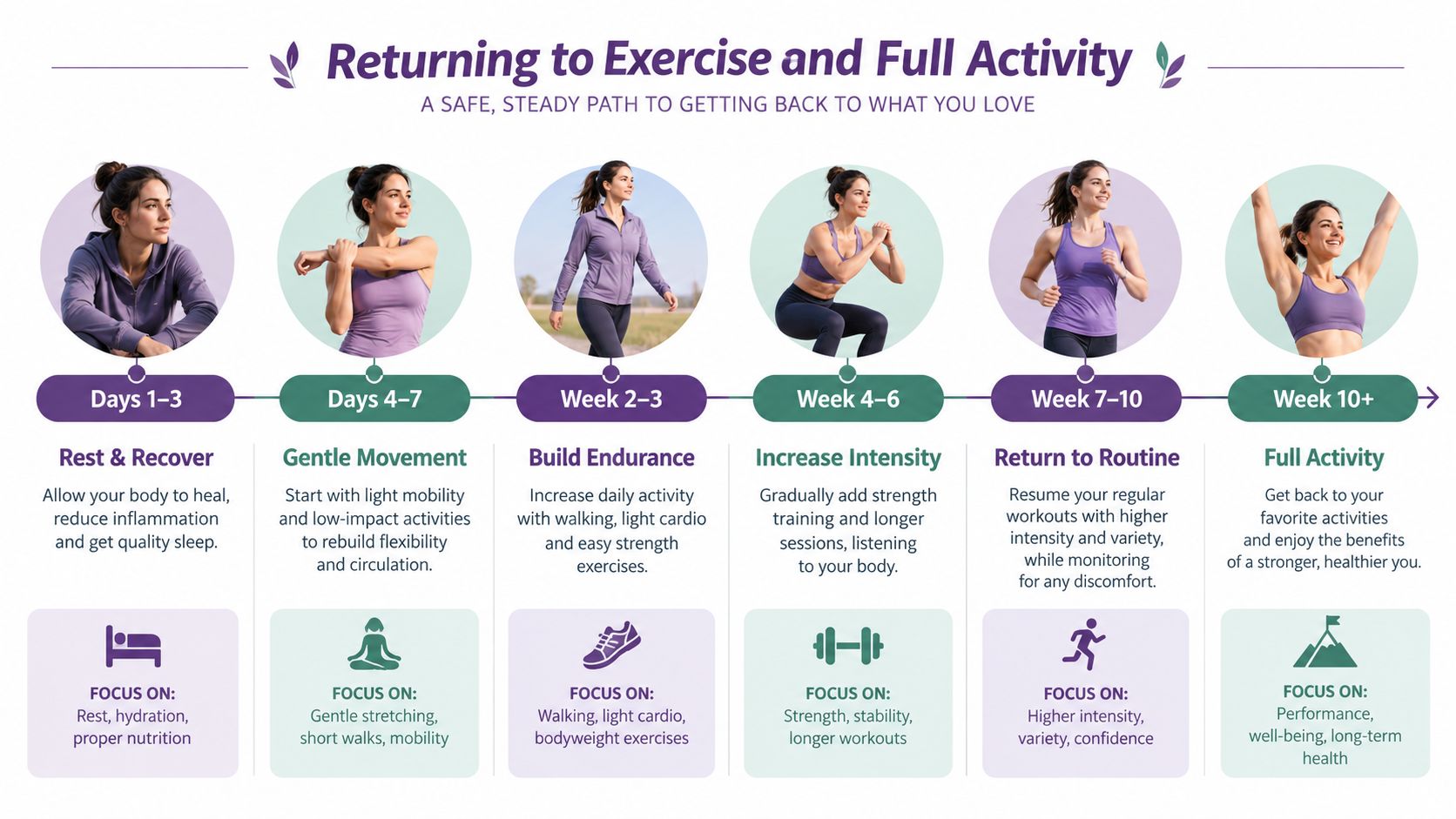
Heavy lifting, high-impact training, and full abdominal workouts belong at the end of the progression. If you're unsure whether a movement qualifies as core work, assume it does and ask your surgical team before performing it.
Warning Signs and When to Call Your Surgeon
Normal recovery can include soreness, bruising, fluctuating swelling, tightness, numbness, and small amounts of clear or pinkish drainage. Symptoms should generally trend toward improvement, even if progress is uneven from day to day.
Call your surgeon's office promptly if you notice:
- Fever or feeling acutely unwell: A fever, shaking chills, or a sudden decline in how you feel needs assessment.
- Rapid swelling: Sudden or expanding swelling, particularly on one side of the abdomen or breast, may require urgent evaluation.
- Bleeding: Bright red bleeding that saturates dressings is not something to monitor casually.
- Incision changes: Increasing redness, warmth, separation, foul odor, or pus-like drainage should be reported.
- Leg symptoms: Calf pain, swelling, or tenderness can signal a clot and warrants prompt medical advice.
- Breathing symptoms: Shortness of breath or chest pain requires emergency attention. Call 911 immediately.
- Breast changes: Sudden asymmetry, marked swelling, or visible implant exposure needs urgent contact with the surgical team.
- Unexpected pain: Pain that worsens instead of gradually improving, especially after the early postoperative period, should be assessed.
- Drain or medication problems: Call if a drain falls out, nausea and vomiting persist, or you can't keep prescribed medication down.
A long-running series discussed in expert postoperative commentary included 268 patients over 10 years, with no deaths, deep vein thrombosis, or pulmonary embolism reported in that series, and complication rates comparable to individually staged procedures. That experience supports careful patient selection and disciplined aftercare, not complacency. You can review the context in this composite-procedure recovery discussion.
Earlier communication is safer than waiting to see whether a concerning symptom disappears.
Optimizing Healing for the Final Result
The final contour is shaped by time and by the choices you make during the healing period. Many authoritative patient resources describe mommy makeover recovery as a three-to-six-month process, even though daily function improves much sooner. Minor swelling can persist for six to 12 months, and breast swelling may remain for several months depending on the procedure, as described in the recovery guide linked earlier.
Support tissue repair
Prioritize regular meals with adequate protein, fluids, and foods you can prepare easily. Your team may recommend a nutrition plan based on your health, medications, and procedure. Don't begin aggressive dieting during recovery. The body needs consistent nutritional support while incisions and deeper tissues repair.
Smoking deserves special attention. The American Society of Plastic Surgeons advises avoiding smoking for several weeks before and after surgery because it can interfere with healing and increase complication risk. Tell your surgeon about nicotine use before scheduling so the team can give you a safe, individualized plan.
Treat swelling as information
Swelling often increases after a busy day, a longer walk, or an activity that was too demanding. Rest, prescribed compression, hydration, and gradual progression are more useful than trying to force swelling away.
Lymphatic massage may be appropriate for selected patients, but timing and technique should come from your surgical team. A service such as Luxe's lymphatic massage offering should be considered only within the postoperative plan approved for your specific healing status.
Protect developing scars
Once incisions are fully closed, your surgeon may recommend silicone sheeting or gel, sun protection, or another scar-care method. Don't apply products to open, draining, or irritated incisions unless your team specifically directs you to do so. Scar color, firmness, and sensitivity change gradually, so early appearance isn't a reliable prediction of the final result.
Compression may also change over time, moving from stronger postoperative support to a more comfortable garment when your surgeon decides the tissues no longer need the same level of containment. The right endpoint differs by procedure and examination findings.
At three months, you may still notice swelling. Between three and six months, much of the contour often becomes clearer, while final settling can continue beyond that window. The recovery process is active work: follow restrictions, respond to your body's signals, attend follow-ups, and ask questions before changing your routine.
Luxe Aesthetic Surgery & Medical Spa offers individualized mommy makeover consultations that can address procedure selection, recovery planning, compression, drainage, and the gradual return to activity. Visit Luxe Aesthetic Surgery & Medical Spa to learn more and request a consultation for a recovery plan built around your goals and medical history.