
Medical Expertise at Luxe Aesthetic Surgery
Luxe Aesthetic Surgery & Medical Spa is led by Haimesh Shah, MD, RPVI , a physician specializing in cosmetic surgery, body contouring, laser procedures, and venous medicine. Dr. Shah is a Diplomate of the American Board of Laser Surgery, American Board of Venous & Lymphatic Medicine, American Board of Wound Management, and American Board of Internal Medicine. He also holds the Registered Physician in Vascular Interpretation (RPVI) credential and has contributed to peer-reviewed medical research.
You're months or years past your last pregnancy, you're exercising again, and some changes aren't responding the way you expected. Your abdomen feels loose even when your weight is stable, and your breasts sit differently than they did before breastfeeding. That's the moment many women start researching mommy makeover surgery, and it's also where confusion begins, because the name sounds like one operation with a standard result.
It isn't. Understanding what the term covers will help you ask better questions, compare plans fairly, and decide whether surgery fits your body and your family life right now.
Table of Contents
- What Mommy Makeover Surgery Actually Means
- The Core Components Surgeons Combine
- Candidacy and the Question of Timing
- Sequencing, Staging, and Awake Anesthesia Options
- Risks Worth Understanding Before Committing
- A Recovery Timeline Built Around Parenting
- Financing, Consultation Quality, and Individualized Decisions
What Mommy Makeover Surgery Actually Means
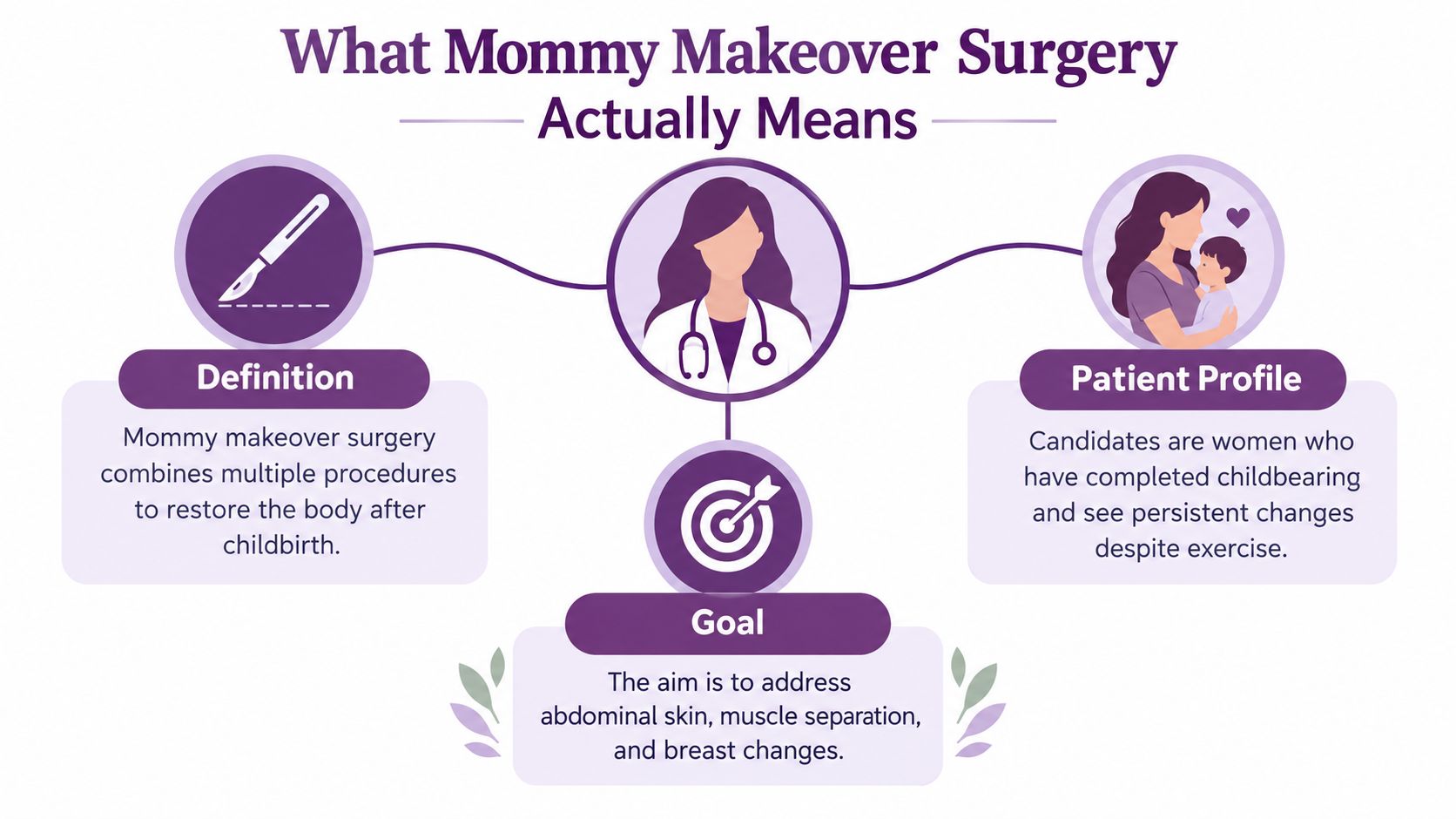
Mommy makeover surgery is not a single standardized operation. It's a coordinated combination of procedures intended to address post-pregnancy changes in the abdomen and breasts. Common components include abdominoplasty, liposuction, breast augmentation, breast lift, or breast reduction, selected because each one solves a different anatomic problem.
Think of the phrase as shorthand, not a menu item. Two patients can both have a mommy makeover and have very different operations, scars, recoveries, and risks. One may need skin removal and muscle repair with a breast lift. Another may need liposuction and an implant exchange, with no abdominal muscle work at all.
Why Surgeons Plan These Procedures Together
Pregnancy doesn't change one isolated spot. The abdominal wall stretches, skin may not retract fully, localized fat can persist, and breast volume and position often change at the same time. Planning the abdomen and breasts together lets a surgeon think about proportion across the whole torso, rather than correcting one area in isolation and discovering later that it no longer balances the other.
Combining procedures can also reduce the need for multiple separate recovery periods. That convenience is real, but it isn't automatic permission to combine everything. Candidacy depends on your health status, anatomy, desired changes, future pregnancy plans, and whether your concerns involve excess skin, localized fat, breast volume, or breast drooping.
A useful starting question: Don't ask what a standard package includes. Ask which specific procedures are being recommended for your anatomy, and why each one is on the list.
Why You Won't Find One Official Count
Patients sometimes look for a single national total for mommy makeovers, and that number is hard to pin down for a good reason. Authoritative national databases generally report each procedure separately rather than publishing a dedicated mommy makeover total. For scale, U.S. national statistics recorded 296,203 breast-augmentation procedures and 93,083 breast-reconstruction procedures in 2010, with approximately half of augmentations using saline implants and half using silicone gel implants, according to FDA background on silicone gel filled breast implants.
Those figures describe one component, not complete mommy makeovers. That's why you should request an itemized surgical plan and procedure-specific risks rather than relying on a single package label. The itemized plan is where the key decision lives.
The Core Components Surgeons Combine
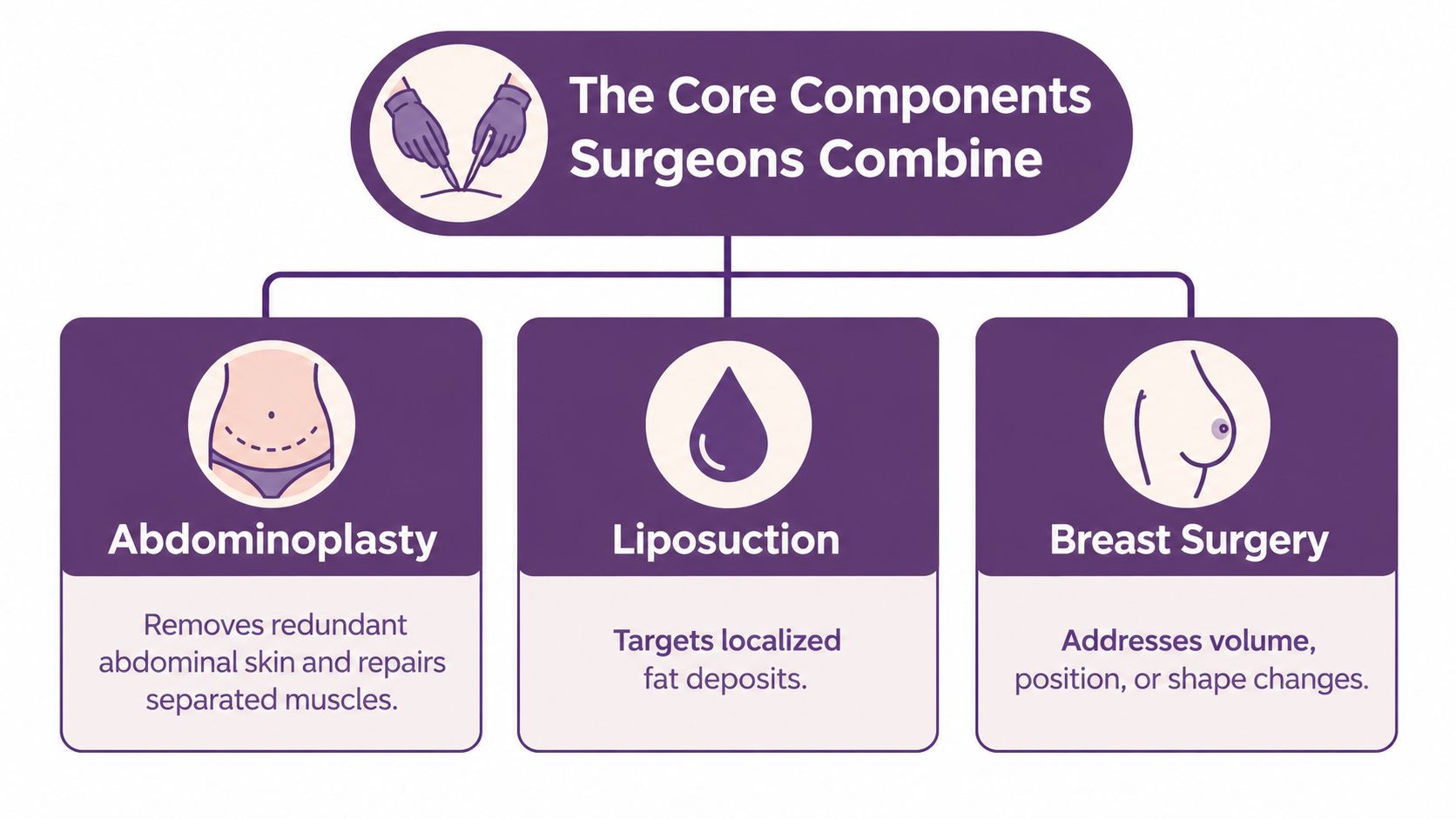
Each component addresses a different layer of tissue. When you understand which layer is causing your concern, the recommendations start to make sense, and so do the omissions.
Abdominoplasty for Skin and the Abdominal Wall
Abdominoplasty, often called a tummy tuck, removes redundant abdominal skin and tightens or repairs the abdominal wall. It's the component most relevant when loose skin hangs or folds, or when separated muscles create a protrusion that core work alone doesn't correct. Before assuming surgery is the only next step, some patients benefit from reviewing safe exercises for postpartum stomach to understand what rehabilitation can and can't change about muscle function and loose skin.
Abdominoplasty doesn't remove weight across the whole body, and it doesn't replace stable habits. Its job is structural. Remove what is redundant, repair what has separated, and redrape what remains under controlled tension.
Liposuction for Localized Fat
Liposuction targets localized fat deposits, for example along the flanks or upper abdomen. It doesn't tighten significantly loose skin, and it doesn't repair muscle separation. If skin quality is poor, removing fat underneath it can leave the surface looser, which is why a surgeon may pair liposuction with skin removal or decline it in a particular area.
Picture rearranging the furniture in the midsection. Liposuction changes the volume in specific spots, abdominoplasty changes the container and its support, and confusing the two leads to disappointing expectations.
Breast Procedures for Volume, Position, or Excess Tissue
Breast surgery in a mommy makeover may involve augmentation, a lift, reduction, or implant exchange. Augmentation addresses volume. A lift addresses position and drooping, which is called ptosis. Reduction addresses excess tissue, and exchange addresses an existing implant. If you're weighing position against volume, a detailed explanation of how breast lift surgery reshapes and repositions tissue can help you separate those two goals before your consultation.
| Component | Post-Pregnancy Concern | Typical Goal |
|---|---|---|
| Abdominoplasty | Redundant skin, separated or lax abdominal wall | Flatter, firmer abdominal contour |
| Liposuction | Localized fat that persists at stable weight | More defined contour in targeted areas |
| Breast augmentation | Volume loss | Restored fullness and proportion |
| Breast lift | Drooping, nipple position change | Lifted, reshaped breast position |
| Breast reduction | Excess breast tissue | Smaller, more proportionate breasts |
| Implant exchange | Existing implant age or concern | Replacement with an updated plan |
A careful plan preserves perfusion, meaning blood supply to healing tissue, and controls wound tension. That's one reason a surgeon may recommend fewer components than you expected. Doing less, well, often heals better than doing everything at once.
Candidacy and the Question of Timing
Good candidacy isn't determined by how long ago you delivered. It's determined by healing, stability, and whether another major change is likely to undo the result.

Four Questions That Matter More Than a Calendar
- Have you finished postpartum healing: Your body needs to have recovered from childbirth itself before elective body contouring makes sense.
- Have you finished breastfeeding: Breast tissue and volume continue to change during lactation, so operating too early can mean planning around a moving target.
- Are you near a stable weight: Significant gain or loss after surgery can alter abdominal and breast results.
- Are future pregnancies planned: Pregnancy after surgery is a separate question from whether the aesthetic result will hold.
The American Society of Plastic Surgeons notes that body-contouring and breast procedures generally should wait until recovery is complete and patients are near goal weight, and it emphasizes that additional pregnancy after abdominal muscle repair can compromise the aesthetic result, as explained in American Society of Plastic Surgeons guidance on post-pregnancy procedure timing.
Separating Possible From Advisable
Here's where readers often get tripped up. Being told pregnancy may still be possible after abdominal surgery isn't the same as being told the repair and skin tightening will look unchanged afterward. Those are two different conversations. A balanced consultation separates them clearly, so you can weigh operating now against preserving the best result for later.
A minimum waiting period isn't a guarantee of readiness. Readiness is postpartum healing, lactation status, weight stability, family plans, and support at home, all considered together.
Your surgeon will also review medical history items that affect combined surgery, including cardiometabolic conditions, anemia, smoking, prior blood clots, medications, and previous operations. Tissue quality matters too, because skin that has lost elasticity behaves differently under tension. If weight, breastfeeding, or family plans are still unsettled, postponing isn't a failure. It's often the decision that protects your eventual outcome.
At Luxe Aesthetic Surgery & Medical Spa, for example, mommy makeover consultations are structured around individualized procedure selection and recovery planning rather than a fixed package, which reflects the kind of case by case assessment you should expect from any practice you interview. Dr. Haimesh Shah is a board-certified physician specializing in cosmetic surgery and phlebology, and he serves as the practice's Medical Director.
Sequencing, Staging, and Awake Anesthesia Options
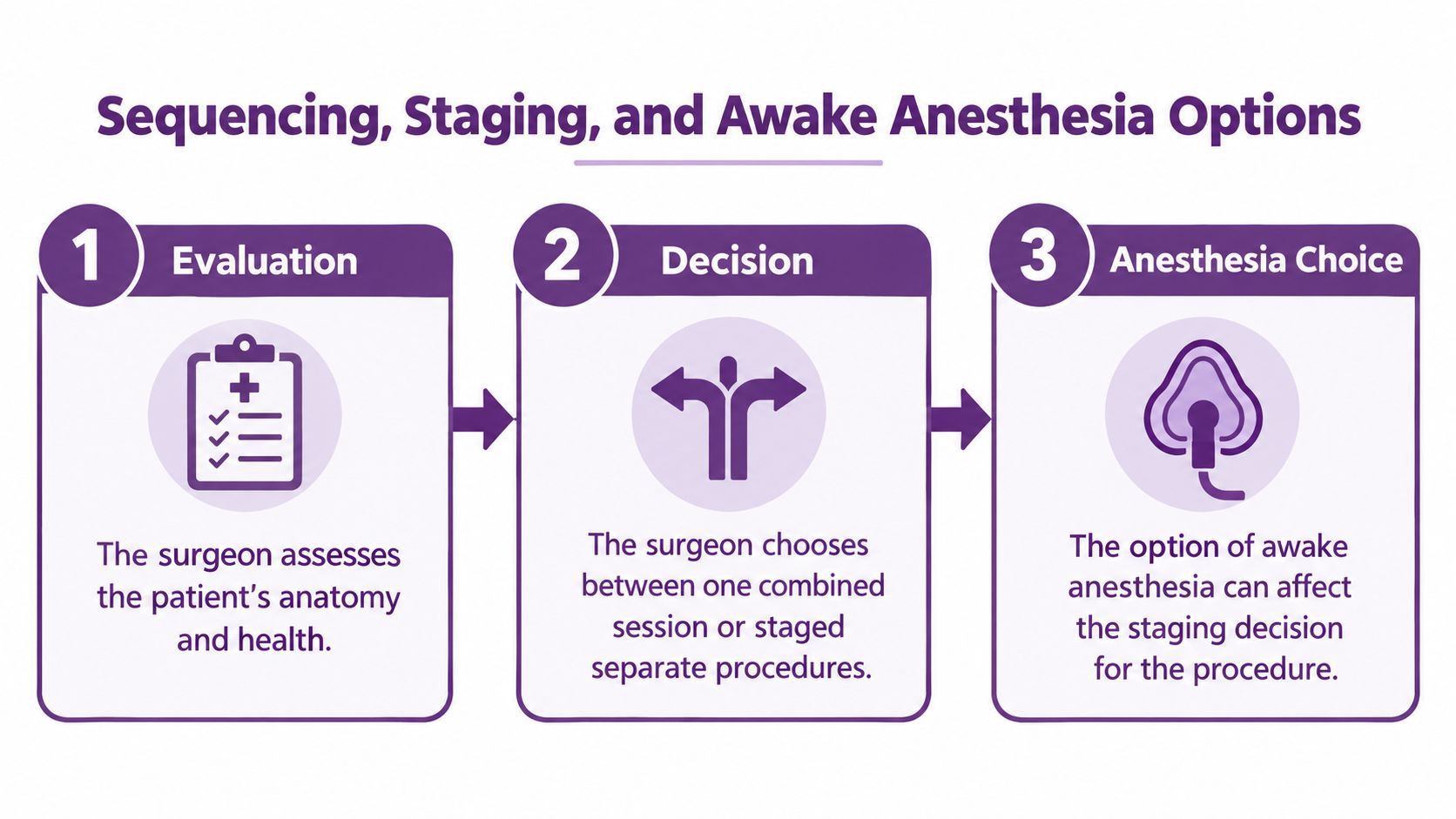
Once the components are chosen, the next decision is sequencing. Should everything happen in one operative session, or should the plan be staged across separate procedures?
Combined Versus Staged Surgery
A combined session offers one anesthesia exposure and one shared recovery, and it lets the surgeon balance the torso as a unit. The trade-off is longer operative time, more tissue healing at once, and a heavier early recovery burden. Staging spreads that burden out. Each operation is shorter, but you recover more than once and wait longer for the complete result.
Staging may be safer when correction needs are unusually extensive, when medical comorbidity is substantial, when skin quality is poor, or when home assistance is limited. Neither approach is superior on its own. The right choice follows from your anatomy, health, and the total extent of surgery being proposed.
What Awake Actually Means
Awake procedures are performed using local anesthesia rather than general anesthesia, for appropriately selected patients and suitable procedures. At Luxe, certain body contouring and breast procedures are offered this way, and patients researching the abdominal component often start by reading about the awake tummy tuck approach and who it may suit.
Precision matters here. Awake doesn't mean every patient qualifies, every procedure can be performed awake, or that local anesthesia carries no risks. It also doesn't mean general anesthesia is dangerous. For appropriate candidates, using local anesthesia may allow a patient to avoid general anesthesia, and it may offer a smoother recovery experience depending on the procedure. That's a conditional statement, and it should stay conditional.
- Anatomy and extent: Larger or more complex corrections may not suit a local anesthesia plan.
- Medical history: Your physician determines suitability after a full history and physical assessment.
- Comfort and tolerance: Being awake during a procedure isn't the right experience for everyone.
- Sequencing interaction: Anesthesia choice can influence whether combining is sensible or staging is wiser.
Be cautious with any claim of guaranteed faster recovery. Recovery depends on what was done, how much tissue was involved, and how your body heals, not on a marketing label.
Risks Worth Understanding Before Committing
Risk discussion isn't meant to frighten you. It's informed consent, and it should be specific to the exact combination you're considering rather than generic to the package name.
Risks Related to Combining Procedures
Combining abdominoplasty with breast surgery changes the risk profile mainly through longer operative time, greater tissue injury, and reduced postoperative mobility. The evidence is mixed. A 726-patient comparative study found no adjusted difference in adverse events between mommy makeover patients and patients undergoing abdominoplasty alone, while another large database analysis reported higher rates of major complications, hematoma, infection, and confirmed venous thromboembolism, or VTE, when breast and abdominal procedures were combined, as summarized in perioperative evidence on combined mommy makeover risk.
That same review estimated VTE at approximately 0.34% for abdominoplasty alone versus 0.67% when a second procedure was added, with risk increasing further when intra-abdominal surgery is involved, per that perioperative review. A pooled analysis of 1,596 abdominoplasty patients found VTE in 0.56% and bleeding in 1.6%, with no statistically significant reduction in VTE from chemoprophylaxis, reflecting varied protocols and incomplete risk stratification.
What does that mean for you practically? Candidacy should be individualized by assessing body-mass index, smoking, prior VTE, thrombophilia, mobility, operative duration, and planned procedure extent. A formal risk score such as Caprini can support decisions about mechanical prophylaxis, early ambulation, and, when clot risk outweighs bleeding risk, appropriately timed medication. Prophylaxis isn't automatic, and it isn't risk-free.
Wound and Healing Complications
Reported complication patterns include seroma, hematoma, wound separation, infection, flap ischemia or necrosis, and VTE. In one recent combined-procedure series, major complications occurred in 14.5% and minor complications in 16.1%, including abdominal and breast wound dehiscence, as reported in a combined-procedure series on mommy makeover outcomes.
Those figures come from a specific cohort and shouldn't be treated as a universal benchmark. They do show why smoking cessation, stable weight, anemia and cardiometabolic optimization, and adequate help at home aren't administrative details. They're part of the safety plan.
Implant-Specific Risks and Long-Term Surveillance
If your plan includes implants, add a second, longer timeline to your thinking. Breast implants are long-term medical devices, not lifetime devices. The FDA identifies capsular contracture, reoperation, implant removal, rupture or deflation, asymmetry, scarring, pain, infection, and changes in nipple or breast sensation among recognized complications, detailed in FDA information on risks and complications of breast implants.
Historical FDA data reported that as many as 1 in 5 primary breast-augmentation patients and 1 in 2 primary breast-reconstruction patients required implant removal within 10 years of implantation, according to that FDA resource. A 2021 review reported that 82% of augmentation patients with one manufacturer's implants and 91% with another's still had their original implants after 10 years, showing retention varies by device, study population, and outcome definition.
Rupture risk also accumulates over time. At 2 years, reported rupture was 2.5% for saline implants versus 0.5% for silicone implants in large postapproval datasets, and a 10-year study of 1,788 patients reported silicone rupture risks of 7.8% after primary augmentation, 5.2% after revision augmentation, and 9.8% after primary reconstruction, as summarized in a 2025 review of breast implant complications.
Silicone rupture can be silent, which is why monitoring continues for as long as you have implants. The FDA recommends a first ultrasound or MRI at 5 to 6 years after silicone implant placement for asymptomatic patients, then repeat imaging every 2 to 3 years, with MRI when symptoms suggest rupture or ultrasound is uncertain, per FDA breast implant screening recommendations. The FDA also recognizes a rare cancer called breast implant-associated anaplastic large cell lymphoma, or BIA-ALCL, which generally develops in fluid or scar tissue surrounding the implant and is associated primarily with textured implants, as noted in FDA consumer guidance on what to know about breast implants.
Before you sign anything: Ask for risks listed procedure by procedure, including what revision surgery could involve and who covers those costs.
A Recovery Timeline Built Around Parenting
Most recovery advice answers the wrong question. It tells you when you might return to a desk, when your hardest physical job may be lifting a toddler who does not care about your restrictions.
A neutral academic medical-center FAQ indicates that mommy makeover recovery commonly ranges from one to four weeks, recommends help with children during the first week, and advises avoiding heavy lifting for one month, with the caveat that recovery varies by procedure combination, according to Stony Brook Medicine patient education on mommy makeover surgery.
Desk Readiness Is Not Parenting Readiness
Sitting at a laptop and parenting a small child place different demands on a healing abdomen and chest. Lifting, carrying, bathing, handling a car seat, and getting up repeatedly at night can all exceed what surgeons mean by light activity. A toddler climbing into your lap can load your incisions in ways a desk never will.
Plan by task, not just by week:
- First week: Prioritize rest, short walks as directed, and full help with children, meals, and household tasks.
- Following weeks: Resume only the light tasks your surgeon clears, and keep delegating lifting and carrying.
- Through the first month: Treat heavy lifting as restricted, which includes most infants in car seats and many toddlers.
- Ongoing: Let surgeon clearance, not a calendar date, trigger each new activity.
Build Your Caregiver Plan Before Surgery Day
Name who will provide childcare, for how long, and who is the backup if that person cancels or a complication extends recovery. Arrange transportation, since you may not be cleared to drive right away, and prepare sleeping and feeding setups that don't require lifting. The broader practical side of postpartum support, including planning help at home, is covered in the Revivol-XR postpartum support guide, which can help you think through assistance you might otherwise underestimate.
Bruising and swelling are expected early and settle gradually, and energy often fluctuates before it improves steadily. If your plan only works when recovery goes perfectly, it isn't finished yet. A realistic plan has slack built into it.
Financing, Consultation Quality, and Individualized Decisions
Financing structures vary across practices, and the total cost depends on which components are included, anesthesia, facility fees, and follow-up care. Because abdominal surgery is often the largest component, reviewing what drives tummy tuck cost and how quotes are structured can help you read an itemized estimate with clearer eyes. Ask what is included, what revision or complication care could cost, and how staging would change the total.
What a Thorough Consultation Should Cover
A strong consultation feels individualized because it is. It should produce an itemized surgical plan, not a package name. It should explain anesthesia options and their limits, scar placement and trade-offs, implant surveillance if implants are involved, and a recovery plan built around your children's ages and your help at home.
Bring this checklist to your first appointment:
- My components: Which procedures are you recommending, and what does each one address?
- My sequencing: Would you combine or stage them in my case, and why?
- My risks: What are my personal risk factors, and how is clot prevention handled?
- My timing: Am I healed, done breastfeeding, and stable enough in weight?
- My recovery: Who needs to help me, with which tasks, and for how long?
- My long term: If implants are included, what monitoring and future surgery should I expect?
If a consultation can't answer those questions in terms of your anatomy and circumstances, keep asking or keep interviewing. Mommy makeover surgery is a collection of choices, and those choices should be visibly yours.
If you're considering mommy makeover surgery and want a plan built around your anatomy, family timing, and recovery support at home, the team at Luxe Aesthetic Surgery & Medical Spa offers individualized consultations covering procedure selection, anesthesia options, and realistic recovery planning. Schedule a consultation to review which components fit your goals, whether combining or staging makes sense for you, and what help you'll need while you heal.