Medical Expertise at Luxe Aesthetic Surgery
Luxe Aesthetic Surgery & Medical Spa is led by Haimesh Shah, MD, RPVI , a physician specializing in cosmetic surgery, body contouring, laser procedures, and venous medicine. Dr. Shah is a Diplomate of the American Board of Laser Surgery, American Board of Venous & Lymphatic Medicine, American Board of Wound Management, and American Board of Internal Medicine. He also holds the Registered Physician in Vascular Interpretation (RPVI) credential and has contributed to peer-reviewed medical research.
A few days after sclerotherapy, you notice a tender spot, a bruise, or a darker line where a vein was treated. It's natural to wonder whether that's part of healing or a sign something's wrong. Knowing which effects are expected and which need urgent attention can make recovery less stressful and help you act promptly if a serious symptom appears.
Table of Contents
- What Patients Really Mean When They Ask About Sclerotherapy Risks
- How Sclerotherapy Works and Why Side Effects Happen
- Common Side Effects You Can Expect After Treatment
- Rare but Serious Complications Worth Knowing
- Why Foam Sclerotherapy Has a Different Risk Profile
- How Providers Reduce Risk Before, During, and After Treatment
- Red Flags That Mean Seek Care Now
- Choosing a Vein Care Practice and Preparing for a Consultation
What Patients Really Mean When They Ask About Sclerotherapy Risks
A patient might lean forward during a vein consultation and ask, “Is sclerotherapy safe?” A useful answer isn't just yes or no. The treatment generally has a favorable safety profile, but its risks range from temporary skin changes to uncommon vascular problems and rare systemic complications. Your own risk depends partly on your health history, the veins being treated, and the technique used.
It helps to sort sclerotherapy risks into those three categories. Bruising, localized tenderness, or pigmentation are usually cosmetic or temporary effects. A clot involving a deep vein is less common but medically important. Events involving the heart, lungs, or nervous system are rare, yet they're a reason for careful screening and clear instructions about when to seek help.
At Luxe Aesthetic Surgery & Medical Spa, vein care sits alongside cosmetic and medical aesthetic services. Medical Director Haimesh Shah, MD, RPVI, is a board-certified physician specializing in cosmetic surgery and phlebology. A consultation should focus on whether treatment fits your goals and medical circumstances, rather than offering a blanket guarantee that it's safe for everyone.
A complete evaluation also distinguishes visible cosmetic veins from concerns that may need broader vascular assessment. For background on one type of circulation assessment used in clinical decision-making, see this ankle brachial index clinical reference. The key is to discuss your anatomy, medical history, and expectations before deciding on treatment.
How Sclerotherapy Works and Why Side Effects Happen
Sclerotherapy treats selected veins by introducing a sclerosant, a solution that irritates the vein's inner lining. The treated vessel closes, and the body gradually absorbs it. You can think of it as closing a side street so traffic takes another route. The closure is intentional, but effects can occur in nearby tissue or, less commonly, if the treatment reaches the wrong part of the circulation.

At the skin level, blood pigments left around a treated vessel can contribute to discoloration. Small nearby vessels may become newly visible, a change called telangiectatic matting. Inflammation in a treated superficial vein can also produce a tender, firm area. These effects relate to the local response to treatment and don't automatically mean that a dangerous complication has occurred.
Liquid and foam are different formulations. Foam is made by combining liquid sclerosant with gas and can be used to treat certain larger or deeper veins. Ultrasound guidance helps a clinician see the vein and surrounding anatomy during treatment, which is especially relevant when targeting veins that aren't visible at the skin's surface.
The underlying principle is the same, but the interaction among the sclerosant, the target vessel, and your venous anatomy matters. That's why a provider chooses the method and amount based on the treatment target rather than using one approach for every patient.
Common Side Effects You Can Expect After Treatment
Skin changes and localized discomfort are among the effects patients are most likely to notice. A 2024 clinical review reports that approximately 30% of patients may develop hyperpigmentation, typically appearing 6–8 weeks after treatment. A 2023 narrative review covering 60 publications reported residual pigmentation rates ranging from 6.1% to 28.6% and telangiectatic matting in as many as 15–24% of cases. The estimates vary because studies differ in treatment methods, follow-up, and how they define complications. The NIH clinical review of sclerotherapy complications describes pigmentation, matting, and other reported effects.
| Common Post-Sclerotherapy Effects and Typical Timelines | Typical Onset | Expected Resolution | Approximate Incidence |
|---|---|---|---|
| Bruising or injection-site tenderness | After treatment; timing varies | Often temporary; individual course varies | No single rate provided |
| Hyperpigmentation | Typically 6–8 weeks after treatment | May fade, but can persist | Approximately 30% in the NIH review; 6.1%–28.6% in the 2023 review |
| Telangiectatic matting | After treatment; timing varies | Individual course varies | Up to 15–24% in the 2023 review |
| Swelling, itching, headache, dizziness, or vasovagal symptoms | Timing varies | Often transient; individual course varies | No single rate provided |
Most pigmentation is a cosmetic concern, not a life-threatening problem, though it may last and sometimes leads to further observation or treatment. Bruising, injection-site pain, swelling, headache, dizziness, visual symptoms, and vasovagal reactions are also reported. Your clinician should explain which effects are plausible for your treatment and what to do if they don't follow the expected course.
These figures aren't promises about what will happen to you. The sclerosant, concentration, vein location, and follow-up period all affect reported rates. A mark or bruise near an injection site can be unsettling, but the more useful question is whether symptoms are localized and stable or are worsening and accompanied by warning signs.
Rare but Serious Complications Worth Knowing
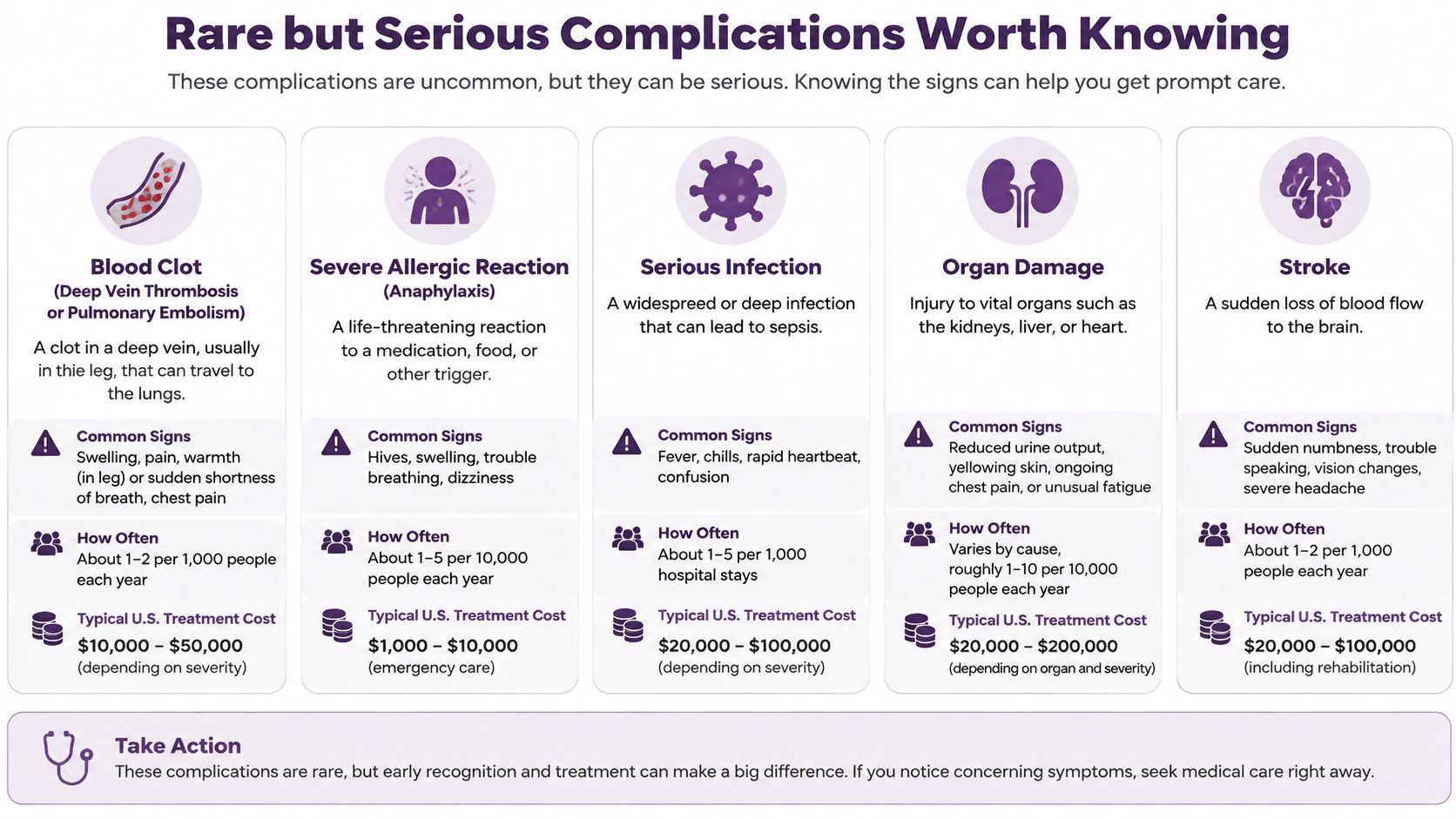
Serious complications are uncommon, but they matter because some need prompt assessment. The German Society for Phlebology guideline reports total thromboembolic-event rates below 1%, with deep-vein thrombosis reported at approximately 0.6% in meta-analyses; proximal DVT and pulmonary embolism are described as very uncommon. The guideline also notes that a Cochrane review considered the evidence about a possible increase in DVT uncertain. The German Society for Phlebology guideline discusses thromboembolic risk and prevention.
A clot may develop if material extends from a treated superficial vein into the deeper venous system. Risk assessment deserves extra care for people with a history of venous thromboembolism, thrombophilia, immobility, active cancer, or estrogen exposure. Some DVT cases may be clinically silent, so symptoms alone aren't a substitute for appropriate evaluation.
The FDA prescribing information for polidocanol, marketed as Asclera in the United States, identifies venous thrombosis and pulmonary embolism as potential risks. It also documents reports temporally associated with treatment of stroke, transient ischemic attack, myocardial infarction, and impaired cardiac function. Some events may involve thromboembolism or air embolism. The label advises avoiding foam prepared with room air because its safety and efficacy haven't been established. The FDA prescribing information for polidocanol provides the product-specific warnings.
A 2023 review reported that neurological complications represented about 2% of major systemic complications and identified inadvertent intra-arterial injection as the most fatal complication. This doesn't mean such events are expected. It explains why careful access, appropriate imaging, patient selection, and follow-up are part of responsible treatment.
Why Foam Sclerotherapy Has a Different Risk Profile
Foam can be useful for certain vein targets, but it doesn't have an identical risk profile to liquid treatment. Because foam is a sclerosant mixed with gas, clinicians consider both the treatment target and the possibility that gas or sclerosant could travel beyond the intended vein. That possibility is one reason to discuss the formulation and technique rather than assuming that “foam” describes a single standardized approach.
NICE guidance describes foam embolisation as a small but significant risk and reports temporary symptoms such as cough, chest tightness, headache, and visual disturbance after foam treatment. It also notes reports of transient ischemic attack, seizure, and stroke, and describes foam preparation by mixing liquid sclerosant with gas as off-label in its guidance. NICE guidance on ultrasound-guided foam sclerotherapy reviews these considerations.
Headaches may be more likely in people with a migraine history. Systemic symptoms have also been associated with sclerosant unintentionally entering the deep venous system, including during ultrasound-guided treatment involving the great saphenous vein. Those factors don't establish that a particular person will have a reaction, but they're relevant to pre-treatment discussion.
For patients, practical questions include which vein is being treated, whether ultrasound guidance is planned, and how the clinician selects the sclerosant concentration and volume. Ask how the foam is prepared, too. The choice between liquid and foam should reflect the anatomy and treatment plan, not a claim that one formulation is universally safer or more effective.
How Providers Reduce Risk Before, During, and After Treatment
Risk reduction starts before an injection. Tell your clinician about prior clots, clotting disorders, migraine with aura, pregnancy, limited mobility, estrogen exposure, significant heart or lung conditions, and medications or supplements. These details help the team judge whether treatment is appropriate and whether a different plan or additional evaluation is needed.
Duplex ultrasound can help assess the superficial and deep venous networks, identify treatment targets, and clarify relevant anatomy when clinically indicated. A careful plan also avoids treating acute thrombosis or significant untreated reflux without appropriate assessment. During treatment, clinicians aim for accurate venous access and the lowest effective sclerosant concentration and volume for the target.
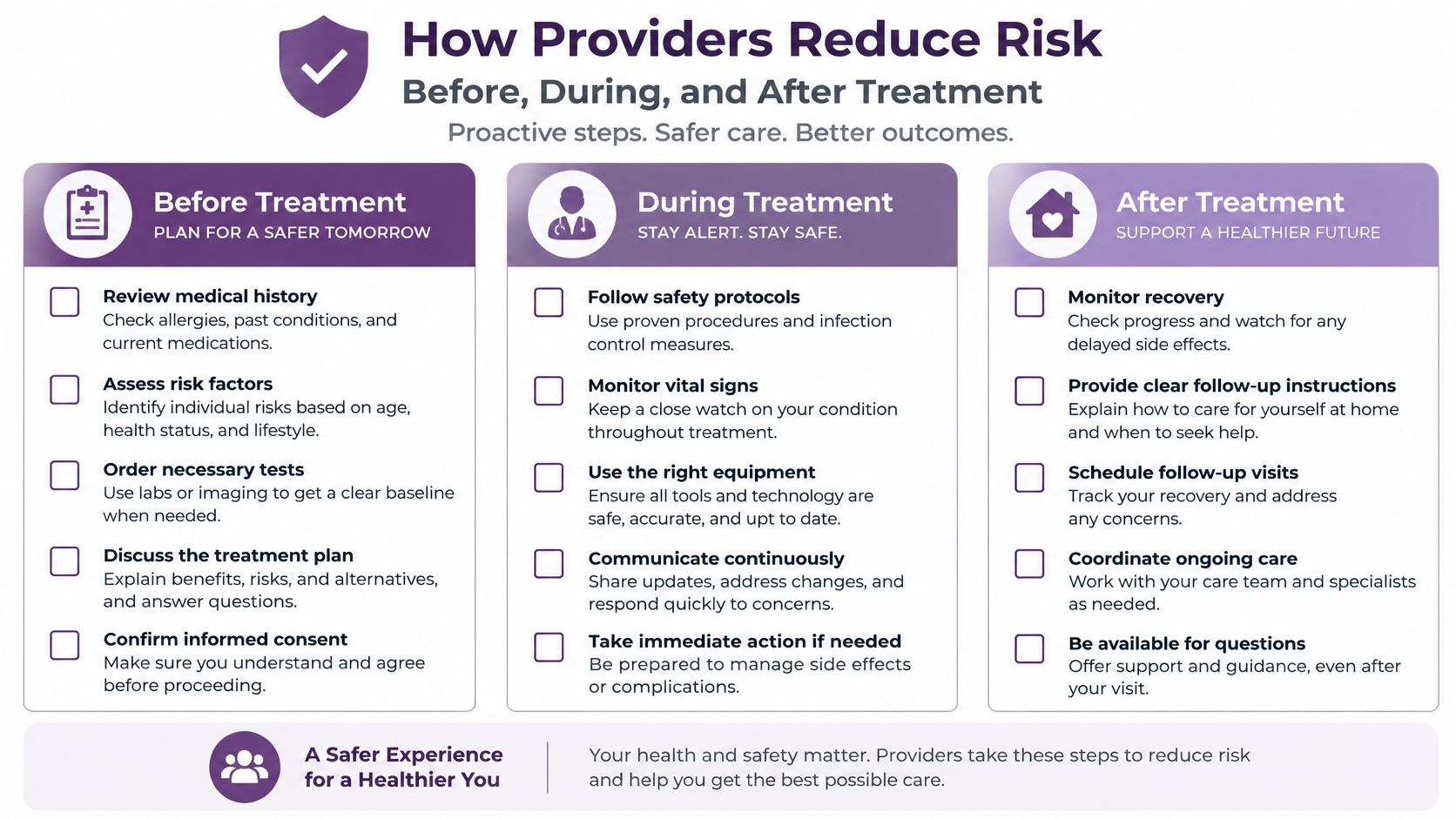
Afterward, follow the treating clinician's instructions on walking, compression, activity, and follow-up. Early ambulation is part of practical thrombotic risk reduction. Don't assume that every patient receives identical instructions; the plan should reflect the procedure and your health history.
Before your consultation, ask: What vein is being treated, and why? Is ultrasound needed? Which formulation is planned? What aftercare should I follow, and whom should I contact if a symptom changes?
Writing down medication names and relevant health history can make the conversation more productive. Ask how the clinician will assess whether the treated vessel is responding as expected and whether additional treatment might be considered.
Red Flags That Mean Seek Care Now
A useful rule is to judge symptoms by location, change, and severity. Mild bruising or tenderness limited to the injection area can fit with ordinary recovery. New symptoms affecting breathing, the chest, one whole leg, or neurological function shouldn't be treated as routine aftercare.
| Often Localized or Expected | Seek Immediate Medical Assessment |
|---|---|
| Bruising near an injection site | New swelling in one leg or escalating calf pain |
| Mild, localized tenderness or itching | Chest pain, shortness of breath, or coughing blood |
| Temporary swelling near the treated area | Fainting or loss of consciousness |
| Pigmentation developing around treated veins | Severe headache, weakness, speech difficulty, or visual disturbance |
New one-sided swelling or worsening calf pain needs evaluation because a clot is one possible concern. Chest pain, shortness of breath, or coughing blood can signal a serious problem involving the lungs or circulation. Weakness, difficulty speaking, a severe headache, or persistent visual symptoms also require prompt medical attention. Don't try to diagnose the cause at home.
For severe symptoms, call emergency services or go to an emergency department. For concerning symptoms that aren't immediately life-threatening, contact the treating practice promptly and follow its instructions. If symptoms worsen while you're waiting for advice, seek emergency care.
Localized bruising and a new breathing problem are not the same kind of recovery symptom. When a warning sign appears, get assessed rather than waiting for a routine follow-up.
Choosing a Vein Care Practice and Preparing for a Consultation
A thorough consultation should make space for both your goals and your medical history. Expect to discuss prior clots, clotting disorders, medications, pregnancy, migraine history, mobility, and other health concerns. Depending on your symptoms and anatomy, the evaluation may include duplex ultrasound to assess the veins involved and identify whether there are issues that need attention beyond cosmetic treatment.
Ask whether liquid or foam is being considered, why that option fits the target vein, and what side effects and rare complications are covered in the consent discussion. It's also reasonable to ask whether treatment may be staged or whether a treated vein could need further evaluation. Sclerotherapy can close selected veins, but it doesn't guarantee that every visible vein will disappear or that no additional procedure will be needed.
Luxe Aesthetic Surgery & Medical Spa provides vein care within a broader medical-aesthetic practice. Dr. Haimesh Shah is a board-certified physician specializing in cosmetic surgery and phlebology. You can review the practice's varicose vein treatment information as one starting point for a conversation about visible veins, discomfort, and appropriate evaluation.
Before your visit, bring an up-to-date medication list and note any recent travel or periods of immobility. Write down prior clotting events and the symptoms you've noticed, including when they occur. A consultation should leave you understanding the proposed approach, its limits, and whom to contact if you have concerns after treatment.
At Luxe Aesthetic Surgery & Medical Spa, patients can discuss sclerotherapy and other vein-care options through an individualized evaluation. If visible veins or leg symptoms are prompting questions, request a consultation to review your goals, medical history, and appropriate next steps.