Medical Expertise at Luxe Aesthetic Surgery
Luxe Aesthetic Surgery & Medical Spa is led by Haimesh Shah, MD, RPVI , a physician specializing in cosmetic surgery, body contouring, laser procedures, and venous medicine. Dr. Shah is a Diplomate of the American Board of Laser Surgery, American Board of Venous & Lymphatic Medicine, American Board of Wound Management, and American Board of Internal Medicine. He also holds the Registered Physician in Vascular Interpretation (RPVI) credential and has contributed to peer-reviewed medical research.
The most consistent derma-roller results develop gradually: atrophic acne scars, fine lines, and uneven texture may improve as new collagen remodels the skin. For thinning hair, scalp needling has stronger support as an addition to established treatment.
Needle depth works like a dose. Shallow punctures may create surface irritation with a weaker remodeling signal, while technique and sterility determine whether the controlled injury heals usefully or causes infection and pigment-related problems. A lower-cost home roller still carries those risks and cannot be treated as a smaller version of clinical microneedling.
Table of Contents
- Benefits of Derma Roller Treatment by Concern
- Scar Wrinkle and Hair Examples from Studies
- How Punctures Remodel Skin and When Results Appear
- Risks Skin Tone and When to Wait
- Home Rollers Clinic Needling and PRP Compared
- Deciding on a Supervised Microneedling Plan
Benefits of Derma Roller Treatment by Concern
| Concern | What studies show | Realistic setting |
|---|---|---|
| Atrophic acne scars | Clinical microneedling can soften depressed scars, but improvement differs by scar shape and protocol. | Clinician-selected treatment over repeated sessions |
| Facial wrinkles and texture | Collagen and elastin remodeling may improve surface irregularity and fine lines gradually. | Professional protocols; home rollers can't be assumed to reproduce them |
| Fine lines with a hydrating topical | Product-assisted treatment needs indication-specific evidence. A hyaluronic-acid combination study discussed below measured acne scars, not fine lines. | Supervised needling with a topical selected for the procedure |
| Abdominal scars | The FDA's microneedling guidance identifies authorized devices for improving abdominal scars, facial acne scars, and facial wrinkles in adults 22 and older. | Regulated medical devices, not every consumer roller |
| Androgenetic hair thinning | Combination treatment can improve hair-growth measures; a consumer roller alone isn't established therapy. | Clinician-directed scalp treatment alongside appropriate medication |
A derma roller is a form of microneedling, using fine needles to trigger a localized repair response. Its most useful benefit isn't immediate exfoliation. It's the possibility of changing the supporting tissue beneath an uneven surface.
That distinction matters when you describe your concern. A depressed acne scar, a brown post-acne mark, and an active breakout may occupy the same cheek, but they aren't the same treatment target.
Read improvement numbers as benchmarks
In a 2024 PubMed-indexed report, patients receiving protocols that included microneedling had 20% to 30% average improvement in acne-scar scores 90 days after the final treatment. That describes improvement on a scoring system, not complete removal of scars.
A 2022 systematic review and meta-analysis included 12 randomized controlled studies and 414 participants and reported a conventional-microneedling mean difference of 0.42, with a confidence interval of −0.12 to 0.73. Because that interval crosses zero, the reported estimate shouldn't be presented as an unambiguous statistically significant benefit on its own. For a patient, a pooled score doesn't identify the right depth or device for an individual scar.
Choose the concern before choosing the device. A treatment name tells you less than the diagnosis, protocol, and outcome being measured.
If acne scars are your main concern, compare the purpose of needling with the treatment category described on the practice's acne laser treatment page. That's a starting point for discussing alternatives, not a reason to assume laser treatment and microneedling are interchangeable.
Match your goal to a row before buying a roller or arranging treatment. If your concern doesn't fit clearly, an examination is more useful than a deeper needle.
Scar Wrinkle and Hair Examples from Studies
Acne scars improve by degrees
Say your cheeks have broad, shallow depressions that become more visible under side lighting. The goal is softer transitions between scar edges and the surrounding skin, so the cheek reads more evenly even though some texture remains.
A 2017 systematic review of acne-scar treatments reported improvement ranging from 31% to 62% with conventional microneedling, and the studies behind that spread explain why it is so wide: every participant in a 2008 study of 32 patients showed evident improvement in rolling scars, a 2014 study of 15 patients recorded a mean 3.4-point improvement on a quantitative global scarring scale, and a 2014 study of 30 patients recorded gains of 4.56 ± 1.31 points for moderate scars and 6.00 ± 1.66 points for severe scars on a 9-point scale.
Each of those scales is a different ruler. Combining a 3.4-point scale gain with a 62% improvement would be like averaging a temperature in Fahrenheit with one in Celsius. The investigators also worked with different patient groups and treatment protocols, so the spread reflects real differences in method, plus genuine variation in results.
Rolling, boxcar, and icepick scars respond differently. A broad, shallow depression differs structurally from a narrow, deep pit, and needle depth, session count, and skin characteristics all shape the outcome. Depth is a trade-off in both directions: shallower punctures may produce weaker collagen change, while deeper needling demands stricter sterility and technique.
For help separating persistent myths from useful terminology, Neutralyze's facts about post-acne scars offer a patient-oriented companion resource. A scar assessment still needs to identify what is physically causing the uneven surface.
Rejuvenation isn't a facelift
For facial rejuvenation, the practical question is whether lines and surface texture become less noticeable. Satisfaction ratings capture how pleased patients feel; lifting sagging tissue or replacing lost volume calls for a different kind of evidence and usually a different category of treatment.
The same discipline applies to body concerns. The stretch mark treatment approach targets a different skin pattern from a facial acne-scar series, so a result in one condition carries no automatic promise for another. At a consultation, the provider examines the skin, discusses when the marks developed, and determines which options suit that patient's skin type and goals.
Hair studies test combinations
In a randomized, evaluator-blinded study of 100 men, 12 weeks of weekly 1.5 mm dermaroller treatment plus twice-daily 5% minoxidil outperformed minoxidil alone across the primary hair-growth measures, and a related trial of 68 men described in the same evidence reported a mean increase of 12.52 hairs per square inch with combination treatment versus 1.89 with minoxidil alone. Even within that work, some patients fell short of a cosmetically significant response.
A 2025 clinical study of 45 men reported that 80% of patients receiving microneedling, minoxidil, and finasteride reached a prespecified improvement score. Those results describe the full regimen; isolating what the rolling itself contributes requires a design that tests each component separately.
Two plausible contributions are temporary improvement in topical delivery and wound-healing signals around follicles. Current evidence leaves the size of each contribution unresolved.
- Patterned thinning: May be appropriate for an adjunctive discussion after diagnosis.
- Sudden shedding or patchy loss: Needs medical evaluation before any cosmetic approach.
- Scarring or inflammatory scalp disease: Requires medical management before needling is considered.
A medical-depth scalp protocol belongs with a trained clinician. A home roller cannot replicate a sterile, depth-controlled session, and its shallower needles may produce a weaker biological response anyway.
How Punctures Remodel Skin and When Results Appear
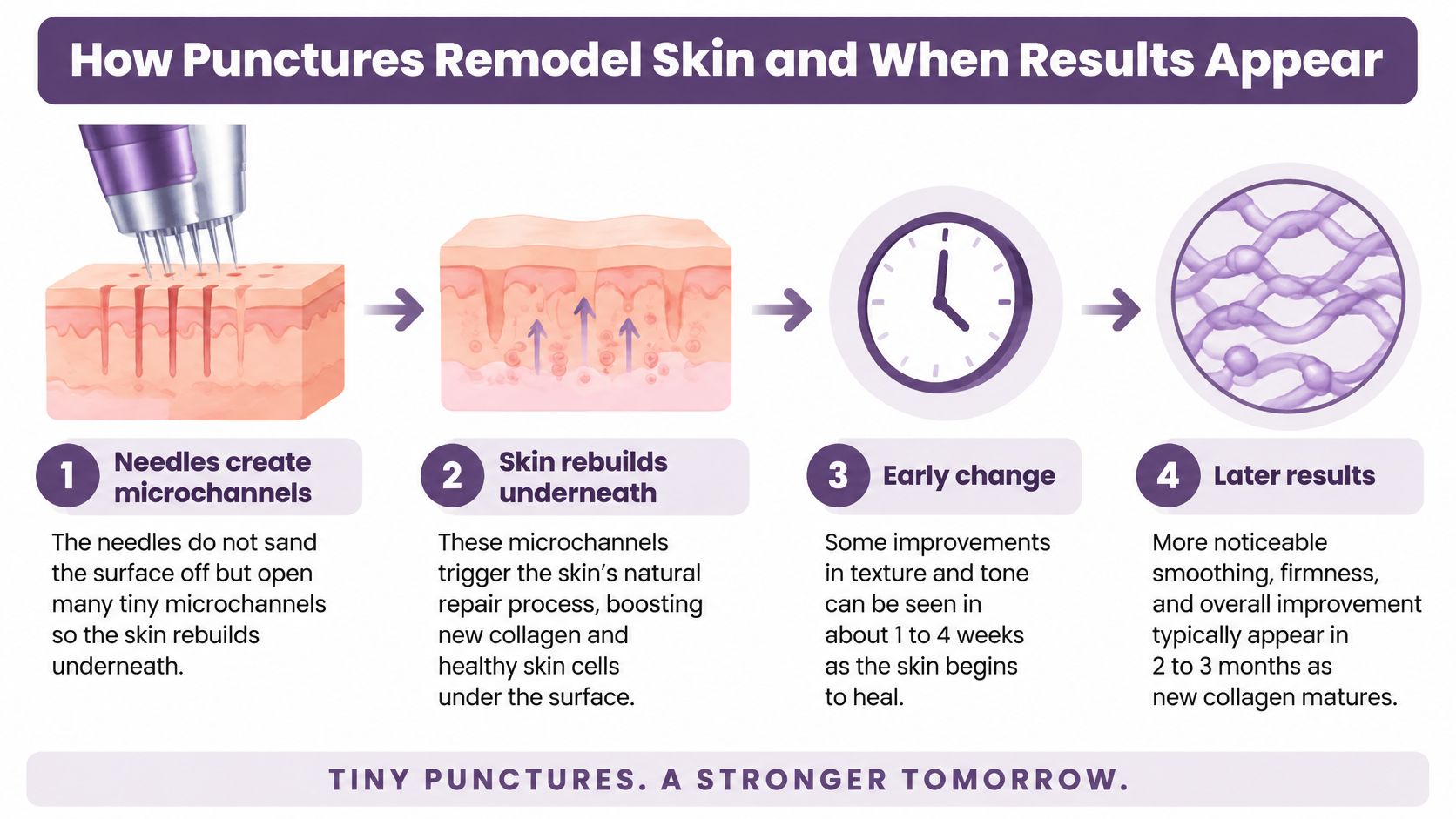
A microneedling pass opens thousands of tiny microchannels through the skin's surface. The visible puncture is the beginning of the process, and the benefit comes from the repair work that follows it.
Platelets release growth signals, a short inflammatory phase begins, and fibroblasts produce and reorganize structural proteins. Collagen helps support the skin; elastin contributes to its ability to stretch and return.
What tissue measurements mean
A clinical review of microneedling described increased collagen types I, III, and VII and tropoelastin after six sessions at two-week intervals, and histologic findings of up to a 400% increase in collagen and elastin deposition at six months after four sessions performed one month apart, with new collagen continuing to develop for approximately 3 to 6 months after the final session.
A tissue measurement is a biological signal, not an appearance score. A 400% rise in collagen deposition does not mean wrinkles improve by the same percentage, the face becomes dramatically tighter, or every treated patient produces that response. It also says nothing about what a consumer roller will accomplish.
Consider someone seeking treatment for cheek scars. Immediately afterward, swelling may temporarily soften the appearance of depressions. The meaningful question is whether those depressions remain less noticeable after the swelling has resolved and tissue has matured.
Different depths serve different jobs
Superficial treatment aimed at topical-assisted rejuvenation isn't equivalent to scar remodeling. A clinician chooses depth according to the indication and anatomical site rather than using the deepest setting everywhere. Depth works in both directions: a shallow pass can produce a weaker collagen response than the indication calls for, while deeper puncturing without matching sterility and aftercare adds risk. A cheaper home roller is not automatically the safer tool.
In a 2023 comparative study in the Journal of Cutaneous and Aesthetic Surgery, acne-scar improvement at 17 weeks was 32.45% with microneedling alone and 39.06% with microneedling plus hyaluronic acid. That study measured acne scars, so it doesn't establish a fine-line benefit, and it doesn't make an ordinary hydrating serum suitable for application through freshly treated skin.
Product selection matters because disrupting the barrier changes exposure. A topical that's comfortable on intact skin may not be appropriate immediately after needling. Use the clinician's designated aftercare rather than adding acids, fragranced products, or an unapproved combination.
Judge progress by healing phase
The sequence is more reliable than a rigid calendar:
- Immediately after treatment: Redness, tightness, tenderness, or mild swelling can dominate the appearance. Don't mistake that fullness for established collagen growth.
- As the surface settles: Skin may look smoother, but early visual change includes recovery from the procedure. Makeup and strenuous exercise should wait until the treating clinician clears them.
- During remodeling: Compare photographs taken in consistent lighting and at the same angle. A different light source can make scars appear improved or worse without any tissue change.
- At reassessment: The clinician considers recovery and response before recommending another treatment. More frequent puncturing isn't a shortcut to mature collagen.
Don't use an early photograph as the final verdict. Healing and remodeling happen on different schedules.
For a fair comparison, keep facial expression, camera distance, and skincare preparation consistent. Avoid judging scar depth immediately after moisturizer, under flattering front lighting, or while the skin remains swollen.
Treatment schedules differ because protocols and patients differ. The durable texture goal comes from matured, reorganized tissue, not from polishing the surface or keeping it repeatedly irritated.
Risks Skin Tone and When to Wait
Mild redness and tightness after microneedling can be expected. Increasing pain, spreading redness, discharge, or worsening inflammation points to a different problem and warrants clinical advice.
A systematic safety review covering 51 studies and 1,029 patients found microneedling relatively safe across several indications, with temporary redness, pain, swelling, and irritation among the common effects. The same review described lasting darkening or permanent scarring as uncommon when treatment is performed with appropriate technique. Low risk with appropriate technique is not zero risk, and aggressive treatment can undermine the cosmetic goal. The safety record applies to clinician-selected treatment. Puncturing an undiagnosed skin condition at home sits outside it.
Skin tone changes the counseling
Post-inflammatory hyperpigmentation means darkening after inflammation or injury. It deserves explicit discussion for patients with darker skin tones, particularly those who have developed lingering marks after acne, irritation, or previous procedures. In skin prone to darkening, inflammation can leave a visible cost, so the conversation should set expectations before treatment begins.
Temporary bruising, pinpoint bleeding, crusting, or sensitivity can also occur. If an unexpected reaction appears, stronger skincare or a repeat procedure can add inflammation rather than resolve it. Stop and get the reaction assessed.
Reasons to postpone or reassess
- Active infection or uncontrolled inflammatory acne: Treat the underlying problem before creating additional punctures.
- Current cold sores or a herpes history without a prevention plan: Discuss the history before treatment.
- Keloid tendency or impaired wound healing: A cosmetic procedure needs a medical risk assessment.
- Unexplained scalp inflammation or hair loss: Establish the diagnosis before proceeding.
- Pregnancy or pregnancy planning with hair medications: Medication suitability requires separate review, particularly for drugs such as finasteride.
Needle depth must match the tissue and the indication. Deep scar treatment belongs in a clinical setting. Unexpected scalp bleeding, folliculitis, or worsening inflammation should prompt stopping and examination rather than harder rolling.
Protect the healing skin
Sterile single-use components or properly sterilized reusable medical equipment are essential. Sharing a roller or relying on a quick rinse to sterilize a puncturing device creates contamination risk. A home roller can feel gentler because it penetrates less, yet shallower punctures may produce weaker collagen change while contamination and repeated irritation remain possible. Needle depth, sterility, and the diagnosis being treated determine whether the benefit justifies the risk.
Aftercare should include gentle cleansing, clinician-selected hydration, and sun protection. Hold aggressive acids and retinoids until the treating clinician confirms they're appropriate again.
Practical rule: If the skin is inflamed, the diagnosis is uncertain, or healing is impaired, postpone puncturing and arrange an assessment.
Sun-heavy schedules belong in the planning conversation. Beach days, outdoor workouts, and other sun exposure can make it harder to protect recently treated skin, so schedule with recovery needs in mind.
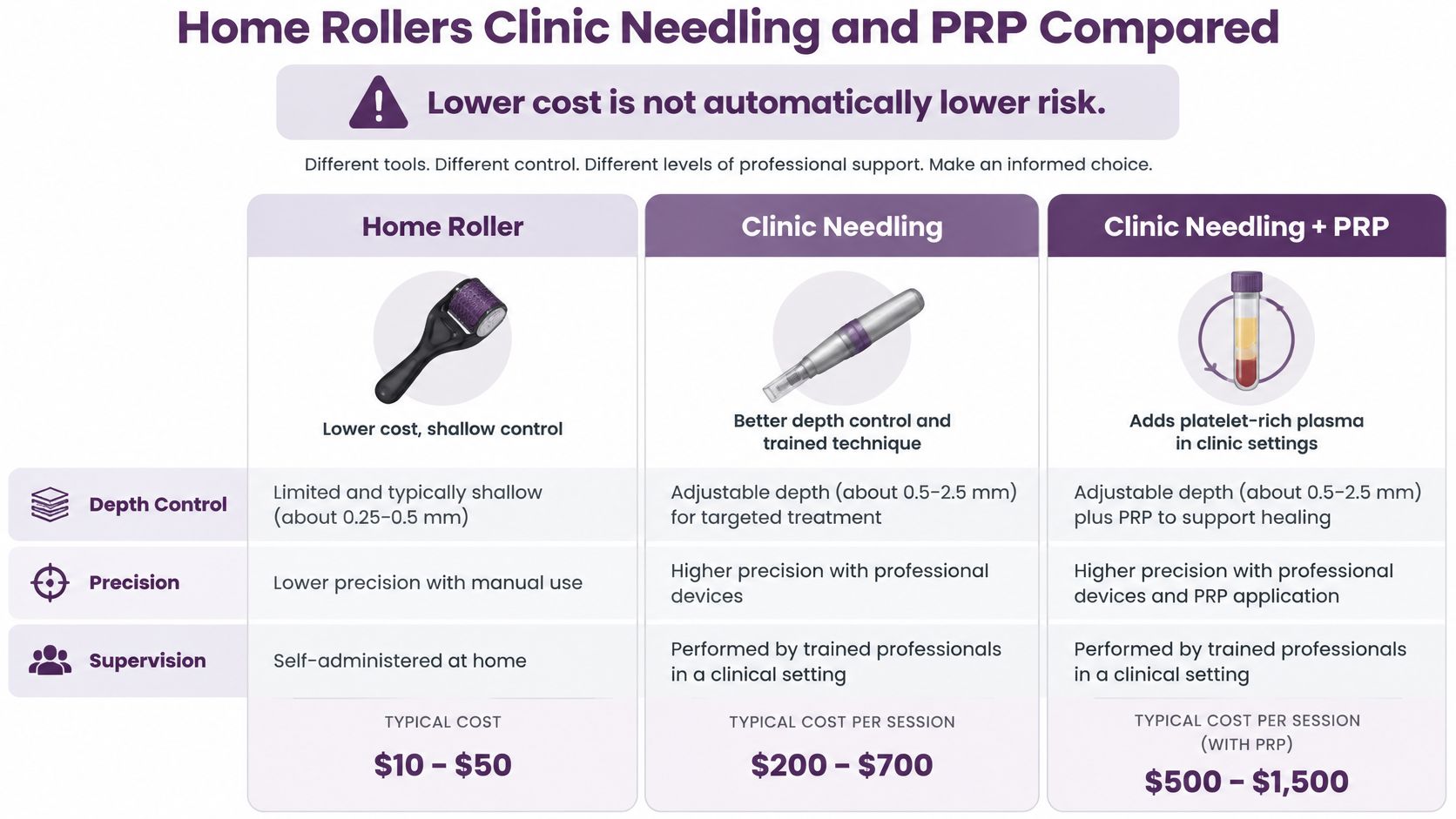
Home Rollers Clinic Needling and PRP Compared
Depth, sterility and indication decide what needling can deliver, and price is a poor proxy for any of them. A lower-cost home roller carries its own distinct risks: shallower punctures may produce weaker collagen stimulation, while contamination and repeated irritation remain possible. Needle depth works like a dose. Too little may underwhelm, and uncontrolled depth in untrained hands adds risk without adding benefit.
A 2025 systematic review of microneedling for facial rejuvenation pooled 21 studies and 723 patients and reported pooled satisfaction of 83% (95% confidence interval, 76% to 88%), with wrinkles assessed in 15 studies and texture in 7; transient effects included redness in 6.8%, scaling in 1.7%, burning in 1.5%, and itching in 0.4%. Those figures describe supervised clinical settings. They say little about what happens when a reused roller meets a bathroom counter.
Compare the treatment environment
| Option | Depth and control | Sterility | Best fit | Main limit |
|---|---|---|---|---|
| At-home derma roller | Fixed needle design; pressure and actual penetration aren't clinically controlled | Reuse and sharing raise contamination risk | Mild cosmetic interest on healthy skin after suitability advice | Shallower stimulus and cumulative irritation; not the studied scar protocol |
| In-office microneedling | Clinician selects depth by site and scar characteristics | Sterile single-use cartridges or appropriately sterilized medical equipment | Acne scars, wrinkles, texture, and selected abdominal scars | Recovery effects, pigment risk, and an individualized series |
| Microneedling with PRP | Clinical needling with platelet-rich plasma added | Clinical preparation of the patient's own blood | Selected patients considering an adjunct | Additional benefit isn't guaranteed; extra preparation and treatment burden |
Control and supervision, rather than needle length alone, separate these options.
PRP plays an adjunct role
Platelet-rich plasma, or PRP, is prepared from the patient's own blood. Adding it creates a different treatment protocol with its own evidence base, so standard microneedling outcomes give no guarantee that results will be multiplied.
Published outcomes differ, and the evidence for additional benefit is mixed. A favorable result from a hyaluronic-acid combination also says nothing by itself about the value of PRP, because they are different materials and interventions.
If you are exploring scalp treatment, PRP For HairLoss's derma roller hair regrowth guide can help identify practical questions to bring to a medical visit. It cannot substitute for a diagnosis or turn a clinical scalp protocol into a home instruction sheet.
For skin texture, the practice's sublative skin rejuvenation option offers another treatment category to weigh during an assessment, since matching the method to the actual skin problem matters more than ranking devices in the abstract.
A mild surface-refresh goal may remain within cosmetic skincare. Depressed scars, significant wrinkles, abdominal scars, or scalp treatment call for medical planning, and anyone considering PRP should understand the uncertainty before adding it.
Deciding on a Supervised Microneedling Plan
The useful decision is whether your concern, skin condition, and expectations fit a treatment that deliberately creates controlled injury. A person with stable depressed acne scars and realistic goals has a different starting point from someone with inflamed breakouts who wants smooth skin before an event next month. The same device name does not make those situations equivalent.
Apply the fit tests
- Your goal matches the evidence. Atrophic acne scars, facial lines or texture, selected scars, and diagnosed patterned thinning treated with appropriate medication are reasonable subjects for a clinical discussion.
- Your skin or scalp is ready. There should be no active infection, uncontrolled inflammation, or unexplained shedding awaiting diagnosis.
- You accept a process rather than an instant fix. Treatment may involve repeated visits, visible recovery, and delayed assessment of the final response.
If a test fails, the next step is diagnosis, treatment of the underlying condition, or waiting. A more aggressive roller does not solve a mismatch between the procedure and the problem. Where the tests fit and the goal goes beyond a mild surface refresh, clinician-directed care more closely resembles the setting in which meaningful outcomes have been measured. PRP can be considered separately rather than treated as a required upgrade.
Bring a precise goal to the consultation
Describe what bothers you in observable terms. Say that side lighting makes cheek depressions obvious, rather than asking for better skin generally. Explain whether your priority is texture, lines, marks, or hair density.
Bring your skincare list, medication history, previous procedure history, and information about unusual scarring or pigment changes. For hair concerns, describe whether the change was gradual, sudden, patterned, or accompanied by itching and tenderness.
Useful consultation questions include:
- What is the diagnosis? Confirm whether the concern is a depressed scar, discoloration, laxity, or another condition.
- What will define success? Agree on the appearance change worth pursuing and how it will be assessed.
- Why this protocol? Understand the device, the depth rationale, the aftercare, and the reasons to choose or decline an adjunct.
- What would change the plan? Discuss how slow healing, pigment changes, or an inadequate response would affect further treatment.
At Luxe Aesthetic Surgery & Medical Spa, the provider recommends a treatment schedule only after evaluating your skin in person. The practice's medical director holds the RPVI credential and board certifications in venous and lymphatic medicine, laser surgery, and internal medicine.
Monthly payment plans are available for surgical procedures, injectables, skin rejuvenation, and other treatments, so patients are not required to pay the full cost upfront. Financial flexibility should support a suitable plan, never determine whether a procedure is medically appropriate.
Results vary, and no device is risk-free. A worthwhile plan defines the likely benefit, the trade-offs, and the circumstances in which treatment should wait.
Luxe Aesthetic Surgery & Medical Spa offers microneedling with PRP and individualized skin assessments to help patients explore appropriate rejuvenation options. If your skin is healthy and your goal fits the concerns discussed here, visit Luxe Aesthetic Surgery & Medical Spa to request a consultation and discuss a supervised plan.