Medical Expertise at Luxe Aesthetic Surgery
Luxe Aesthetic Surgery & Medical Spa is led by Haimesh Shah, MD, RPVI , a physician specializing in cosmetic surgery, body contouring, laser procedures, and venous medicine. Dr. Shah is a Diplomate of the American Board of Laser Surgery, American Board of Venous & Lymphatic Medicine, American Board of Wound Management, and American Board of Internal Medicine. He also holds the Registered Physician in Vascular Interpretation (RPVI) credential and has contributed to peer-reviewed medical research.
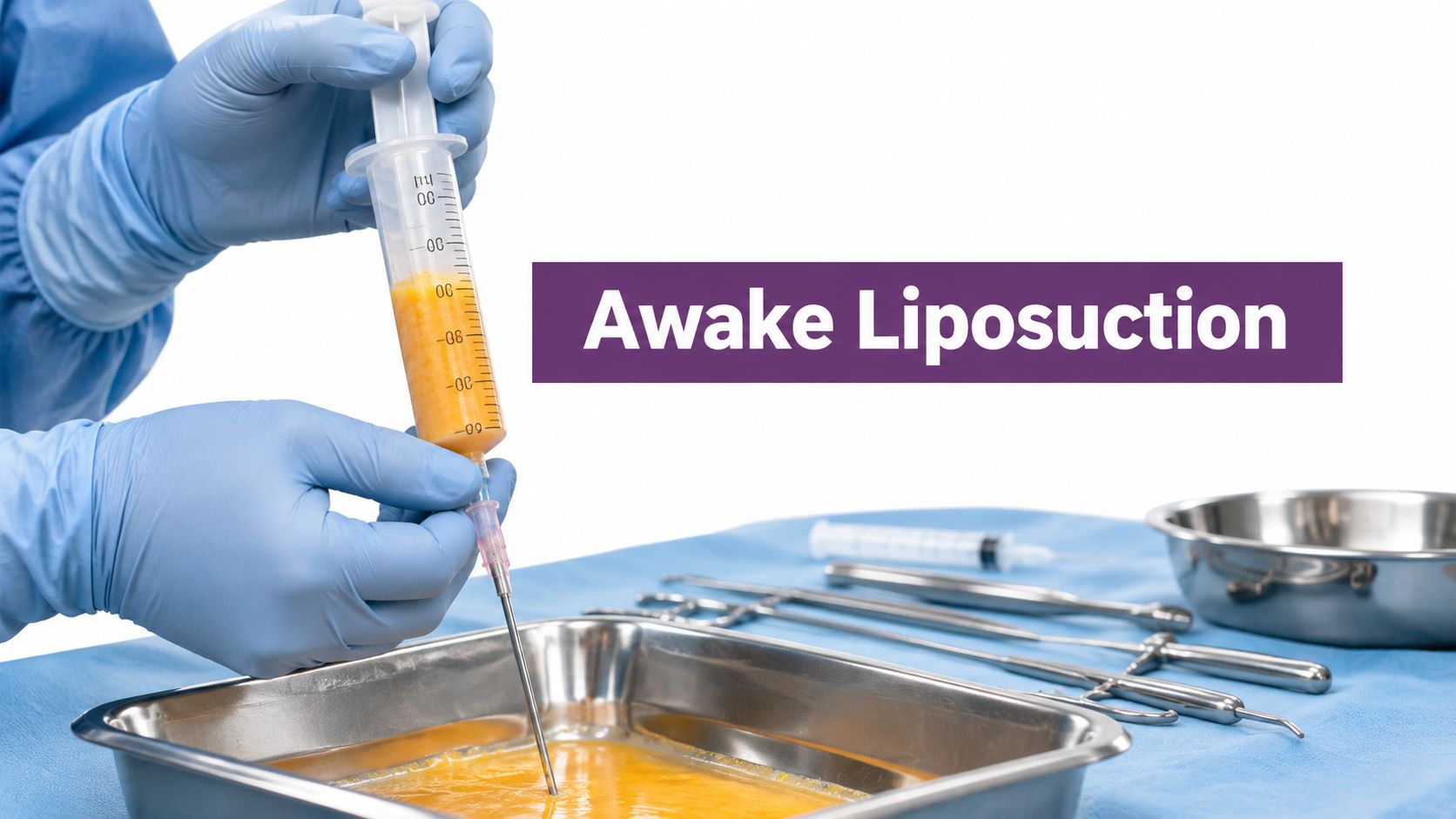
Awake liposuction typically uses tumescent local anesthesia instead of general anesthesia, and reported pain scores were approximately 1.1 out of 10 during the procedure and 0.53 out of 10 afterward. It isn't automatically low-risk, however, because safe treatment depends on patient screening, carefully calculated lidocaine dosing, appropriate treatment scope, monitoring, and emergency preparedness.
The popular advice is that staying awake makes liposuction simple. That's incomplete. The meaningful clinical question isn't whether you're conscious during surgery. It's whether your medical history, medications, anatomy, expectations, and planned treatment can be managed safely with local anesthesia. Fat transfer adds another layer of uncertainty because harvested fat must survive after reinjection, and the final result can be smaller or less predictable than the initial treatment suggests.
Table of Contents
- What Awake Liposuction and Fat Transfer Actually Means
- Awake Local Anesthesia versus General Anesthesia for Liposuction
- How Fat Transfer Works and Why Results Vary
- Who Is a Candidate for Awake Liposuction and Fat Transfer
- Recovery, Results, and When to Consider Revision
- Why Provider Selection and Screening Standards Matter
What Awake Liposuction and Fat Transfer Actually Means
Awake liposuction describes an anesthesia approach, not a guarantee about comfort, recovery, or suitability. Instead of relying on general anesthesia, the clinician places a diluted local-anesthetic solution into the targeted fat compartment. You remain conscious, although the treatment area is numbed and the team may use appropriate comfort measures according to the clinical plan.
Fat transfer, also called autologous fat grafting, uses your own fat rather than a synthetic filler or implant. The clinician harvests fat from a donor area, processes it, and reinjects it into a recipient area where additional volume or contour may be desired. Common goals include reducing localized fullness in one region while restoring volume in another.

The treatment has two separate objectives
Liposuction removes selected fat. Fat transfer places some of that tissue elsewhere. Combining the procedures can make sense when a patient wants more definition in a donor area and added fullness in a recipient area, but the two parts shouldn't be treated as a single predictable exchange.
The amount removed does not equal the amount that remains after grafting. Processing, handling, recipient-site blood supply, injection technique, healing, and later changes in body weight all influence the outcome. The procedure therefore requires a plan for both contour reduction and biological graft survival.
A systematic review of 157 publications reported low pain scores for liposuction performed with tumescent local anesthesia, approximately 1.1 out of 10 during treatment and 0.53 out of 10 after surgery. The same review reported complications in 1.2% of liposuction procedures, and identified no deaths associated with tumescent local anesthesia among 33,429 cases published since 2003. These findings are reassuring for properly selected and monitored cases, but they don't make every awake procedure appropriate for every patient or body area. See the systematic review of tumescent local anesthesia in liposuction for the full context.
Practical rule: “Awake” describes how anesthesia is delivered. It doesn't replace medical evaluation.
The safest interpretation is conditional. A limited, well-planned treatment may be compatible with local anesthesia, while a broader operation, significant medical condition, high anxiety level, or unsuitable medication profile may call for another approach.
Awake Local Anesthesia versus General Anesthesia for Liposuction
General anesthesia affects the whole body and typically involves deeper unconsciousness, airway management, and recovery from systemic anesthetic medication. Tumescent local anesthesia works differently. Dilute lidocaine with epinephrine is infiltrated into the treatment area, where it helps numb tissue, separate fat planes through hydrodissection, constrict small blood vessels, and reduce blood loss.
The distinction is practical, but it isn't a simple safety contest. General anesthesia may be appropriate for a larger or more complex operation when the treatment plan, patient comfort, and surgical control require it. Local anesthesia may suit a selected patient whose treatment area, aspirate plan, medical history, and ability to remain comfortable are compatible with an awake setting.
What the local-anesthetic protocol must control
The important dose is the total systemic lidocaine exposure, not merely the percentage printed on the solution label. Published guidance commonly cites 35 to 55 mg/kg as a routine tumescent range, while pharmacokinetic analyses estimate practical maxima of approximately 45 mg/kg when liposuction is performed and 28 mg/kg when it isn't, as discussed in this pharmacokinetic review of tumescent anesthesia.
Those figures aren't interchangeable targets for every patient. A responsible plan accounts for body weight, the total treatment area, solution concentration, infiltration time, liver function, medication interactions, and any other local anesthetic exposure. Epinephrine can slow vascular uptake, but it doesn't eliminate the possibility of local-anesthetic systemic toxicity.
The clinical team should document the total milligrams administered, infiltrate incrementally, monitor vital signs and mental status, and maintain readiness to manage toxicity. The setting also matters. An office-based procedure still requires appropriate equipment, trained personnel, observation, and a clear escalation plan.
| Consideration | Local anesthesia | General anesthesia |
|---|---|---|
| Consciousness | The patient remains awake | The patient is unconscious |
| Medication exposure | Local anesthetic exposure must be calculated carefully | Systemic anesthetic management is required |
| Best fit | Selected patients and controlled treatment plans | Operations requiring deeper anesthesia or broader control |
| Main decision | Whether the patient and procedure fit a monitored local protocol | Whether general anesthesia is appropriate for the planned operation |
Luxe discusses selected local-anesthesia procedures in its awake tummy tuck resource. The same principle applies here: the label matters less than the individualized assessment behind it.
How Fat Transfer Works and Why Results Vary
Fat transfer is not a simple process of removing fat and putting it back. The harvested tissue must be collected with limited trauma, separated from unwanted fluid and debris, and delivered in a way that gives small parcels access to surrounding tissue. A technically careful transfer can improve the conditions for graft survival, but it can't guarantee that all injected fat will remain.

Technique influences the biology
A typical workflow separates harvesting, processing, and reinjection. Clinicians generally aim to handle the tissue gently, place small parcels through multiple passes and tissue planes, and deliver fat during controlled cannula withdrawal. Large boluses can create uneven pressure and may not establish the same access to the recipient tissue.
No single harvest or processing method has emerged as universally superior for long-term retention. The practical priorities are atraumatic collection, careful transfer, layered placement, and conservative correction. The receiving tissue matters just as much as the harvested material.
Results vary by treatment site. In breast fat grafting, a systematic review covering 35 studies and 3,757 women reported an average injected volume of 300 mL and average retention of 58%, with reported retention ranging from 44% to 83%. The review also reported oil cysts in 6.5%, calcifications in 4.5%, and fat necrosis in 1.2% of patients. These findings are described in the systematic review of breast fat grafting outcomes.
Why a staged plan may be more honest
A patient may want a substantial change in one session, but the recipient area may not safely accept or retain the desired volume. Overfilling can increase irregularity, pressure-related compromise, and the likelihood of revision. A staged approach may produce a more controlled contour when the desired enhancement exceeds what the tissue can reasonably support.
Patients should also understand that fat behaves as living tissue. It can be resorbed, develop areas of firmness or fat necrosis, and change with future weight gain or loss. For breast procedures, later imaging providers should know about previous fat grafting because benign postoperative findings can require clinical interpretation.
The guide to fat-transfer breast augmentation provides another patient-focused explanation of how transferred fat is used for volume enhancement. The central expectation remains the same: the initial injected volume isn't the final retained volume.
Who Is a Candidate for Awake Liposuction and Fat Transfer
Wanting to avoid general anesthesia doesn't automatically make someone a candidate for awake surgery. Candidacy depends on whether the planned procedure can be performed within a controlled local-anesthesia protocol and whether the patient's health, medications, emotional readiness, and expectations support that plan.
A proper consultation should begin with more than a treatment wish list. It should examine the proposed areas, the amount of fat that may be removed, the intended recipient site, the likely procedure duration, and how the patient is expected to tolerate communication and positioning while awake.
The medical screening is broader than anesthesia preference
Candidate evaluation should address:
- Cardiac and respiratory status: The team needs to understand conditions that may affect tolerance of the procedure or response to stress.
- Liver and kidney function: These organs influence medication handling and overall perioperative planning.
- Clotting and venous-thromboembolism risk: Liposuction can carry clot-related risks, so personal history and risk factors matter.
- Coagulation disorders and medications: Medically necessary anticoagulants may make an awake procedure unsuitable or require coordination with the prescribing clinician.
- Drug interactions: Medications metabolized through CYP3A4 can potentially increase lidocaine toxicity, as explained in this clinical overview of tumescent liposuction.
- Allergies and prior anesthetic reactions: Previous problems with local anesthetics must be discussed before treatment.
The clinician should also review nicotine use, supplements, recent medication changes, and any condition that could alter healing or medication metabolism. Patients shouldn't stop prescribed medication on their own. The prescribing clinician and surgical team need to coordinate any change.
Anatomy and emotional readiness count too
Awake treatment requires realistic expectations about sensation, communication, and the pace of the procedure. Severe procedure-related anxiety, difficulty remaining still, or an expectation of zero discomfort can make local anesthesia a poor fit even when the patient's general health is good.
Body composition and skin quality matter because liposuction removes fat, not every cause of loose skin. Significant laxity may require a different contouring strategy. Psychological screening also matters. A stable treatment goal, realistic understanding of asymmetry, and absence of untreated body-image concerns support safer decision-making.
A patient who qualifies medically may still need a different procedure if the anatomy or goal doesn't match what liposuction and fat transfer can accomplish.
Awake treatment may be inappropriate when the scope is too broad, the planned duration is difficult to control, medical conditions increase anesthetic risk, or the patient cannot tolerate the experience. The decision should be made after examination and review of the complete treatment plan, not from the procedure name alone.
Recovery, Results, and When to Consider Revision
Recovery after awake liposuction and fat transfer depends on the treated areas, the volume and technique, the patient's healing response, and the aftercare plan. Early swelling and bruising can make the contour look uneven or exaggerated. Those first impressions are not a reliable measure of the final result.
Compression, walking as directed, wound care, medication instructions, and scheduled follow-up all matter. Patients should ask when they can resume specific activities rather than assuming that feeling better means every activity is appropriate.

Expect the result to evolve
Fat retention is biologically variable. A 2025 systematic review notes that resorption can reach 60%, while independent clinical guidance describes expected resorption of roughly 30% to 50% after fat transfer and recipient-site fat necrosis rates of about 3% to 15%. These findings support conservative planning and are summarized in this review of fat-transfer outcomes and complications.
| Recovery concern | What it can mean |
|---|---|
| Swelling and bruising | The early contour may not reflect the eventual shape |
| Firmness or lumps | Healing tissue, fluid, fat necrosis, or uneven resorption may need assessment |
| Partial volume loss | Some transferred fat may not survive |
| Asymmetry | Differences may settle, persist, or require later correction |
| Persistent irregularity | A revision discussion may be appropriate after healing stabilizes |
A touch-up isn't automatically a sign that the first procedure failed. It may be considered when the tissue has settled and a meaningful asymmetry, contour irregularity, or insufficient retained volume remains. The timing should be determined by the treating clinician, because correcting too early can mean treating temporary swelling rather than the established result.
Patients should contact the clinical team promptly for worsening rather than improving pain, spreading redness, fever, significant drainage, shortness of breath, chest pain, or sudden leg swelling. Those symptoms require medical attention and shouldn't be managed by waiting for a routine appointment.
For practical aftercare questions, see this recovery guide after liposuction. The most useful recovery plan is specific to the actual areas treated and the patient's medical history.
Why Provider Selection and Screening Standards Matter
The provider conversation should focus less on whether a clinic advertises an awake option and more on how the team manages the risks behind that option. A careful consultation should make the protocol understandable before the patient commits to treatment.
Ask direct questions about the planned areas, the expected scope, the anesthesia solution, monitoring, emergency readiness, postoperative observation, and follow-up. You should also know who calculates the anesthetic dose and how the team accounts for other medications or medical conditions.
Questions that reveal the quality of the protocol
Use the consultation to ask:
- How will you calculate my total lidocaine dose? The answer should address body weight, solution concentration, all treated areas, and any additional local anesthetic.
- What medical conditions could change the plan? The clinician should discuss liver, kidney, cardiac, respiratory, clotting, and medication considerations.
- What happens if I become uncomfortable or develop concerning symptoms? A clear answer should include the ability to pause, reassess, escalate care, or stop the procedure.
- How will you monitor me? Monitoring should involve more than asking whether you feel fine.
- What areas and volume are appropriate for local anesthesia? A provider should explain the limits of the proposed plan instead of presenting awake treatment as universally suitable.
- How do you counsel about retained fat? The discussion should include resorption, asymmetry, fat necrosis, imaging considerations when relevant, and possible staged treatment.
- Where will follow-up occur? You should understand who will evaluate healing concerns and how urgent problems are handled.
The American Society of Plastic Surgeons' evidence-based safety advisory recommends limiting lidocaine to 35 mg/kg for awake liposuction using tumescent local anesthesia. That limit is higher than the commonly cited 7 mg/kg limit for conventional lidocaine with epinephrine because tumescent solutions are highly diluted and absorbed more slowly. The advisory also cautions that 35 mg/kg may not be appropriate for patients with low protein levels or other conditions that impair lidocaine metabolism. Review the ASPS evidence-based liposuction safety advisory when preparing questions for your consultation.
Transparency is part of the treatment
A responsible provider won't promise permanent retention of every transferred cell, painless treatment, zero downtime, or universal eligibility. The team should explain what the procedure can address, what it can't correct, and what could lead to another procedure.
Luxe Aesthetic Surgery & Medical Spa offers selected awake liposuction and autologous fat-grafting procedures under local anesthesia, with treatment planning based on the patient's anatomy, goals, and medical suitability. Its Medical Director, Haimesh Shah, MD, RPVI, is described by the practice as a board-certified physician specializing in cosmetic surgery and phlebology.
The right choice is the provider who makes the decision process visible. That means documenting the anesthetic plan, screening for interactions, defining the treatment scope, explaining fat-retention uncertainty, and providing a realistic follow-up pathway. The word “awake” should never substitute for those standards.
Visit Luxe Aesthetic Surgery & Medical Spa to learn about selected awake liposuction, body contouring, and autologous fat-transfer options in Southern California. Request a consultation to discuss your anatomy, medical history, lidocaine-safety considerations, and whether a local-anesthesia plan is appropriate for your goals.